
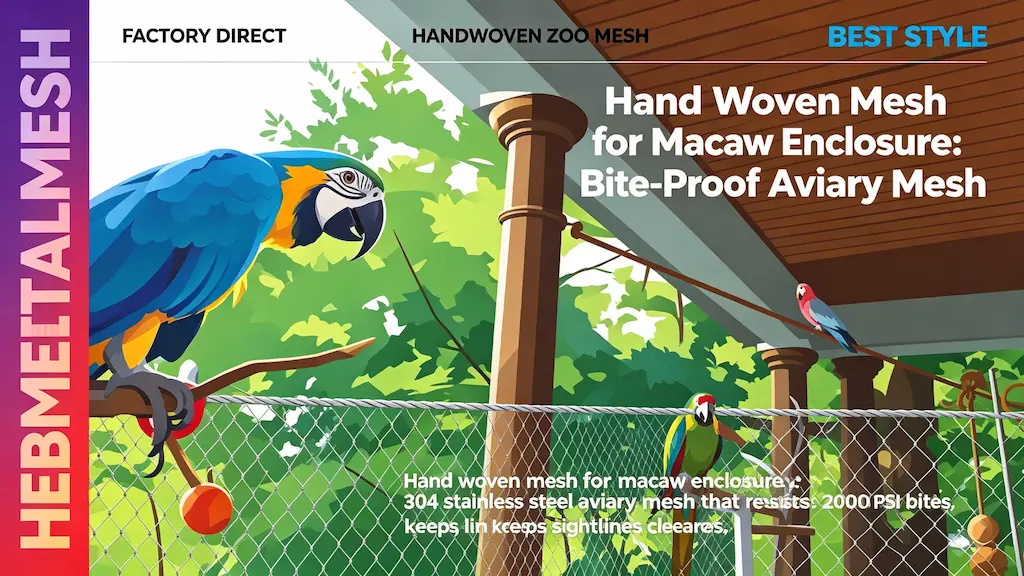
A large parrot cage fails for two reasons, and neither is size: the bird chews through a coating and swallows it, or the aperture is wide enough for a beak to reach a fixing. Get the material and the pitch right and the pen lasts decades. This guide gives the numbers – wing span clearance, the cable diameter that matches each beak, and the cost.
Executive Summary
Parrot pen mesh is hand-woven stainless steel rope netting, and it beats welded wire in a parrot application for one reason above all – parrots are chewers, not escape artists. There is no coating to strip, no weld to corrode and no zinc in the structure. Specification comes down to aperture, set by the smallest head you must contain, and cable diameter, set by the strongest beak that will work on it. Aviary grades plan out at $14-26 per square metre, woven to your dimensions up to roughly 9 m by 18 m. The reference specification is the parrot enclosure mesh product page.
Quick Answer:
Quick Answer: For most large parrots, specify 1.6 mm stainless cable at a 25-38 mm aperture; for macaws and large cockatoos, step up to 2.4 mm cable at 51 mm. Give the bird a pen at least twice its wingspan wide, hang the mesh from a rigid top rail, and avoid galvanised or coated wire – zinc and plastic are what send a parrot to an avian vet. Expect $14-26 per square metre.
Key Takeaways
- Two numbers decide everything. Aperture contains the bird; cable diameter survives the beak.
- Zinc and lead are disqualifying. Galvanised wire, soldered joints and leaded brass cause heavy-metal toxicosis in psittacines.
- Wider beats taller. Parrots fly horizontally, so parrot pen mesh height matters less than width.
- 304 indoors, 316 outside. Near salt water, 316 is cheaper over a service life.
- Panels are made to your drawing, so one replacement door panel can be ordered alone.
Accredited institutions work to published welfare and containment standards, and the Association of Zoos and Aquariums <a href=”https://www.aza.org/” rel=”nofollow” target=”_blank”>publishes the accreditation standards</a> that most North American facilities design against.
What “Large” Means in Numbers
The usual advice – a cage of at least 36″ x 48″ – is a floor, not a target, and it is wrong for macaws. The better rule is wing span clearance: the pen should be at least twice the bird’s wingspan in the direction it wants to fly, which for a parrot is horizontal. A bird that cannot extend its wings without touching mesh stops exercising, and a sedentary parrot develops the feather-plucking owners mistake for behavioural issues.
| Bird | Wingspan | Min. pen width | Min. height |
| Budgerigar, cockatiel | 25-40 cm | 90-100 cm | 90-120 cm |
| African grey, Pionus | 46-55 cm | 120 cm | 150 cm |
| Amazon | 60-70 cm | 150 cm | 180 cm |
| Sulphur-crested cockatoo | 70-80 cm | 180 cm | 200 cm |
| Scarlet, green-wing macaw | 100-120 cm | 240 cm | 200 cm |
| Hyacinth macaw | 120-140 cm | 300 cm | 220 cm |
In a walk-in pen, keep the highest perch below shoulder height; parrot pen mesh height above that becomes a cleaning job you postpone. Parrot pen mesh weight matters when a pen is suspended: 1.2 mm at 25 mm is about 0.6 kg/m², 1.6 mm about 1.0, 2.4 mm at 51 mm about 1.2. Weigh a sample before sizing a frame.
Why Material Beats Size
Most retail cages are galvanised or powder-coated welded wire, and both are wrong for a bird that dismantles things for a living. Galvanised wire carries a zinc coating, and parrots do not need to eat the mesh – they abrade it and swallow the flakes. Zinc toxicosis is well documented in psittacines: lethargy, green diarrhoea, and a blood zinc level your vet charges you to find. Lead is worse – soldered joints and leaded brass both leach. PVC is not toxic but it shreds, and swallowed strands obstruct.
Stainless rope mesh removes all three problems. There is no coating, no weld and no zinc – the sheet is 304 or 316 wire rope crossed at a fixed pitch and joined at each crossing by a pressed ferrule sleeve. It also behaves differently under load: cut one cable and its neighbours pick up the load, so a damaged sheet still contains the bird. Welded mesh has no redundancy – the weld is the weakest point and the first to corrode.
On beak shear force: a hyacinth macaw is credited with beak pressures up to 2,000 PSI in industry literature, while measured values for large macaws sit nearer 300-500 PSI. Either destroys welded wire and coated mesh; neither comes close to parting a 2.4 mm stainless cable, whose break load rating is around 4 kN. The failure mode is never the cable breaking – it is a bird working a loose strand loose.
Outdoor parrot pen mesh changes two things: specify 316 within about 5 km of the coast, and cover 30-50% of the roof with shade cloth. Stainless does not degrade under ultraviolet light, so uv resistant netting outlasts knotted nylon, which embrittles in three to five years. A black oxide aviary mesh cuts glare from inside the pen.
Parrot Pen Mesh Spacing: Aperture and Cable
Parrot pen mesh spacing is written as aperture x aperture x cable diameter, and the two halves answer different questions. Aperture is containment: set it so the smallest head cannot pass, with margin for a juvenile. Cable diameter is a beak problem: set it so the bird cannot deform the opening.
| Bird group | Aperture | Cable | HM code | Weight | Indicative price/m² |
| Finch, budgie | 25 mm | 1.2-1.6 mm | HM1225 / HM1625 | 0.6-1.0 kg/m² | $18-26 |
| Cockatiel, parrotlet | 25 mm | 1.6 mm | HM1625 | 1.0 kg/m² | $18-26 |
| African grey, Pionus | 25-38 mm | 1.6 mm | HM1625 / HM1638 | 0.7-1.0 kg/m² | $16-24 |
| Amazon, small cockatoo | 38 mm | 1.6-2.0 mm | HM1638 | 0.7-1.0 kg/m² | $14-22 |
| Large cockatoo | 38-51 mm | 2.0 mm | HM1638 / HM2050 | 0.8-1.0 kg/m² | $14-22 |
| Large macaw | 51 mm | 2.4 mm | HM2450 | 1.2 kg/m² | $16-24 |
Two cautions. Parrot pen mesh for macaws is quoted at 51 mm because a large macaw’s skull will not pass it – a small species or a juvenile may, so drop to 38 mm when either applies. And parrot pen mesh for cockatoos and parrot pen mesh for african grey sit in the same band, where the deciding variable is chewing time, not size. Ask the mill certificate for rope construction (7×7 on finer diameters, 7×19 where flexibility matters), the break load rating per diameter – 1.6 mm near 1.8 kN, 2.4 mm near 4.0 kN in 304 – and aperture tolerance: a hand-woven sheet is not a machined grid, so allow roughly ±2 mm. The macaw-proof parrot enclosure mesh range carries every combination above; the aviary netting catalogue lists the same codes in roll form.
Parrot Pen Mesh Frame, Corners and Doors
The mesh is the easy half; most home-built pens fail at the frame, and especially at the corners. A parrot pen mesh frame should be a rigid box with a continuous top rail, because panel tensioning loads the header before anything else, and a header that deflects sags the sheet within a season. A 32-40 mm OD stainless or powder coated perimeter frame tube is enough up to about 2.4 m span; beyond that, step to 50 mm. Powder coated tube is fine inland; bare stainless is safer outdoors, where a chipped coating rusts.
Parrot pen mesh corner detail is where installers improvise and lose. Do not cut the sheet and butt two edges – that leaves loose cable ends exactly where a bird spends its time. Fold the sheet around a corner post, keeping the weave continuous, and lace the fold through the outer row of apertures.
Parrot pen mesh door deserves more thought than it gets. Order it pre-hung in its own welded stainless frame, with the opening cut and bound by the weaver, and fit two latches of different types – a parrot that has watched you open one slide bolt will open it. The door is the panel a bird tests first, so it gets the same cable diameter as the walls.
Parrot Pen Mesh Installation
Parrot pen mesh installation is closer to rigging a sail than to assembling a shed. The sheet ships slack because the weave is not pre-tensioned – normal, not a defect.
Fix the top edge first, along the rigid header, using panel edge binding – a rope threaded through the top row of apertures and clamped to the rail – instead of individual clips, which concentrate load and pull the weave out of square. Then tension progressively from width to height; pulling one edge tight in a single pass is what produces the diamond distortion owners mistake for a manufacturing fault. Fixing centres tighten as span grows: roughly 300-400 mm along the top rail, 200-250 mm on the lower band and around the door. A perimeter tension cable through the bottom row, anchored to the frame, stops a macaw prising an edge open at floor level. Parrot pen mesh tensioning is finished work, not a one-time step – re-tension after the first week, then annually.
Parrot Pen Mesh Cost
Parrot pen mesh cost tracks steel weight, which rises with the square of cable diameter, and labour, which rises as aperture falls. At 25 mm there are roughly 1,600 cross points per square metre and every cross point is two hand passes, which is why a fine aviary panel can cost more than a coarse carnivore panel in twice the cable.
Worked example: a macaw pen 2.4 m wide, 1.2 m deep and 2.0 m high has about 17.3 m² of wall and roof. At $16-24/m² for 2.4 mm cable at 51 mm, mesh alone lands around $280-420, and frame tube, door hardware and fixings typically add as much again. Budget $600-900 for the structure; read any quote far below that as undersized cable.
Most suppliers sell the mesh loose. A parrot pen mesh kit – cut panels, perimeter tension cable, edge rope, ferrules, bound door panel – costs a little more per square metre and removes the two mistakes that ruin a build: cutting the sheet yourself and mismatching hardware, since a galvanised bolt through a 316 panel is a galvanic cell and fails first. The same logic applies at scale – see the walk-in aviary design notes and the macaw outdoor aviary build guide.
Parrot Pen Mesh Maintenance
Parrot pen mesh maintenance is a quarterly job, not a weekend project. Rinse the sheet with fresh water – a hose on a low setting is enough; a pressure washer aimed at ferrules is not. Walk the fixing line looking for three things: a raised or cracked ferrule sleeve, any single strand lifted out of the weave, and corrosion at a dissimilar-metal fixing. Act on a raised strand immediately – a parrot that finds it will have it out of the panel in an afternoon.
The rest is aviary hygiene: dry substrate, drainage that does not pool under the pen, and food and water placed so they cannot be fouled from above. Keep perches at least 150 mm clear of the mesh and give the bird a hardwood branch to destroy. Ventilation closes the list – cockatoos and African greys produce powder down a solid three-sided indoor pen traps, so leave two open faces or fit a low extract.
FAQ
51 mm aperture on 2.4 mm cable (HM2450) for an adult large macaw; drop to 38 mm for a smaller species or a juvenile, since the containment test is the smallest head in the pen.
No. Zinc from a galvanised coating causes heavy-metal toxicosis in psittacines, and parrots abrade coatings by instinct. Use bare stainless rope mesh and match all hardware to the alloy.
Not by parting the cable – a 2.4 mm 304 rope carries a break load rating near 4 kN, orders of magnitude above any beak pressure. A macaw can, however, work a loose strand loose.
A 2.4 x 1.2 x 2.0 m macaw pen needs about 17 m² of netting: roughly $280-420 at $16-24/m², with frame and hardware adding a similar amount.
304 indoors and inland. Choose 316 within about 5 km of salt water, or where the pen is washed with bore water.
Send us the species, the pen dimensions and whether it sits indoors or outdoors, and we will return a specification with a budget range. Contact our engineering team.