
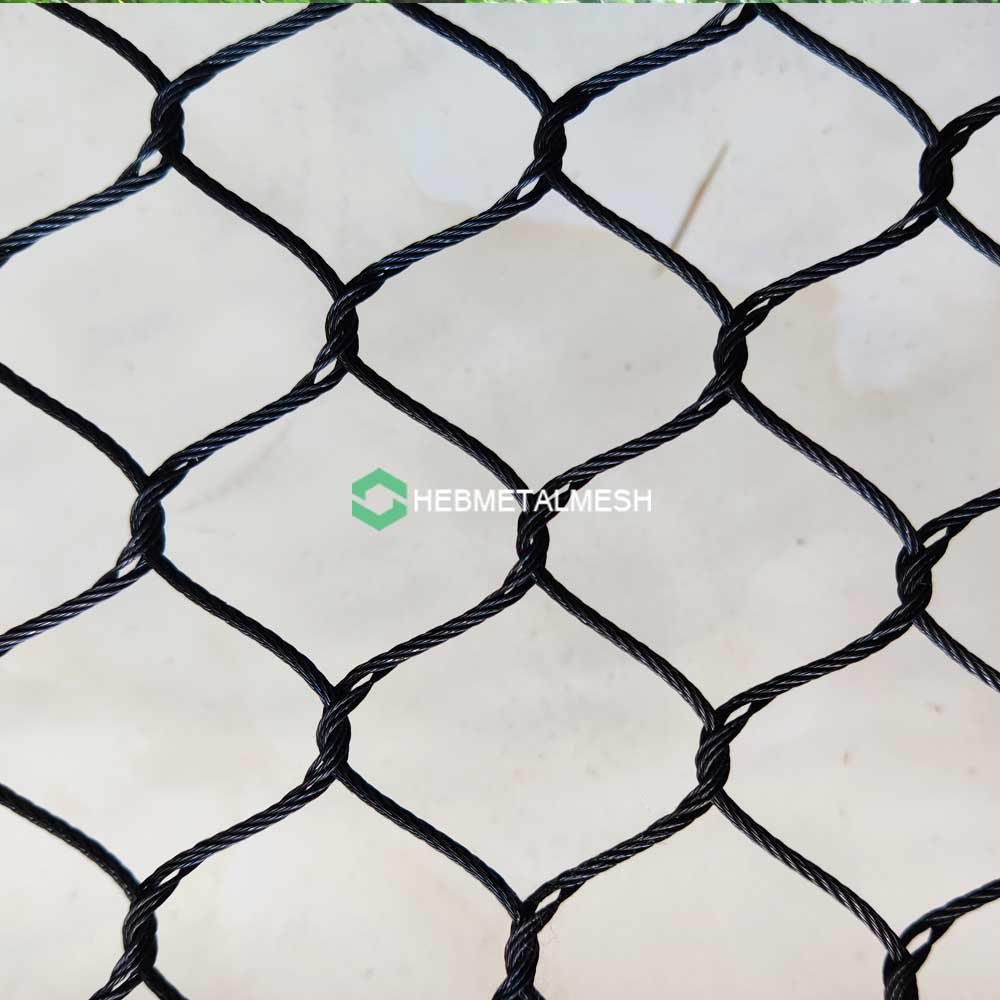
A handwoven stainless panel is usually bought as though it were a single decision: pick the grade, pick the finish, send the order. It is three decisions that pull against each other, plus a fourth that holds the result together. That is why two buyers can describe almost the same enclosure and end up with panels that look nothing alike. One gave up openness. The other gave up rope.
Executive Summary
A mesh trade-off is not a commercial preference. It is a geometric and metallurgical fact. The aperture sets what the panel stops. The rope diameter sets what the panel survives. Together they set how much of the enclosure you can see and how much wind passes through it. Improve one and you pay on the others, and the payment is not linear. Closing the aperture blocks the view faster than it adds containment, because once the pitch approaches the rope diameter there is more wire in the field than hole. Thickening the rope adds metal as the square of the diameter, but a rope never delivers the full strength of the wires it is made from, and the edge fitting gives more of it back. Containment and survival are therefore separate purchases. An honest specification states both, names the lever it gave up, and puts a number on the loss. The reference specification is the aviary netting product page.
Not sure which lever your project can afford to lose?
Send the smallest animal that must not pass, the largest force the panel will take in one place, and the height it has to reach. We will come back with an aperture, a rope diameter, a panel break and a planning-range figure per square meter.
Send your two numbersQuick Answer: What is the trade-off in a mesh specification?
Quick Answer: It is the exchange between aperture, rope diameter, and open area. Aperture decides what cannot pass. Rope diameter decides how much abuse the panel absorbs before it changes shape. Open area is the consequence of both, and it decides how much light, air, and view the enclosure keeps. No specification raises all three at once. One of them, the number that has to be sacrificed, is always the one the buyer did not write down.
Key Takeaways
- Aperture buys containment. It does not buy strength, and the two are not interchangeable.
- Rope diameter buys survival, and it charges for it in open area at every crossing.
- Open area falls faster than aperture once the pitch gets close to the rope diameter.
- A rope delivers less than the sum of its wires, and the edge fitting takes more.
- The lever to give up is a design decision. Write it into the order or inherit it on site.
Why every use asks the same question
Aviary, cage, pool barrier, facade panel, animal crate. The list of uses is long and mostly a sales device, because each one is the same question asked with different numbers: how small must the gap be, how much rope goes around it, and how much view can be lost. How to tell which trade-off your use forces starts with two answers, not a catalog. Name the smallest thing that must not pass, and the largest force the panel will take in one place. Those two answers fix two of the three levers before price is mentioned, which is why every mesh use is a trade-off rather than a menu. The 1 in × 1 in × 1/16 in specification is the commonest starting point for the opposite reason: it is small enough for a finch and open enough to see through, so most briefs move one lever from it and leave the other alone.
The three levers, and what each one actually buys
| Lever | What it changes | What it buys | What it costs |
| Aperture | The gap between crossings | Containment of everything wider than the gap | View, light, and air, at an accelerating rate |
| Rope diameter | Metal per meter of strand | Resistance to deformation, abrasion, and point load | Weight, cost, and more obstruction at every crossing |
| Tension | The geometry the panel holds at rest | Predictable cell size under load | Installation time, and a structure able to carry the pull |
The third lever is the one buyers forget, and it is not a product property. A panel that arrives tight and is installed slack has the aperture of the drawing and the behavior of a different panel. Which trade-off decides the mesh you get is therefore answered partly in the factory and partly at the frame. Why a rigid panel settles the trade-off for you is that it cannot do this at all: a welded grid is dimensionally fixed by its joints, so the only variables left are the ones the factory chose.
Why a smaller aperture is not automatically safer
Closing the gap until nothing can pass is the instinct, and it is wrong for reasons unrelated to price. Why a smaller aperture is not automatically safer is that containment depends on what the animal can reach, not on the average body. What the animal can reach decides the surplus: a hand, a beak, a claw, a horn tip, the head of a juvenile. A gap narrower than the smallest reaching part is enough; anything tighter is bought with view and buys nothing. As the pitch closes on the rope diameter, the diamond width shrinks toward the wire thickness, the panel stops reading as mesh and starts reading as screen, and the enclosure loses the daylight that made it worth displaying. The aviary panel range runs from 20 mm to 102 mm for that reason: the small end is for small birds, not because small is safer.
What you give up when you thicken the rope
Rope is the lever buyers reach for to feel safer, and the most expensive to pull. What you give up when you thicken the rope is money first and view second. Doubling the diameter roughly quadruples the metal in the panel, and because the wire is thicker at every crossing, the loss is felt twice. A cold drawn 304 wire reaches a proof stress well above the annealed figure, and the gain shows up as resistance to bending rather than as a bigger number on a certificate. The finish is the cheap part: a bright annealed surface is the mill condition and adds nothing to the price, while black oxide trades a small premium for a panel that stops reflecting light and starts disappearing against a dark background. The black aviary mesh range is what that looks like on a full panel, and the one place a finish changes the trade-off instead of decorating it. What does not change is the part buyers assume: strength in service is not the wire’s tensile figure. A rope does not achieve the full strength of its steel wires due to construction losses. The helical lay costs roughly a tenth to a fifth before anything is fitted, and ductility is what keeps that loss from turning into a brittle failure at a clamp.
How the panel looks at four specifications
Same alloy, four specifications, and the view moves more than the strength. Open area here is the clear pitch divided by the pitch, squared.
| Aperture (pitch) | Rope diameter | Open area | What it reads as |
| 102 mm | 1.6 mm | about 97% | Almost nothing; a shadow line |
| 51 mm | 1.6 mm | about 94% | A fine grid, visible at ten paces |
| 51 mm | 3.2 mm | about 88% | A grid, clearly present in photographs |
| 25 mm | 3.2 mm | about 76% | A screen, with the animal behind it |
The bottom row is the surprise: halving the pitch at 3.2 mm rope costs about twelve points of open area, while doubling the rope at 51 mm costs about six. Containment is the expensive purchase in view and survival the cheap one, which is the trade-off between containment and a clear view reduced to a single comparison.
How wind enters the trade-off
A panel is a porous surface, and porosity behaves in the opposite direction to instinct. How wind enters the trade-off is through the same open area that gives you the view. A very open panel lets most of the wind through and sheds almost no load. A tight panel with thick rope begins to behave like a solid surface, and a solid surface does not shelter an enclosure; it loads the structure and drops turbulence on the lee side. Most enclosures want the porous end of that curve for structural reasons alone, and the mesh specification should say so rather than pretend a containment panel is a windbreak. Where shelter matters, it is usually a separate structure built for the purpose.
Why the perimeter is where the trade-off is paid
Every number above describes the field of the panel. The field is rarely what fails. Why the perimeter is where the trade-off is paid is that the load collected across the whole panel arrives at an edge of a few centimeters, and the edge has to hand it to a frame that was built by somebody else. The perimeter rope is the member that does the handing over, and the eye splice or swaged fitting at each corner is the point where the panel either keeps its rated capacity or gives part of it back. This is the cheapest place to add capacity and the easiest place to lose it, which is why the edge detail belongs in the quotation and not in a note about “fixings included”. A panel that is fixed rather than terminated usually measures correctly on the day and reads differently two winters later.
How to write a trade-off into the order
The trade-off is decided whether or not it is written down. When the trade-off is resolved on site is too late, because the resolution is chosen by whoever is holding the drill. How to write a trade-off into the order takes four lines: the aperture and the reason for it, the rope diameter and the span it was chosen for, the edge detail and its rated capacity, and the one property the buyer accepts losing. Why cheap netting is a trade-off made by someone else is that a lower price is never a discount on the same panel; it is a decision about aperture, rope, or edge that has been taken by the seller and handed to the buyer as a finished object.
How the panel changes over its working life
A specification is a snapshot, and the panel does not stay in it. Ask how the trade-off changes over a panel life and the answer is geometry: repeated point loads in the same place open the aperture locally, relaxation removes some of the tension that held the pitch, and an edge that slipped once keeps slipping. None of that shows up as corrosion, and none of it is visible from a distance. The measurement that matters is the aperture in the lane the animals actually use, taken at handover and repeated annually, because a panel whose aperture has drifted has changed which trade-off it is delivering without anyone deciding to change it. Replacement is where the original decision gets audited, and the budget-versus-grade comparison explains why the cheaper panel is usually the one replaced first.
FAQ
No. It means a stiffer panel with more metal in it. Strength in service depends on how the load reaches the edge, and a thicker rope on a weak termination simply delivers a bigger load to the weakest point. On a short span a heavier rope mostly buys weight.
Treat it as nominal. Open area depends on the actual pitch after weaving and on the rope diameter at the crossing, and both move slightly in production. The table above is arithmetic, not a promise; ask for the measured figure on the panel you are buying.
Only if both animals need the same aperture. Where they do not, the panel is set by the smaller one and the larger animal’s needs are met with rope diameter and edge capacity, which are independent. Trying to meet both with one aperture usually produces a panel that is too tight for the view and still not strong enough for the larger animal.
Name the lever you can lose before you order.
Send the smallest animal that must not pass, the largest point load, the span and the height. We will return the aperture, the rope diameter, the edge detail and a planning range for the area, with the sacrifice stated in numbers.
Request a specification