
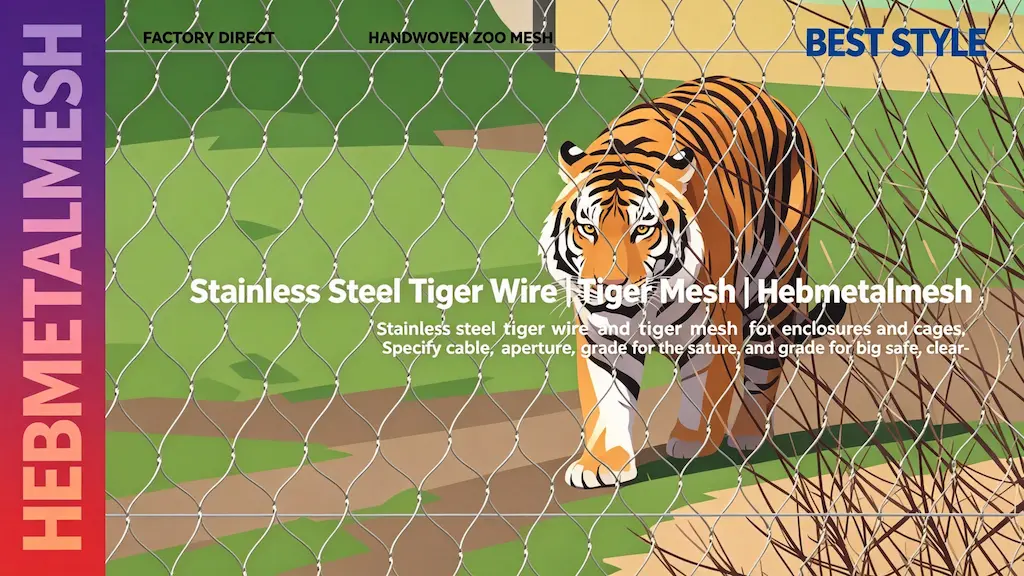
Comparing tiger netting for sale comes down to four numbers and one document: cable diameter, mesh aperture, stainless grade, panel size — and the mill test certificate proving the cable is what the seller claims. Most zoos land on a hand-woven panel in 3.2 mm stainless cable at 76 mm aperture (HM3276), in 304 inland and 316 on the coast. This guide is for the person placing the order: what to specify, what it costs, how long it takes, and how to tell a factory from a trading company before the deposit moves.
Executive Summary
Tiger netting for sale is not a commodity roll product. It is a made-to-order panel, hand-woven from continuous stainless steel cable and terminated on a border cable, so its performance is set at the weaving bench rather than on site. Specify the cable diameter and grade for the site’s corrosion class, the aperture for the smallest animal that will ever occupy the space, and the panel size for the opening. Then verify: ask for the mill test certificate for the wire and a breaking load test for the assembled panel. Price follows steel content — a 3.2 mm panel costs roughly double a 2.0 mm panel of the same area — and lead time is set by weaving, not freight. The reference specification is the tiger enclosure mesh product page.
Ready to Buy Tiger Netting? Get a Factory-Direct Quote
Send the opening dimensions, the species and the site climate. We return a cable diameter, aperture, panel layout, lead time and landed price within 24 hours.
Request My Quote →Quick Answer: What Should I Check Before I Buy Tiger Netting?
Five things, in order. Cable diameter — 3.2 mm is the working standard for a big cat front, 2.0 mm only for light secondary lines. Aperture — 76 mm square is the default; go smaller only where a paw or a cub must not pass. Grade — 304 stainless for inland, 316 stainless steel for salt aerosol, tropical humidity or chlorinated wash-down. Construction — hand woven ferrule mesh with continuous cable, not welded grid, because a weld is a crack initiation point and a cut end is a claw catch. Documentation — a mill test certificate for the wire and a breaking load figure for the finished panel. A supplier who cannot produce both is selling you a photograph.
Key Takeaways
- 3.2 mm cable at 76 mm aperture (HM3276) is the default big-cat spec; 2.0 mm at 76 mm (HM2076) suits secondary lines.
- 304 stainless handles most inland sites; 316 is specified for coastal, tropical and wash-down environments.
- Ask for the mill test certificate and a breaking load figure for the assembled panel, not just the wire.
- A single panel woven to the opening removes the joints that fail first in service.
- Price follows steel: cable diameter and area dominate; hardware and freight are quoted separately.
Accreditation bodies treat a barrier as a system rather than a fence line. The Association of Zoos and Aquariums publishes standards in which containment is demonstrated through primary barriers, shift doors, holding areas and keeper protocols together — which is why a buying decision that looks at mesh alone tends to under-specify the project.
What You Are Actually Buying
A tiger netting panel is woven on a bench from continuous stainless cable. Each cable crosses and is locked at every intersection, so the panel carries load in both directions, with no weld to crack and no cut end to catch a claw. It arrives as a single sheet sized to the opening — routinely up to 9 m × 18 m, larger in some specifications — rather than as strip material lapped and seamed on site. Fewer seams means fewer of the failure points that dominate maintenance calls. The same flexibility lets the mesh be notched around a gate frame or a culvert and re-terminated to the border cable, so repairs stay local.
| Code | Cable diameter | Aperture | Typical use |
| HM2076 | 2.0 mm (5/64 in) | 76 × 76 mm | Secondary lines, off-exhibit runs, overhead spans |
| HM32102 | 3.2 mm (1/8 in) | 102 × 102 mm | Long spans and overhead where sightlines dominate |
| HM3276 | 3.2 mm (1/8 in) | 76 × 76 mm | Primary big cat fronts, holding, night houses |
HM3276 is what most tiger projects converge on. A 3.2 mm 7×19 stainless cable is commonly published with a minimum breaking load in the 7–8 kN band — confirm it on your batch certificate — and at 76 mm the opening is smaller than a tiger’s head and paw span while still reading as open from the public side.
Wire Rope Diameter and Alloy
Wire rope diameter is the biggest lever on both strength and price, because steel content scales with the square of the diameter: doubling from 2.0 mm to 3.2 mm roughly doubles the steel and roughly doubles cost per square metre.
| Grade | Composition | Specify when |
| 304 | ~18% chromium, 8% nickel | Inland exhibits, temperate climates, freshwater wash-down |
| 316 | 304 plus molybdenum | Within about 5 km of coast, tropical humidity, chlorinated wash-down |
The molybdenum in 316 resists chloride pitting, and pitting is how a barrier actually fails — not by a tiger breaking it, but by a strand corroding at an anchor over a decade. Finish is the other choice: bright Nature reads as a light sheen; black oxide disappears against planting and is the pick where the netting must not appear in photographs.
Sizing the Opening by Risk Zone
One exhibit usually contains several containment problems; specifying them all at the primary front spec wastes money.
| Zone | Construction | Why |
| Public front | 3.2 mm at 76 mm | Impact, paw pressure, public expectation |
| Tiger holding mesh | 3.2 mm at 76 mm | Small enclosed space, animals press the barrier |
| Tiger night house mesh | 3.2 mm at 76 mm, black oxide | Confined, low light, close contact |
| Tiger run netting | 2.0 mm at 76 mm | Long external runs, lower contact pressure |
| Tiger off exhibit mesh | 2.0 mm at 76 mm | No public interface, service access only |
| Tiger pen netting (quarantine) | 3.2 mm at 76 mm | Unknown animals, higher unpredictability |
| Tiger pen mesh (temporary) | 2.0 mm at 76 mm | Short-duration, relocatable |
| Tiger containment barrier (overhead) | 2.0–3.2 mm at 76–102 mm | Climb and jump defeat, not impact |
| Tiger compound fencing (perimeter) | 3.2 mm at 76–102 mm | Boundary definition, secondary line |
Two rules: size the aperture for the smallest animal that will ever use the space — a cub changes the calculation — and treat the overhead plane as part of the barrier, because a covered run is cheaper than a taller wall.
Factory or Trading Company: Five Checks
Most of the risk when you buy tiger netting sits with the counterparty, not the product.
- Mill test certificate for the wire. A real factory supplies the certificate from its wire mill with heat number, tensile strength and composition. A reseller writes “material: stainless steel 304” on the quotation.
- Breaking load test on the finished assembly. The wire figure is not the panel figure. Ask for a pull test on a woven sample with the ferrule termination in the load path.
- Ferrule versus weld. Hand woven ferrule mesh has no heat-affected zone and no brittle joint. If the quote describes welded grid, that is a different product class.
- Sample from the production run. Any supplier of factory direct tiger netting can send a 300 mm square cut from current production; insist it matches the order and keep it for comparison at delivery.
- Process evidence. Bench photographs carrying your panel reference, a packing list tied to panel IDs, a named production contact. Evasion on any of these is the answer.
A tiger netting manufacturer will also ask you questions — species, weight, opening size, climate, fixing substrate. A trader asks only for the quantity.
The RFQ Checklist That Produces an Accurate Quote
The gap between a ballpark and a firm number is information, not willingness. Send these:
- Dimensioned sketch of each opening (width × height, square or raked).
- Species, estimated adult weight, and the smallest animal the space must hold.
- Preferred aperture and cable diameter — or a request for a recommendation.
- Grade and finish.
- Edge treatment: border cable on two sides, four sides, or a sleeve.
- Fixing substrate: steel frame, concrete, masonry, or tensioned catenary.
- Hardware: border cable, ferrules or clamps, turnbuckles, eye bolts, base rail.
- Quantity in square metres and the number of separate panels.
- Destination port or site address, and any access restrictions.
Every line in a tiger netting quote built from that list maps to a physical item, so it can be compared like-for-like across suppliers.
What It Costs
Carnivore-grade hand-woven stainless netting — 2.0–3.2 mm cable at 20–102 mm aperture — typically plans in the 20–38 per m² band, with 3.2 mm at 76 mm near the top and 2.0 mm at 102 mm near the bottom. Treat that as a budget figure: it excludes border cable and tensioning hardware, crating, freight, duty and site access equipment.
The number that matters is cost per year of service. A barrier replaced every eight to twelve years is re-specified, re-ordered and re-installed three times inside the life of one stainless panel — and every replacement closes the exhibit, which is the largest line item of all.
Lead Time and Ordering Sequence
Tiger netting lead time is dominated by weaving, not shipping. Allow roughly 10–25 working days from drawing approval to completion depending on cable diameter, panel count and season, then add freight — commonly three to six weeks by sea to Europe or North America, or days by air for small urgent panels at a far higher rate. Panels are rolled on protective wrap, crated and labelled to match the packing list and layout drawing, so the crew knows which panel goes where without unrolling everything.
- Confirm material, grade and specification against the site’s corrosion class.
- Approve panel sizes and layout against the drawing.
- Agree price, lead time and delivery terms in writing.
- Request the production sample before releasing the deposit.
- Place the order and pay the deposit.
- Production begins; progress photographs are issued against your panel IDs.
- Balance payment, then shipment with the certificate and packing list.
- After-sales support, including re-termination guidance.
Where Barriers Actually Fail
The mesh rarely fails; the edge does. A panel is only as good as its tensioning hardware — border cable, stainless ferrules or clamps, eye bolts or base rail, turnbuckles on long runs. Specify stainless throughout: a plated clamp is a corrosion point located exactly where the tension lives, and it is the most common cause of a five-year-old barrier going slack.
Sequence matters more than speed. Set the perimeter fixing to structure, hang the panel from the top edge at 300–400 mm spacing, tension downward and across until all sag is gone, then terminate the bottom edge on a base rail or buried fixing — a loose bottom edge is how a cat gets a paw behind the mesh. Re-tension at 30 days, then inspect each spring and after any major storm.
Five Buying Mistakes
- Specifying by photograph — a picture says nothing about cable diameter or grade.
- Buying on price per square metre alone — compare diameter, grade and aperture first.
- Skipping the overhead plane — cats climb; an open top is an open door.
- Mixing metals — mild steel anchors on stainless mesh create a galvanic cell at the worst location.
- Ordering against an unapproved drawing — every field change after weaving starts is a re-weave, not a trim.
FAQ
Hand-woven stainless steel rope mesh at 3.2 mm cable and 76 mm aperture, in 304 or 316 depending on the site. It resists impact, cannot be chewed through, and offers no climbable surface.
Plan on 20–38 per m² for carnivore-grade stainless netting as a budget range, with 3.2 mm at the top and 2.0 mm at the bottom. Hardware, crating and freight are quoted separately.
Yes — it is the normal route for zoo projects. Factory direct tiger netting removes the reseller margin and puts you in contact with the people who can change the specification before weaving starts.
Typically 25 – 30 working days to weave after drawing approval, plus freight. Air freight is available for small urgent panels at a significantly higher rate.
304 for inland temperate sites; 316 for coastal locations, tropical humidity and chlorinated wash-down.
Ordering Your Panels
Buying tiger netting for sale is a specification exercise with a document trail: cable diameter, aperture, grade, panel size, then the certificate that proves all four. Get those right and the barrier outlives the exhibit around it. Send the opening dimensions, the species and the climate, and we will return a cable diameter, aperture, panel layout, tiger netting lead time and landed price within 24 hours. Where the project also covers other carnivores, the animal fence mesh range and the stainless steel rope mesh page carry the full tables, while the tiger netting options category lists stocked configurations. For the primary front, start from the tiger enclosure fence netting specification.
Send your drawings and the species list — we will size the cable, the aperture and the fixing schedule, and quote it factory direct. Contact us to start.