
An enclosure is bought as a set of components and judged as an outcome, and those are never the same list. Enclosure performance criteria are not the wire gauge, the aperture or the alloy printed on the invoice. They are what an animal can do, and stops doing, once it is inside. That is an awkward arrangement for everyone in the chain, because the score is taken after the money is spent, by a judge who was never asked to sign the specification. A mesh supplier can deliver a flawless roll and still watch the project fail on a criterion nobody wrote down, and a buyer can cut every corner on the wire and still pass, because the animal happened to be forgiving. The point of writing criteria down is to stop that lottery before the concrete is poured.
Executive Summary
An enclosure is specified correctly only when its specification is written as an expected result rather than a bill of materials. Three consequences follow. First, the useful unit of measurement moves from the product to the animal: the number that matters is not how thick the wire is but what proportion of a natural behavior the animal can still perform inside the finished structure. Second, the criteria that decide long-term performance are not the ones that decide price. Aperture, surface and the perimeter are fixed on day one and cannot be renegotiated later, while the loads that dominate a structural calculation can be revised for years. Third, the score cannot be taken at handover; it is taken over the first weeks of occupancy, by keepers, using behavior as the instrument, which is why a specification with no stated outcome can never be verified. The reference specification is the animal enclosure mesh product page.
Writing an enclosure specification that can actually be checked later? Send us the species, the number of animals, the dimensions of the finished volume, the mesh you have in mind and the behaviors the enclosure is supposed to support, and we will return a comparison of apertures, cable sizes and perimeter details against those behaviors.
Quick Answer: What Should Be Scored, and by Whom?
Decide the outcome first, then choose the product. Name the behaviors the enclosure must permit — sustained flight, climbing, retreat, social grouping, feeding at ground level — and name the behaviors it must prevent, chiefly escape and injury. Then write down what would count as failure in each case, and only then select mesh aperture, cable diameter and the perimeter detail. The scoring is done later and by other people: keepers recording behavior, and veterinarians recording injury. If your specification does not say what a passing result looks like, no one holding the clipboard afterwards will know what you were aiming at.
Key Takeaways
- Criteria are outcomes, not components; the animal is the instrument that measures them.
- Aperture, surface finish and the perimeter are irreversible decisions; loads are not.
- The behaviors the enclosure must allow are the specification; mesh is the answer to it.
- Performance is scored during occupancy, not at handover, so the standard must be stated in advance.
- A perfect roll of mesh cannot rescue a brief that never named a result.
The Figure Nobody Records
Ask five people what makes a good enclosure and you will get five product answers: a heavier cable, a smaller aperture, a darker finish, a taller post, a thicker frame. Ask them how they would know, six months later, whether the enclosure they built was any good, and the conversation stops. There is no record kept, on most projects, of what the finished structure was supposed to achieve. The drawings record dimensions. The order records material. Nothing records intent. The benefits of a mesh enclosure are real, but they only appear when somebody wrote down what the structure was for.
That gap is where disappointment lives. An enclosure is an unusually honest kind of engineering, because the structure cannot argue back: either the animal uses the space as intended or it does not, and the animal’s behavior is the only evidence that will ever be produced. Everything a buyer can hold in hand — the sample, the certificate, the price per square meter — is upstream of that evidence. None of that argues against buying well; it argues for writing down the result you are buying, in a form a stranger could check.
Five Domains, One Structure
Welfare science has been useful here for thirty years, and the most compact tool it offers is the five domains model, which scores an animal’s situation across nutrition, its physical environment, its health, its behavioral interactions and the resulting mental state. The framework is maintained by welfare scientists and applied in the field by organizations such as Wild Welfare, whose assessments turn those headings into a working checklist. A welfare assessment built on those five headings is not a formality imposed from outside: it is the clearest available description of what an enclosure is for, and the shift from avoiding harm to securing positive welfare is the same shift seen from the animal’s side.
Physical environment is the domain the mesh owns outright, because it decides temperature, shade, airflow, wetness and the amount of usable space. Behavioral interaction is where the specification is usually too vague: an enclosure can be perfectly safe and still prevent the animal from repeating the behavior that makes it recognizable as its species. That is the point at which choosing a fence around the animal stops being a slogan. Mental state is the domain the other four add up to, and the only one that is worth calling a welfare outcome rather than an input.
A specification that worries only about the physical environment buys strength, and strength is the cheapest thing on the list. The behavioral half costs almost nothing to get right at the design stage and cannot be bought back later, and it is exactly the half that no datasheet mentions. Two projects with identical stainless steel grade can therefore produce opposite results, and the difference is not in the metal. Whether the animal is able to express a full behavioral repertoire is the most reliable single welfare indicator available on site, and it is also the one a product catalog is structurally incapable of carrying.
Why the Brief Has to Be Written as an Outcome
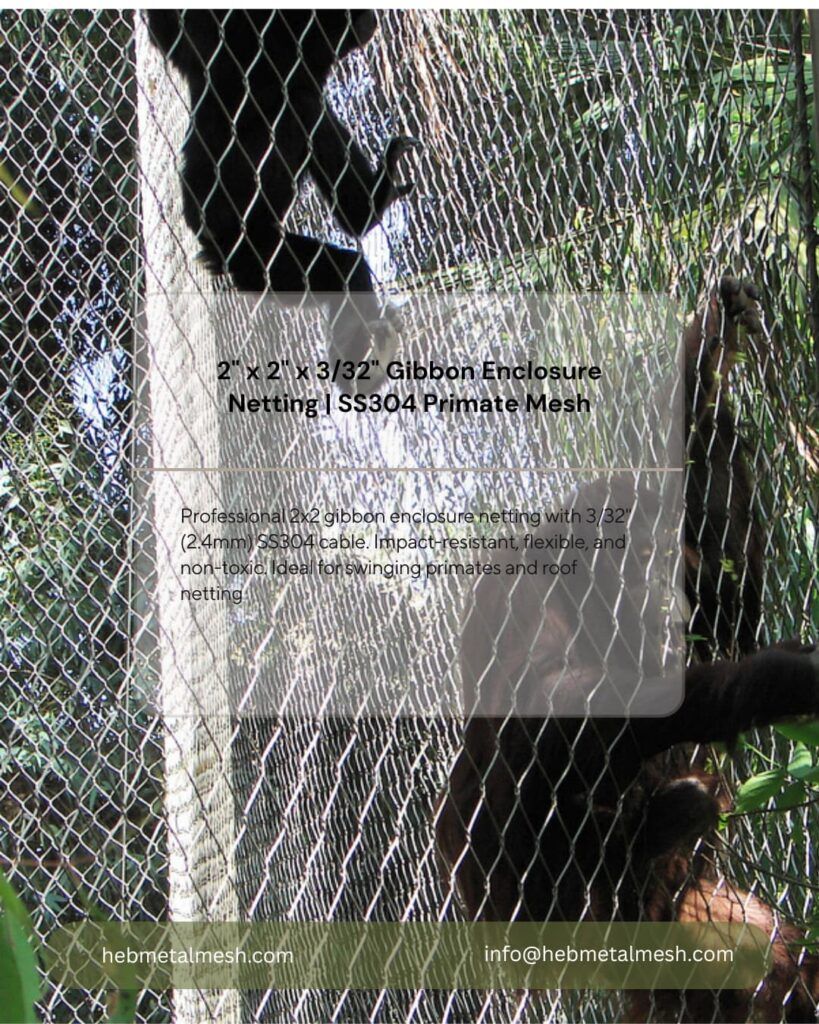
The practical difficulty is that an outcome based enclosure looks, on paper, less precise than a component list. “A resident pair of gibbons can brachiate continuously for at least 20 meters without touching a solid surface” is a sentence a builder can work from; “heavy duty mesh” is not. Yet buyers reach for the component list because it is easy to compare prices on, and a comparison of prices is the only evaluation many projects ever perform. That is how enclosure performance quietly becomes a procurement exercise, a trade in the balance between safety and freedom that no price column ever records.
Written as an outcome, the same requirement produces a very different document. It states what the finished structure must not present: no gap between cable and frame that a digit can enter, no hard edge within reach of a body, no void below the perimeter.
Once the behaviors are fixed, aperture and cable stop being matters of taste and start being consequences. Design criteria that arrive in this order — behavior, then geometry, then material — survive contact with a supplier’s price list. They also make the enclosure outcome that the brief predicted the thing that gets checked, rather than a matter of opinion.
Four Decisions That Move the Score
Almost all of the enclosure’s long-term behavior is fixed by four choices, and none of them is really about price.
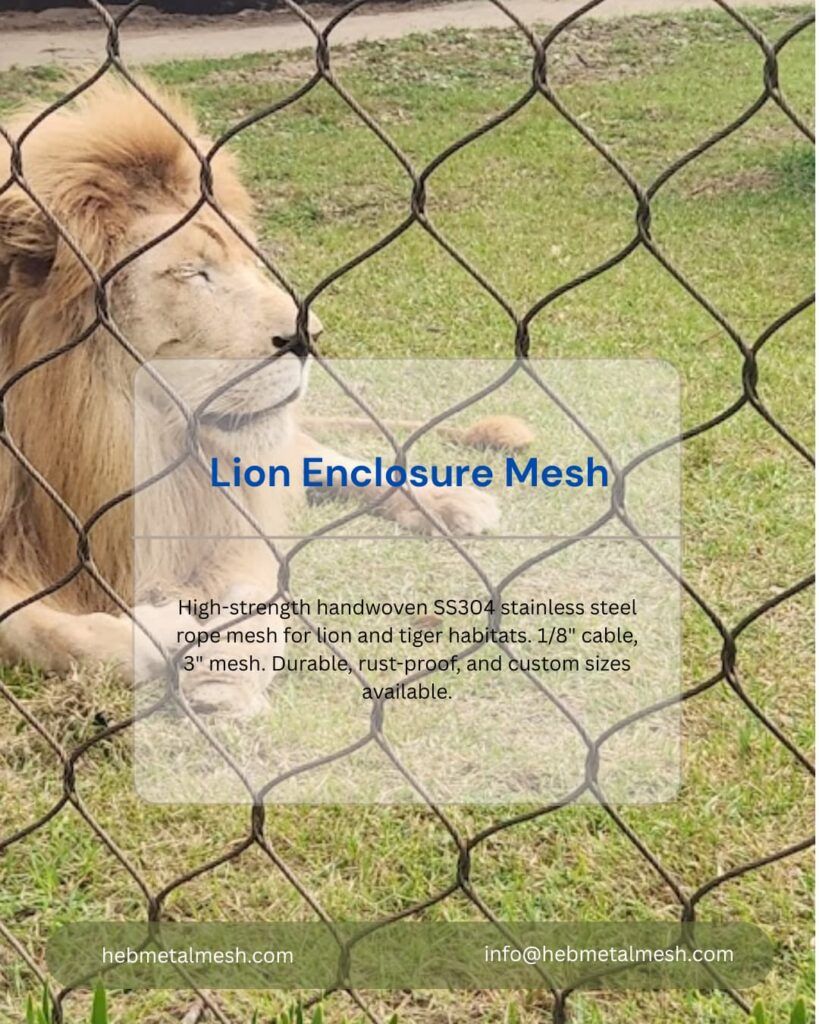
Aperture and cable diameter are one decision, not two. The pair sets what can pass through the panel and what happens to an animal that lands on it. A smaller mesh aperture with a thinner cable can be lighter and less visually intrusive than a large aperture with a heavy cable, and will fail a structural calculation in a different way.
Open area decides which loads the frame never sees. Every square meter of hand woven mesh is mostly air, and its open area determines how much wind passes through the plane instead of pushing on it.
Surface and material decide the injury record. A knotless, hand woven mesh has no joint to catch a feather, a claw or a lip, and its stainless steel grade decides what that surface looks like ten years later. The relevant question is not whether the alloy resists corrosion — it is whether the surface stays smooth enough that contact with it is harmless, which is a different claim and a stricter one. Breaking load protects the structure; the finish protects the animal.
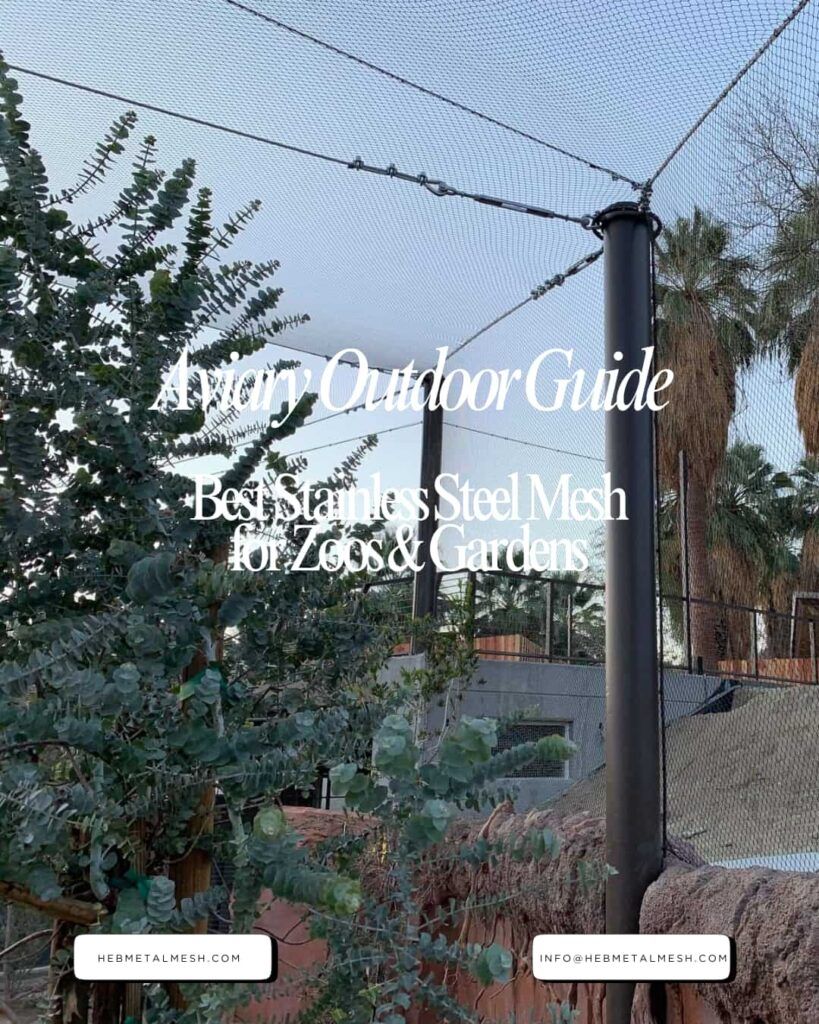
The perimeter decides whether the enclosure is the object that fails. Most escapes and most damage begin where the panel stops being a panel: at the ground line, at a corner, at a gate, at a junction between mesh and structure. The bottom detail is the least glamorous item on any drawing and the one that carries the design life of the whole enclosure, because it is the part that cannot be inspected easily and cannot be replaced cheaply. Longevity is bought at the edges, not in the middle. The ground line in particular is where siting, exposure and drainage decisions arrive at the structure.
The Score Is Taken After Handover
Nobody signs off an enclosure at handover, and it is worth being honest about that. The measurement that matters happens later, during the first weeks of occupancy, when keepers begin to record what the animal actually does. A post occupancy evaluation done properly asks four things: whether the intended behaviors are occurring at the intended frequency, whether any unintended behavior has appeared, whether injury has occurred and of what kind, and whether the maintenance burden matches what was promised.
That is a modest routine, and it changes what commissioning means. A structured enclosure assessment carried out on this basis produces a document that later projects can be judged against, and an enclosure evaluation taken at the same interval is the only way measuring enclosure success becomes possible at all rather than a matter of opinion. It also gives the operator something a purchase cannot: enclosure performance stated as a trend over time.
Operators who run this loop consistently find that the quality of life enclosure they thought they were buying and the one they got differ in predictable places. Almost always the gap is at an edge, a junction or a surface — the cheap items — rather than at the center of a panel. The same principles of good zoo enclosure design explain why.
Reading the Brief Before the Quote Goes Out
Put the four sections on a single page, in this order: the species and the group size; the behaviors the enclosure must support and the behaviors it must prevent; the geometry those behaviors imply, in spans, heights and distances; and the irreversible details — aperture, surface, perimeter. Anyone can then judge whether a quote answers the brief, and anyone can later judge whether the build answered it too. Knowing how to judge an enclosure in advance is what makes that possible, and it takes a single page.
Two habits separate a brief that works from one that does not. The first is stating the failure as well as the target: how many escapes are acceptable, which injuries are not, and how long the structure must stand before any panel is replaced. The second is keeping the brief alive after the order is placed. A specification no one checks is not a standard; it is a preference with a heading.
FAQ
The animal decides, and keepers translate. Behavior during the first weeks of occupancy is the strongest available evidence, supported by the injury record and by whether the space is being used the way the design intended. Certificates and test reports describe the material, not the result.
No. A heavier cable or a smaller aperture can make a structure safer without making it better. Material choices are consequences of a brief; they cannot substitute for one.
Before the first sample is requested, and in enough detail that a supplier could challenge it. Write it while the design is still fluid and changing it costs nothing, because the version written afterwards is only ever a description of what was already bought.
The perimeter. Ground line, corners, gates and mesh-to-structure junctions account for a disproportionate share of escapes, damage and maintenance, and they are the hardest items to change once the structure is standing.
Have a specification you are not sure can be verified? Send us the current brief, the species and the intended behaviors. We will tell you which of the criteria are checkable, which are wishes, and which of the four irreversible details you have not yet decided.
Ready to specify an enclosure by the result rather than by the roll? Our enclosure mesh is made to the aperture, cable size and perimeter detail your brief calls for.