
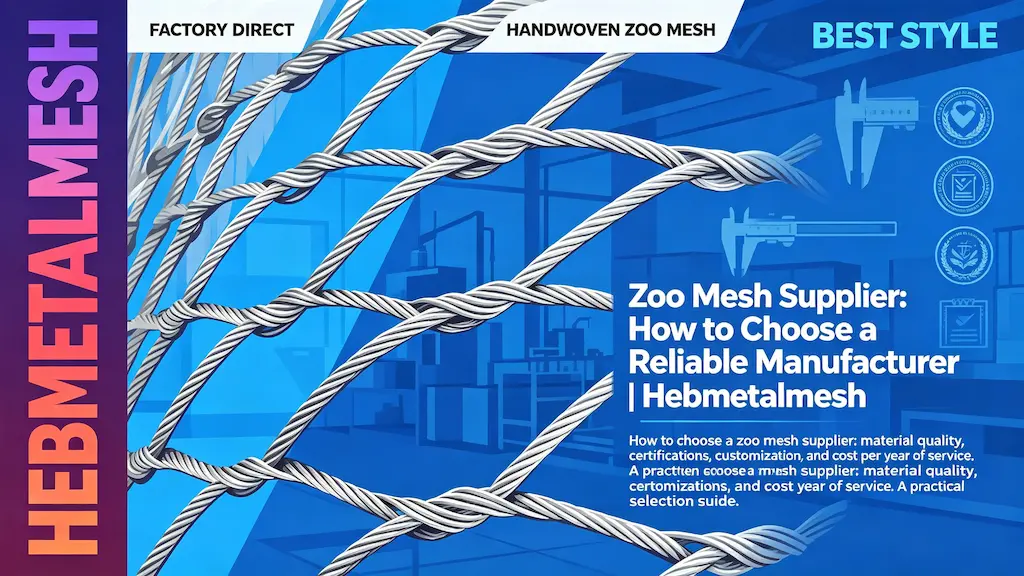
A zoo barrier has two jobs that pull against each other. It must hold an animal that has no interest in being held, and it must not stand between that animal and the person watching it. Steel bars do the first and fail the second; a solid pane does the second and complicates the first. Handwoven stainless steel rope mesh does both, because it is a tensioned net of thin rope: almost everything the eye meets is opening rather than structure. This guide is for the people who sign off that decision, and it sets out how to specify mesh for an unobstructed view without trading away containment.
Executive Summary
An unobstructed view in a zoo enclosure is a property of open area, not of branding. Rope mesh delivers it because the barrier is built from 1.2 mm to 3.2 mm rope at apertures of 20 mm to 102 mm, so most of every square meter is air. The figures that set safety and the figures that set visibility are therefore the same two: aperture and rope diameter, which is why the view is a by-product of settling containment properly rather than a concession made afterward. Read the barrier as a structural element, not a screen: rope construction governs its behavior under load, chromium content governs how long it survives the site, and the perimeter detail decides whether the panel can be tensioned and inspected. The reference specification is the animal enclosure mesh product page.
Planning a barrier that has to disappear?
Send the viewing distances, the species and the opening dimensions. We will return a recommended aperture, rope diameter and alloy, with an indicative planning range per square meter.
Request a mesh specificationQuick Answer:
An unobstructed view comes from handwoven stainless steel rope mesh, with apertures from 20 mm to 102 mm, rope diameters from 1.2 mm to 3.2 mm, and single panels up to roughly 9 m by 18 m. As a planning range, aviary-grade material falls between US10 and US22 per square meter, and heavier carnivore-grade material between US20 and US38. Because the opening is the material, visibility and containment are set by the same two numbers: choose the aperture from the smallest animal that must not pass, then the rope from the load it must carry.
Key Takeaways
- Unobstructed visibility is an open-area result, so specify the barrier as a net rather than a screen.
- Aperture is the visibility control: the opening is what the visitor and the animal both look through.
- Rope yield strength and cyclic loading behavior matter more than a single breaking figure on a barrier that moves daily.
- Every rope intersection is a crevice, so pitting resistance and site chemistry decide whether the panel outlives the frame.
- Safe containment is usually a perimeter property; the middle of a panel is rarely where a barrier fails.
- Cleanability belongs in the design conversation, because a barrier that cannot be washed will not be.
Why a Pane Fails Where a Net Succeeds
Glass, acrylic and polycarbonate are the obvious answer to a viewing barrier, and they are why some exhibits feel like aquariums. They are optically excellent, but a solid surface collects: a film, a scratch, and a reflection that turns a dark animal into a mirror. At the scale of a large enclosure, a transparent barrier also needs frames and mullions, which reintroduce the visual structure you were trying to remove. A transparent mesh is not a surface that can fog or film; it is a structure with holes in it, and the eye reads the holes. Weight settles the rest, since a glass barrier of any real strength is heavy, needs a foundation, and cannot be repaired in place, which is why the wider trade-off is covered in fencing in zoos: safety, aesthetics and animal welfare.
The useful reframing is not “how do I make a window?” but “how open can the barrier be while still doing its job?” Answer that, and a clear sightline follows from the specification.
How a Woven Net Produces an Unobstructed View
Rope mesh is made by hand from stainless steel wire rope, and the rope construction is the whole argument. Each rope is a bundle of strands pressed into ferrules at every crossing, so the material stays continuous and flexible. Because the rope is thin, the panel presents very little material per square meter, and the opening dominates. Two figures then describe the result: aperture, the clear distance across one opening, and rope diameter. A 2 mm rope at a 51 mm aperture leaves well over 90 percent of the panel open; halve the aperture and you halve the opening without touching the rope.
That is why unobstructed viewing is an aperture decision before it is anything else. The visitor sees through the openings, and so does the animal, which is a welfare point as much as an aesthetic one: an animal that can watch what happens outside its enclosure is calmer than one facing a wall. For a group of animals on a large exhibit, unobstructed views depend on the panel being wide and the framework being light, and both are easier with a flexible net than with panes. Every choice that produces an unobstructed view of animals comes down to those same two numbers, which also fix how the enclosure is built around them, the subject of balancing safety and freedom in zoo enclosures.
Containment You Cannot See
A net contains an animal by being strong in tension and continuous in plan. Two mechanical properties do the work. Yield strength is the load at which the rope stops behaving elastically and begins to deform permanently, and it tells you whether a big cat leaning on a panel will stretch it or merely load it. Cyclic loading is the quieter of the two, because a primate that swings on a panel or a big cat that paces along it applies thousands of small loads, and a barrier that flexes easily will fatigue its fixings long before it breaks a strand. The failure worth designing against is catastrophic failure, a panel that opens at a corner in a single event, which is a perimeter problem, not a field one. Load is highest where the panel is restrained, so the frame, the edge detail and the anchors carry the design.
For secure containment, exploit the redundancy of a woven net: a single damaged strand stays local, because load redistributes through the crossings around it. Safe containment also means a second line of defense: a net that stops the animal, plus a moat or offset that stops a determined climb. Where the animal is a leaper, geometry matters as much as the mesh, and panels that run an entire wall without field joints help on both counts, as set out in seamless netting: large woven panels with no joins.
Alloy, Site Chemistry and the Crevice Problem
Stainless steel is not a coating, so it cannot be breached the way galvanized wire can: it resists corrosion because a thin chromium-rich oxide film re-forms in air, which is why a cut end or a scratch is not a permanent weak point. That film needs oxygen, and it objects to crevices. Both matter for a woven net, because a net is nothing but crossings, and every crossing is an overlap where water can sit and air cannot. Pitting resistance therefore becomes a specification issue rather than a footnote. The chromium content of the alloy sets the baseline, and the molybdenum in 316 stainless raises resistance to pitting and crevice attack in chloride-bearing conditions.
That is why 316 exists as a separate grade, and the guidance on where 304 stops being adequate is explicit. The British Stainless Steel Association is blunt that “any form of crevices must be avoided”, and it makes the mechanism plain: “Stainless steels rely on a source of oxygen to maintain their passive condition.” Both point the same way for a mesh barrier: keep the crossings clear of deposits, detail the panel so water cannot pond in them, and let the site rather than the budget choose the grade. Inland enclosures away from salt and fertilizer runoff are normally well served by 304; coastal sites, splash zones and walls facing a sea breeze belong on 316.
Designing for Immersion and Aesthetic Appeal
An immersive experience is the design goal that an open barrier makes possible. Once the barrier stops being a visible object, a visitor stops reading the exhibit as a box and starts reading it as ground an animal occupies, and that shift is the difference between a display and a habitat. Zoo design has moved this way deliberately, and the move is easier with a material that follows a curve without mullions, a direction explored in innovative animal enclosure designs. Immersive viewing is therefore a buildability argument as much as an optical one.
Aesthetic appeal in an enclosure is mostly a question of what the design team is allowed to build. A net can be tensioned over an organic plan; a pane cannot. The result is a naturalistic enclosure whose boundary is a curve rather than a rectangle, and the same material lets a designer match rope diameter to the animal, so a heavy rope reads as strength around a tiger and a fine one as lightness around a small primate. An unobstructed sightline from the viewing deck depends on lightness of structure, and openness is also what lets daylight and moving air reach the ground, which is what most animals need.
Detailing, Tensioning and Cleanability
A net is a tension structure, so the perimeter is where the engineering lives. A panel should be captured at its edges in a way that can be tensioned, and the frame should be able to carry what the mesh hands to it. Light framing is the point of the material, but it has to be adequate: an undersized post moves, a moving post loosens the net, and a loose net no longer reads as a clean plane. Where a very large opening has to be covered, the number of field joints is the main variable, and fewer joints is better for the view and for the load path alike.
Cleanability is the maintenance question that follows. Stainless needs no re-coating, so upkeep is washing rather than painting, and the design should make washing possible: reachable panels, a hose that reaches the lower rows, and no horizontal ledges where droppings collect. A smooth rope and a bright finish both help, because a surface that sheds water sheds dirt with it. The routine itself is described in maintenance tips for stainless steel wire rope mesh. A barrier with no moving parts and no coating still has one wear point, the fixings, and those can be read from the ground.
Ready to specify a barrier by how it looks from the path?
Send us the exhibit plan, the species and the site exposure. We will recommend an aperture, rope diameter and grade, confirm the widest panel we can weave, and quote it.
Send your exhibit dimensionsFAQ
It is a measure of open area rather than a marketing claim. A woven net of 1.2 mm to 3.2 mm rope at a 20 mm to 102 mm aperture leaves the great majority of the panel as opening, so the visitor looks through the mesh rather than at it.
Yes, when the rope diameter and the perimeter detail are specified for the load. The panel is strong in tension, the load concentrates at the edge, and the frame and anchors decide whether it holds or stretches.
A tighter aperture reduces the open area, so it does cost some visibility. The gain is containment of smaller animals, and the usual compromise is to size the aperture on the smallest animal and keep the rope as light as the load allows.
As a rule, yes. Chlorides in coastal air exceed the level at which crevice and pitting attack becomes a hazard, and the molybdenum in 316 stainless raises resistance to both. Inland sites away from salt and fertilizer runoff are normally well served by 304.
By washing. There is no coating to renew, so routine work is a wash-down that lifts droppings and dust out of the crossings, ideally with the panel reachable from the ground. Detailing the mesh so water drains rather than ponds does most of the work between washes.
A local repair is normal. A damaged strand is tied out and new rope is woven into sound mesh, and because the net is a redundant structure the load path survives the repair. That is another reason to keep the perimeter reachable. The reference specification is the animal enclosure mesh product page.