
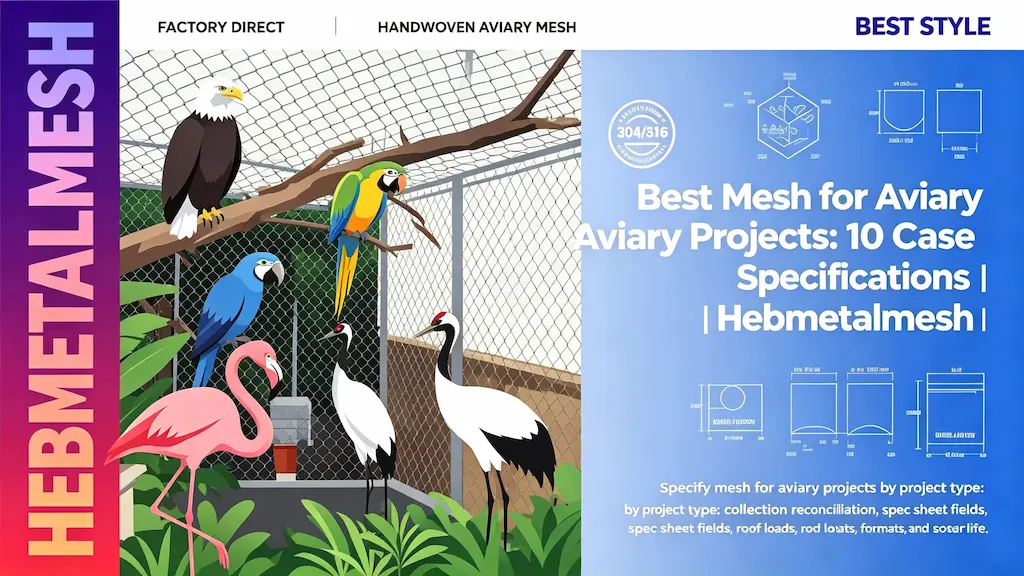
Ten aviary projects, ten different answers — and the difference is never the brand of the mesh. It is the collection. Two numbers settle almost every bird aviary specification: the aperture the smallest resident cannot pass through, and the cable diameter the largest beak cannot deform. Panel format, frame spacing, roof pitch and budget all follow from those two. This guide works through the ten project cases that cover most briefs, from a private finch flight to a flamingo lagoon to a walk-through exhibit, and shows what genuinely changes between them. Best mesh for aviary projects is not one specification; it is a short decision sequence, and the sequence is what follows.
Executive Summary
Ten project types cover almost all aviary work, and each is governed by a different constraint: the smallest resident sets aperture, the largest beak sets cable diameter, and the collection mix decides whether a single panel has to satisfy two incompatible birds. The working range is 1.2–3.2 mm cable at 20–102 mm aperture, hand woven from 7×7 strand into panels up to 9 m × 18 m. SS304 suits inland sites; SS316 adds molybdenum for coastal air and chlorinated wash-down. Aviary grades plan at roughly **$10–22 per square metre** for lighter work, and heavy raptor or walk-through structures run $20–38, both before fixings and installation. Expect two to four weeks of factory lead time plus two to six weeks of transit, and an EN 10204 3.1 mill certificate with every order. The reference specification is the aviary netting product page.
Quick Answer:
What is the best mesh for aviary projects? Hand-woven stainless steel rope mesh, specified at the aperture your smallest resident cannot pass and the cable diameter your largest beak cannot deform. No single aperture or gauge covers ten projects — the collection decides, and every other number is downstream of those two.
Key Takeaways
- Aperture is set by the smallest bird and cable diameter by the largest beak. The two numbers pull in opposite directions and both have to be satisfied.
- A mixed collection is the hardest brief in aviary work, because the tightest aperture and the heaviest beak rarely belong to the same bird.
- Woven rope mesh built from 7×7 strand keeps its mesh tension after local damage, which is why it outlasts welded alternatives on a public flight.
- Roof panels carry a load case that walls do not: snow load, wind uplift and corner loading all concentrate at the perimeter cable rather than in the panel.
- Fix the format and the fixings at the same time as the mesh. Panels, rolls and cut-to-size pieces change the site labour, and the frame usually decides the opening date.
Aviary guidance from the Association of Zoos and Aquariums treats the barrier as a life-support system rather than a fence, which is the correct frame for any aviary holding birds the public can see.
Ten Aviary Project Types and What Each One Needs
The aviary project types that reach a mesh manufacturer are remarkably consistent: a private finch flight, a mixed parrot collection, a raptor rehabilitation mews, a waterfowl or flamingo lagoon, a pheasant or peacock display, a walk-through bird park, a zoo bird house, a conservation breeding unit, a quarantine and holding facility, and a retrofit of an older netted structure. Each is governed by a different constraint, which is why one specification can never be copied across to the next job. A breeding aviary project is judged on disturbance: the barrier should be invisible to the birds, fine enough that pairs do not rub against it, and quiet enough that it does not rattle in wind. A walk through aviary project is judged by the visitor instead — tall enough to walk beneath, transparent enough to feel open, and robust enough that a member of the public cannot reach a bird or damage a panel.
Reading the Collection Before You Read the Price List
Avian mesh is specified from two numbers, and both are worth writing down before opening a catalogue. The first is the smallest bird that must not escape. The second is the largest beak, bill or hand that must not deform the panel or reach through it. Mesh gauge for birds gets used loosely for both, which is where most specifications go wrong: aperture is the opening, gauge is the wire, and the two are independent variables. A 20 mm aperture in 1.2 mm cable and a 20 mm aperture in 3.2 mm cable present the same window and behave nothing alike when a macaw leans on it. Strand construction is the third number. A 7×7 rope built from seven bundles of seven wires carries forty-nine wires per strand, which is why one broken wire costs about two per cent of that strand’s capacity instead of ending the panel.
Writing the Aviary Project Specification
A usable aviary project specification is short and dull, and that is the point. It carries the enclosure footprint and clear height, the collection with sexes and counts, the aperture and cable diameter, the panel or roll format with a mesh take off by area, the frame spacing and fixing detail, the roof load case, the alloy grade and finish, and the inspection and re-tensioning interval. An aviary specification sheet that omits the collection is unbuildable, because nobody can price a barrier without knowing what stands behind it. The aviary material list is the last column of the exercise rather than the first: edge cable, tensioners, ferrules and anchor plates routinely add ten to twenty per cent to the material figure that a mesh-only quotation shows.
Mixed Species Aviary Projects and the Two-Bird Problem
A mixed species aviary is the hardest brief in aviary work, because the tightest aperture and the heaviest beak rarely belong to the same bird. A multi species aviary holding macaws beside small conures has to block the conures while surviving the macaws, which usually means taking the small aperture and then upgrading the cable diameter beyond what the small bird alone would justify. The discipline is to list every resident, mark the smallest and the strongest, and specify to both limits. Where the gap between them cannot be closed, splitting the collection across two panels costs less than buying one over-strength curtain that still lets finches through.
| Resident collection | Aperture | Cable | Model |
| Finches and small softbills | 20 mm | 1.2 mm | HM1220 |
| Budgerigars and small parakeets | 25 mm | 1.6 mm | HM1625 |
| Conures, ducks, small waterfowl | 38 mm | 2.0 mm | HM2038 |
| Amazon parrots, cockatoos | 38 mm | 2.4 mm | HM2438 |
| Macaws and large raptors | 38 mm | 3.2 mm | HM3238 |
| Pheasants, peafowl, cranes, flamingos | 76 mm | 3.2 mm | HM3276 |
Aviary Roofing and the Overhead Case
Aviary roofing is where an aviary project stops resembling a fence. An overhead panel sees uplift rather than impact, and its serviceability is governed by panel deflection — hold it near one per cent of clear span so the mesh neither ponds water nor drums in wind. Snow load is the number clients forget. At a 38 mm aperture with 2.4 mm cable the open area percentage is around 88, and wet snow bridges a 38 mm opening instead of falling through it, so a minimum roof pitch near fifteen degrees does more work than an upgraded cable. Corner loading concentrates at the eaves and the four anchors, which is why the edge cable and the boundary fixings, not the panel, form the real load path.
Formats, Alloy and Finish
Aviary project materials arrive as panels, rolls or cut-to-size lengths, and SS304 covers inland sites while SS316 is the marine grade stainless for coastal air and chlorinated wash-down. Finish matters more than most buyers expect. Bright annealed is the default surface, and a black oxide finish is specified where a dark barrier should disappear against planting, or where glare off a polished panel would disturb birds. Panels cut the number of site joints on a long run, rolls suit a frame that is already standing, and cut-to-size lengths reduce waste on awkward geometry. Whichever you choose, keep the alloy and the finish identical across mesh, ferrules, edge cable and tensioners — mixed metals at a marine site quietly undo the grade upgrade you paid for.
What an Aviary Project Cost Buys
Aviary project cost tracks three variables and largely ignores a fourth. Cable diameter moves the number fastest, aperture second, panel size third, and order volume barely moves it at all. As a planning range, aviary-grade woven mesh lands at **$10–22 per square metre**, with heavy raptor and walk-through grades at $20–38, both before fixings, frame and installation. Sensible aviary project planning therefore fixes the collection and the footprint first, then buys the lightest specification that satisfies both governing numbers. An over-specified panel is the most common expensive mistake on a small flight; an under-specified one is the most expensive mistake on a public exhibit.
Five Mistakes That Recur Across Aviary Projects
Specifying aperture from the average bird rather than the smallest is the first. Treating mesh gauge as interchangeable with aperture is the second. Ordering panels before the frame spacing is fixed is the third, and it is the one that most often delays an opening, because mesh arrives on schedule and waits on the ground. Forgetting that a roof panel needs a different load case is the fourth. The fifth is comparing suppliers on price per square metre alone — the grade comparison explains why SS304 and SS316 are not interchangeable, and vetting a netting supplier is a shorter exercise than replacing a panel set five years early. Rolls and panels can also be combined in one order to cut site joints.
Sourcing, Lead Time and Lifecycle
Woven rope mesh is made to order: two to four weeks at the factory plus two to six weeks of transit, with an EN 10204 3.1 certificate on the order. The number that most often delays an aviary opening is not production but the frame. After installation, mesh tension settles as the rope beds in, so a re-tension four to six weeks after commissioning — and again at the first annual inspection — is normal rather than a defect. Broken wires show up within about 300 mm of a ferrule almost every time, which makes the perimeter the only place worth a routine walk. Panel sizes, cable diameters and alloy options for every case above sit on the bird aviary mesh product page, so a specification can be checked against the real schedule rather than a brochure. The installation sequence decides most programme risk, and how zoo netting pricing works explains why the specification moves the number before volume does. A well-built woven panel carries a 25 to 30 year service life; the fasteners, not the mesh, are usually what ends it.
FAQ
Far fewer than ten. Aperture and cable diameter vary by collection, but the format, grade and fixing detail repeat — which is why a single specification sheet with two variables usually covers a whole bird park.
None reliably. A 20 mm aperture stops a finch, and the same panel in 3.2 mm cable is what a macaw needs for strength, so the practical answer is the small aperture with the heavy cable rather than a compromise on either.
The panel can be the same; the load case cannot. Roofs see snow load and uplift instead of impact, so pitch, support spacing and edge cable — not aperture — become the governing decisions up there.
Compare delivered area, alloy, cable diameter, aperture, panel size, edge treatment and certification. Price per square metre alone hides whichever of those the cheaper quotation has left out.
Still working through the specification for an aviary project? Send the collection list, enclosure dimensions and site conditions to our team and we will return an aperture and cable schedule, a format recommendation and an indicative material budget.