
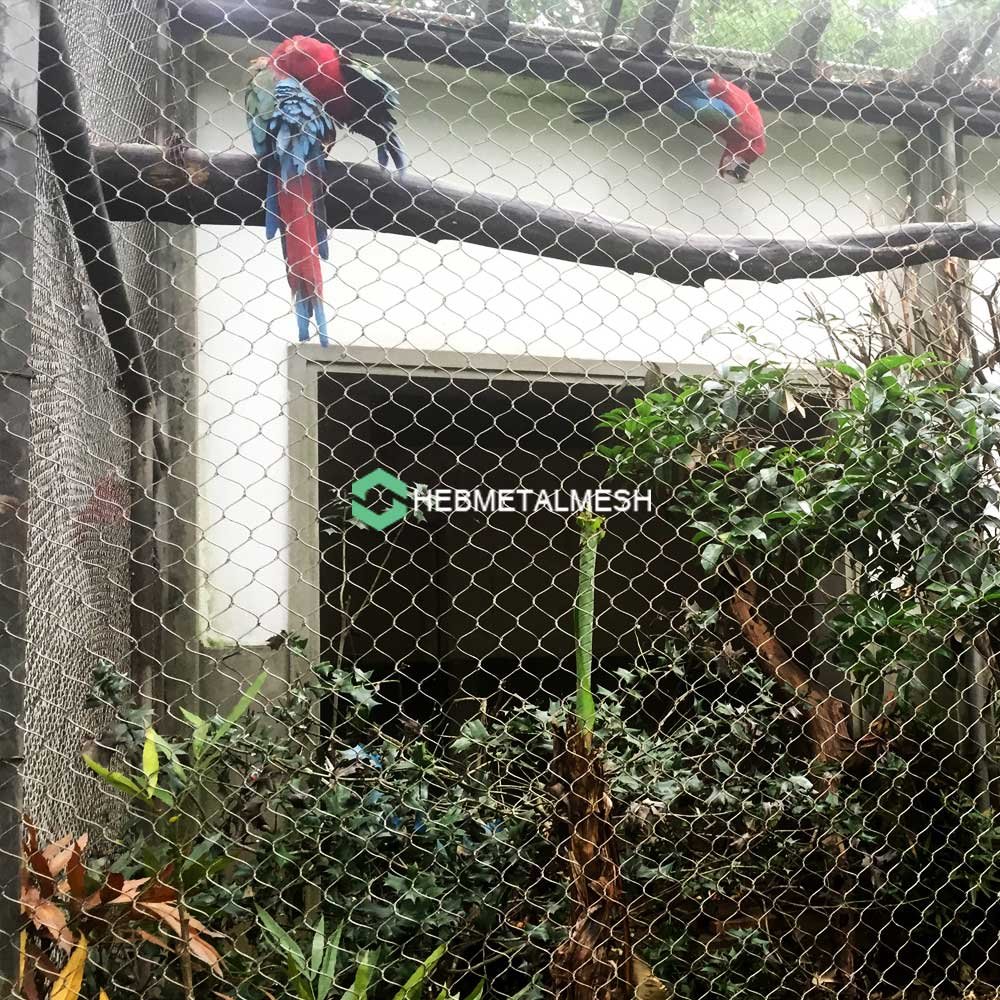
A parakeet does not test a mesh panel. It tests the places where panels meet. The hinge side of the door, the corner where a roof bay lands on a post, the sliver of daylight under a bottom rail — a budgerigar will work those openings patiently, for an hour, until one gives.
Keepers who lose a bird almost never find a torn panel. They find a gap. That is the uncomfortable fact behind every aviary for parakeets that ends up empty: the enclosure followed a bird-sized idea of security instead of the measurements of a forty gram psittacine.
The buyer picked mesh from a catalog photo, the fabricator built the frame to whatever panel size the supplier stocked, and nobody wrote down the one number that decides the build.
Executive Summary
For a parakeet, the binding constraint on an aviary is aperture, not strength. A budgerigar carries a head roughly 15 to 18 mm across, which turns a 25 mm opening into a gap it can push a skull through and either escape or hang itself.
The practical ceiling for most parakeets is 12.7 mm, and 9.5 mm for budgerigars and the small grass parakeets. Everything downstream follows: wire diameter has to hold that opening without sagging, fixing spacing has to keep the mesh tight at the frame, and the door, skirt and floor need the same scrutiny.
Get the aperture right and the rest of an aviary for parakeets becomes ordinary fabrication work. Get it wrong and no amount of heavy framing will save the bird.
Quick Answer
Use 12.7 mm (1/2 inch) mesh as the working maximum for parakeets, and 9.5 mm (3/8 inch) for budgerigars and small grass parakeets. A 25 mm (1 inch) aperture is too large — a parakeet can push its head through and either escape or hang itself. Size the mesh to the smallest bird in the collection, then close the door, skirt and floor gaps to the same standard.
Key Takeaways
- Aperture decides whether an aviary holds a parakeet; wire strength only decides how long the mesh lasts.
- 12.7 mm is the ceiling for most parakeets, 9.5 mm for budgerigars and small grass parakeets.
- The head is the widest rigid part of the bird. Measure across the skull, not the beak.
- A thin wire in a small opening sags between fixings, which opens the aperture under load.
- Door gaps, roof junctions and bottom rails leak birds that a perfect panel would have held.
- Specify aperture, gauge, panel size and fixing spacing in millimeters, or the fabricator will choose for you.
The Smallest Bird Sets the Mesh Spec
Most aviary failures are not structural. They are dimensional. A parakeet needs an opening small enough that the skull will not pass, and that figure drives every other decision.
When buyers ask about mesh aperture for parakeets, they want a number. The honest answer is a method plus a ceiling.
The ceiling is 12.7 mm. Below that the bird cannot get its head through, and a head that will not pass will not drag a body behind it. Above it, the bird becomes a lever, and a panicking parakeet breaks its own neck against a frame it cannot see.
This is where most guides get it wrong. A 25 mm zoo mesh suits a macaw. For a hookbill lighter than a bar of soap it is a hazard.
What the head width actually decides
Parakeet head width is the measurement that sets everything. Take it across the widest point of the skull, just behind the eyes. Do not measure the beak — it is narrower and it moves.
| Bird | Typical adult weight | Maximum aperture | Working gauge |
| Budgerigar | 30–40 g | 9.5 mm (3/8 in) | 16–18 |
| Grass parakeet (Neophema) | 40–50 g | 9.5 mm (3/8 in) | 16–18 |
| Cockatiel | 80–100 g | 12.7 mm (1/2 in) | 14–16 |
| Ringneck parakeet | 115–140 g | 12.7 mm (1/2 in) | 14–16 |
| Alexandrine parakeet | 200–260 g | 12.7 mm (1/2 in) | 12–14 |
Treat the table as a starting point and measure your own birds.
If the build is your first, this guide to a safe small bird aviary covers the layout side.
Reading Aperture, Gauge and Wire Diameter Together
Bar spacing for parakeets gets quoted as a single figure. That is where trouble starts, because aperture and wire diameter are a pair. A 12.7 mm opening in 1.2 mm wire behaves differently from the same opening in 2.0 mm wire.
Wire diameter for parakeet mesh is a structural question. The mesh has to resist a bird hitting it at speed, a cat pressing outside, and its own weight across a span.
Why a thin wire is not the cheap option
Small openings tempt suppliers toward thin wire, because the mesh looks dense and the price looks good. The trade-off arrives in service.
Thin strands in a fine weave lose tension earlier, and a slack panel sags into a shallow bowl. That sag changes the aperture at the low point.
For a psittacine that climbs all day, a slack panel is a foothold that moves. The bird works the gap at the fixing until it widens.
Buy the gauge in the table, not the lightest mesh on the quote. The options in the parrot netting range list aperture and gauge side by side, which is the only way to compare them.
Escape Points That Have Nothing to Do With the Mesh
Parakeet aviary escape points cluster in the joinery. Walk a finished aviary at dusk and the failures show up as thin lines of daylight.
On an aviary for parakeets, that is the whole inspection method, and it takes ten minutes. Start with the frame.
The door gap
The aviary door gap is the most common failure on a small-bird build. A door that closes against a stop looks sealed and is not.
Hinges settle, timber moves with the season, and a latch that held in June leaves a 6 mm shim gap in November.
Fix it with an overlap, not with precision. A door that closes onto a rebated frame, with mesh carried past the opening, tolerates movement.
Skirt, floor and the buried edge
Aviary skirt depth is the dimension most often skipped in plans. A skirt turns outward at the base and runs along the ground, and it stops an animal digging in.
For parakeets the skirt does a second job. It closes the bottom rail gap that a bird will find within a week.
Floor mesh for aviary builds is a separate decision. A mesh floor dries fast, but it drums underfoot unless closely supported.
A solid floor with a mesh skirt is easier to clean and kinder to small feet. Either works, provided the junction has no gap wider than the aperture.
Panel options for this class of build are set out in this mesh size guide for small bird aviaries.
Check these seven points on any build:
- Hinge side and latch side of every door.
- Roof-to-wall junction, especially where a bay meets a post.
- Bottom rail, all the way around.
- Panel-to-panel seams, top and bottom.
- Feed and service hatch frames.
- Cable, pipe and misting-line penetrations.
- Any clip or tie that has worked loose since installation.
Flight Length, Height and Perch Layout
Flight length for parakeets matters more than total floor area. A budgerigar flies fast and flat, and it needs a straight run to do it. A long narrow aviary beats a square one of the same footprint, because the bird can build speed before the far wall.
Height helps only when the vertical space is furnished. An eight foot aviary with every perch at shoulder level has four feet of unused air. Stagger the perches so the bird has a reason to climb, and leave the top third clear.
Perch diameter and foot health
Perch diameter for parakeets should vary across the aviary. A budgerigar’s foot grips best around 10 to 15 mm, and a mix of diameters exercises the tendons instead of loading the same contact points.
Natural branch perches give that variation for free, provided the wood is safe and dry. Avoid smooth dowel everywhere — it is standing on a polished floor for a living.
Place at least one perch where the bird can reach the mesh. A bird hanging from one toe will find the gap instead.
Stepping up a size class changes the numbers, and this cockatiel aviary mesh review shows where the line falls.
Mixed Collections: The Parakeet Is the Constraint
When a collection mixes species, the smallest bird in a mixed aviary sets the mesh for the whole structure. A 9.5 mm aperture costs more per square meter than a 25 mm one and looks dense from a distance.
There is no way around it. Two mesh specifications on one building means a transition detail somewhere, and that transition is a gap.
Build the whole envelope to the small bird and accept the cost. Mixed-species exhibit standards published by WAZA treat the barrier as one system for exactly this reason.
A quarantine aviary belongs in the same conversation. New arrivals spend four to six weeks apart from the flock, and that pen needs the same aperture as the main one. A quarantine built from spare coarse mesh defeats its purpose the day a bird escapes it.
Frame, Fixing Spacing and Panel Tension
Panel fixing spacing controls tension, and tension controls whether the mesh holds its aperture. A fine weave fixed at 600 mm centers will bell outward between clips; the same panel fixed at 300 mm centers stays flat.
For small-aperture mesh, treat 300 mm as the working maximum and tighten to 200 mm on door frames and any panel over 1.5 m. Use clips that grip the wire, not clips that pinch it, because a pinched strand work-hardens and cracks.
Test the finished panel by hand. Press the center of a bay with two fingers. It should move a few millimeters and return.
If it stays dished, the spacing is too wide or the gauge is too light. The panel will keep sagging through its first winter.
Cleaning, Repair and the Spare Panel
A cleaning hatch sounds like a detail until the first deep clean. Build one at each end, sized so a hand and a scraper fit through without removing a panel. Every opening you add is a gap, so specify the hatch with the same overlap detail as the door.
Repair is the other long-term cost. An aviary repair mesh match depends on two things: the same aperture and the same wire diameter, because a panel of the right aperture in the wrong gauge looks correct and hangs wrong.
Order spare mesh with the original build. Two square meters from the same production run removes the six-week wait after a storm.
The construction sequence is covered in this build guide for small bird aviaries.
What to Put on the Order
Write the specification in numbers and the fabricator has nothing to interpret. Leave it in prose and you inherit whatever the workshop had on the floor.
- Aperture in millimeters, with a stated tolerance.
- Wire diameter and gauge, not a strength claim.
- Panel sizes, and the largest single panel the factory can weave.
- Fixing spacing at the frame, in millimeters.
- Skirt depth and the wall-to-floor detail.
- Door type, swing direction and the overlap dimension.
- Spare panels, ordered with the main run.
FAQ
No. A budgerigar’s beak cannot cut stainless wire, and it cannot fatigue a strand at the diameter used in aviary mesh. The real risk is mechanical: a bird works a loose clip until the opening grows.
Twenty years is a reasonable expectation for grade 304 mesh in a temperate climate, with the frame matching it depending on timber treatment. Coastal air shortens that. Salt attacks cut ends and clips first, so inspect the fixings annually.
Grade 316 stainless, not 304. The molybdenum in 316 resists chloride pitting, which is the failure mode that turns a bright panel dull and then rough. In humid inland air, 304 is fine if water cannot pool in the frame.
A 12.7 mm panel in 1.5 mm wire runs about 2 kg per square meter, so a 2 m by 1 m bay lands near 4 kg. That is a one-person lift on flat ground and a two-person lift at height. Weight climbs fast with wire diameter, which is why you solve aperture before gauge.
It changes how the aviary reads, to a bird and to you. Bright stainless throws glare and a dark panel recedes, which makes the enclosure look open rather than caged.