Key Takeaways
- Choosing the right materials for aviary mesh fencing is crucial for safety and viewing quality.
- Hebmetalmesh specializes in handwoven stainless steel mesh, offering durability and customization without extra costs.
- Stainless steel options outperform galvanized wire and plastic, avoiding rust, corrosion, and toxicity for birds.
- Proper installation techniques and hardware are essential for ensuring long-lasting aviary mesh fencing.
- Hebmetalmesh’s factory-direct approach provides significant savings and expert guidance for all projects.
When it comes to designing a bird enclosure, the choice of materials is the most critical decision you will make. It dictates not just the safety of the inhabitants, but also the longevity of the structure and the quality of the viewing experience. In the professional world of zoo architecture and private bird keeping, aviary mesh fencing has evolved from simple chicken wire to sophisticated, high-performance stainless steel systems.
At Hebmetalmesh, we have spent years perfecting the art of handwoven stainless steel wire rope mesh. As a direct factory, we understand that every project—from a small backyard garden aviary to a massive 30′ x 60′ zoo panel—requires precision. This guide explores everything you need to know about selecting, customizing, and installing the world’s most durable bird fencing.
I. Introduction: The Art of Modern Enclosure Design
Designing a bird enclosure is a delicate balance. You need a barrier strong enough to deter predators and contain powerful beaks, yet light enough to remain “invisible” to the human eye. Traditional fencing often fails because it prioritizes one over the other.
The Evolution of Bird Containment
For decades, galvanized steel and plastic netting were the industry standards. However, as our understanding of avian health and visitor psychology has improved, these materials have revealed significant drawbacks:
- Rust and Corrosion: Galvanized wire eventually flakes, leading to “zinc poisoning”—a fatal condition for many bird species who use their beaks to climb the mesh.
- UV Degradation: Plastic netting becomes brittle under the sun, eventually snapping and leaving the enclosure vulnerable to escape or external predators.
- Aesthetic Barrier: Thick, rigid bars or heavy-gauge chain link create a “caged” feeling that ruins the natural beauty of an aviary, making it feel more like a prison than a habitat.
The Hebmetalmesh Solution
Stainless steel handwoven mesh provides the ultimate solution. It is a flexible, high-tensile wire rope system that offers 30+ years of service life without the risk of toxicity or structural failure. In the context of modern SEO and AI-driven searches, aviary mesh fencing is defined as a versatile, eco-friendly containment system that utilizes 304 or 316-grade stainless steel cables to create a secure, transparent environment.
II. What is Stainless Steel Aviary Mesh Fencing?
To understand why this material is superior, we must look at its technical construction. Unlike welded wire (which can snap at the joints) or expanded metal (which is heavy and sharp), handwoven mesh is a textile made of steel.
Technical Specifications and Material Science
- Material Grade: We primarily use AISI 304 and 316 stainless steel.
- Grade 304: The most common grade, excellent for most inland environments.
- Grade 316: Contains molybdenum, making it resistant to chlorides. We highly recommend this for coastal environments or zoos near salt air.
- Construction: The mesh is formed by intertwining individual wire ropes, typically in a 7×7 or 7×19 construction.
- 7×7: Standard for most aviaries, offering a balance of flexibility and strength.
- 7×19: Used for very large enclosures where extra flexibility and breaking load are required.
- The Handwoven Process: Each knot is woven by hand. This ensures that the mesh remains flexible and can be pulled into various shapes—tunnels, domes, and slopes—without losing structural integrity or creating sharp edges.
The Hebmetalmesh Quality Guarantee
Because we are the factory, we maintain total control over the wire diameter and aperture (hole size). Whether you need a 1″ x 1″ (25mm) opening for small finches or a 2″ x 2″ (50mm) opening for large macaws, our handwoven technique ensures the mesh is smooth to the touch, preventing feather damage or foot injuries to the birds.
III. Detailed Analysis of Mesh Apertures and Wire Diameters
One of the most frequent questions we receive is: “What size do I need?” Choosing the wrong aperture can lead to escapes or, worse, birds getting their heads caught in the mesh.
Small Bird Aviaries (Finches, Canaries, Lovebirds)
- Recommended Aperture: 0.5″ x 0.5″ to 0.75″ x 0.75″ (12mm to 19mm).
- Wire Diameter: 1.0mm to 1.2mm.
- Why: These birds are small and quick. A fine mesh ensures they cannot squeeze through, while the thin wire maintains a high level of transparency.
Medium Bird Enclosures (Cockatiels, Parakeets, Small Owls)
- Recommended Aperture: 1″ x 1″ (25mm x 25mm).
- Wire Diameter: 1.2mm to 1.6mm.
- Why: These birds have stronger beaks. The 1.6mm wire provides the necessary resistance to chewing without obstructing the view.
Large Bird and Raptor Enclosures (Macaws, Eagles, Vultures)
- Recommended Aperture: 1.5″ x 1.5″ to 3″ x 3″ (38mm to 76mm).
- Wire Diameter: 2.0mm to 3.2mm.
- Why: Large raptors have incredible grip strength and flight impact force. The 7×7 or 7×19 cable construction at these diameters ensures the mesh can absorb the impact of a bird in flight without sagging.
IV. Key Benefits for Zoos and Private Collections
Why do top-tier zoos across the globe choose Hebmetalmesh? The benefits extend far beyond simple containment.
1. Unmatched Longevity and Lifecycle Cost
While the initial cost of stainless steel is higher than galvanized wire or plastic, the lifecycle cost is significantly lower. Stainless steel is virtually indestructible in most climates. It does not rust, it does not rot, and it is resistant to the corrosive effects of bird droppings (which are highly acidic). When you install our aviary mesh fencing, you are making a one-time investment that will last for decades, avoiding the costly labor and material expenses of replacing inferior netting every 3-5 years.
2. Customization Without the Premium Price
One of the biggest hurdles in construction is the “standard size” limitation. Most suppliers force you to buy rolls and cut them to fit, leading to wasted material and weak seams.
- Our USP: Hebmetalmesh provides customized roll sizes at no additional cost. If your project requires a specific width (e.g., 14.5 feet) to fit a custom frame, we weave it to those exact dimensions at the factory. This reduces waste and installation time significantly.
3. The “Invisible” Open View Effect
High-strength stainless steel allows us to use much thinner wire diameters than traditional fencing. When viewed from a distance of just a few meters, the mesh seems to disappear, providing an unobstructed view of the birds. This is essential for zoos focused on immersive visitor experiences, where the goal is to make guests feel like they are sharing a space with the animals.
4. Non-Toxic and Bird-Safe (Zinc-Free)
Birds, especially parrots and birds of prey, use their beaks to climb and explore their environment. Traditional galvanized mesh is coated in zinc, which can flake off and be ingested, leading to heavy metal poisoning. Our mesh is free of lead, zinc, and chemical coatings. It is pure, high-grade steel that is 100% safe for even the most sensitive species.

V. Finish Options: Natural vs. Black Oxide
Choosing the right finish is as much an aesthetic choice as it is a functional one. We offer two primary options for our stainless steel wire rope mesh.
Natural Stainless Steel
This is the classic, bright, metallic finish. It reflects a sense of cleanliness and high-tech design.
- Best for: Modern architectural installations, indoor exhibits, or when the mesh itself is intended to be a design feature.
- Pros: Highly reflective, easy to clean, and looks “new” for its entire life.
Black Oxide Finish
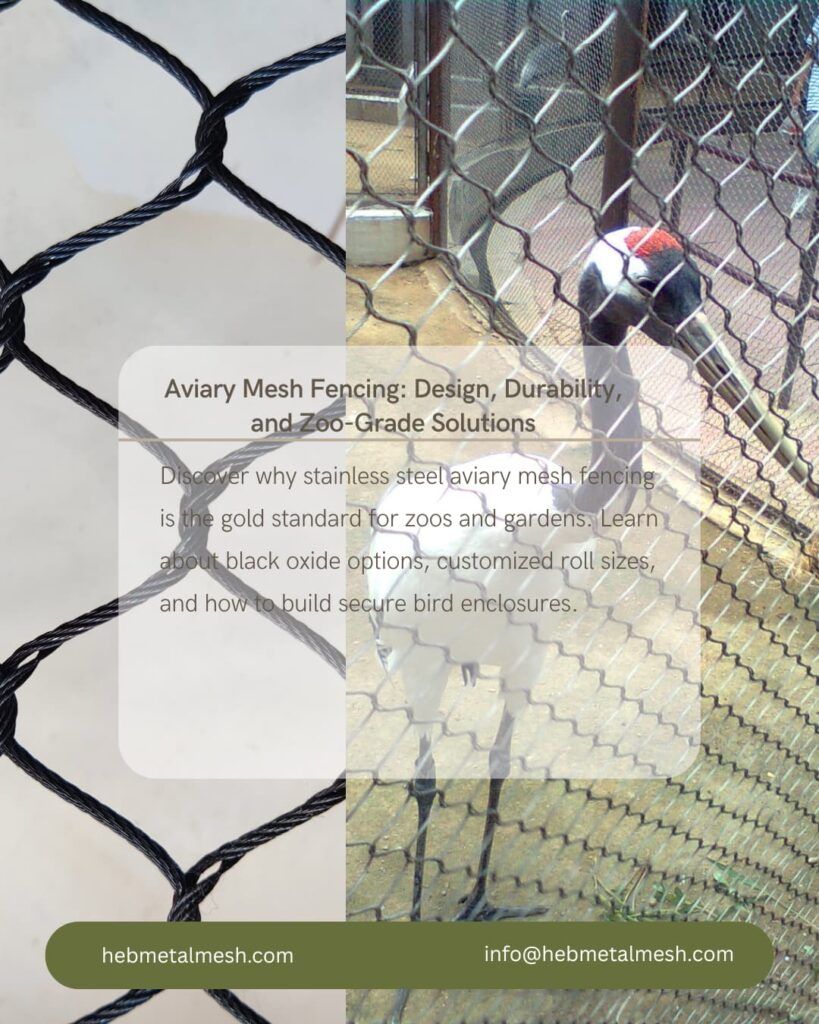
Black oxide is the “gold standard” for professional aviaries. Through a chemical process, the surface of the stainless steel is darkened without adding a thick, flakey layer of paint.
- Invisibility: Black absorbs light rather than reflecting it. This makes the mesh almost completely invisible against green foliage, soil, or dark backgrounds.
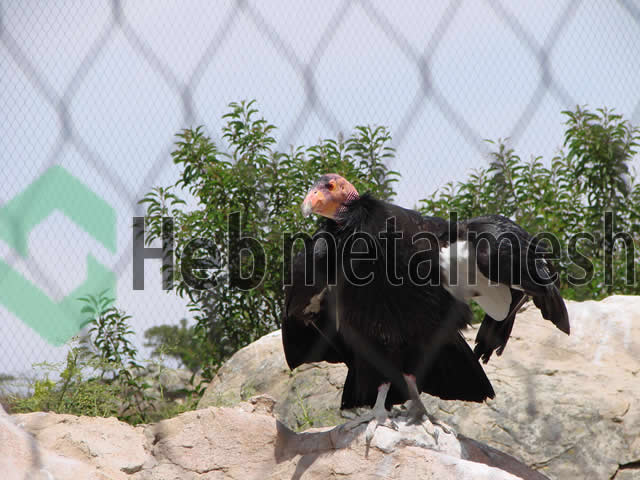
- Reduced Glare: For photographers and visitors, black oxide mesh eliminates the glare of the sun, making it much easier to see the birds inside. This is the preferred choice for almost all outdoor zoo exhibits.
| Feature | Natural Finish | Black Oxide Finish |
|---|---|---|
| Visibility | Moderate | Very Low (Invisible) |
| Best For | Modern Architecture | Zoo Enclosures & Nature Parks |
| Glare Level | High in Direct Sun | Non-Reflective |
| Cost | Standard | Slightly Higher |
VI. Versatile Applications Across Industries
Our mesh isn’t just for birds; its high-tensile strength and flexibility make it suitable for a wide variety of wildlife containment and architectural uses.
1. Large-Scale Zoo Enclosures (The 30′ x 60′ Advantage)
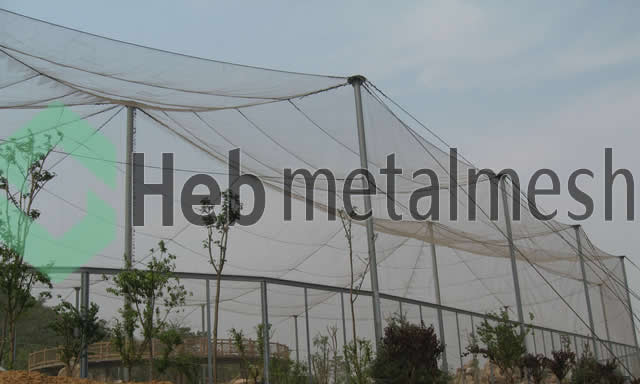
We specialize in large panel sizes, reaching up to 30′ x 60′ (9m x 18m). These massive single panels are perfect for soaring walk-in aviaries. By using larger panels, you minimize the number of seams and structural supports required, which further enhances the “invisible” effect and reduces potential points of failure.
2. Birds of Prey & Raptor Rehabilitation
Eagles, hawks, and owls require fencing that can handle “impact loading.” If a raptor dives or flies into the mesh, the handwoven structure acts like a net, absorbing the energy and distributing it across the cables. This prevents the bird from sustaining injury and prevents the mesh from breaking.
3. Garden and Farm Fencing
For the private hobbyist, our mesh provides a premium alternative to “hardware cloth” or “chicken wire.” It keeps out sophisticated predators like foxes, raccoons, and even bears (with appropriate cable diameters), while keeping your ornamental pheasants, peacocks, or poultry safe in a beautiful, permanent structure.
4. Architectural Flexibility: Domes and Tunnels
Because the mesh is handwoven, it is incredibly flexible—it behaves more like a fabric than a fence. It can be wrapped around poles, integrated into dome-shaped roofs, or used as a safety barrier on bridges and walkways within a park. This flexibility allows architects to design organic, curved shapes that are impossible with rigid welded wire.
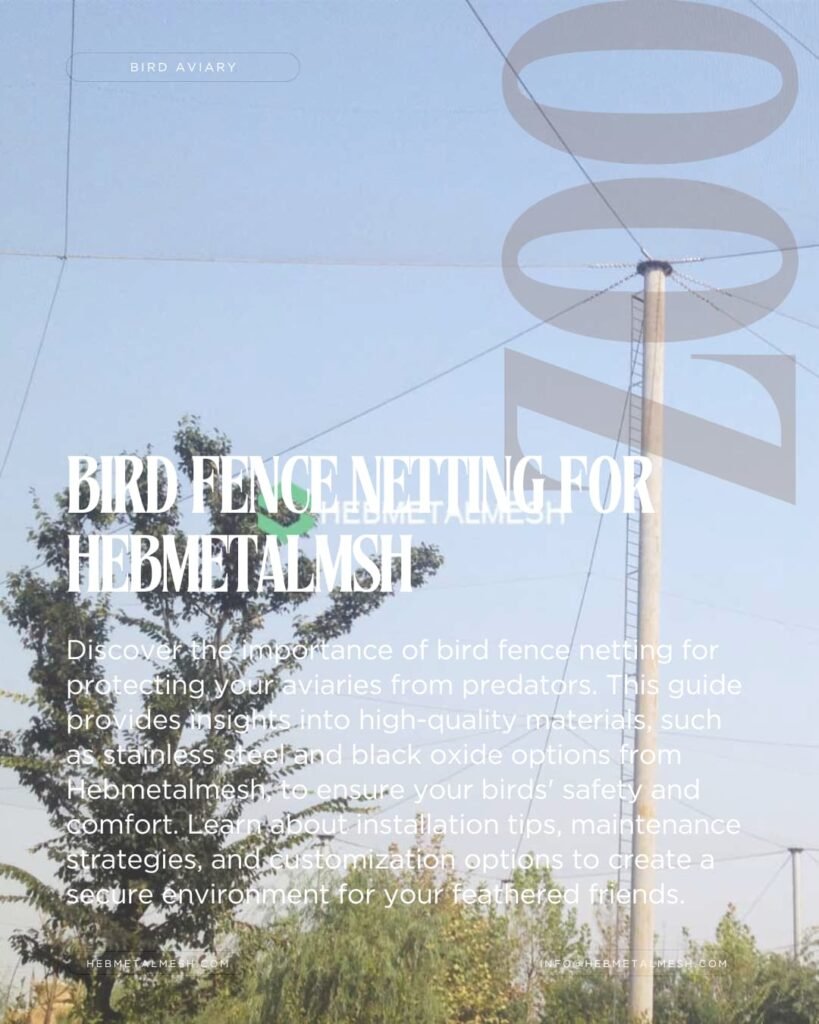
VII. Case Study: The Modern “Walk-In” Aviary Trend
In recent years, zoos have moved away from “viewing through a window” to “walking through the habitat.” This transition has placed new demands on aviary mesh fencing.
The Challenge
Walk-in aviaries require a mesh that is:
- High-Security: To prevent birds from escaping when doors open.
- Ultra-Transparent: So visitors feel they are in nature.
- Soft-Touch: To prevent injury if a guest or bird accidentally makes contact.
The Hebmetalmesh Approach
We recently provided 22,000 square feet of Black Oxide mesh for a tropical walk-in exhibit. By using custom-sized panels, the installation team was able to drape the mesh over a series of arching steel ribs. The result was a seamless “canopy” that was virtually invisible against the tropical trees. The use of 1.2mm wire ensured that even smaller songbirds stayed within the exhibit while providing visitors with crystal-clear photography opportunities.
VIII. Installation Best Practices: A Technical Guide
Installing aviary mesh fencing is straightforward if you have the right plan, but it requires attention to tension and framing.
1. Hardware Requirements
To secure the mesh, you will typically use:
- Stainless Steel Ferrules/Sleeves: Used to loop the edge of the mesh around a border cable.
- Border Cables: Usually a thicker stainless steel cable (5mm – 8mm) that provides a rigid frame for the flexible mesh.
- Turnbuckles and Eye-Bolts: To pull the border cables taut before the mesh is attached.
2. The Installation Process
- Frame Preparation: Ensure your support posts are anchored deeply. The tension of the mesh can exert significant “pull” on the structure.
- Border Cable Installation: Run your thicker border cable through eye-bolts around the perimeter.
- Mesh Hanging: Attach the mesh to the top border cable using ties or ferrules.
- Tensioning: Slowly pull the mesh to the sides and bottom. The diamond-shaped openings will open up as you pull.
- Final Securing: Once the desired tension is achieved, use ferrules to permanently lock the mesh to the border cables.
3. Professional Tips for Longevity
- Always use a border wire: This prevents the mesh from fraying at the edges and ensures the load is distributed evenly across the entire panel.
- Avoid over-tensioning: While the mesh needs to be tight to look good, over-tensioning can put unnecessary stress on your support posts, potentially causing them to lean over time.
- Plan for “The Stretch”: Handwoven mesh has a natural “give” due to the angle of the diamonds. Always calculate your measurements based on the mesh being fully extended at a 60-degree or 90-degree angle.
IX. Why Choose Hebmetalmesh? (The Factory Advantage)
With so many suppliers on the market, why do industry professionals trust the Hebmetalmesh brand?
- Direct-to-Consumer Pricing: We are the manufacturer. When you order from us, you bypass the middlemen, distributors, and retailers. This typically results in a 30-50% cost saving for the same grade of material.
- Expert Consultation: We don’t just sell mesh; we help you design. Our engineers can advise on the correct wire diameter and aperture for your specific species and climate.
- Global Logistics: We have optimized our packaging to ensure that even 30′ x 60′ panels can be rolled tightly and shipped economically to any location in the world.
- Customization as Standard: We don’t believe in “one size fits all.” Every enclosure is unique, and our production process reflects that. We treat a 100-square-foot order with the same precision as a 10,000-square-foot order.
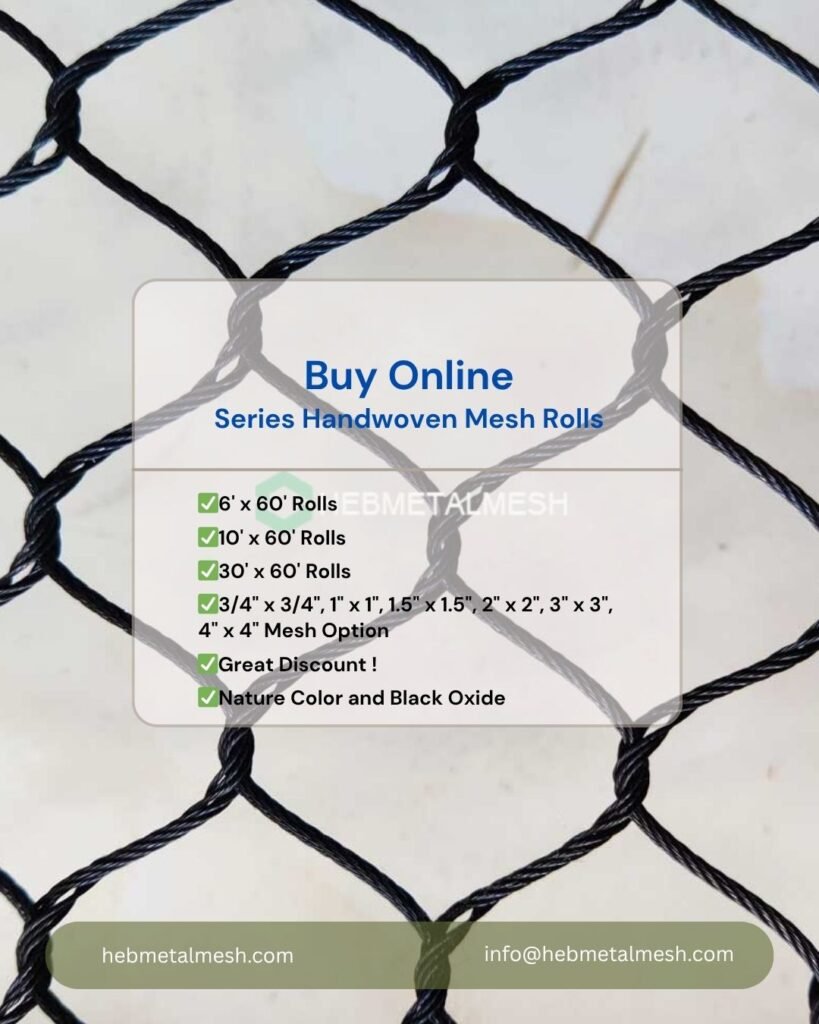
X. Species-Specific Mesh Recommendations
To help you choose the right product, here is a quick reference guide based on common aviary inhabitants:
Raptors (Eagles, Owls, Hawks)
- Mesh Type: 2.0mm to 3.2mm wire.
- Aperture: 2″ x 2″ (50mm).
- Reasoning: High impact resistance and extreme durability.
Parrots and Macaws
- Mesh Type: 1.6mm to 2.4mm wire.
- Aperture: 1″ x 1″ or 1.5″ x 1.5″.
- Reasoning: Resistant to the “wire-cutting” power of parrot beaks.
Finches and Softbills
- Mesh Type: 1.0mm to 1.2mm wire.
- Aperture: 0.5″ x 0.5″ or 0.75″ x 0.75″.
- Reasoning: Prevents escape and keeps out small predators like snakes or rodents.
Waterfowl and Flamingos
- Mesh Type: 1.5mm to 2.0mm wire.
- Aperture: 2″ x 2″.
- Reasoning: Excellent for large-span roof covers in lagoon-style exhibits.
XI. Purchasing Guide: Ordering from the Hebmetalmesh Store
Ready to start your project? Ordering customized aviary mesh has never been easier. We have streamlined our online store to cater to both professional contractors and private hobbyists.
- Measure Your Framing: Determine the length and width of the panels you need. If you have a complex shape, sketch it out—we can often weave irregular shapes to minimize on-site cutting.
- Select Your Grade: Choose AISI 304 for general inland use or AISI 316 for coastal areas.
- Choose Your Finish: We recommend Black Oxide for 90% of outdoor aviary projects due to its superior invisibility.
- Check the “Store” Page: You can browse our standard sizes for quick shipping or use our contact form for a custom quote on large panels. Visit the Hebmetalmesh Store to start your journey.
Quick FAQ
Stainless steel wire rope mesh (handwoven) is widely considered the best due to its strength, non-toxic (zinc-free) properties, and 30-year lifespan. It outperforms galvanized and plastic alternatives in every category.
The aperture should be small enough to prevent the bird’s head from passing through. For small birds, 0.75″ is standard; for parrots, 1″ to 1.5″ is common; for large raptors, 2″ is preferred.
Yes, for viewing purposes. Black Oxide mesh absorbs light and reduces glare, making the fence almost “invisible” to visitors, whereas natural stainless steel reflects light and is more visible.
Yes, Hebmetalmesh specializes in customized roll sizes with no additional cost, with panels as large as 30′ x 60′.
No. Unlike galvanized wire which contains zinc, stainless steel is non-toxic and safe for birds to climb and chew on.
For more information on technical specifications, to request a sample, or to get a quote for a large-scale project, visit our homepage at https://hebmetalmesh.com. You can also order directly from our online store for fast, factory-direct shipping.