
Executive Summary
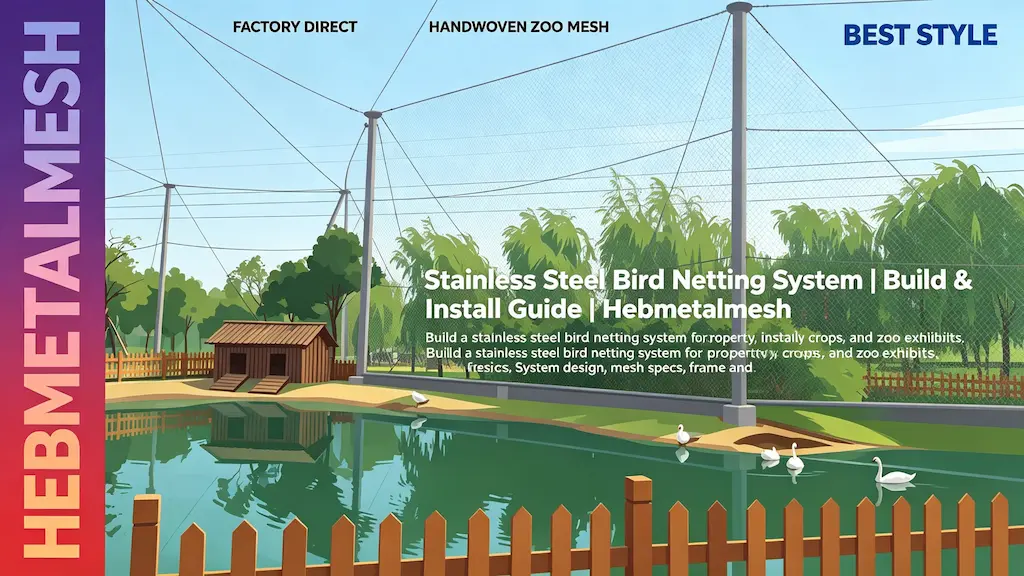
A stainless steel bird netting system is a tensioned barrier built from stainless steel rope mesh, a border cable, and a supporting frame, designed for bird exclusion on property, crops, and zoo exhibits. Unlike nylon or polyethylene netting, it uses 304 stainless steel cable that resists weather, chews and UV damage for 20–30+ years. This guide explains how to build a bird netting system correctly: how to size the mesh aperture and rope diameter for the target species, how the tension system works, how to attach the mesh to the bird netting system frame, and how to install, tension and maintain the finished barrier. The reference specification is the aviary netting product page.
Building a Bird Netting System? Get a Free Quote
Send us your protected area, the target bird species, and the climate. We return a mesh grade, aperture, and cable diameter recommendation within 24 hours.
Request My Free Quote →Quick Answer: How Do You Build a Bird Netting System?
A bird netting system has four parts: the stainless steel rope mesh panel, a border cable around every edge, a supporting frame, and a tensioning method. Sizing comes first — match the mesh aperture to the smallest bird you must exclude (20–51 mm for most songbirds, up to 102 mm where only large birds matter) and the rope diameter to the threat (1.2–2.0 mm for passive exclusion, 2.0–3.2 mm where predators or impact are expected). Then build the frame, hang the mesh with a border cable, tension it so the panel has no slack pocket, and secure every seam. Done correctly, the system outlasts the building it protects.
Key Takeaways
- Stainless steel rope mesh outlasts nylon and polyethylene netting by decades and cannot be chewed through.
- Size the mesh aperture to the smallest excluded bird: 20–51 mm for songbirds, 51–102 mm for larger species.
- The border cable, not the mesh face, carries the load — every edge must terminate on one.
- Tension is a system: top edge first, then sides, then re-tension after 30 days as the cable settles.
Aviary and enclosure guidance in this article follows husbandry standards published by the Smithsonian’s National Zoo.
Why Stainless Steel Rope Mesh Wins as a Bird Netting System
The single biggest decision in any bird netting system for property is the material. Nylon and polyethylene nets are cheap, but they sag, degrade under sunlight, and tear where a raccoon or a rat decides to test them. Stainless steel rope mesh removes those failure modes entirely:
- Weather resistance. SS304 forms a passive oxide layer that shrugs off rain, frost and sun. A correctly specified panel serves 20–30+ years outdoors.
- Bird exclusion you can trust. The rigid cable grid cannot be stretched open at a seam or pushed aside at a corner.
- Predator protection. A raccoon or cat that can tear a polymer net simply cannot cut 304 stainless cable.
- Invisible appearance. Thin ropes read as almost nothing from a distance, so the system protects without ruining the view.
This is why zoos, orchards, warehouses and residential properties all standardize on stainless steel rope mesh bird netting when the installation is meant to last. The trade-off is upfront cost — stainless costs more per square meter than polymer netting. Priced over a 25-year service life, however, the stainless system is usually the cheaper option, because the polymer net has been replaced two or three times in that window and has never once stopped a determined predator.
The Four Parts of a Bird Netting System
1. The Mesh Panel
The mesh is the barrier. It is built from stainless steel rope mesh — strands of wire rope crossed and joined by stainless ferrules, or hand-woven for fully flexible panels. Panel size is not a constraint: sheets are produced up to 9 m × 18 m, so most installations are covered in a few large pieces rather than many small patches.
2. The Border Cable
Every edge of every panel terminates on a border cable — a heavier rope that carries the tension load from the mesh face into the frame. Without it, load concentrates on individual strands and the panel tears at the first hard pull. The border cable is the difference between a net and a bird netting system.
3. The Frame
The bird netting system frame is the structure the mesh hangs on: steel or aluminum posts and rails sized to the panel load. The mesh is the barrier; the frame is the skeleton. For large spans, intermediate purlins shorten the unsupported distance and keep the panel drum-tight.
4. The Tension System
A slack panel is a climb route and a wind sail. The tension system — turnbuckles at corners, tensioning clamps along the border cable — keeps the mesh taut year-round. Rope mesh stretches 2–4% on first load, so plan a re-tension pass about 30 days after installation.
Bird Netting System Design: Sizing the Mesh
Correct bird netting system design starts with two numbers: the mesh aperture and the rope diameter. The aperture must be smaller than the narrowest body part of the smallest bird you need to exclude.
| Target Birds | Mesh Aperture | Rope Diameter | Example Code |
| Finches, small songbirds | 20–25 mm | 1.2–1.6 mm | HM1220, HM1625 |
| Parrots, pigeons, crows | 25–38 mm | 1.6–2.0 mm | HM1638, HM2038 |
| Large birds, poultry, raptors | 51–76 mm | 2.0–2.4 mm | HM2076, HM2476 |
| Very large birds, impact zones | 102 mm | 2.4–3.2 mm | HM24102, HM32102 |
A finer aperture uses more stainless per square meter and costs more, so do not overspecify. Measure the smallest bird on site, add a safety margin, and stop there.
Bird Netting System Installation: Step by Step
A reliable bird netting system installation follows five steps:
- Build and brace the frame. Posts at 3–6 m centers, top rail sized to the span, corner gussets where wind loads are high.
- Attach the top edge. Fix the border cable to the top rail with stainless clamps every 100–150 mm, pulling the mesh level as you go.
- Tension the panel. Work from the top down, pulling each bay taut before clamping the sides, so no bay shows a slack pocket.
- Seal the seams. Overlap adjacent panels by at least 100 mm and clip them together with stainless ferrules or clips — a gap wider than the aperture is an escape route.
- Terminate the bottom. Bury the bottom border cable or anchor it to a base rail so birds cannot dive under and predators cannot push in.
Use 304 or 316 stainless hardware throughout. Plated steel staples will corrode within a season and restart every problem you just solved.
Applications: Property, Crops, and Zoo Exhibits
Residential. A stainless steel bird netting for balconies and terraces stops pigeons and sparrows roosting on ledges while staying visually quiet. Bird netting system for buildings covers courtyards, atriums and loading docks without blocking light.
Agricultural. An agricultural bird netting system over orchards and vineyards keeps flocks off the crop. The mesh sheds snow and ice better than polymer nets and lasts through many harvests, so the per-season cost falls sharply.
Commercial. A commercial bird netting system protects warehouses, factories and retail canopies from droppings, nesting and the health hazards that follow. The stainless grid holds up to the cleaning regime that polymer nets cannot survive.
Zoos. A bird netting system for zoo exhibits doubles as the enclosure barrier, combining bird exclusion with keeper and visitor safety. Species-specific specs live on the eagle enclosure netting, crane aviary mesh and garden netting pages; the shared base material is the bird netting mesh range this guide is built on.
Bird Netting System Maintenance
A bird netting system maintenance routine is short: inspect twice a year, walk the perimeter for loose clamps and damaged ferrules, check the turnbuckles, and brush off heavy snow before it cycles freeze-thaw. Storms are the best time to watch the system — a panel that drums in high wind needs one more clamp, not a new net. Because the mesh does not rust, sag or degrade, there is nothing to paint, replace or retighten beyond the hardware. That is the maintenance story of stainless steel rope mesh — nearly none, for decades.
FAQ
A stainless steel bird netting system is a tensioned barrier of stainless steel rope mesh (1.2–3.2 mm cable, 20–102 mm apertures), a border cable on every edge, a supporting frame, and turnbuckle tensioning.
20–30+ years outdoors with minimal maintenance, versus 3–8 years for nylon or polyethylene netting.
Match the aperture to the smallest excluded bird: 20–25 mm for finches, 25–38 mm for parrots and pigeons, 51 mm and up for large birds where mass is the design driver.
Yes — the mesh and border cable clamp onto existing posts and rails, which is the cheapest way to retrofit a patio, warehouse bay or orchard row.
Barely. The thin ropes read as near-invisible from a few meters, which is why it is used where appearance matters.
Rope mesh stretches 2–4% on first load; factory pre-stretching and a re-tension pass after 30 days remove nearly all of it.
No. A raccoon or cat can tear polymer netting but cannot cut 304 stainless steel cable, which is the core predator protection advantage of this system.
Yes — as a custom bird netting system supplier we cut panels up to 9 m × 18 m to your drawing, finish edges on border cables, and ship install-ready hardware.
When the goal is a barrier that excludes birds for decades rather than a season, the stainless steel bird netting system is the engineering answer. Contact us with your area, species and climate, and we will size the mesh and quote the complete system.