
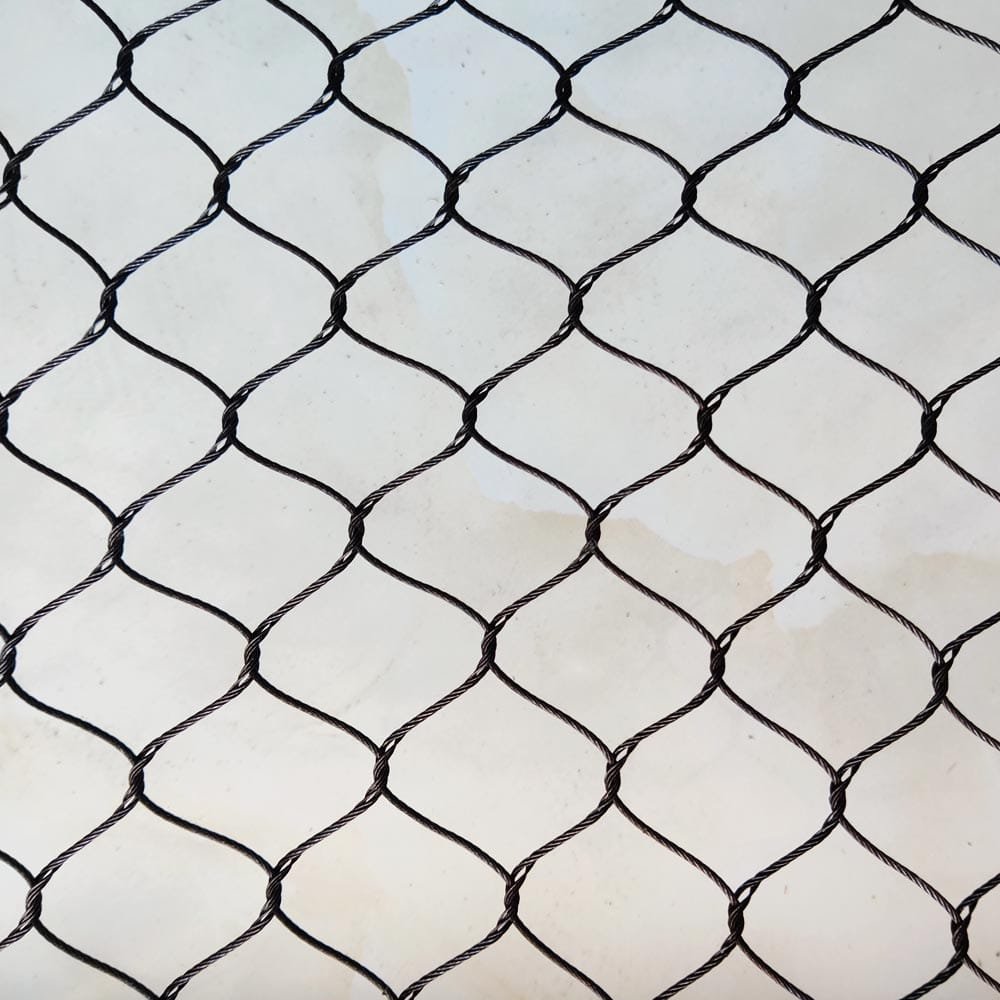
Most aviary mesh is chosen to stop a bird leaving. A cassowary enclosure has to survive the bird trying to go through it, at speed, with a claw that evolved to open a rainforest floor.
That difference is not a matter of buying a thicker roll. A parrot tests mesh with its beak at a single point and works patiently. A cassowary delivers a forward and downward kick with two toes, and the impact arrives concentrated on one claw rather than spread across the panel. Mesh that holds a macaw can fail that test in a season.
Cassowaries also carry a casque, a keratin structure that meets the world first when the bird runs. Keepers work with them behind barriers for good reason, and the barrier has to be designed for a bird that weighs close to what a person does.
This article covers what that means in practice: how the kick loads a panel, why aperture and gauge decisions differ from a normal aviary, where the casque changes the detail, and what to put in a specification.
Executive Summary
Cassowary enclosure mesh has to absorb a concentrated, repeated impact rather than a steady push. Flexible rope mesh handles that load because it deflects and returns, while a rigid welded panel work-hardens at the welds and eventually cracks.
Three decisions carry most of the risk: gauge and post spacing to take the kick, aperture sized for a chick rather than an adult, and a gate arrangement that protects keepers at the moment they enter.
Height, ground detail and sightlines finish the job. A cassowary can jump, push and run a fence line, so a yard designed only for the kick leaves three other routes unplanned. Budget attention in that order, because the first decision sets the price of the other two.
Send the Yard Layout, Not a Guess at the Gauge
Share the yard dimensions, the number of birds and the substrate. We will propose a panel build and post spacing for cassowary enclosure mesh, confirm the aperture against your smallest bird, and price the gates and corner returns as part of the same schedule.
Request a Cassowary Panel ProposalQuick Answer
Specify a flexible stainless rope mesh on a frame built for impact, not a welded panel sized for static load. Set aperture for the smallest bird that will ever be in the yard, plan for the casque hitting the mesh at running speed, and use a double gate so a keeper never opens a door into an occupied yard.
Key Takeaways
- The kick is a concentrated impact, not a distributed push.
- Flexible rope mesh deflects and recovers; welded panels crack at the welds.
- Aperture follows the chick, not the adult bird.
- The casque meets mesh at running height, so the detail matters.
- A double gate protects the keeper, not the bird.
- Ground detail and sightlines decide whether the yard works.
Why a Cassowary Changes the Mesh Brief
Three things separate this bird from anything else behind aviary bird netting. It cannot fly, so it invests everything in its legs. It runs through dense vegetation, so it leads with its head. And it is territorial enough that keepers treat every entry as a two-person job.
That combination puts load on a fence in a way that bird mesh normally never sees. A flighted bird hits mesh at low speed and low mass. A cassowary arrives with body mass behind a two-toed kick, and it repeats the attempt when the first one does not work.
The welfare side runs in parallel. A bird that damages its casque or catches a toe on a panel is a veterinary problem, and a mesh chosen purely for strength can create both.
What the Kick Does to a Panel
The claw does the damage. A cassowary’s inner toe carries a long, sharp claw, and a kick drives it forward and down. On a rigid welded panel that concentrates stress at a weld, which is the weakest point in the assembly.
The second issue is repetition. A single impact might only dent a panel. Two hundred impacts along the same fence line work-hardens the steel, and a crack follows. That failure mode is why energy-absorbing rope mesh suits a cassowary yard better than a welded grid.
The third is rebound. Flexible mesh moves with the impact and returns, so the bird’s own momentum is partly spent on the panel’s deflection. A rigid panel returns nothing and takes everything.
| Threat | What it does to mesh | Design response |
|---|---|---|
| Forward kick with the inner claw | Concentrated point load, broken wires at a weld or node | Flexible rope mesh, heavier gauge, closer post spacing |
| Two-footed rake down the panel | Abrasion along a horizontal band at kick height | Sacrificial lower band or a heavier bottom section |
| Body weight driven into the mesh | Panel deflection, post lean, tension loss | Braced posts, tensioned edge cable, deeper footings |
| Casque at running speed | Impact at head height, abrasion on the casque | Mesh that gives, plus a visual barrier where the bird charges |
| Chick squeezing through | Escape at the aperture, not the panel | Aperture set for the chick, not the adult |
| Digging and pushing at ground level | Gap opening under the bottom edge | Buried apron or a hard ground line |
Gauge, Aperture and the Casque Problem
Gauge follows the load path, and the load path runs from claw to post. A heavy gauge on light posts simply moves the failure into the frame, so the two decisions belong together. On a cassowary yard the posts carry more of the design attention than the mesh does.
Aperture is where most yards get it wrong, because the brief is usually written for the adults in the collection. Chicks are small, and a pair that breeds will produce a chick that fits through a mesh sized for its parents. Set the aperture for the smallest bird that will ever stand behind it.
The casque needs a different kind of thinking. It is a living structure with a keratin surface, and a bird that charges a fence can abrade or split it. Injury risk on a netting panel covers the details that decide whether a barrier damages an animal, and a cassowary yard should be specified against that standard rather than against a strength target alone.
Toes matter too. A claw that catches in an aperture during a kick produces a panicked bird and a serious injury, which is another reason the aperture should be small enough to refuse a toe but large enough to release one.
Captive yards carry conservation weight as well, because the species faces habitat loss and vehicle strikes across its range, which BirdLife International documents in its species accounts.
Height, Jumping and the Top of the Yard
A cassowary cannot fly, and that fact has produced more under-built yards than any other. The bird can jump, it can run at speed into a fence, and it can use a bank or a fallen trunk as a launch point.
Height should be set for the terrain rather than for the species list. A yard with a slope, a mound or a raised feeding platform needs more height on that side. A flat yard with nothing to climb needs less, but it still needs a top detail that turns a bird back rather than letting it find the seam.
The top of the panel is also where the tension lives. A mesh run that is tied off loosely at the top sags, and a sagging top edge is a gap. Tensioned edge cable along the top and bottom keeps the panel where the drawing put it.
Gates, Lobbies and Keeper Safety
Every cassowary incident that reaches a serious outcome involves a person and an open door. The mesh is the easy part of that equation; the gate arrangement is the part that actually protects staff.
A double gate, or a lobby with two leaves and a mesh return between them, means a keeper never opens a door directly into an occupied yard. The lobby costs a square meter of space and removes the single most common failure in dangerous-animal housing.
Three details finish it. The gate must swing away from the keeper’s escape route, not across it. The latch must work with one hand while the other holds a shield or a rake. And the gate frame must be built to the same impact standard as the aviary mesh fence, because a gate is where a bird concentrates its attention.
Ground, Planting and Sightlines
The floor of a cassowary yard takes more load than most specifications expect. These birds pace, run and turn at speed, and a soft substrate turns into a rutted channel along the fence line within a season. A hard margin at the base of the mesh keeps the bottom edge stable and makes inspection possible.
Planting serves two purposes. It gives the bird cover and something to work through, which reduces fence pressure, and it gives keepers and visitors a sightline break. A yard with a clear view from every angle keeps the bird charging the same stretch of mesh.
The visual barrier matters most during introductions and pair formation. Mesh alone lets two birds see each other constantly, and constant visual contact between incompatible animals is a welfare problem with a predictable outcome.
Inspection and the Early Signs
A cassowary yard should be walked weekly, and the walk should follow the same route every time. Look for the same four things: broken wires at kick height, a polished band where the claw has raked the panel, slack in the edge cable, and any gap at the ground line.
The early signs are easy to miss because they look cosmetic. A shiny patch on the mesh is abrasion, and abrasion is the first stage of a broken wire. A slight bow in a post is a footing problem that will get worse.
Where a panel has taken damage, what a tensile test proves about the original build is the baseline for judging whether a repair restores it. Replacing a section with a lighter panel because it was in stock is how a good yard becomes a weak one.
Specifying the Panel
The specification should read like a load document, not a shopping list. Anyone quoting cassowary enclosure mesh needs the yard geometry and the bird count before a gauge means anything.
- State the number of birds and whether breeding is planned.
- Give the smallest bird that will occupy the yard, chick included.
- Mark the terrain features a bird could launch from.
- Set post spacing and footing depth as one decision.
- Specify the ground line: buried apron or hard margin.
- Draw the gate lobby and the direction of every swing.
- Require the panel tensioned at top and bottom, not tied off.
A yard built this way also solves the supply question, because panels arrive to a schedule rather than as a generic roll cut on site. Choosing between rolls and finished panels matters more on a cassowary yard than on a small aviary, because every field cut is a new edge that has to be terminated to the same standard as the factory edge.
FAQ
Strong enough to take a repeated concentrated impact, which is a different target from a static load rating. The practical answer is flexible rope mesh on braced posts with short spans, rather than a heavier rigid panel on the same frame.
It cannot fly, but it can jump and it can launch from a slope, a mound or a fallen trunk. Height should follow the terrain on each side of the yard, and the top edge needs a detail that turns the bird back rather than a flat tie-off.
One sized for the chick rather than the adult, because a breeding pair will produce a bird small enough to walk through a mesh set for its parents. Check the aperture against the smallest bird the yard will ever hold, not the largest.
For a while, and then it will crack. The kick concentrates stress at a weld, and repeated impacts work-harden the steel until a wire fails. A flexible rope mesh absorbs the same impact by moving with it.
Yes, wherever keepers enter an occupied yard. A lobby with two leaves means a door never opens directly into the bird’s space, and that arrangement removes the most common cause of serious incidents in dangerous-animal housing.
Build the Yard Around the Bird
Send the layout, the bird count and the terrain notes. We will return a panel build, a post spacing recommendation and a gate schedule for cassowary enclosure mesh, so the specification closes before the first footing is dug.
Send My Yard Layout