

A bird found hanging in a net was not careless. It put its head through an opening that was wide enough for the head and too narrow for the shoulders, and then something closed. Every step of that sequence is settled before the first post goes into the ground: the opening measured against the bird, whether the mesh can deform once a bird is inside it, and how thick the strand is that the bird is pushing against. Bird entanglement is a property of the product, which is why it can be designed out and why it cannot be trained out of the bird.
Executive Summary
Entanglement runs in three stages and each has its own control. The aperture decides whether contact happens at all, and the dangerous range is the band a head enters but a body cannot. Whether contact becomes restraint depends on movement: a knitted net deforms and tightens around what it has caught, a tensioned panel does not. Whether restraint becomes injury depends on the strand, because thin twine under a wide aperture was the combination that entangled birds in a controlled trial while thick twine on the same openings did not. Reading the three separately is the whole method. The reference specification is the aviary bird netting product page.
Quick Answer:
Does a wider aperture catch more birds? Not on its own, and that is the counter-intuitive part. A wide opening held by a thick, locked, tensioned strand is how a large bird is excluded safely: the head enters, the shoulders are refused, and nothing in the mesh can tighten. A wide opening on thin, slack twine is how birds die. The number matters less than what the mesh is able to do after the bird has committed to it.
Key Takeaways
- Entanglement has three controls, not one: aperture, movement, and twine diameter.
- Risk sits in a band set by the bird, not by the mesh: a head fits and the shoulders do not.
- A mesh that cannot deform cannot close on a bird, whatever the aperture size.
- Thin twine turns a refused head into a cut neck; thick twine gives the bird an edge to push back from.
- Aperture follows the smallest bird the barrier must stop and the largest bird it must hold.
Name the species, and we will size the aperture

Contact Is Decided by the Aperture
Put any square opening against any bird and only three outcomes exist. Narrower than the head, and the bird inserts nothing; the mesh is a wall. Wider than the body, and the bird moves through; the mesh excludes nothing. Between them is the band a head enters but a body cannot, the only geometry in which a bird can be caught, and it is defined by the width of the head and the width of the body rather than by anything printed on the invoice.
That band also answers why birds fly into netting. A bird is not testing the product; it is going where the geometry allows, so the type of contact tracks the opening. This is why an aperture measured at full stretch is the only figure worth quoting: a mesh that reads 20 mm on a slack net is a different hole once it is pulled flat at the frame, and a design written in one number and installed at another is how a sound rule becomes a trap.
There is no single safe aperture, only a safe aperture for a bird. A small passerine has a head about half the width of its shoulders, so the band is narrow and sits low; a duck or a heron carries a heavy head and a deep chest, and the band sits high and wide. The head and the shoulders are the only two dimensions that need to be measured.
Restraint Is Decided by Movement in the Mesh
Contact is not the same as restraint, and the difference is movement. A knitted net is a set of slip knots: pull one opening and the neighboring openings close, so a bird that pushes through a mesh distorts the geometry around its own neck. That is the mechanism people describe as birds get caught in netting, and it needs no assistance from the bird beyond a single attempt to reach the other side.
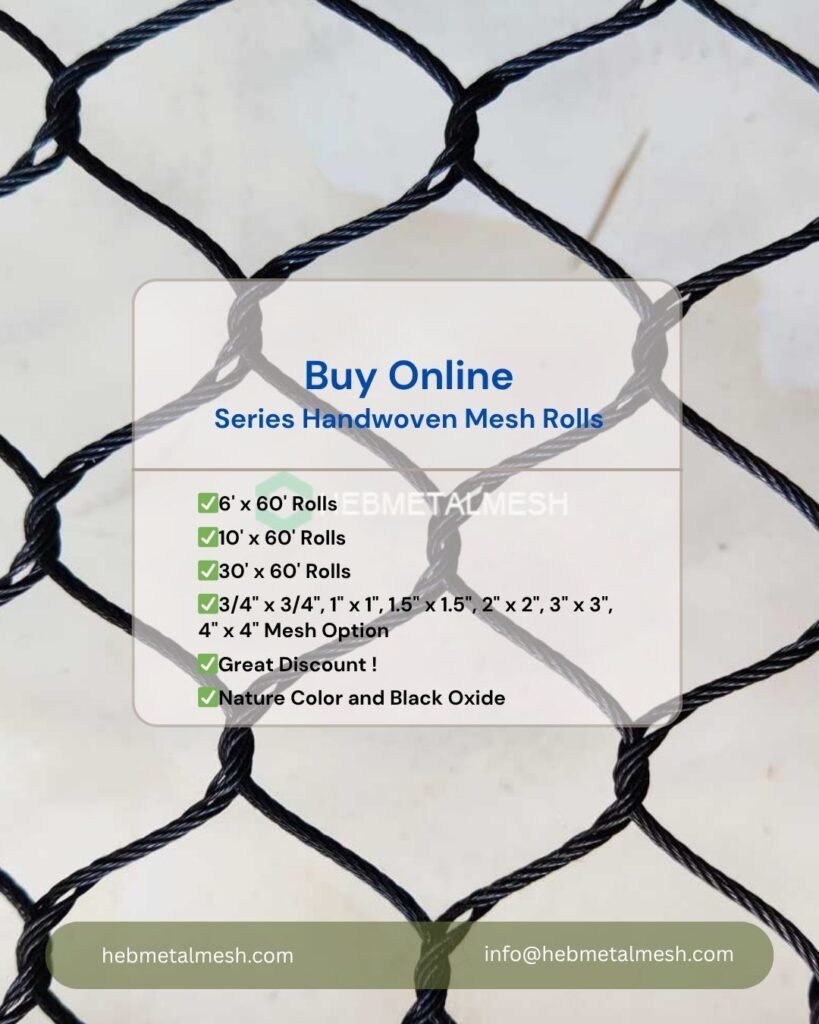
A handwoven stainless steel rope mesh solves a different problem. Each intersection is a node that cannot slip, so tension applied at one opening stays at that opening. Nothing closes behind the head. The wire rope either holds its shape or it does not, and the bird can always withdraw along the path it entered. What a buyer should be asking for, precisely, is mesh that will not close on a bird once the head is inside it.
That is also why tension is not a cosmetic detail of installation. A slack panel of any material forms pockets, and a pocket is a shaped restraint; a taut panel behaves like a plate with holes in it. Tension is what keeps a mesh stiff enough to refuse rather than gather, and it is set by the frame and the fixings long before it is set by the mesh. It is also the property that separates a locked rope panel from a heavy synthetic net that creeps under load. A 9 m by 18 m panel of 76 mm by 3.2 mm mesh weighs about 260 kg, so this is a dimensioned job rather than a drape.
Injury Is Decided by the Twine
The third control is the strand, and it has the clearest evidence behind it. In a controlled trial with captive common eiders, Varennes and co-authors tested eight nets varying in mesh size from 3 to 12.5 inches, in twine diameter, and in material, and they were direct about the result: Nets with thin twine and large mesh size were more likely to cause bird entanglement. Their recommendation was the opposite of a bargain net, a maximum mesh of about 6 inches with a larger twine.
The same trial explains the difference in contact. At 3 inch mesh the birds were probably unable to get a head through at all, so they pushed and bit instead; at 5 to 6 inches they tried the head and pushed with the whole body; at 8 inches they went through. “The total number of interactions was not different between mesh sizes,” the authors write, “however, the type of interactions varied with the mesh size.” Push and bite damage is therefore a real load case, and it lands on the strand rather than on the frame.
Six inches is wider than anything we stock, and that is not a disagreement. It was the largest mesh that held a duck weighing 1.5 to 2.3 kg, and the same paper records growers running 4 inch nets against eiders in Scotland and Sweden, which is the top of our range.
Strand diameter does two things at once here. It blunts the edge the bird is working against, which matters because a thin monofilament under load cuts rather than restrains. And it holds the aperture square under that load, so the opening the bird entered is the opening it can leave by. Across a stainless range of 1.2 to 3.2 mm the strand is 2.4 to 6.4 times the diameter of the half-millimeter monofilament that most cheap bird netting is knitted from.
What a Bird Does When It Reaches the Mesh
What a bird does on contact is predictable enough to specify against, and it is not avoidance. In the same trial the birds “showed no or little fear of approaching the experimental nets, and all interacted with our set-up”, which is the sentence to remember when a supplier claims a mesh is deterrent by appearance alone. A barrier is not respected; it is negotiated.
The negotiation happens at the aperture edge. A bird arrives, checks the opening with its head, and either withdraws or commits. If it commits and the shoulders follow, the bird is through and the barrier has failed. If it commits and the shoulders are refused, the bird is now inside the band, and from that moment the outcome belongs to the material. There is no third behavior to appeal to, and no amount of warning color changes the mechanics, which is why entanglement is a property of the mesh and not a problem of bird behavior.
This is also where the choice of face starts to matter. A bird that drops onto a roof arrives faster than one that walks up to a wall, so the roof is the face that wants the finer aperture size and the wall is the face that wants the heavier strand, which is why the roofs of large flight aviaries are usually specified a grade or two away from the walls.
Matching the Aperture to the Bird
The sequence for a specification is short. List the birds the barrier must hold inside, take the smallest head width in that list, and set the aperture below it; then check the largest bird in the same list, because the opening still has to be an aperture the bird cannot grip with feet and beak. Where a single enclosure holds both a dove and a crane, the species table for aperture is decided by the dove and the wire by the crane.
| Aperture | Wire | Open area | Typical duty |
| 20 mm | 1.2 mm | 89.0% | small passerines, finches, softbills |
| 25 mm | 1.6 mm | 88.3% | mixed small birds, walk-in aviary |
| 51 mm | 2.4 mm | 91.2% | parrots, macaws, small mammals |
| 76 mm | 3.2 mm | 92.1% | large birds, walk-through exhibits |
| 102 mm | 3.2 mm | 94.0% | cranes, large waterfowl, structural spans |
The range bottoms out at 20 mm for a practical reason: a mesh fine enough to refuse the head of a finch would be insect screen, not structure. At that end of the range the panel is not relying on geometry to keep the head out, it is relying on a thick, rigid, locked strand to make the visit harmless, which is the argument running through this whole page. The top of the range is deliberately coarse. 102 mm is four inches and 76 mm is three, and the four-inch panel is the one that carries the heavy span without a mid-frame, which is why it is the standard for large flight enclosures. Both are aviary mesh from the same works, and the difference between them is not quality but geometry.
Grade is a separate decision from any of this. 304 covers most inland collections, and 316 is bought for corrosion resistance where salt air or wash-down chemicals are present. Tensile strength is then set by the load the panel has to carry, which on a four-inch span is the wind and the frame rather than the bird. Twine diameter is set by both, because the strand that carries the wind is also the edge the bird works against.
The Mesh Is Fixed at Its Edges
Half of the entanglement cases that reach a supplier are not mesh problems at all; they are edge problems. A panel that is fixed at the posts and left free between them scallops, and a scallop is a pocket with a mouth. The fix is a continuous line of fixings along every edge, and a frame spacing that comes from the panel rather than the other way round.
Corners carry roughly twice the load of an intermediate post because two faces arrive at one point, and a corner that gives way converts a taut surface into a slack one across the whole bay. Where a stock panel will not fit the frame, panels are woven to the opening instead of being cut from a roll and stretched to suit, because a stretched edge is a slack face. A handwoven mesh is made to the opening for exactly that reason: the edge is finished where the frame is, not where the roll ran out.
Send the frame drawing and we will check the aperture against it
FAQ
Below the head width, yes, because nothing can enter. Above the body width the mesh stops excluding, so the useful range for any species is narrow and sits between the two dimensions. Choosing outside that range is how a specification ends up either useless or dangerous.
Because the band is set by the bird. A 51 mm opening is generous for a macaw and a trap for a small conure, in the same building.
It reduces the two mechanisms that turn contact into injury: the strand cannot cut, and the aperture stays square under load so the bird can withdraw. The trial evidence points the same way, with thin twine on wide mesh doing the most damage.
No, and inspection is the wrong control. A correctly specified, tensioned panel has no pocket to find; a slack one has too many.
It is less forgiving than a soft net, which is why the roof of a flight enclosure carries the finer aperture and why the wire diameter matters more on the face a bird strikes than on the face it walks up to.