
Scale an aviary up and the material does not change. The wire is the same wire. What changes is how fast the bird is travelling when it reaches it.
A finch in a three-metre cage never gets out of second gear. Give the same animal seventy metres of clear air and it arrives at a speed it would not reach outdoors under any pressure that matters. That arrival, not the rope diameter, is the number a large enclosure is built around.
Executive Summary
Soft catch aviary mesh answers the physics of a big flight volume rather than the arithmetic of a small one, because what makes birds collide inside an avian enclosure is not their weight but their speed. Impact energy rises with the square of closing speed, and the conversion that makes it usable: any object arriving at 45 km/h carries the energy of a fall from 8 m, a figure independent of the bird’s mass, since the equivalent drop height is v²/2g. So the aperture must be fine enough that no head or wing passes through an opening and is then held, the panel must be carried on a support grid wide enough to let it travel, and every rigid object inside the volume — post, edge cable, door frame, perch — must be settled before the concrete is poured, because mesh cannot make a hard object soft. The reference specification is the aviary netting product page.
Planning a large aviary where the birds will be flying at speed? Send the flight volume, the species list with a working mass for each, and the rigid objects you cannot move — we will return aperture, rope diameter and support grid as one schedule.
Request an impact specificationQuick Answer:
A large aviary hurts birds with speed, not strength. The mesh rarely breaks; the bird does. Because bird impact energy goes as the square of closing speed, an enclosure big enough for a bird to reach 45 km/h is one in which every arrival carries the energy of an eight-metre fall, whatever that bird weighs. Three answers: an aperture fine enough that a wing or head cannot pass through and be caught, a panel carried on a support grid wide enough to move when struck, and a frame that keeps rigid objects out of the flight path.
Key Takeaways
- Bird impact energy scales with speed squared, so in a large enclosure the design input is velocity rather than weight.
- The aviary equivalent drop height is v²/2g: 15 km/h is about 0.9 m, 30 km/h about 3.5 m, 45 km/h about 8 m, 60 km/h about 14 m.
- The mesh is the softest surface in the enclosure; the injuries happen at the hard ones.
- Compliance absorbs an arrival, and compliance is bought from support spacing rather than from rope strength.
- Aperture is injury geometry, not strength: a wing or head that passes through an opening and is then held is the mechanism, and no rope diameter prevents it.
- Nothing softens a post after the pour, so rigid objects must leave the flight volume at drawing stage.
Standards for the accommodation and welfare of birds in managed collections, including the expectation that enclosure surfaces do not injure the occupant, are published by AZA, the Association of Zoos and Aquariums.
Speed Is the Variable That Scale Creates
A small aviary is bounded by its walls. A large one is bounded by geometry, because the bird spends most of its time with no wall in view.
Take a flight volume 60 m long, 30 m wide and 20 m high — an ordinary size for a walk-through collection. The longest straight line inside it is 70 m, longer than a football pitch is wide. What matters is aviary flight speed rather than cage size, because it sets every other quantity on this page. Its companion figure is aviary flight distance: the longest unobstructed run, measured corner to corner in three dimensions rather than along the floor.
That is the difference between large scale aviary netting and a domestic flight cage.
The Mesh Is the Softest Thing in the Enclosure
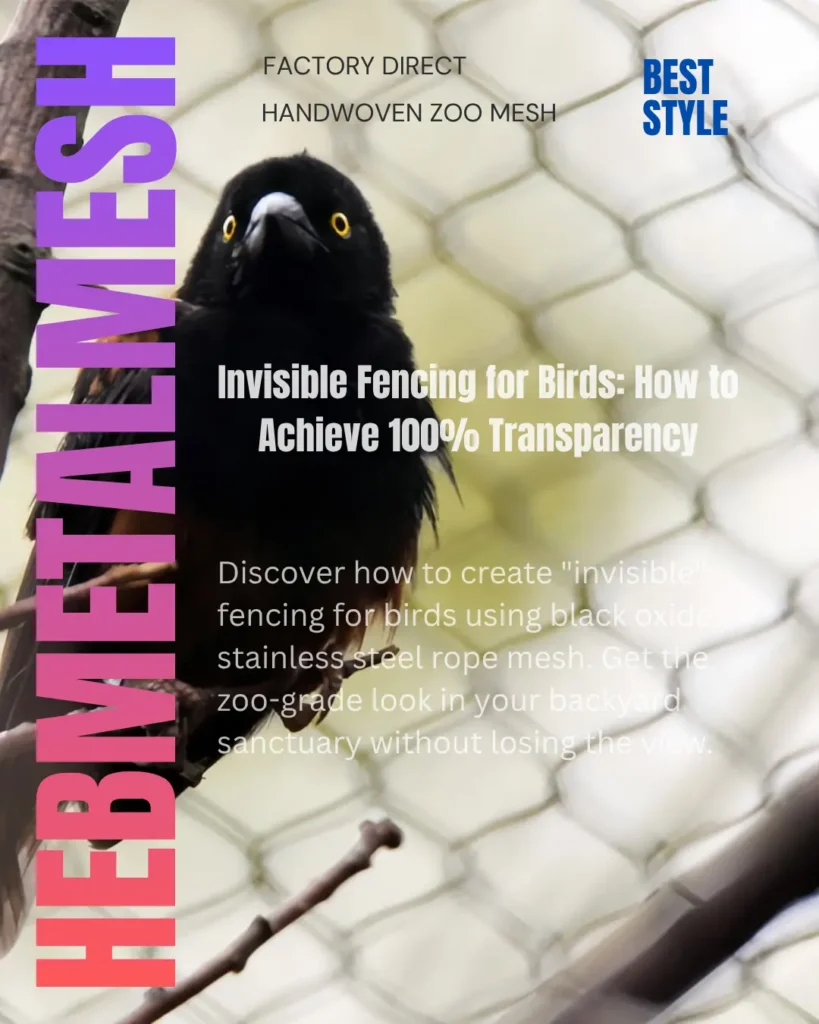
The instinct is to treat the netting as the hazard; it is the opposite. A stainless steel rope mesh panel is the only large surface in an avian enclosure designed to move, and the one a bird is least likely to be hurt by. A soft catch mesh is worth more here than a heavier one.
An aviary bird injury almost never begins at the mesh. It begins at whatever the mesh is stretched between. A bird reaching the panel decelerates over a metre or more of give; a bird reaching a post, an edge cable or a door frame stops in a few centimetres, and that difference is the injury.
| Rigid object inside the flight volume | What it does to a bird arriving at speed | What the specification can still change |
| Edge cable and perimeter fittings | A hard, small-diameter line is the classic wing-breaker: the wing folds across it and the body cannot follow | Carry the cable outside the panel, or sleeve it wherever it must run inside |
| Posts, mullions and the door frame | Immovable, and the only items in the volume that cannot give at all | Move them out of the flight path at drawing stage, cap or radius the tops, and use an aviary padded frame at the door |
| Perches, feeders and the ground | Intended as the aviary landing surface, and usually the hardest thing in the enclosure | Set the perch so the approach is clear and the bird can bleed speed before it arrives |
Cases in managed collections are dominated by these objects, which is why aviary bird injury prevention is largely an exercise in moving things.
Compliance Is Bought From the Support Grid
If arrival energy has to go somewhere, it goes into movement. That makes the panel’s freedom to travel the real impact variable, and travel is a property not of the wire but of how far apart the panel is held. Clamped to a tight frame every metre, the same mesh stops almost immediately and the whole shock lands at one cross point. On a wider grid it bows, recovers, and hands the load to the edge.
This is the same compliance question that governs netting deflection on any tensioned panel, and the reason an impact specification and a strength one can point in opposite directions. The support grid has to be settled first, because it decides whether the mesh behaves like a net or like a wall. The span side is worked through in our note on overhead netting, the material response in netting deflection.
Reading a Mesh Specification Against an Impact
Three numbers decide how soft an arrival feels.
Rope diameter sets how far the panel can extend and how stiff each cross point is; the range runs from 1.2 mm to 3.2 mm, and the thin end is the forgiving one. Aperture sets the geometry of the injury rather than the strength of the panel: 20 mm is the floor of the range and exists for small birds, 38 mm suits mid-sized species, and 51 mm or 76 mm is normal for larger birds. Weight sets what the panel does under load: 3.2 mm rope on a 76 mm aperture runs roughly 1.5 to 2.0 kg/m², so a full 9 m by 18 m panel is 240 to 325 kg, which is a delivery constraint as much as a structural one. Setting-out on unusual geometry is covered in our note on enclosure panel layout.
Two material details then matter on a catch surface. An interwoven mesh keeps every cross point free, so one broken wire in a 7×7 strand costs only a few per cent of the strand’s breaking load, where a fused grid releases the whole crossing at once. Open area — about 88 per cent at a 20 mm aperture, 94 per cent at 102 mm — keeps it light rather than a stiff screen. That is the difference between flexible cable netting and a rigid barrier, and why aviary impact absorbing netting and energy absorption netting are specified as three numbers rather than chosen one at a time.
Designing the Flight Path, Not Just the Boundary
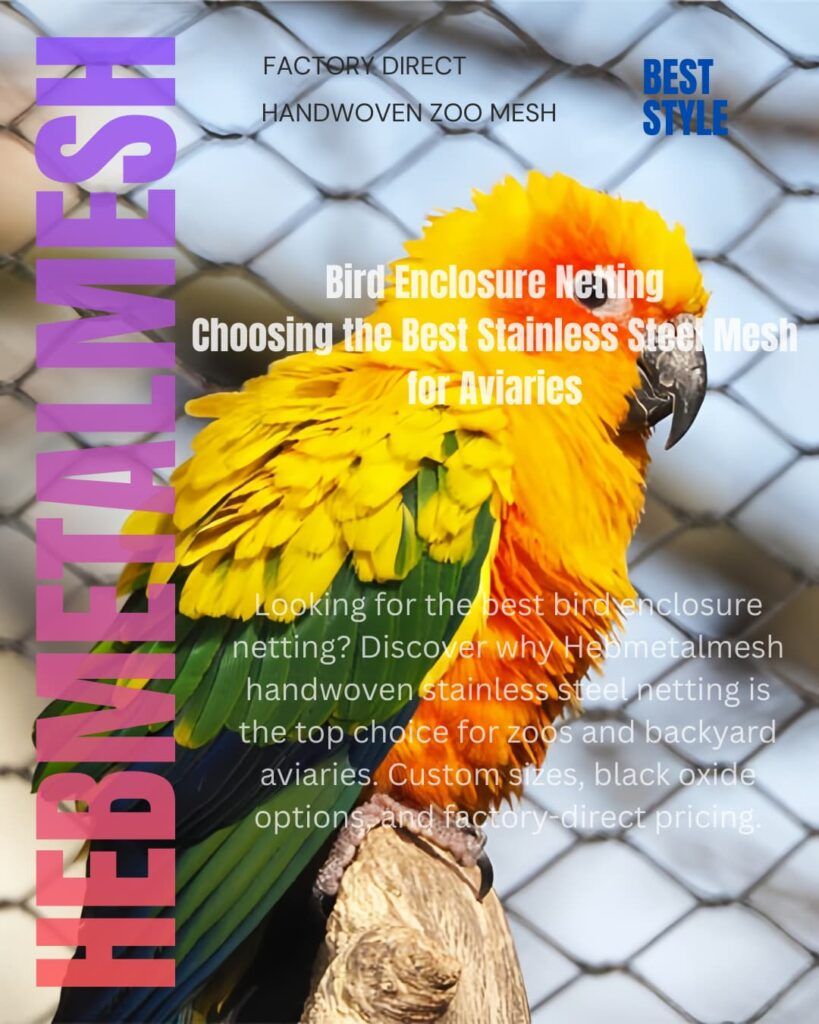
A large aviary is the only kind of enclosure where interior layout is an impact decision: here the bird uses the whole volume.
Keep the volume clear: any strut, brace or tie crossing the interior is an object a bird can meet, and the cheapest way to prevent a collision is to have nothing to collide with. Treat the approach as part of the design: a bird that must turn or climb before landing has already begun its aviary deceleration, while one with a straight run at full speed has not. And accept that the ground is hard and the perch usually is too, so a heavy bird dropping onto a rigid perch is a routine aviary hard perch injury waiting for a startled night.
Mesh cannot fix any of it. aviary bird collision risk is set at drawing stage by where the solids are, and it peaks in the first weeks, when a new flock has not learned the shape of its enclosure, as covered in our note on aviary commissioning. Mesh softens the last stage of a mistake; it does not prevent it.
What “Heavy Duty” Should Mean Here
Heavy duty is the phrase that leads buyers to the wrong rope. On a bird enclosure it is not a strength claim: a heavier rope is a stiffer rope, and a stiffer rope is a harder surface, so the specification that sounds toughest can produce the most aviary wing injury at the same flight speed.
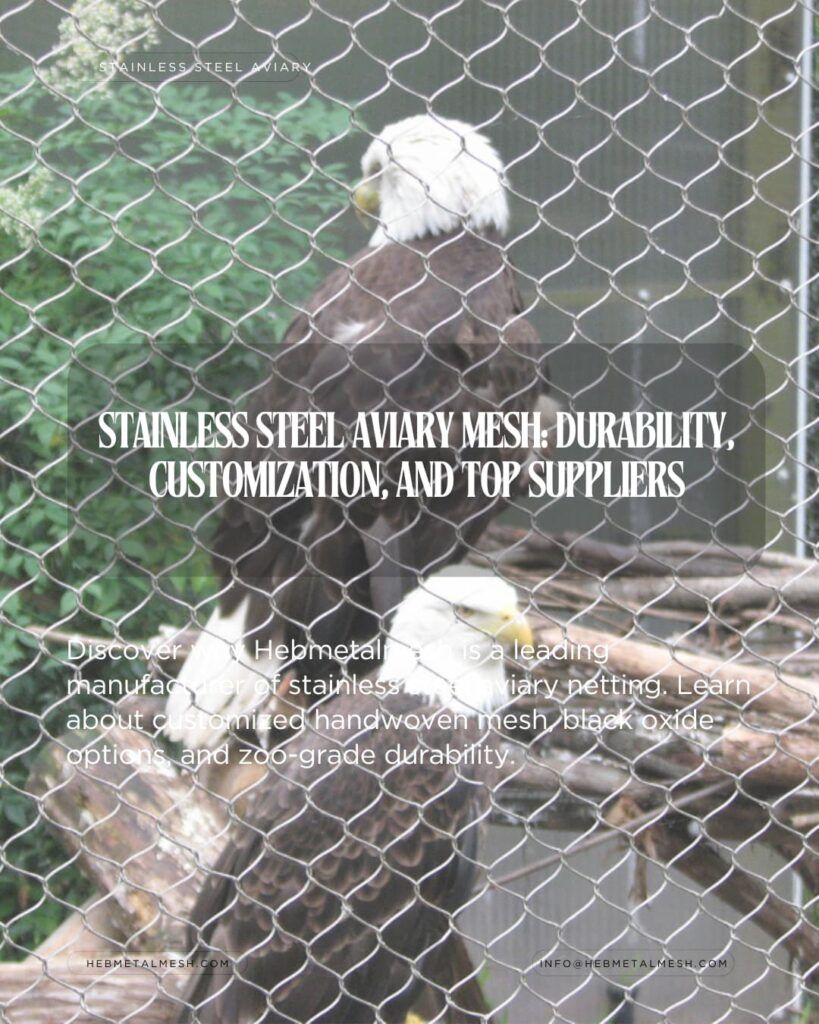
What deserves the name is the duty class of the whole system: grade and finish for the site, corrosion allowance where the site demands it, a support grid that lets the panel move, and a frame whose hard parts are out of reach. flight enclosure netting on the largest volumes usually means a coarser aperture with a moderate rope, because the birds are large and the volume is doing the work.
Weighing that against a heavier specification, our heavy duty aviary netting guide sets out the selection logic, and the range is the aviary netting specification this argument is written against. aviary stopping distance, not breaking load, is the figure that answers whether a bird walks away.
What to Send the Factory
Five things turn this into an order. The flight volume in three dimensions, so the longest internal line can be calculated. The species list with a working mass and a cruise speed for each, because the softest surface has to serve the fastest bird, not the heaviest. The rigid objects you cannot move. The support grid and where the perimeter is picked up, since that decides how far the panel can travel. And the exposure, so grade and finish are decided by the site rather than the price.
Give us those and the return is a panel schedule, an aperture and rope diameter, and the frame details that matter for impact — a planning range rather than a fixed quotation, since aviary-grade mesh generally prices between 10 and 22 USD per square metre and the volume moves that figure more than the finish does. A bird enclosure mesh order is only ever as good as the three dimensions you send.
Frequently Asked Questions
Convert the speed to metres per second, square it, and divide by 19.6. The result is the height of the fall that would give the same energy, and it is independent of mass. So 45 km/h works out at about 8 m, and 60 km/h at about 14 m.
Usually the opposite. A heavier rope raises the panel’s stiffness, so it deflects less and the shock is spent over a shorter distance at fewer cross points. Heavier rope is chosen for beaks, claws, predators and abrasion, but for a bird that arrives in flight the compliant specification is normally the safer one.
It depends on the smallest bird that has to stay in, not the largest. The working floor of the rope range is 20 mm, which holds small passerines; 38 mm is a mid-size compromise; 51 mm and 76 mm are for birds whose heads and wings could never enter openings that size.
Sometimes. The changes needing no structure are moving or padding the objects inside the volume and slackening the panel’s fixing pattern so it travels further. Taking edge terminations outside the panel, opening up the support grid or moving a post out of the flight line all need structure, and were cheapest at drawing stage.
Send the flight volume dimensions, the species list with working masses and a note on which objects cannot be moved, and we will size the aperture, the support grid and the frame for the arrival rather than the weight.
Specifying mesh for a flight volume where the birds are genuinely fast? Give us the dimensions, the species list and the hard objects you are stuck with, and we will size the aperture, the support grid and the frame for the arrival, not the animal’s weight.
Send us the flight volume