
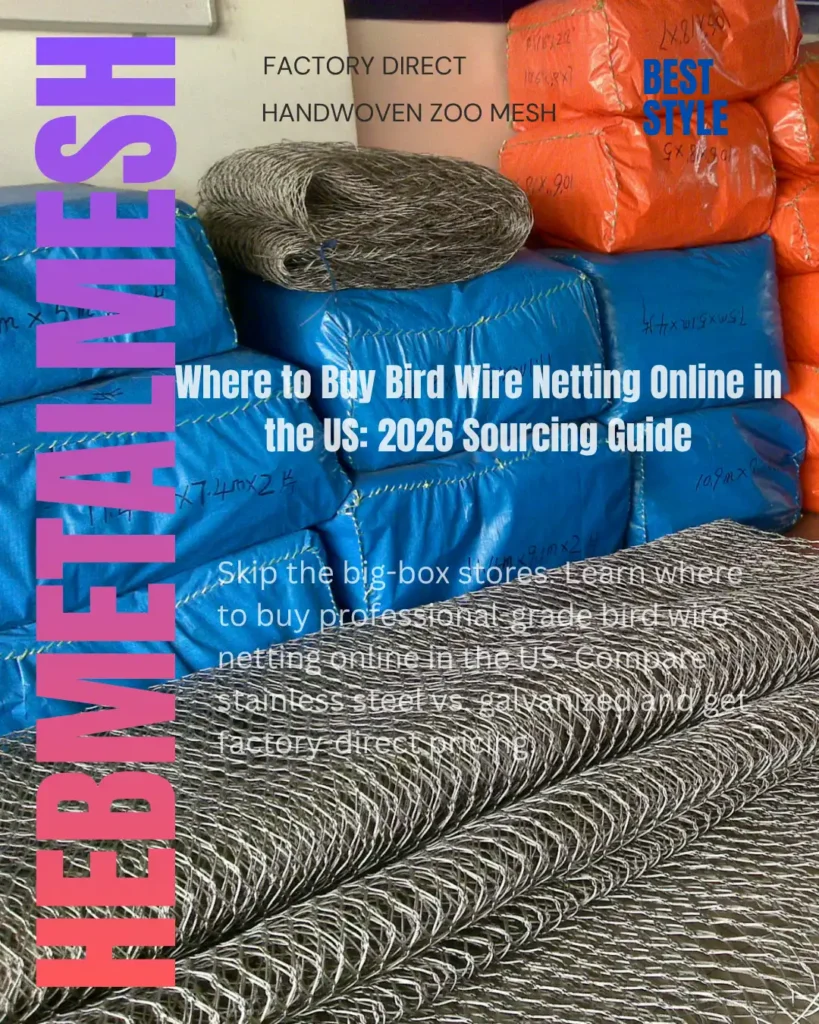
A US buyer who orders bird wire netting from an overseas mill is not shopping. They are importing, and the netting import duty that follows is fixed by a classification code rather than by the price on the web page. Three facts sit under every such order. The duty is a percentage of a declared value, so the code sets the cost. The buyer, not the seller, is normally the importer of record. And the goods are made to measure, so nothing can be sent back. The bird netting itself is ordinary, well-understood hardware; the transaction is a cross-border event with documents, a bond and a filing deadline attached to it. This page treats the order as what it is: an entry.
Executive Summary
Buying an aviary mesh online answers a question about convenience and leaves three harder questions unanswered. The first is classification. A woven stainless cloth and a galvanised welded panel are different articles for entry purposes, and the same 3.2 mm rope can enter under more than one heading depending on how it was made, so the duty is settled by what the goods are rather than by what the listing calls them. The second is responsibility: on an ordinary consumer-style order the consignee is the importer of record, which means the bond, the entry and the liability for a wrong description all sit with the buyer. The third is shape: a hand woven wire mesh panel is fabricated to the buyer’s dimensions, and panels run as long as nine metres, so the shipment is freight rather than a parcel and the returns process that a buyer expects does not exist. A specification that names the alloy, the weave and the weight per square metre is what makes all three answerable before the loom runs. The reference specification is the aviary netting specification product page.
Ordering into the United States? Send the alloy, the aperture, the cable diameter, the panel sizes and the delivery address, and we will return the panel schedule, the packing breakdown and the mesh documents your broker will ask for, as one pack.
Request a landed-order packQuick Answer:
Duty is charged as a percentage of the value declared at entry, and that value and the heading it enters under are set by the goods themselves: the alloy, the construction and the country of origin. On a factory-direct order the buyer is normally the importer of record, so the customs bond, the entry filing and the accuracy of the description are the buyer’s exposure, not the seller’s. Freight is charged on the greater of actual weight and dimensional weight, which matters because a crate of mesh is mostly air. And because a panel is woven to a 3,180 mm bay rather than cut from stock, there is no return and no restocking fee: the only inspection that protects the buyer is the one that happens before production.
Key Takeaways
- Duty follows classification. The heading is argued from the alloy and the construction, not from the words in the product title.
- Country of origin is where the goods were wholly produced, not where the order was placed or the seller’s warehouse sits.
- The importer of record is usually the consignee. A customs bond and a licensed customs broker both sit on that name.
- The entry is built from a commercial invoice, a bill of lading and a packing list. A vague invoice weakens every figure behind it.
- Freight is priced on dimensional weight as well as mass, so oversize panel shipping is a specification decision, not an afterthought.
- A made-to-measure panel cannot be restocked. Approve a drawing and a sample, then hold the drawing as the as-built record.
- A planning range for aviary-grade stainless runs about $10 to $22 per square metre, before ocean freight, duty and inland delivery.

Online Is a Way to Order, Not a Way to Buy
A web storefront is a quotation interface, not a stock position. When a mill in another country publishes specifications and a price, the buyer is looking at a factory’s capability rather than at a warehouse, and the act of clicking an order button starts a production job and an export shipment at the same time. That is not a problem, but it changes what has to be decided first. A domestic purchase can be reversed at the counter. An import cannot be reversed at all once the goods are on the water, and it cannot be reversed cheaply once the factory has cut and terminated a panel. The practical consequence is that the buyer has to be right about the specification before the order exists: alloy, aperture, cable diameter, frame spacing, panel sizes and loading. A stainless steel rope mesh and a galvanised grid are not substitutes, a corrosion resistant mesh earns its premium only on a coastal or a chlorinated site, and a flexible cable netting panel carries load differently from a rigid grid. Every one of those is a decision that a catalogue page cannot make on the buyer’s behalf.
Duty Attaches to a Classification, Not a Product Name
Duty is levied on declared value under a heading, and the heading follows the article. A 304 stainless steel mesh that is woven is not the same article as a galvanised welded grid, whatever both are called on a landing page. The harmonized tariff is a description system, and an hts classification is argued by describing the goods precisely: the alloy, the wire construction, whether the cloth is woven, welded or cable-laid, and the weight per square metre. The agency that administers the entry, U.S. Customs and Border Protection, is the body whose published rules a classification has to satisfy. That description has to be supportable, and it is supported by the mill’s own paperwork. Where a specification is loose, the classification drifts and the duty moves with it. This is why an aperture question is never only an aperture question: the same choice that sets the mesh size for a bird aviary also fixes the weight per square metre that a classification is written from.
| What it settles | The document that proves it | What goes wrong without it |
| The heading the goods enter under | Mill certificate showing alloy and heat number | The entry drifts to a residual heading |
| The value duty is charged on | Commercial invoice itemised by panel | The broker has to estimate the value |
| Whose name the entry is made in | Purchase order and bill of lading | The consignee becomes the importer by default |

Someone Has to Be the Importer of Record
The importer of record is the party legally responsible for the entry, and on a factory-direct order that party is normally the consignee. It is worth saying plainly what that means. The customs bond is registered to that name and can be continuous or single-entry. A licensed customs broker files the entry on that name’s instructions. The netting customs clearance happens at the port of entry where the goods physically arrive, which is a different place from the delivery address, and it can happen before or after the inland leg depending on the terms. The liability for an inaccurate description also rests on that name, and no seller’s disclaimer reaches it. Two earlier pages cover the ground on either side of this one and are worth reading first: how the supply route places risk between tiers, and what a factory qualification proves about who actually makes the mesh.
The Entry Is Built From Three Documents
An entry is assembled from records that the buyer often never sees. The commercial invoice carries the value and the terms of sale. The bill of lading is the document that controls who can collect the goods, which is why it is a finance instrument as much as a transport one. The packing list carries the physical truth: how many panels, what each one measures, how they are bundled and marked. These three do different jobs and cannot substitute for one another. A single lump-sum invoice leaves the value to somebody else’s judgement. A packing list that says “six bundles” without panel marks makes a shortage claim impossible to settle. A bill of lading issued to a party who is not the importer creates a release problem at the port. For a fabricated order the packing list should mirror the approved panel schedule, because that document is also the only record of what was in the crate. The aviary netting specification is the reference the schedule is built from.

Why a Panel Order Is Not a Parcel
Panels are fabricated up to about nine metres by eighteen metres, and a nine-metre panel is nine metres in one direction no matter how it is folded. It will not travel as a parcel. It moves as less-than-container freight or as a crated load, and it is priced on the greater of actual weight and dimensional weight, so a crate that is mostly air is charged as though the air had mass. A 3.2 mm rope at a 76 mm aperture weighs roughly 1.5 to 2.0 kilograms per square metre, which means a modest-looking order is heavy as well as long. That combination sets the freight class before any rate is quoted. Sea freight is also the least elastic part of the schedule, so float belongs at the delivery end rather than at the loom, an ordering principle that is worked through step by step in the order clock write-up.
Paying for Something That Does Not Exist Yet
Nothing is manufactured when the payment is arranged, so the money has to move against a description rather than against goods. The proforma invoice is the seller’s quotation in the shape of an invoice, and it is the document a bank reads when a letter of credit is used and the document a broker reads when an entry is pre-filed, so it should name the alloy, the weave, the aperture, the cable diameter, the panel sizes and the packing. Where risk passes, and at which point of delivery, is a term to be written down rather than assumed. A deposit against a proforma and a balance against a copy of the transport document is the ordinary sequence. What matters is that the invoice describes the same article that the entry declares: when the invoice says netting and the entry says wire cloth, the weaker of the two documents decides the outcome.

The Order You Cannot Send Back
A restocking fee is a retail concept applied to goods that could be sold again. A hand-woven panel woven to a specific bay, with a terminated edge and a ferrule fitted at each end, is not one of those goods. It fits one frame. There is nothing to restock and no second buyer. That has one useful consequence and one uncomfortable one. The useful consequence is that the specification review is the entire warranty of fit, which is exactly what a netting and materials comparison sets out to settle before anything is cut. The uncomfortable consequence is that the aperture is a nominal figure with a tolerance, and the frame as built always differs from the frame as drawn, so the survey has to happen on the actual steel. A 20 mm aperture and a 102 mm aperture are both correct answers to different questions; neither can be adjusted after weaving.
Frequently Asked Questions
Almost never. Quoted prices are for the goods, and usually exclude ocean freight, duty and the inland leg. Ask for the two figures separately and treat the sum as the number to compare against a domestic quotation.
Normally the buyer, because the buyer is the importer of record. The duty is calculated on the declared value at entry and paid through the broker who files it. That role, and the bond behind it, should be understood before the order is placed.
No. A made-to-measure panel has no second buyer. This is why the drawing and a pre-production sample are approved before the loom runs, and why the approved drawing is kept as the record.
Because freight is charged on the greater of mass and volumetric size, and panels run to nine metres. A crate of woven mesh is large and light, so the dimensional weight governs the charge.
Put the entry inside the order. Send the sizes, the alloy and the delivery address through the contact form and the specification, packing list and mesh documents come back in one reply.