
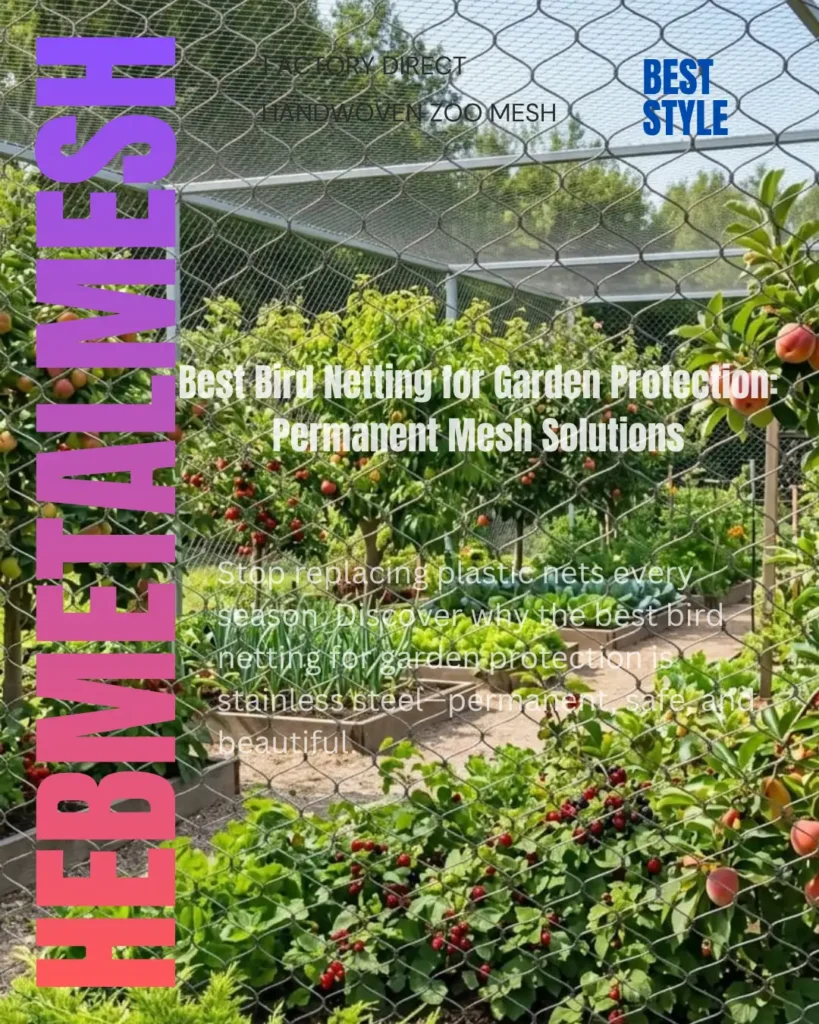
Fruit tree canopy netting is not a fence with a different address. A fence answers a question that stays true all year: the animal is out there, the plant is in here. A canopy answers a question that is true for a fortnight — the fruit is ripe, the sugar is up, and until it is picked a single peck costs the whole fruit. The structure stands for decades while the load on it lasts two or three weeks, so the design starts at the harvest window and works outward to the aperture, the frame and the roof.
Executive Summary
The problem a fruit tree presents is not theft but infection. A bird does not strip a cherry tree the way a starling strips a seed field; it opens one fruit, and the wound is what draws the wasps, the fruit fly and the brown rot that take the rest of the branch. The damage threshold is one peck rather than one fruit, so the barrier’s real job is preventing first contact instead of reducing consumption. That reframes every number on the schedule. The mesh must stand off the canopy, because fruit pressed against wire is fruit a beak can reach through the mesh. The aperture is set by the pest bird’s body and by nothing else, so a mesh fine enough to exclude a sparrow also excludes the bees the blossom needs. The roof panel collects snow and leaf litter on a horizontal span no vertical run ever sees, and the frame is sized to the tree’s mature spread rather than the tree standing there today. The reference specification is the plant and crop protection netting product page.
Netting an orchard or a single tree? Send the species, the mature spread, the pest birds you actually see and the harvest date, and we will return the aperture, frame geometry, roof load case and a panel schedule as one document.
Request a specificationQuick Answer:
Fruit tree canopy netting means enclosing the canopy inside a frame that stands clear of the branches, not draping mesh over them. The aperture is chosen for the pest bird — 20 mm holds out a house sparrow, 25 mm a starling and 38 mm a blackbird — while the frame’s height and width are set by the tree’s mature spread. The barrier only works during the ripening window, yet it must still carry a snow load and open for pruning, thinning and picking.
Key Takeaways
- One peck ruins a fruit, so the barrier is judged on first contact rather than on the weight of fruit lost.
- Ripening is the trigger: a green cherry is invisible to a bird, so the working season runs two to three weeks.
- Stand-off matters more than aperture, because fruit touching wire is within reach of a beak that cannot pass the mesh.
- The horizontal roof panel, not the vertical run, is the load case, since snow and leaf litter both settle on it.
- The frame is built to the tree’s mature spread, because the tree outlives every other decision made on the day.
Reference figures for pest-bird exclusion and crop timing are published by RHS, whose crop-by-crop guidance is what any ripeness or damage-threshold claim has to rest on.
A Fruit Tree Is Attacked From Above, and Only When the Fruit Is Ready
A cherry is not attacked while it is green. It is attacked in the last two or three weeks before harvest, when sugar accumulates and the skin turns, and that is precisely when the crop’s value peaks. This is the fruit ripening window, and it defines the working life of everything you build: for fifty weeks the plot is a garden, and for two or three of them it is a target. Birds find fruit by sight and ignore it until the colour changes, so the honest measure of ripening fruit bird damage is not the flock overhead in June but the days between colour break and picking.
That has an awkward consequence. A seasonal drape looks cheap because the material costs little, yet it goes up and comes down in exactly the weeks the barrier has to be reliable and is on the tree while the tree is picked. Anyone trying to protect fruit trees from birds is making a calendar decision as much as a material one, and if the aim is to protect ripening fruit from birds, the barrier has to be standing before the colour change rather than after the first loss.
The Bird Does Not Steal the Fruit, It Opens It
Almost every bird pecking fruit leaves a fruit still hanging and intact except for one hole, and that hole is the whole loss. A pecked cherry is not half a cherry; it is a discarded cherry plus an entry point. Wasps follow the wound within hours, fruit fly follows the wasps, and brown rot infects through the same opening and spreads along the branch wherever fruit touches its neighbour. A crop that loses five per cent to beaks can lose a third to what the beaks let in.
So the barrier is not defending a tonnage, it is defending a surface. Stopping the first peck is worth more than stopping the hundredth, and it is much easier, because a bird that never lands never pecks. The geometry of a canopy enclosure therefore matters more than its strength: the specification keeps a bird off the fruit rather than surviving its weight.
Aperture Is Chosen for the Bird, the Frame for the Tree
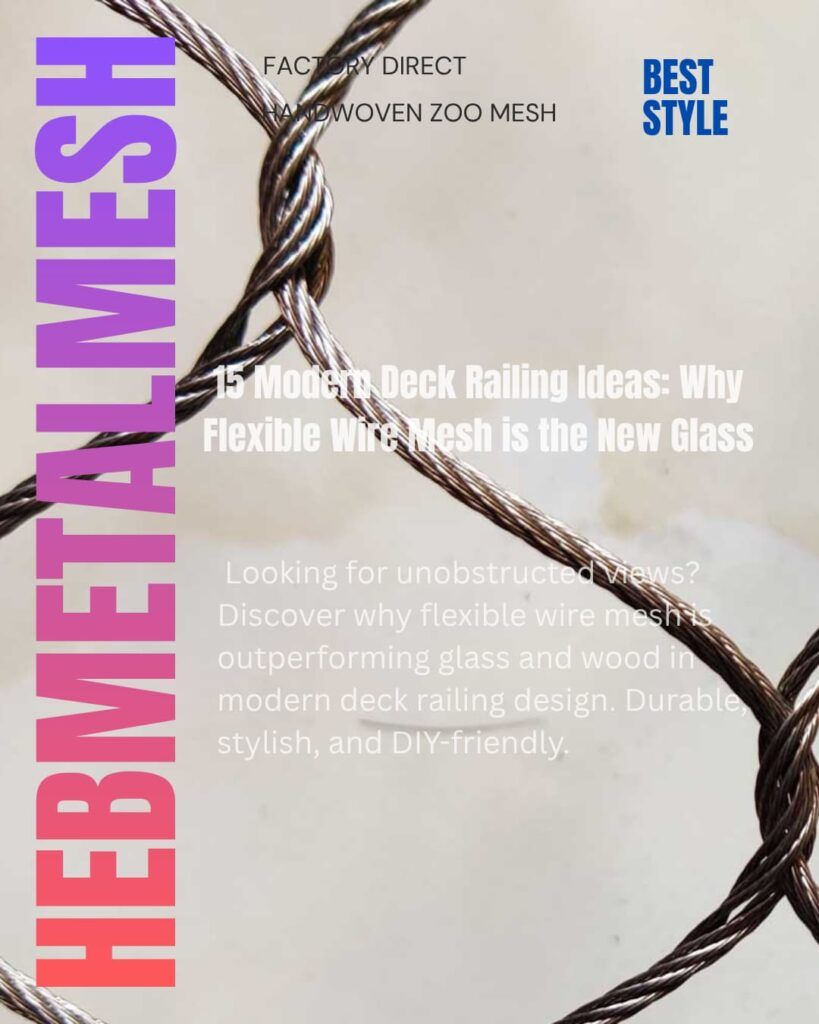
Bird exclusion in a garden is a body-size calculation, and only three birds usually matter. A house sparrow wants roughly 20 mm, a starling 25 mm and a blackbird 38 mm, so the netting aperture for birds on a fruit cage is normally fixed at 20 to 25 mm for small passerines and 38 mm where thrushes do the damage. Go much finer and the mesh starts to work against the gardener, because a pollinator friendly mesh and a bird-proof mesh are close to contradictory at the same aperture. The range runs from a 1.2 mm rope on a 20 mm aperture to 3.2 mm on 76 mm, in 304 and 316, as a stainless steel rope mesh that is hand woven rather than welded.
| Pest bird | Working aperture | Rope and aperture | Notes |
| House sparrow | 20 mm | 1.2 mm on 20 mm | The finch family pecks buds and fruit alike |
| Starling | 25 mm | 1.2 mm on 25 mm | Arrives in flocks, works a tree in an afternoon |
| Blackbird | 38 mm | 1.6 mm on 38 mm | Takes ground fruit as well as canopy fruit |
Frame dimension is a different argument. Netting height for fruit trees is not the height of the tree today but the height at the end of its useful life, because a cage built to this year’s canopy is a cage the tree grows out of within three seasons. A 304 stainless steel mesh suits the inland garden and 316 is used where salt or industrial fallout is present, which is a corrosion question rather than a strength one.
Why the Mesh Has to Stand Off the Canopy
The most common failure in domestic fruit protection is a net that touches the fruit. A cage around a fruit tree only works if it is an enclosure rather than a cover, because a bird cannot pass a 25 mm aperture but it can push its head through the slack and reach whatever the mesh rests on. A draped panel is also lifted at every branch contact, which puts the mesh onto the crop and concentrates every winter’s ice and snow at the same points.
The fix is geometric. A fruit tree cage is built as a frame outside the branch spread with the mesh tensioned to it, so no part of the canopy sits within a beak’s reach of the panel. That stand-off is also what makes the roof a structural member: a horizontal panel over a tree collects snow and fallen fruit, while the side panels carry almost nothing but wind. A flexible cable netting in 316 with a corrosion resistant mesh weave holds tension for decades, and rope mesh is typically 85 to 92 per cent open, so the tree loses very little light and the fruit colours normally. The frame is clad in a few custom sized garden panels laced edge to edge, which keeps the stand-off uniform along the whole run. Panel geometry is covered in the note on mesh size for a bird aviary, which applies the same aperture logic to a different occupant.
The Tree You Have Is Not the Tree You Will Have
A fruit tree is the only garden structure that changes size after installation, and it does so on a predictable schedule. Dwarfing rootstock keeps a mature cherry or apple inside three metres, while a standard tree of the same variety doubles that. Trained forms change the problem again: an espalier or fan against a wall is a flat plane and takes a panel, while a free-standing standard is a volume and takes a box. Spend the money on stone fruit netting sized to the rootstock you planted and it will still fit in fifteen years; size it to the sapling and the third summer will make the decision for you.
Where a cherry tree netting cage goes around an established tree, the mature spread can simply be measured; where the tree goes in this autumn, the number has to come from the rootstock and the training form, and a canopy that is too small is not a discount but a rebuild. A garden bed is fixed geometry, and the barriers that suit it are a different job — garden bed protection is an application matrix rather than a volume.
Getting Inside It: Pruning, Thinning, Picking
A canopy enclosure is entered many times a year and closed afterwards, which is a design requirement rather than an afterthought. Harvest access netting usually means a laced panel or framed door on the least visible side, sized for a person carrying a basket, with the same aperture as the rest of the cage so an open door is a temporary gap rather than an invitation.
Inside, the work is annual and unavoidable: winter pruning shapes next year’s crop, summer thinning removes the fruit that would otherwise crowd and rot, and picking runs in several passes through the whole fruit harvest protection season. Total harvest window netting on a mixed plot can mean eight weeks rather than two. The netting applications for gardens note sets out how one structure absorbs several of these jobs, and the garden bird netting case follows the bird side of the same problem on a vegetable plot. A zoo grade enclosure mesh is not required for a domestic orchard, but the tensioned frame that makes a zoo enclosure work is, and the specification for the whole range sits on the garden netting range page.
What the Mesh Cannot Do
A bird-proof aperture is not an insect-proof one, which is worth stating before the order rather than after the first wasp. A 20 mm opening stops a sparrow and passes a cabbage white, a codling moth and every wasp in the parish. The answer is not a finer mesh, because a 1 mm screen also locks out the bees that pollinate the blossom.
Nor does a canopy address anything at ground level: animals arriving on foot need a vertical run. The note on fine mesh garden netting covers that lower boundary, where a hand woven wire mesh panel tolerates far more abuse than a light woven cloth.
Frequently Asked Questions
No. Rope mesh is typically 85 to 92 per cent open, so it removes very little light and colours fruit normally, and the wires are thin enough to dissipate heat rather than act as a radiator.
Before the colour break, not after the first loss. Damage begins as sugar rises, so a barrier fitted in the week the fruit turns is already late.
That is the failure mode the specification exists to avoid. A draped panel rests on the fruit once it is lifted at the branch contacts, and the bird only has to reach through the slack. A cage around a fruit tree built outside the branch spread is the version that works.
No, and it is not designed to. Animals arriving at ground level need a vertical run with a buried or weighted edge, which is a separate part of the same build with its own load case.
Stop sizing a permanent structure against a temporary problem. Send us the species, the mature spread and the pest birds you actually see, and we will return the aperture, the frame geometry and the roof load case as one document.
Building a fruit cage that will still fit in fifteen years? Give us the rootstock, the training form and the harvest window, and we will specify aperture, panel sizes, edge cable and roof loading before the tree goes in the ground.
Talk to an engineer