
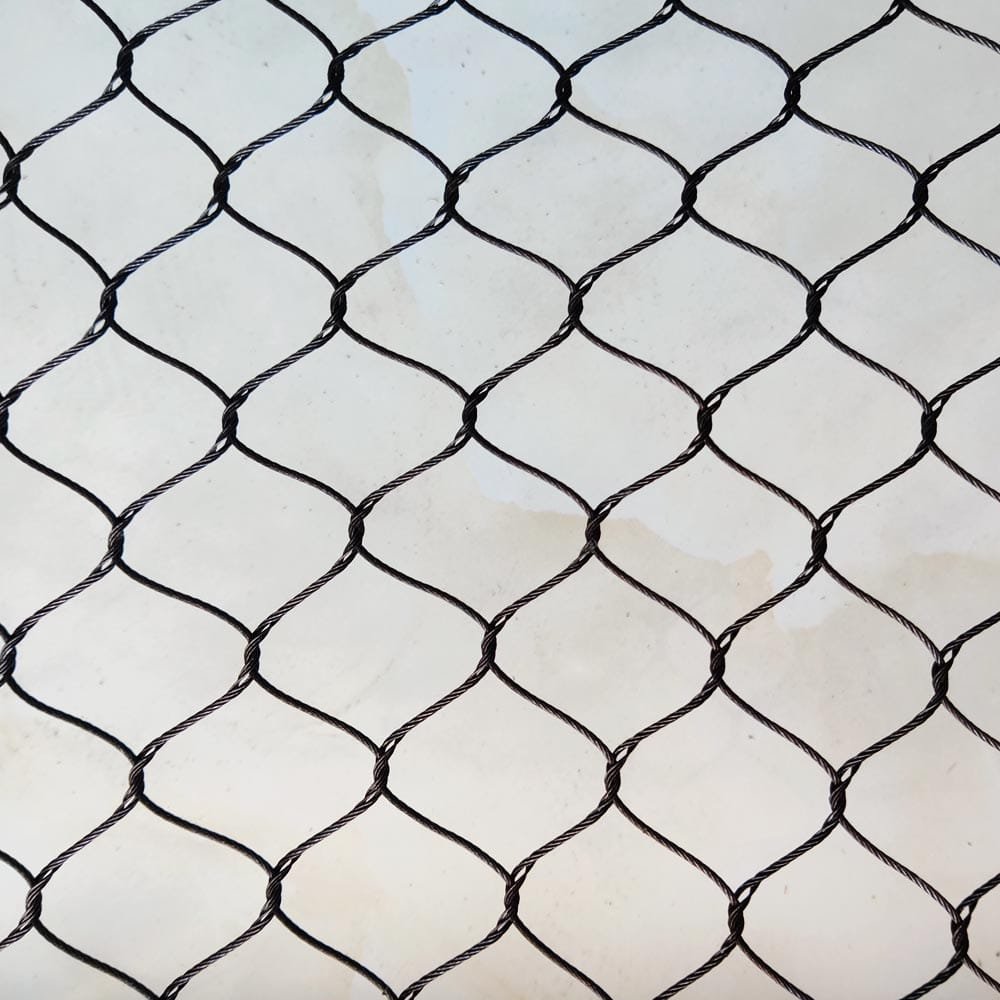
Whether you are protecting a warehouse, solar panel array, or industrial facility, stainless steel cable mesh is the gold standard for long-term bird exclusion. This guide explains how to select the right steel grade (304 vs. 316), specifies optimal mesh sizes for different bird species, and details professional installation techniques to avoid costly maintenance and maximize the lifespan of your bird netting roof system.
Introduction: Why Stainless Steel Outperforms Traditional Netting
The most effective way to protect commercial infrastructure is through a physical exclusion barrier. By installing a durable mesh system, you create an impenetrable wall that prevents birds from entering nesting sites or damaging sensitive equipment. While many facility managers initially opt for UV-stabilized polyethylene, these materials are temporary solutions that eventually fall victim to environmental stressors.
Plastic netting, even when rated as “UV-stabilized,” is susceptible to thermal expansion, wind-driven abrasion, and chemical degradation. Over time, the sun’s rays break the polymer chains, leading to brittle fibers, sagging, and eventual tearing. Once a tear appears, the entire barrier system is compromised, necessitating costly full-scale replacements.
In contrast, stainless steel bird netting for roofs provides a permanent, maintenance-free solution. Because steel is impervious to UV radiation and temperature fluctuations, it retains its structural integrity for decades. Choosing stainless steel transforms a recurring maintenance expense into a long-term capital investment. For a detailed breakdown of how these systems are planned and deployed, refer to our Bird Netting for Roof: A Complete Guide.
Material Science: 304 vs. 316L for Industrial Roofing
From a professional China stainless steel cable mesh factory with 10+ years export experience.
When sourcing metal mesh, the grade of stainless steel is the single most important factor in your project’s lifespan. We frequently consult with clients who unknowingly use 304 grade in corrosive environments, only to face premature surface rusting.
304 Stainless Steel is the standard for general, inland applications. It offers excellent tensile strength and durability in dry, clean urban environments. However, for roofs located within 5 miles of a coastline or near heavy industrial zones with acid rain, 316L grade is non-negotiable. The addition of molybdenum in the 316L alloy provides a much higher resistance to chloride-induced pitting and crevice corrosion, which is essential for maintaining the structural safety of an elevated exclusion barrier.
Material Compatibility Comparison
| Environment | 304 Grade | 316L Grade | Recommendation |
|---|---|---|---|
| Inland / Urban | Excellent | Superior | 304 is cost-effective |
| Coastal / Marine | Poor (Risk of Rust) | Excellent | 316L Required |
| Industrial / Chemical | Moderate | Excellent | 316L Recommended |
Expert Insight: Polishing Processes
Quality isn’t just about the alloy; it’s about the finish. We offer two primary methods to enhance your mesh:
- Mechanical Polishing: This creates a smooth, bright appearance through physical abrasion. It is cost-effective and suitable for most standard industrial netting applications.
- Electrolytic Polishing: This is an electrochemical process that removes surface imperfections and creates a microscopically smooth, uniform finish. This process significantly increases corrosion resistance, making the mesh easier to clean and nearly immune to atmospheric contamination.
For professional-grade specifications tailored to your facility, view our full Product Catalog. Whether you are in a high-salt coastal region or a standard warehouse district, selecting the right grade and finish ensures your investment remains a true “install-and-forget” solution.
4. Custom Fabrication: Reducing Waste and Installation Time
Many procurement managers fall into the trap of purchasing standard-sized rolls, assuming they can cut them to fit on-site. In reality, this often leads to excessive material waste, complex on-site handling, and frayed edges that compromise the structural integrity of the barrier. Our factory-direct approach focuses on “no-waste” prefabrication.
By providing us with your architectural roof plans, we can manufacture the stainless steel mesh to your exact dimensions before it leaves our facility. This eliminates the need for field-cutting and minimizes the labor hours required for installation on high-rise or irregular roof structures. When the panels arrive, they are ready to be tensioned immediately.
To streamline the installation process, we offer specialized edge treatments. Depending on your support structure, you can choose from various custom edging options:
- Rope Borders: Ideal for perimeter cables, providing a clean, heavy-duty finish that allows for easy attachment.
- Wire Borders: Best for high-tension applications where minimal movement is required.
These pre-configured edges act as the primary load-bearing points, significantly speeding up the tensioning phase. You can explore these versatile configurations further in our guide to Rope Netting: Durable and Adaptable Solutions.
5. The Engineering of Tension: Hardware and Edge Fixing
Proper tensioning is the difference between a long-lasting bird exclusion system and one that sags or fails under wind loads. The structural stability of your bird netting roof relies on the physics of corner and intermediate attachments.
Choosing Your Edge-Fixing Method
We recommend three primary methods for securing your mesh, depending on the scale of your roof:
- Sleeve Fixing: The most robust method for heavy-duty industrial roofs, using stainless steel sleeves to crimp the mesh to the perimeter cable.
- Buckle Fixing: Provides a cleaner aesthetic, suitable for smaller spans or areas requiring periodic adjustment.
- Winding: A traditional, cost-effective method involving weaving a stainless wire through the mesh edge and around the support cable. It is highly adaptable for irregular corners.
Avoiding Galvanic Corrosion
One of the most common mistakes in industrial installation is mixing metals. Never use galvanized steel clamps or turnbuckles with stainless steel mesh. Doing so triggers galvanic corrosion, where the different electrical potentials of the metals cause the fasteners to rust and fail prematurely, eventually causing the entire net to collapse. Always use matching 304 or 316-grade stainless hardware to ensure your system remains inert and durable.
Physics of Tension
Your perimeter system must distribute wind and static loads evenly. We recommend installing corner attachments that utilize high-strength turnbuckles to maintain consistent tension across the entire span. Intermediate attachments should be spaced at specific intervals—typically every 2 to 3 feet—to prevent “belly” sag. For projects requiring high-precision protection, our 1×1 1/16 Stainless Steel Aviary Netting is specifically engineered to handle these high-tension environments, ensuring your roof remains protected for years to come.
6. Installation Logistics & Safety Compliance
Securing your roof is about more than just keeping birds away—it is about maintaining the safety and integrity of your building’s primary assets. When installing netting on industrial flat roofs, especially those housing high-value solar panel arrays, the primary goal is to prevent nesting beneath the panels while strictly adhering to safety regulations.
Protecting Your Roof Membrane
One of the most frequent concerns for facility managers is the risk of water leaks caused by drilling into the roof membrane. Fortunately, you can achieve a robust, tensioned barrier without penetrating the surface. We recommend the use of non-drill perimeter systems, which utilize weighted mounting bases or existing structural parapets to anchor the cable perimeter. This method protects the integrity of your waterproofing membrane while providing a rigid frame for the Stainless Steel Aviary Mesh.
Meeting OSHA and Safety Standards
When working at height, safety compliance is non-negotiable.
- Worker Safety: Any installation near roof edges must follow OSHA guidelines for fall protection. Ensure your installers are using proper tie-off points that do not conflict with the netting installation.
- Fire Code Compliance: Industrial facilities often require fire-rated materials. Stainless steel mesh is inherently non-combustible, offering a significant advantage over plastic alternatives that can melt or release toxic fumes during a fire event.
- Solar Panel Integrity: Proper mesh installation prevents “nesting-induced” overheating. When birds build nests under solar panels, they trap heat and debris, which can reduce energy efficiency and create fire hazards. A stainless steel barrier keeps the area ventilated and clear, ensuring your solar investment operates at peak performance.
7. Quality Assurance: Shipping, Packing, and Long-Term Value
From a professional China stainless steel cable mesh factory with 10+ years export experience.
The quality of our mesh doesn’t stop at the manufacturing line; it must endure the long journey to your facility. We recognize that international shipping can involve significant humidity, temperature changes, and rough handling. To ensure your order arrives in pristine condition, we have refined our export packing protocol to be as durable as the steel itself.
Our Factory-Standard Packing Process
We treat every shipment with the care required for high-grade construction materials:
- Moisture-Resistant Wrapping: Each roll or custom panel is first wrapped in anti-corrosion plastic film to block humidity. This prevents surface oxidation before the product is even installed.
- Waterproof Layering: We add a secondary layer of heavy-duty, waterproof woven bags to shield the mesh from salt air and rain during ocean transit.
- Fumigation-Certified Pallets: To comply with international shipping regulations (ISPM-15), we use exclusively fumigated wooden pallets. This ensures seamless customs clearance and provides the structural base needed for forklift handling.
By investing in professional-grade packaging, we ensure that the material you receive is free from kinks, dents, or environmental damage. This attention to detail guarantees that the product arriving at your site is ready for immediate deployment, saving you time and preventing the hidden costs associated with damaged or substandard materials. Investing in the right logistics is just as critical as choosing the right alloy—it is the final step in ensuring your bird netting roof serves your facility for decades to come.
8. Key Takeaways
To ensure your bird netting project provides permanent, high-value protection, keep these essential procurement and engineering factors in mind:
- Prioritize Material Grade: Select 304 stainless steel for standard inland environments. Always upgrade to 316L stainless steel for coastal, marine, or highly corrosive industrial zones to prevent long-term pitting.
- Embrace Custom Fabrication: Avoid the inefficiency of “off-the-shelf” rolls. Prefabricated, custom-sized panels reduce on-site waste, minimize labor costs, and ensure a seamless, high-tension fit for irregular roof geometries.
- Master Tensioning Physics: Use consistent hardware—specifically matching stainless steel components—to avoid galvanic corrosion. Utilize turnbuckles at corner points to distribute load and maintain tautness over large spans.
- Invest in Proper Installation: Whether using drill-based anchors or non-drill membrane-safe mounts, prioritize structural integrity. Proper tensioning prevents “belly” sag and ensures the mesh remains an effective exclusion barrier against birds.
- Focus on Lifecycle Value: While stainless steel has a higher initial cost than plastic netting, its immunity to UV degradation and extreme weather makes it the most cost-effective solution over a 10+ year horizon.
9. FAQ Section
Plastic (polyethylene) netting typically degrades within 2–5 years due to UV exposure, wind abrasion, and temperature cycling, leading to sagging and tears. In contrast, stainless steel bird netting is engineered for a 20+ year lifespan. It does not break down under UV rays or become brittle in extreme heat or cold, making it a “one-and-done” capital investment.
Yes, and it is highly recommended. Bird nesting beneath solar panels creates fire hazards, trapped heat, and acidic waste buildup that damages panel surfaces. Using a non-drill, tensioned stainless steel frame around the perimeter of your solar array effectively seals the area, preventing bird entry while allowing for essential airflow and maintenance access.
The choice depends entirely on your environmental exposure. If your facility is inland and away from heavy chemical pollutants, 304 is durable and cost-effective. If your roof is within 5 miles of the coast or near industrial processing plants that emit corrosive exhaust, the molybdenum content in 316L is essential to prevent rust and surface corrosion.
Yes. Stainless steel is naturally non-combustible and maintains its structural integrity even in high-temperature environments. Unlike synthetic netting, which can melt, drip, or release toxic smoke during a fire, stainless steel provides a safe, passive barrier that complies with strict industrial fire safety standards.
For large-span areas, tensioning is determined by the “span-to-sag” ratio. Professional installations typically aim for a tension level that keeps the mesh taut enough to prevent bird entry without exceeding the breaking load of the support cables. We recommend working with your mesh supplier to calculate the specific wind and snow loads for your region, as these dynamic forces dictate the strength requirements for your perimeter turnbuckles and corner brackets.
Need Custom Bird Netting Solutions for Your Facility?
Get factory-direct pricing and engineering support from experts with 10+ years of experience. We provide custom-sized mesh, precise hardware, and global shipping tailored to your specific roof dimensions.
Request a Quote/Sample