
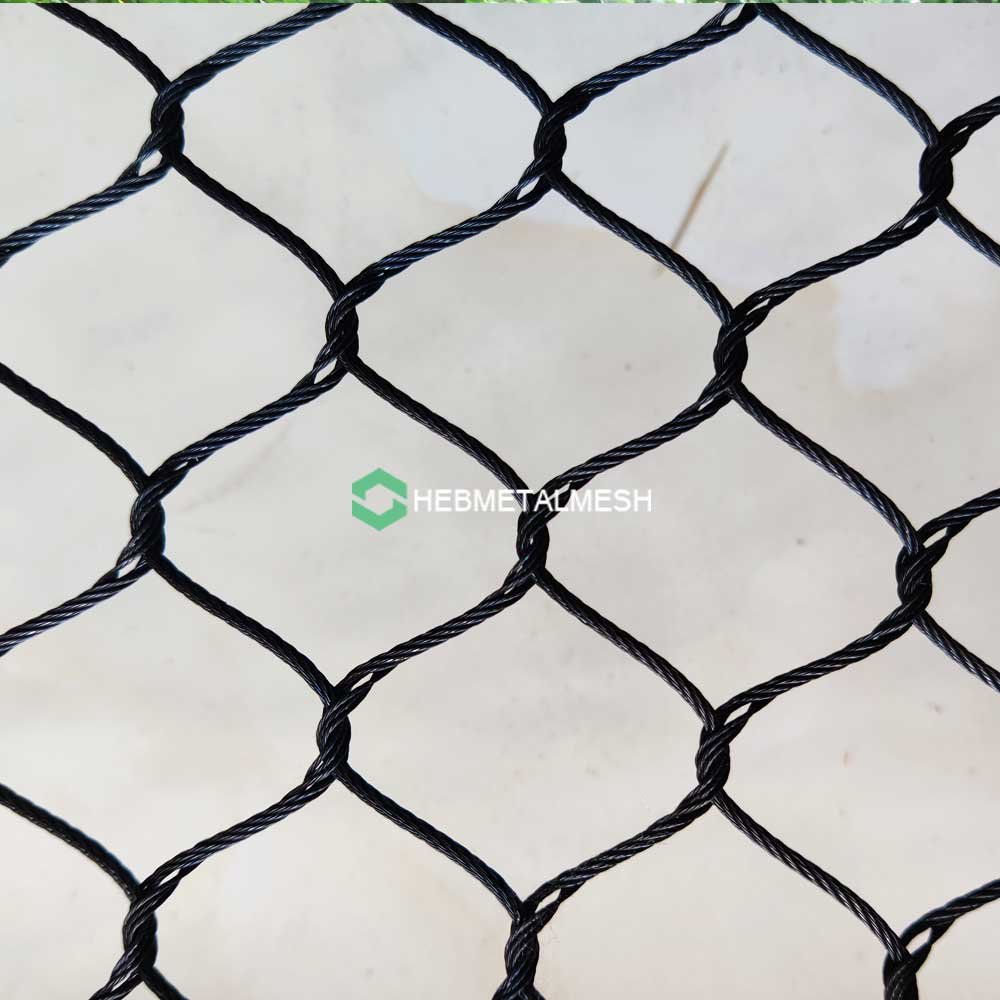
A mesh guardrail is judged twice, by two different people, against two different documents. The first is an inspector with a code book, and the code asks three questions: how high is the rail, what can pass through it, and what load does it hold. The second is the architect who drew it, and they care about something the code never mentions — how much of the view the mesh removes. Mesh guardrail specification is the discipline of satisfying both at once, and the useful part is that the two are not really in conflict: a safety code constrains only one of the three variables in a mesh panel, which leaves the other two free to buy the design.
Executive Summary
Most guardrail guidance treats compliance and appearance as a trade-off, as though a safer barrier must look heavier. That is true of solid infill, where the only way to add strength is to add material, and it is not true of mesh. A woven or cable infill has three independent variables — the aperture, the cable diameter and the tension — and a guardrail code constrains only the first of them. That asymmetry is the whole design opportunity: pass the opening test, then spend the cable and the tension on the look rather than on strength nobody needs. The reference specification is the animal fence mesh range product page.
Specifying a guardrail infill? Send the occupancy, the rail height, the span between posts and the exposure. Back come the aperture, cable diameter, tension and fixing detail as separate lines, with the one that the code decides marked as fixed and the two that carry the design left open.
Request an infill specificationQuick Answer:
A mesh guardrail is a barrier whose infill is a mesh panel rather than glass, pickets or a solid sheet. It is specified against three code numbers and one design number: the rail height (commonly 1,100 mm or 42 inches for a guardrail, with a handrail at 900 mm), the maximum opening (a 100 mm sphere must not pass, which is why a 50 mm aperture is standard), and the load the rail must resist (typically a 200 lb point load and a 50 lb/ft line load, with deflection held to about 25 mm). The design number is the aperture again, seen from the other side: the wider the mesh, the more transparent the barrier looks, and the aperture is the one variable both the code and the architect have a view on.
Key Takeaways
- A guardrail code constrains the opening, not the strength of the mesh. Aperture is the compliance variable; cable diameter and tension are free.
- The sphere rule sets the aperture. If a 100 mm sphere cannot pass, the opening is compliant, and 50 mm is usual because it also reads as a fine, quiet texture.
- Adding cable to fix a wide opening is the classic error. It makes the barrier heavier and more expensive and no more compliant, because the code never measured the wire.
- Deflection is where a guardrail infill fails a test it never saw. A panel that holds the load but flexes like a hammock fails the intent of the rule even when the maths passes.
- Grade follows the site, not the drawing. Coastal air and de-icing salt make a coastal guardrail grade a 316 decision, and a stainless panel bolted to a galvanised post needs an isolator.
The dimensional and loading provisions that a guardrail is checked against are published in the International Building Code by the International Code Council, which is where the height, opening and load figures quoted here should be confirmed for a specific project.
Why a Guardrail Passes Two Different Tests
Mesh behaves differently from every other infill because its strength and its opening are not the same measurement. In a picket rail, the gap between the pickets and the amount of steel in the rail move together: tighten the spacing and the rail gets heavier. In a mesh panel the guardrail infill mesh opening and the load path are separate properties, set by different choices at the factory.
That separation is what makes a mesh balustrade design work. The architect selects an aperture for the texture and the sightline; the engineer selects a cable diameter and a tension for the load. Because those decisions do not interfere, a barrier can be visually light and structurally generous at once, which is why mesh appears on so many staircases and mezzanines where glass would be too heavy to lift and pickets would be too dense.
The Four Numbers a Guardrail Is Judged On
Before any mesh is discussed, four numbers decide whether a design is compliant, and each closes off a range of later choices.
| Test | Typical requirement | What it fixes |
| Height | 1,100 mm (42 in) guardrail; 900 mm handrail | The frame, not the mesh |
| Opening | 100 mm sphere must not pass | The aperture |
| Load | 200 lb point load; 50 lb/ft line load | The cable and its fixings |
| Deflection | About 25 mm at the top rail | The tension and the post spacing |
The guardrail height requirement is a frame decision and costs nothing to get right. The guardrail load requirement follows the occupancy: a domestic balcony and a stadium concourse are not the same barrier, and a public building may be specified to a barrier class several times the domestic line load. Check the guardrail building code that actually governs the site, because the class, not the mesh, sets the guardrail line load the infill must survive — and guardrail code compliance is judged against that class, not against the apparent solidity of the panel.
The Sphere Rule Decides the Aperture, Not the Cable
The most useful test in guardrail design is also the simplest to describe: a sphere of a defined diameter is offered to every part of the guardrail infill opening, and it must not pass through. That is the sphere rule guardrail inspectors apply, and its consequence is a rule of thumb — keep the guardrail clear opening under 100 mm and the compliance question is answered.
Two mistakes follow from misreading it. The first is to satisfy a wide opening by thickening the cable, which adds weight and cost without changing the measurement the rule cares about. The second is to treat aperture and cable as one dial. They are not: a 50 mm aperture can be woven from a 2.0 mm or a 3.2 mm cable. What changes is the guardrail infill weight, the stiffness and the visual density. A guardrail infill mesh specification that separates the two is easier to approve and much easier to cost.
Load and Deflection: the Two-Part Test
Compliance is not one test but two, and the second is the one that catches mesh. The guardrail point load and the distributed guardrail line load ask whether the infill and its fixings survive a defined force. Deflection asks whether the barrier still behaves like a barrier while carrying it.
A panel that holds 200 lb and then sags 100 mm has passed the first test and failed the second. Mesh has an advantage here: because the load is shared across thousands of woven crossings or across a tensioned cable grid, the force spreads sideways into the posts instead of concentrating at one fixing. Tension is the control. Raise it and the guardrail deflection limit becomes easier to meet, the panel rings true under a hand and the surface stays visually flat — which is also what the architect wanted.
Buying the Look Back
With compliance handled, the design half is a choice between three textures. A tight aperture with a fine cable reads as a translucent sheet and suits a staircase guardrail mesh or a balustrade infill panel where the barrier has to disappear. A wider aperture with a heavier cable reads as a grille and suits a mezzanine guardrail infill where the mesh is part of the composition rather than a substitute for glass. A tensioned grid with visible edge cables reads as structure, which is often chosen for an architectural guardrail infill on an exposed facade.
Glass is more transparent than any mesh, and heavier, more fragile and harder to maintain at height; mesh sits between glass and pickets, and is the right answer wherever the barrier has to be lifted, cleaned or replaced by one person.
Grade and Corrosion at the Fixing
A guardrail is an exterior product, and its exposure is decided by the building, not by the drawing. Inland and sheltered, 304 stainless is normally sufficient. Within sight of the sea, or anywhere de-icing salt is used, the coastal guardrail grade is 316, because the molybdenum addition is what resists chloride pitting.
The fixing is where appearance and durability separate. Where a stainless panel is bolted to a galvanised or aluminium post, the two metals must be separated at the contact or a galvanic cell forms and the less noble metal corrodes. A nylon or neoprene isolator at each fixing costs almost nothing and removes the electrical path. Guardrail maintenance is then a matter of inspection rather than repair: check the tension, check the isolators, check for abrasion where the mesh touches the frame, and the guardrail infill system will outlast the coating on anything it is bolted to.
The Fixing Schedule for a Guardrail Infill
Everything above becomes a purchase only when it appears as a detail. A guardrail infill fixing detail is a short drawing showing four things: how the panel is terminated at each end, how the edge cable or rod is anchored, how the infill joins the post or the structure, and how the change of material is isolated. Producing it before the order is the difference between a barrier that is installed and a barrier that is adjusted on site.
Two entries do most of the work. The anchor detail at the post decides where the load goes, and it is also the item most often left to a different trade than the rail. The panel tension is the second: it is set at installation and changes with temperature, so record the setting and the ambient temperature at handover. A guardrail infill schedule that lists the aperture, cable, tension and fixing for each run gives the installer a target and the client a maintenance baseline. The panels themselves are drawn from the animal fence mesh product range, cut to the run.
What to Put in the Guardrail Specification
The brief that gets the best answer is short and specific. Give the occupancy and the governing code, the rail height, the clear span between posts, the exposure and the look you are trying to achieve. Then ask for four lines: the aperture, the cable diameter, the tension and the fixing detail, with the aperture marked as code-governed and the other three marked as design choices.
A guardrail infill specification is not a product description; it is a set of decisions with owners. Two of them stay adjustable — tension and finishing detail — and one does not, because the aperture is woven in. Get that one right against the code first, then spend everything else on the look.
Frequently Asked Questions
The deciding test is the opening, not the wire: a guardrail clear opening must be small enough that the code’s sphere cannot pass, which in most codes means keeping it under 100 mm. A 50 mm aperture is usual because it clears the test with margin and reads as a fine, even texture from a distance.
Not in the way most buyers expect. The code measures the opening and the load the rail must resist; it does not reward a heavier wire at a fixed aperture. A larger cable diameter changes the guardrail infill weight and stiffness, which helps meet the deflection limit and gives the barrier a more solid feel, but it is a performance and appearance choice rather than a compliance shortcut.
It depends entirely on the exposure. Inland and sheltered, 304 is normally adequate and less expensive. Within sight of the sea, on an exposed facade or where de-icing salt is used, the chlorides justify a coastal guardrail grade in 316, and the reason should be recorded so a later substitution can be judged rather than guessed.
Through an isolated connection. Where the mesh and its fittings are stainless and the post is galvanised, aluminium or painted steel, a nylon or neoprene isolator at each fixing keeps the two metals out of electrical contact and prevents the galvanic corrosion that otherwise appears years later.
A mesh guardrail is specified once and looked at for decades, so the one decision that cannot be revised — the opening — should be made against the code first, and everything adjustable should then be spent on the design. Send the occupancy, the rail height, the span and the exposure to our specification team and we will return the aperture, cable, tension and fixing detail as separate lines with their owners named. If you want to see how the same panel is used in a different duty, the construction safety mesh and the fall protection case show the sister applications, the perimeter guarding guide covers the security side, the architectural mesh note is the design-led view of the same material, and the fencing materials guide takes the format decision further.