
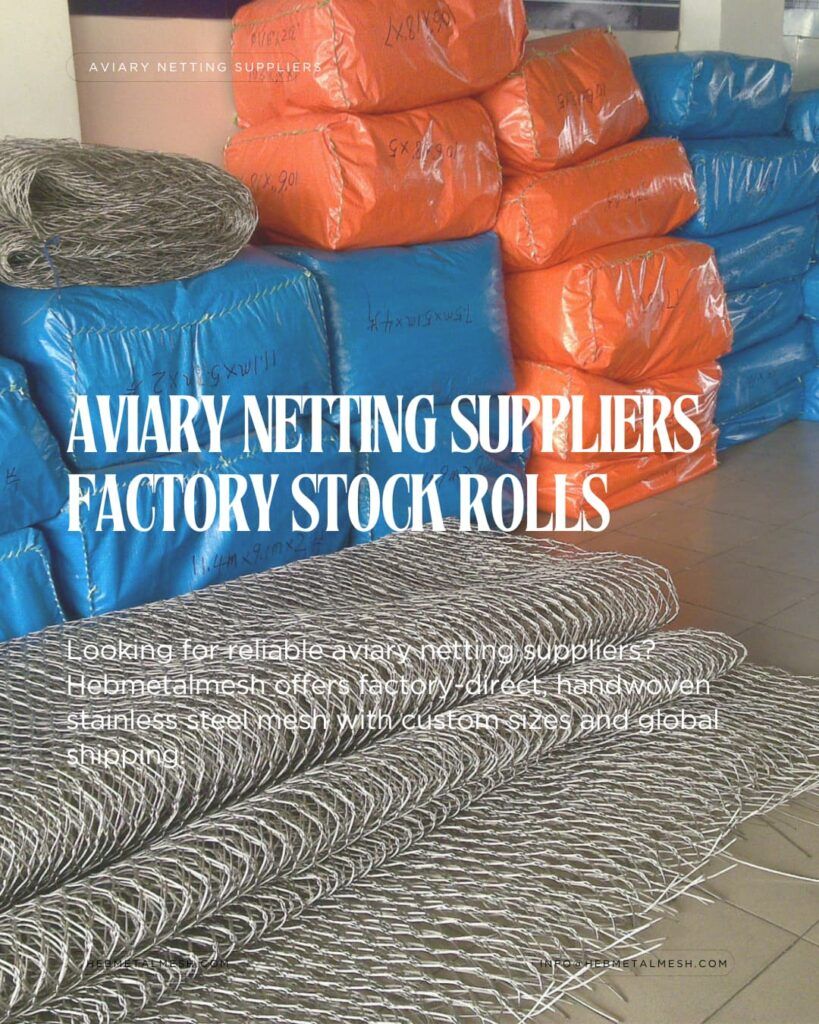
An aviary is usually bought on a single number, and it is rarely the number that decides the outcome. When you order stainless steel aviary netting you order a nominal aperture — 25 mm, 40 mm, 50 mm — and that figure goes into the drawing, the quotation and the purchase order. What the finished panel delivers is a range. Hand-woven mesh is a textile, and a textile never holds one dimension; it holds a band. The bird that escapes a well-built aviary almost never passes through the aperture that was specified. It passes through the widest one the weaver left behind. That is the whole case for judging netting aperture consistency separately from aperture size, and for treating a supplier’s tolerance as the product you are actually buying.
Executive Summary
Netting aperture consistency is the gap between the aperture a panel is ordered at and the aperture it holds across its whole area, and that gap decides whether an aviary contains its birds. Three consequences follow. First, the dimension that matters is the largest aperture in the panel, not the average one, because containment is a worst-case test and a single drifted diamond loses a small bird. Second, aperture and cable are bought together but measured separately: cable diameter is a drawn dimension held to a tight manufacturing tolerance, while aperture is created by the weaver’s hands and drifts with knot consistency, strand lay and panel tension. Third, consistency can be specified and verified — through a stated tolerance, a retained master sample and a first article inspection — but only before the loom starts, because a hand-woven panel cannot be re-toleranced afterwards. The reference specification is the aviary netting product page.
Need a panel that holds one aperture across its whole span? Send us the birds, the aperture you have specified, the panel dimensions and the exposure. We will tell you the weave tolerance we can hold on that construction and what the widest opening would be.
Quick Answer: What Does Aperture Consistency Actually Mean?
It means the supplier’s ability to hold one hole size across a whole panel. A nominal aperture is a target; consistency is how tightly the finished mesh clusters around it. If a supplier quotes 50 mm but can only hold plus or minus 4 mm, the real panel contains openings up to 54 mm, and that is the figure a small bird will find. Asked properly, the question is not “what aperture do you sell” but “what weave tolerance do you hold, and what is the largest aperture in the worst panel you would ship?”
Key Takeaways
- Aperture is bought as a nominal figure and delivered as a tolerance band.
- Containment is decided by the largest aperture in the panel, not the average.
- Cable diameter is a drawn dimension; aperture is a woven one, and it drifts.
- A tolerance quoted without a master sample and a first article inspection is a claim, not a control.
- Consistency costs almost nothing to agree before weaving and cannot be added afterwards.
The Nominal Aperture Is a Promise, Not a Measurement
Every catalog in the trade prints aperture in millimeters and treats it as a fixed property of the product. A hand-woven panel is not made that way. Each diamond is formed by tying two cables around each other, so the finished opening is the product of variables the weaver controls — how evenly the knots are set, and how much tension the panel is held under — plus one they only inherit, the strand lay of the cable itself. A nominal 50 mm aperture is therefore best read as a target the whole panel is aimed at, not a dimension that every opening reaches. A stainless steel netting manufacturer who understands this will talk about holding a band.
The two halves of a mesh specification behave differently. Cable diameter comes off a drawing die and is stable along the whole coil. Aperture has no die: it is the space between two knots, and it inherits the variation of the process that tied them.
Why Hand-Weaving Drifts
Three mechanisms account for almost all aperture variation in a finished panel, and a buyer who understands them can predict where it will show.
The first is knot consistency. A knot pulled slightly tighter than its neighbor closes the diamonds around it and pushes the openings either side of it wider, so weaving quality reads as a slow ripple rather than an obvious fault — which is why it survives a glance.
The second is tension. A permeable panel is tensioned on site, and tension redistributes the aperture: pull it harder along one axis and the diamonds elongate along it and close across it.
The third is the cable. Both strand lay and lay length vary a little from coil to coil, so the same nominal cable can present a marginally different profile to the knot. The wire count in a 7×7 cable is 49 strands and in a 7×19 it is 133, and the finer the strands, the smoother the surface the knot grips. None of this is a defect; what separates one supplier from another is whether the drift is measured, bounded and written down.
The Largest Aperture Is the Only One That Matters
Containment is not an average. It is a single test applied to the worst opening in the panel, decided by the smallest bird in the enclosure rather than the largest. A finch passes through a gap roughly the width of its own body, so on a 25 mm panel an aperture drift of three millimeters is a twelve percent change — the difference between a securely netted flight and an open door.
The same logic sets the direction a tolerance should be allowed to run. Given the choice between a panel that varies two millimeters above and below the nominal and one that varies four millimeters below and one above, the second is the safer product, because the failure mode is one-sided: wide holes lose birds, narrow ones do not. A specification that says “50 mm” without saying which way the variation may fall has left its most important clause unwritten.
Two Suppliers Quoting 50 mm Are Not Selling the Same Product
Two quotations can both read “50 mm, 304 stainless” and describe different products, because one supplier is quoting a nominal and the other is quoting a band they can hold. Unless the tolerance is stated, the quotations are not comparable, and the cheaper one is usually the one with the wider band. A comparison of mesh suppliers that ignores this ends up comparing brochure numbers.
The way to make them comparable is to convert both to the same worst case. Ask each supplier for the largest aperture they would accept in a shipped panel, in millimeters, and set that number beside the price. A supplier quoting 50 mm with a stated tolerance of plus or minus 2 mm is offering a worst opening of 52 mm; one quoting a five percent band is offering 52.5 mm; and one offering no figure is offering an unknown. Commercial, technical and welfare risk all sit inside that number.
What a Supplier Has to Control, and Prove
A weave tolerance has to be written down as a figure the factory works to, not a promise made on the quotation. In practice the weaver is given an aperture band, a maximum and a check interval, and the panels are measured against it rather than assumed to comply. The mesh tolerance that results should be stated as a total band across the panel, not one reading at one point, because a panel can pass a spot check and fail an area check.
Knot consistency does the most work and shows the least in a photograph. The test is not whether the knots look even, but whether aperture variation measured across the diagonals of a finished panel stays inside the band. A supplier who measures this will keep a master sample: a retained panel, agreed with the buyer at the start, against which later production is compared. That converts an abstract tolerance into an object. The other quality decisions around it — alloy, finish, edge detail — are set out in what a quality aviary supplier supplies.
Guarding a broken strand belongs to the same system. A single broken strand does not only weaken one cable; it lets the adjacent diamonds relax, so a localized aperture opens. A factory that inspects for this is checking its manufacturing tolerance as much as its strength.
How a Buyer Checks Consistency Before the Order
Everything that decides aperture consistency is settled before the first panel is woven, so the checks happen before the order rather than after delivery.
Ask for a first article inspection on the actual construction you are buying, not on a generic sample from stock. An inspection record should report the aperture measured at a defined number of points across the panel, the range and the diagonal distance, so the figures can be set against the tolerance the supplier quoted. A certificate that says the mesh conforms, without numbers, cannot be audited.
Agree a master sample and take physical possession of it. Keep it flat, dry and out of sunlight, because it is the reference for every later batch and for repair panels years afterwards. Then agree what happens when a panel measures outside the band. A defect rate is only meaningful once the definition of a defect has been agreed, and the two common definitions in this trade — a missed knot and an out-of-band opening — are not the same thing.
Close the loop on measurement itself, too. A weaver’s check is only as good as the calibration behind the gauge, so ask what the hole size tolerance is measured with and how often that instrument is verified. This is not an unusual request: measurement of length and dimension is a discipline with published practice behind it, maintained by bodies such as the NIST Physical Measurement Laboratory, and a factory working to a written band will normally have a gauge with a record attached. How the panel dimensions themselves are set out, once the band is agreed, is covered in customizing an aviary system.
What Goes Wrong, and When
Most consistency failures do not appear at handover. They appear at the two moments when an aviary changes: installation and repair.
Installation is where tension re-shapes the mesh. A panel specified at 50 mm can be pulled to a tighter reading along one axis by a fitter working to a straight edge, and the result satisfies the drawing while narrowing the openings along one diagonal. The supplier should be able to say how much movement the panel will take before its apertures leave the band. The tensioning sequence that keeps a diamond pattern square is set out in the right netting for a bird aviary.
Repair is the harder moment. A woven aviary is built once and repaired for decades, and every replacement panel has to match the aperture of the panel beside it — closely enough that the join is invisible to a bird. That is the strongest argument for buying consistency from the start: a supplier who held a band can weave a matching panel ten years later, and one who never measured cannot.
FAQ
No. Size is the nominal figure you order; consistency is how tightly the finished panel holds it. A 50 mm panel with a wide band is a different product from a 50 mm panel with a narrow one, even though both are sold as 50 mm.
Ask for the band in millimeters at your aperture, the direction of allowed variation, and the largest permitted opening stated as a number. On small-aperture aviary panels, a band of a couple of millimeters each way is a reasonable target for hand-woven stainless mesh.
It does, indirectly. A finer-strand cable holds a knot more smoothly, so a 7×19 construction tends to weave with less local variation than a 7×7 at the same diameter. Grade 304 or 316 changes corrosion behavior rather than aperture.
No. Tensioning moves the aperture slightly and restores nothing the loom got wrong. The band is set when the knots are tied, which is why the tolerances have to be agreed before production rather than inspected in afterwards.
Writing an aperture tolerance into an aviary order? Send us the aperture, the smallest bird in the enclosure, the panel sizes and the installation method. We will confirm the band we can hold, the worst-case opening and the sample we would retain against it.
Specifying an aviary on the number the bird tests, rather than the number on the drawing? Our stainless steel aviary netting is woven to a stated aperture band and shipped with the sample that proves it.