
Executive Summary
Hebmetalmesh, a specialized stainless steel netting manufacturer based in Hebei, China, produces hand-woven stainless steel netting for zoos, aviaries, farms, and architectural safety applications. The company distinguishes itself from general trading companies by exercising full control over raw material sourcing, production tolerances, and customization capabilities. Their mesh is constructed from 304 and 316 stainless steel wire and cable, hand-woven into a flexible, corrosion-proof lattice that performs for decades in harsh outdoor conditions. For a complete overview of our product specifications and available mesh sizes, explore our Zoo Mesh Series , which covers everything from small-bird aviary netting to heavy-duty predator enclosures.
Unlike welded panels that crack under repeated movement, hand-woven stainless netting bends with wind, animal contact, and temperature swings while maintaining enclosure security. The company leverages its position within Hebei’s dense metal-mesh manufacturing cluster to offer traceable material certifications, faster lead times, and direct accountability to project managers worldwide.
Key Takeaways
- Superior material selection matters — 304 stainless suits inland, low-chloride environments, while 316 stainless (with 2–3% molybdenum) provides superior resistance to salt spray and chlorides, making it essential for coastal applications and marine zoos.
- Hand-woven mesh outperforms welded alternatives — The flexibility of hand-woven stainless netting distributes force across the entire lattice, absorbing impacts from animals, snow loads, and wind without cracking, unlike rigid welded joints that create stress points.
- Full manufacturer control ensures quality and customization — As a direct manufacturer rather than a trading company, Hebmetalmesh controls raw material chemistry, maintains tight tolerances, and produces custom shapes (triangles, cylinders, tensioned ceilings) that machine looms cannot replicate.
- Three variables define the right specification — Aperture size must be smaller than the smallest animal part that could pass or get stuck; cable diameter increases with species size and impact load; grade selection depends on environmental chloride exposure.
- 316 stainless pays for itself in coastal environments — While 304 withstands inland chloride deposition (<10 mg/m²/day), coastal sites (100–500 mg/m²/day) cause pitting in 304, whereas 316 remains stable, eliminating costly replacement cycles.
- Installation success depends on framing, not the mesh itself — Properly graded hand-woven stainless mesh outlasts the surrounding structure; most failures stem from inadequate perimeter framing, uneven tensioning, or unprotected edges rather than mesh defects.
- Proven longevity in demanding applications — With correct grade selection, stainless steel rope mesh commonly serves 20+ years outdoors with minimal maintenance, far outperforming galvanized or PVC-coated alternatives.
- Direct manufacturer accountability delivers value — The factory that weaves the mesh answers warranty questions directly, with no intermediary rebranding, ensuring traceable certificates, faster lead times, and direct technical support for enclosure projects.
Why Work With a Dedicated Stainless Steel Netting Manufacturer
Choosing a specialized manufacturer stainless netting partner — rather than a general trading company — changes the outcome of your enclosure project in three practical ways.
First, a real factory controls the raw material. We source certified 304 stainless and 316 stainless coils and cables, so the chemistry of every roll is documented. Second, a manufacturer controls tolerance. Aperture size, cable diameter, and edge finishing are measured against the order, not against a vague catalog photo. Third, a manufacturer can customize. When a zoo needs a 150 mm × 150 mm opening for a tiger and a 25 mm × 25 mm opening for a parakeet, the same Hebei metal mesh workshop produces both on one production line.
To better understand the history and evolution of this specialized mesh, read our detailed guide on Zoo Mesh Secret, History, Choice and Price , which traces the origins of handwoven stainless steel netting and explains how to select the right specification for your project.
Material Grade: 304 Stainless vs 316 Stainless
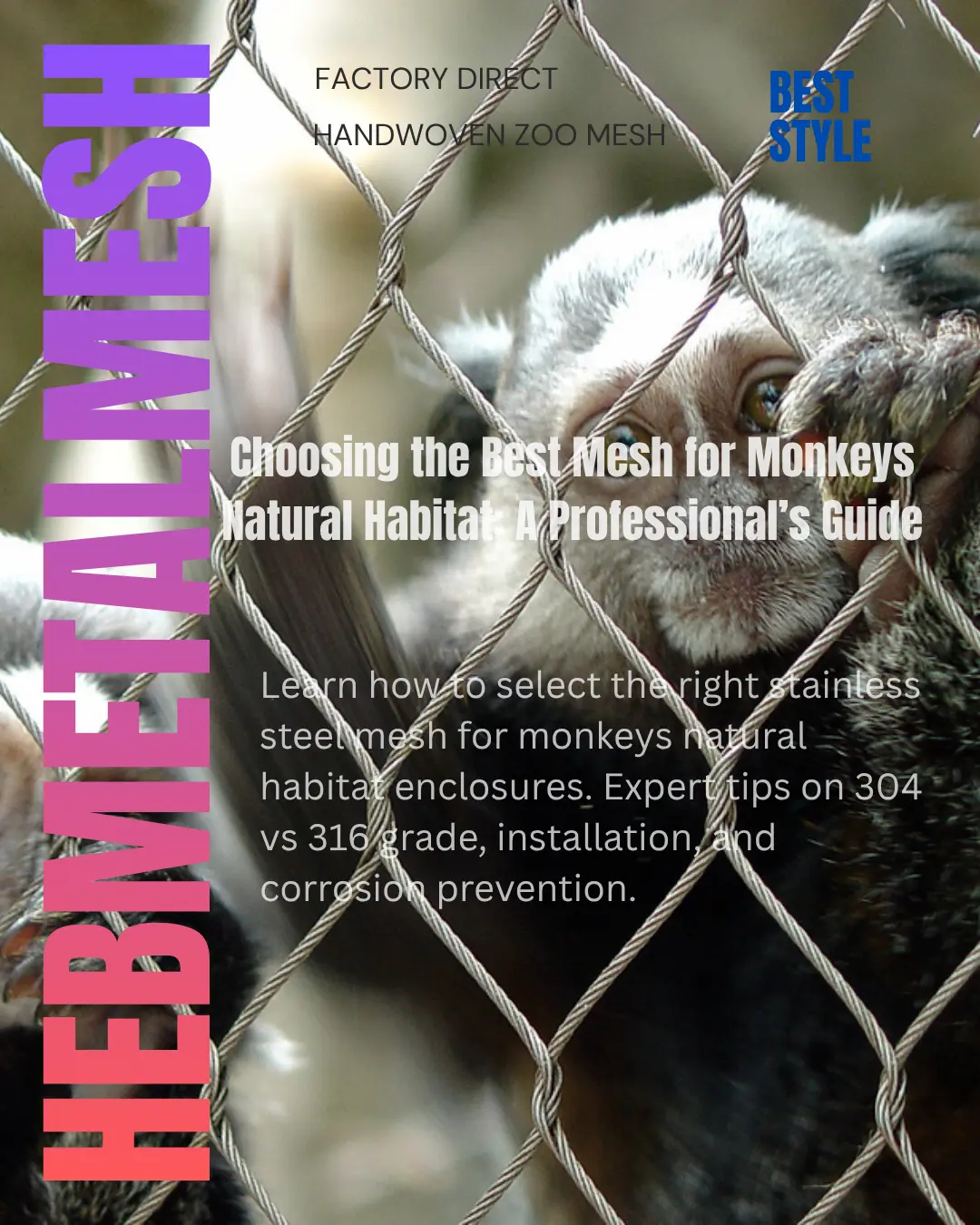
The single most important decision in any stainless steel netting project is the alloy grade. Both 304 stainless and 316 stainless belong to the austenitic family, which means they are non-magnetic, highly formable, and naturally corrosion resistant through a chromium oxide passive layer.
- 304 stainless contains roughly 18% chromium and 8% nickel. It is the workhorse grade for inland, low-chloride environments — aviaries away from the coast, indoor displays, and most farm fencing.
- 316 stainless adds 2–3% molybdenum, which dramatically improves resistance to chlorides and salt spray. For marine zoos, coastal aviaries, and any animal enclosure netting exposed to fertilizer or urine, 316 is the safer long-term choice.
According to ASTM International grading for austenitic stainless steels, the molybdenum in 316 is what pushes its pitting-resistance equivalent above the threshold needed for aggressive environments (ASTM A480 general requirements for flat-rolled stainless). For most outdoor stainless steel netting exposed to weather, 316 pays for itself by avoiding the replacement cycle that cheaper alloys force. For a deeper dive into material grades and their specific applications across different animal species, visit our Animal Enclosure Mesh product page, where we break down the recommended specifications for various zoo and wildlife habitats.
Hand-Woven vs Welded: Why Inox Netting Outperforms
The term inox (from the French inoxydable) is simply stainless steel by another name, but it signals a European quality tradition of long-lasting wire products. Welded mesh is rigid: a single impact at a weld node can propagate a crack. Hand-woven hand woven steel mesh, by contrast, distributes force across the whole lattice. A bird strikes it, a monkey swings on it, a snow load presses it — and the grid absorbs the energy instead of breaking.
Learn more about the installation process and best practices in our step-by-step guide: Installing Zoo Mesh: A Step-by-Step Guide , which covers everything from measuring and planning to tensioning and securing panels.
This flexibility is why flexible stainless steel mesh has become the global standard for modern zoo design. Architects specify it not only because it is strong, but because it disappears visually, letting visitors see the animal rather than the barrier.
The corrosion math is straightforward. Inland atmospheres rarely exceed 10 mg/m²/day of chloride deposition, a level both 304 and 316 withstand indefinitely. Coastal sites can see 100–500 mg/m²/day, where 304 stainless eventually shows pitting but 316 stainless remains stable. Specifying 316 for any stainless steel netting within a few kilometers of the sea is the single most cost-effective decision in the whole enclosure budget — it trades a small material premium for the elimination of a replacement cycle.
Our Production Series Netting
As a full-line stainless steel netting manufacturer, we organize output into clear production series netting families so specifiers can match product to animal and budget.
Stainless Steel Rope Mesh (Cable Mesh)
Stainless steel rope mesh — also called stainless steel cable mesh or cable netting — is our flagship product. It is constructed from stainless steel wire ropes (typically 7 × 7 or 7 × 19 strands) joined at intersections by ferrules or hand knots. The result is a flexible stainless netting that can be tensioned flat like a wall or draped like a curtain. For specific applications, we offer a wide range of handwoven mesh products. The 1″ x 1″ Stainless Steel Aviary Netting is ideal for small songbirds and finches, while the HM2038 Handwoven Stainless Steel Netting with 1.5″ apertures is perfect for medium-sized bird enclosures and monkey fencing.
Common specifications:
AI Overview: This table offers a quick, data‑driven guide for selecting the right stainless steel netting specification. By matching aperture (mesh opening) and cable diameter to the target animal type or application, you can ensure safety, durability, and cost‑effectiveness. Use it as a starting point for your enclosure design – for custom needs, always consult with the manufacturer.
| Aperture (mm) | Cable diameter (mm) | Typical use |
|---|---|---|
| 25 – 50 | 1.2 – 1.6 | Small birds, finches, reptiles |
| 50 – 75 | 1.6 – 2.0 | Aviaries, medium birds |
| 75 – 100 | 2.0 – 2.4 | Primates, small cats |
| 100 – 150 | 2.4 – 3.2 | Large cats, hoofstock, fall protection |
Zoo Mesh Netting
Zoo mesh netting is the category name for large-aperture rope mesh used in safari parks, walk-through exhibits, and barrier systems. Because the mesh is transparent at distance, it lets designers build enclosures that feel open while meeting strict containment standards. Many facilities combine a smaller animal enclosure mesh panel at the lower visitor interaction zone with a larger-aperture panel above. For large-scale aviary projects, our Heavy Duty Bird Netting for Large Scale Aviaries guide provides expert insights on material selection, structural engineering, and long-term durability for commercial zoo exhibits.
Aviary and Animal Enclosure Netting
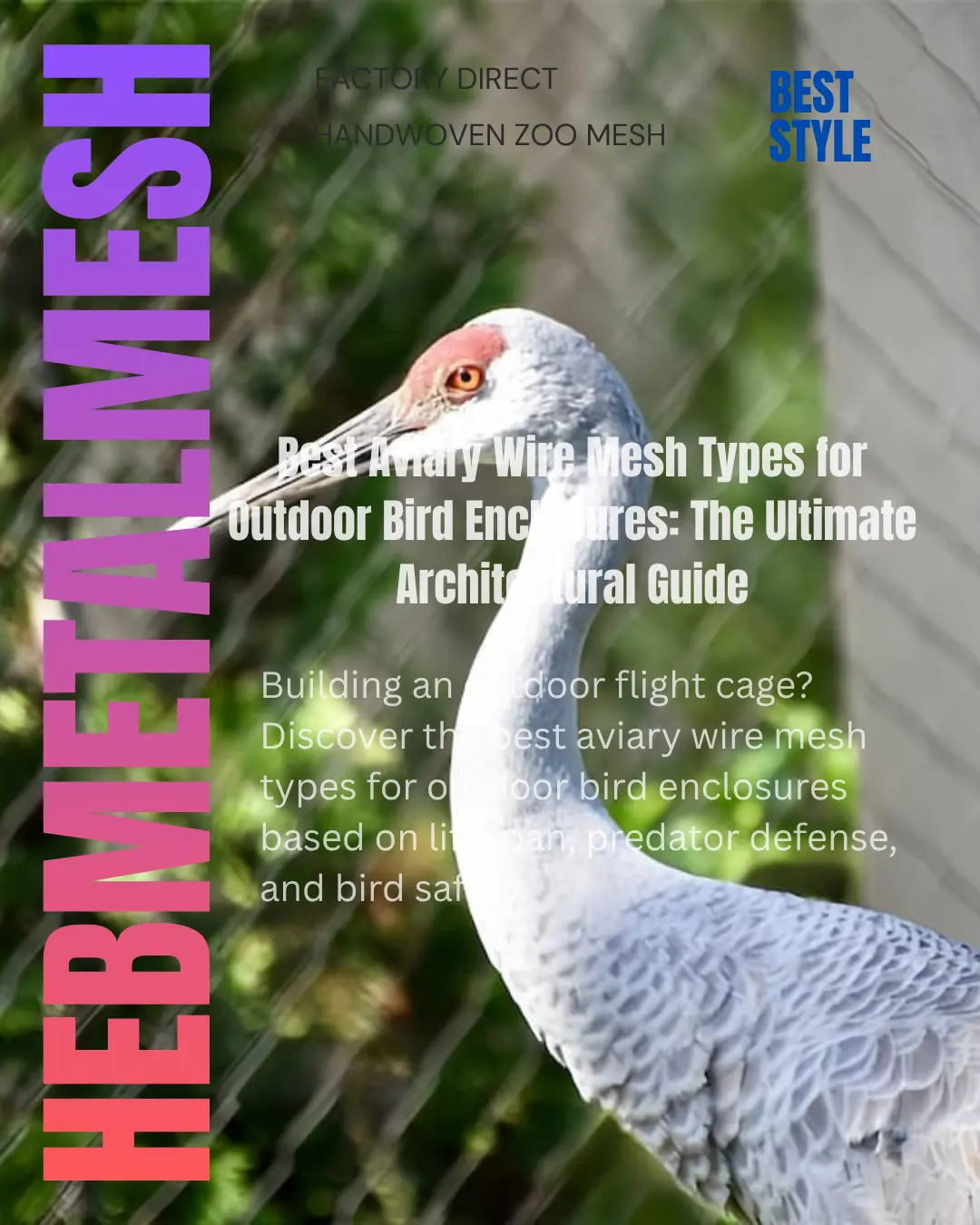
For feathered species, animal enclosure netting must avoid feather and foot entrapment. Our smaller apertures (25–50 mm) and smooth ferrule finishes prevent the snagging that welded grids cause. The same handwoven stainless steel mesh works for bat houses, butterfly pavilions, and reptile walkways. Explore our Wire Mesh for Aviary – Uses and Advantages guide to learn more about how aviary wire mesh protects birds from predators while providing proper ventilation and a safe environment.
Flexible Stainless Steel Mesh for Farms & Greenhouses
Beyond zoos, flexible stainless netting secures poultry runs, protects orchards from birds, and reinforces greenhouse structures. A farmer in a coastal region told us his previous galvanized mesh rusted through in three seasons; switching to 316 stainless steel netting eliminated the annual replacement entirely.
How Hand-Woven Stainless Netting Is Made
Inside our Ketong metal mesh workshop in Hebei, production follows a disciplined sequence:
- Wire drawing & rope twisting — stainless rods are drawn to precise diameters, then twisted into 7 × 7 or 7 × 19 cable.
- Cutting to length — ropes are cut to the panel dimension with a tolerance of a few millimeters.
- Hand weaving / ferrule joining — skilled workers lay the lattice on a jig and crimp ferrules at each crossing, or knot the intersections for a fully seamless look. For primate enclosures requiring maximum flexibility and impact absorption, our 2″ x 2″ x 3/32″ Gibbon Enclosure Netting is the professional standard for brachiation habitats, engineered specifically for high-agility primates like gibbons and siamangs.
- Tensioning & edge finishing — the grid is stretched square, and edges are capped or cabled for clean installation.
- Inspection — every panel is checked for aperture consistency and surface defects before packing.
Because the weaving is done by hand, we can produce non-standard shapes — triangles, cylinders, and tensioned ceilings — that a machine loom cannot.
Choosing the Right Mesh Specification
Picking the correct stainless steel netting comes down to three variables:
- Aperture (opening size): Must be smaller than the smallest animal part that could pass or get stuck. Rule of thumb: opening < one-third of the animal’s head width for birds.
- Cable diameter: Larger species and higher impact loads need thicker cable. A 3.2 mm 7 × 19 rope handles big-cat containment; a 1.2 mm rope suits small aviaries.
- Grade: 304 stainless for dry inland use; 316 stainless for coastal, marine, or high-ammonia environments.
When in doubt, send us the species and the enclosure drawing. As a stainless steel netting manufacturer, we will recommend a specification rather than oversell the most expensive option. For apex predator habitats, our Handwoven Stainless Steel Lion Enclosure Mesh – 1/8″ Cable x 3″ Mesh provides extreme structural integrity with high-transparency aesthetics, engineered to withstand the physical force of large carnivores while maintaining an elegant, nearly invisible barrier.
Applications by Industry
AI Overview: This table maps key industries to the most suitable stainless steel netting products and explains the primary benefit of each solution. Whether you are designing a zoo exhibit, protecting poultry, or installing architectural fall protection, this guide helps you quickly identify the right mesh type. For challenging environments like marine or coastal settings, 316-grade stainless is recommended for its superior corrosion resistance.
| Industry | Recommended product | Why it fits |
|---|---|---|
| Zoos & safari parks | Zoo mesh netting, cable mesh | Transparent barrier, high strength |
| Aviaries | Small-aperture rope mesh | No feather snag, lightweight |
| Farms & poultry | Flexible stainless netting | Predator-proof, rust-free |
| Architecture & safety | Stainless steel cable mesh | Fall protection, façade greening |
| Marine / coastal | 316 animal enclosure mesh | Salt-spray resistance |
Beyond the applications listed above, our stainless steel mesh is also widely used for tiger exhibits, tiger venues fencing, and tiger barrier netting . The lightweight yet durable construction provides significant impact resistance and a long product life cycle, making it safe for keeping animals secure and protected.
Why Hebmetalmesh — Hebei Metal Mesh Since Day One
Hebmetalmesh grew out of the dense metal-mesh manufacturing cluster in Hebei, China — the same region that earned the shorthand Hebei metal mesh a reputation for wire-product expertise worldwide. Operating under our Ketong metal mesh production identity, we combine local supply-chain scale with export-grade quality control.
For larger enclosure projects requiring extensive coverage, our 4″ x 4″ Handwoven Stainless Steel Mesh Rolls come in 30′ x 60′ rolls with multiple cable diameter options, providing ample coverage for perimeter fencing, deer enclosures, and large-scale animal habitats.
What sets a dedicated manufacturer stainless netting apart is accountability. The factory that weaves your hand woven stainless netting is the factory that answers your warranty question. There is no importer in the middle rebranding an unknown source. For project managers, that means faster lead times, traceable material certificates, and a direct line to the people who built the mesh.
Installation & Tensioning Best Practices
A hand woven stainless netting panel only performs as well as its frame and tension. Three rules keep the mesh square and long-lived:
- Build a rigid perimeter. The grid needs a structural frame — steel tube, angle iron, or tensioned cable — that will not sag. A loose panel flaps, fatigues, and eventually stretches.
- Tension evenly. Pull the stainless steel cable mesh from all four edges at once, then lock it. Uneven tension creates permanent bias in the lattice and weakens containment at the slack corner. For detailed guidance on mesh selection, aperture sizing, and supplier evaluation, refer to our comprehensive gibbon enclosure supplier guide , which covers material specifications and procurement considerations for professional zoo projects.
- Protect the edges. Cap cut cables and seal ferrule ends so no strand can unravel. For animal enclosure mesh at visitor contact height, a smooth top rail prevents clothing or feather catches.
Most installation failures we see are frame failures, not mesh failures. The handwoven stainless steel mesh itself, properly graded, simply outlasts the structure around it.
Frequently Asked Questions
304 stainless is ideal for inland, dry environments, while 316 stainless adds molybdenum for superior resistance to salt, chlorine, and ammonia — the conditions found in coastal zoos and fertilizer-exposed farms.
For dynamic loads, yes. Hand woven steel mesh flexes and distributes impact across the whole grid, whereas welded joints are rigid stress points that can crack.
Absolutely. Because our handwoven stainless steel mesh is woven by hand on a jig, we produce custom panels, cylinders, and tensioned ceilings to your drawing.
With proper grade selection (316 near coast), stainless steel rope mesh commonly serves 20+ years with only occasional rinsing — far longer than galvanized or PVC-coated alternatives.
Yes. Every order ships with specification sheets and mounting notes, and our team advises on tensioning and frame design for animal enclosure netting projects.
Conclusion
A stainless steel netting manufacturer lives or dies by consistency, material honesty, and the ability to match mesh to animal. Hebmetalmesh delivers all three through our Hebei production lines and Ketong metal mesh workshop — from small-aperture aviary panels to large-aperture zoo mesh netting and flexible farm fencing. Our hand woven stainless netting in 304 and 316 stainless gives you a corrosion-proof, nearly invisible barrier built to outlast the enclosure around it.
Ready to specify your project? Contact our team with your species, aperture needs, and drawing — we will return a tailored quotation.