
Executive Summary
Most aviary enclosures do not fail all at once. They fail at one detail: a rusted cut edge, a loose fastener, a sagging span, or a 1/4″ gap under a door. In field inspections, corrosion and slack tension cause the majority of escapes and predator break-ins. Galvanized wire fails first, usually within three to five years outdoors, because zinc flakes off and the steel underneath rusts. Welded joints crack next, since each weld is a stress point. Stainless steel wire rope mesh removes both failure paths, but it still needs correct hardware and correct tension. The nine cases below come from real enclosure problems. Each one includes the warning sign and the fix, so you can catch the issue before a bird finds it.
Need the Right Mesh for Your Birds? Get a Free Quote
Send us your bird species, enclosure size, and climate. We return a graded stainless steel mesh recommendation and a custom price within 24 hours.
Request My Free Quote →Key Takeaways
- Corrosion and slack tension cause most aviary mesh failure, not bird damage.
- Galvanized wire sheds zinc, which poisons hook-billed birds and rusts the steel beneath.
- Galvanized bolts on stainless mesh corrode within one season through galvanic action.
- Sagging mesh stretches the aperture, and a stretched 1″ opening becomes an escape route.
- Snow, wet leaves, and fallen branches load a roof far harder than birds do.
- Quarterly inspections catch nearly every problem while it is still cheap to fix.
- A buried mesh apron or concrete footing stops the digging predators that kill birds at night.
Why Aviary Enclosures Fail
An aviary is a tensioned system. The frame carries load, the mesh carries tension, and the hardware transfers force between them. When one part weakens, the load moves somewhere else.
For example, a stretched perimeter cable lets the mesh sag. The sag opens the diamonds. Wider diamonds let a bird push its head through. Therefore, a corrosion problem becomes a containment problem within a season.
The Nine Most Common Failure Modes
🔍 9 Critical Aviary Failure Modes — At a Glance
Corrosion and slack tension cause the majority of aviary escapes and predator break-ins — not bird damage. Galvanized materials introduce zinc toxicity risks and galvanic corrosion when mixed with stainless. Quarterly inspections catch nearly every problem while it is still cheap to fix. The table below maps each failure mode to its root cause, warning signs, and proven fixes.
| Failure mode | Root cause | Warning sign | Fix |
|---|---|---|---|
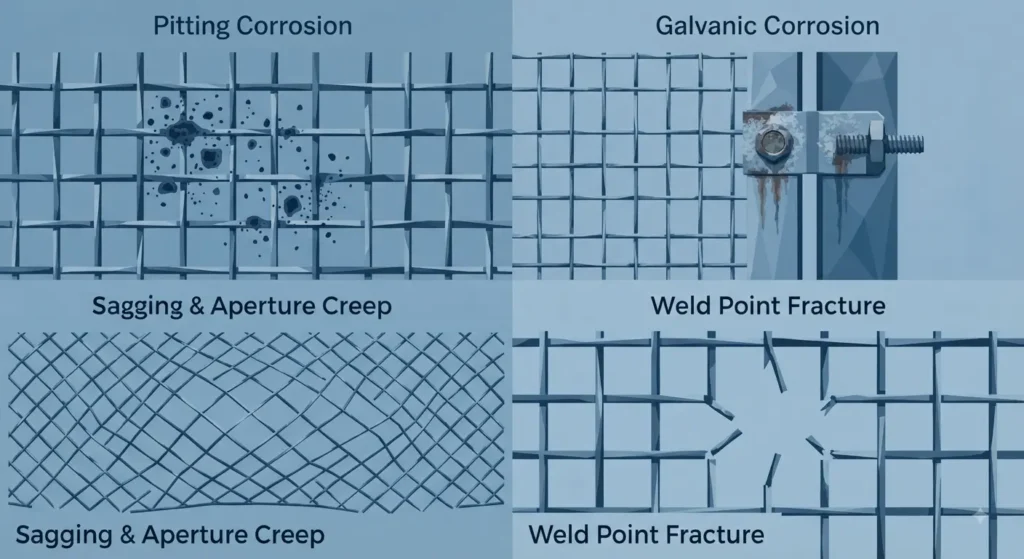
| 1Rust at cut edges | Field cutting without passivation | Brown streaks below cuts | Deburr, passivate, cap with a border cable |
| 2Pitting corrosion | Chloride in coastal or pool air | Tiny dark specks on wire | Replace with 316 grade mesh |
| 3Galvanic corrosion | Mixed metal fasteners | Rust rings at every clip | Swap to matching-grade hardware |
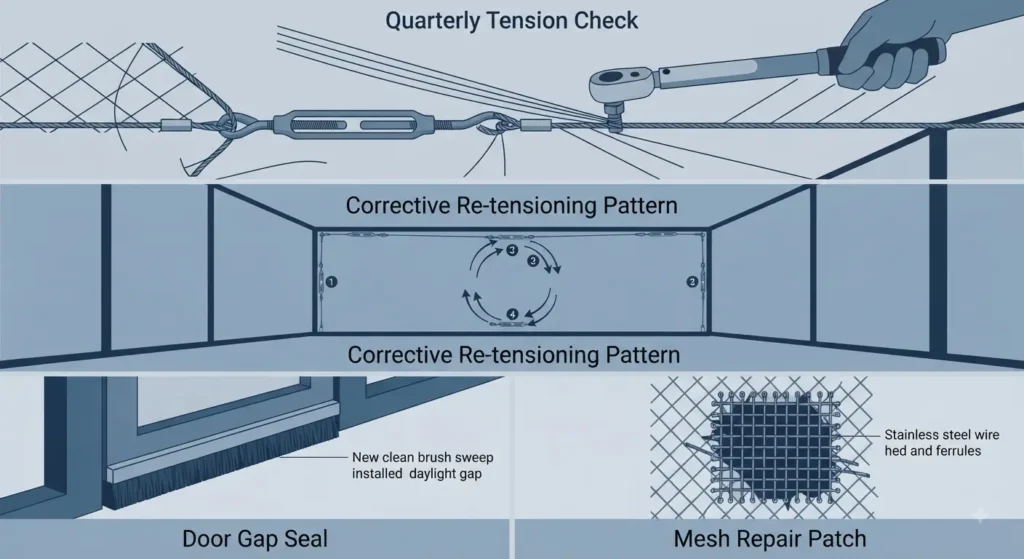
| 4Sagging and aperture creep | Under-tensioned span | Visible belly in the panel | Re-tension turnbuckles in a circular pattern |
| 5Weld point fracture | Rigid welded joints under flex | Snapped intersections | Move to hand-woven rope mesh |
| 6Zinc flaking | Galvanized coating wear | White powder, chewed spots | Replace with uncoated stainless |
| 7Door and sill gaps | Frame settling or worn hinges | Daylight at the threshold | Fit a bottom sweep and adjust hinges |
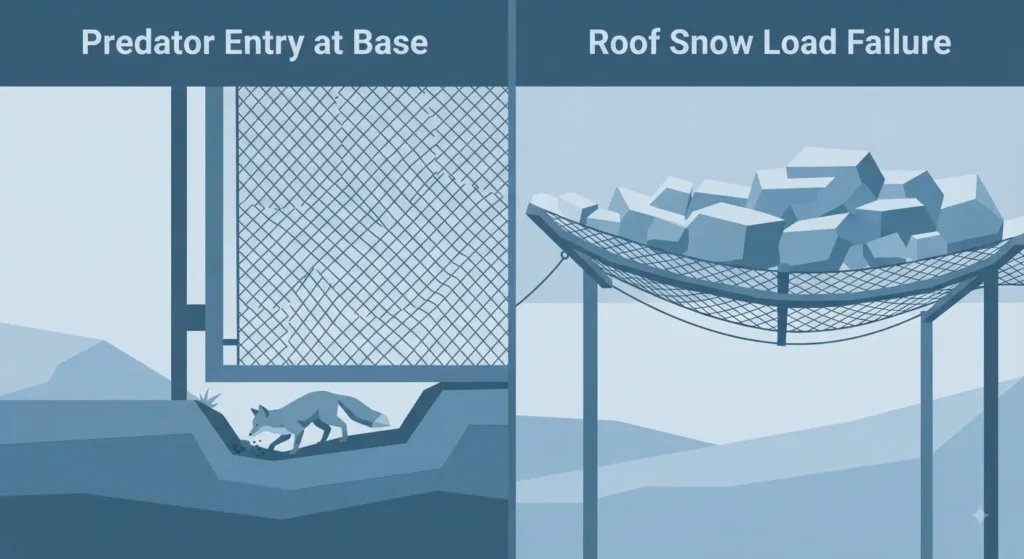
| 8Predator entry at the base | No apron or footing | Digging marks along the wall | Bury a 12″ apron or pour a footing |
| 9Snow and branch overload | Roof span not rated for load | Bowed roof cables | Add intermediate supports, trim overhanging limbs |
Case 1 and 2: Rust and Pitting
A Florida park installed 304 mesh in an outdoor coastal flight. Pitting appeared within 18 months. By year five, the panels needed replacement. An adjacent enclosure built with 316 mesh showed no corrosion after 15 years.
The lesson is simple. Within five miles of salt water, 316 is not an upgrade. It is the baseline. Molybdenum protects the chromium passive layer from chloride attack.
Case 3: Galvanic Corrosion at the Fasteners
A breeder secured stainless mesh with galvanized hog rings from a farm store. Rust rings formed at every clip inside six months. The mesh was fine. The hardware was not.
Match every component to the mesh grade. That includes rings, ferrules, turnbuckles, eye bolts, and lacing wire.
Case 4: Sagging and Aperture Creep
Rope mesh is flexible by design. Consequently, it must be tensioned, not just fastened. Mesh tacked to a frame with staples will belly out within a year.
Run a 6 mm stainless perimeter cable through eye bolts. Tension with turnbuckles until the surface is drum-tight and the diamonds sit even. Then re-check after 30 days, because tension always settles.
Case 5 and 6: Welded Panels and Galvanized Coatings
Welded panels look rigid, but each weld is a hard point. Bird impact and thermal movement flex the wire, and the weld cracks before the wire does.
Galvanized panels add a second problem. Parrots strip the zinc while climbing. Zinc poisoning, sometimes called new wire disease, causes feather plucking, kidney damage, and seizures. There is no safe way to keep hook-billed birds on galvanized wire.
Case 7: Doors and Sills
Doors move. Hinges wear, frames settle, and a 1/4″ gap opens at the bottom.
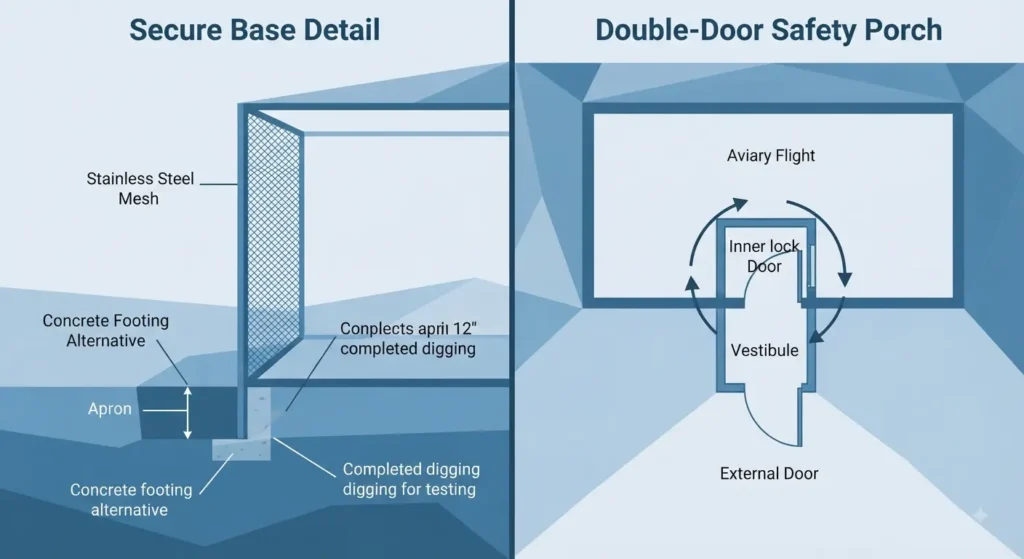
Fit a brush sweep or a stainless threshold plate. In addition, build a double-door safety porch so a single gap never leads straight outside. Our notes on designing the perfect walk-in aviary cover vestibule sizing and door swing.
Case 8: Predators at the Base
Foxes, raccoons, and rats dig. A wall that stops at grade level stops nothing.
Bury a mesh apron 12″ down and 12″ outward, or pour a continuous concrete footing. Both details turn the base into a solid barrier.
Case 9: Snow, Leaves, and Branches
Roof failures rarely come from wind. They come from weight. Wet snow at 12″ deep adds serious dead load across a wide span.
Increase cable diameter to 5/64″ or 1/8″ in snow country. Also add intermediate support posts and keep tree limbs trimmed back at least 10 ft.
How a Small Gap Becomes a Big Problem
Failures rarely announce themselves. They creep.
Take a single loose eye bolt on a 10 ft span. The cable slackens by 5 mm. The mesh bellies slightly, and the diamonds open from 1″ to about 1 1/8″. That is still invisible from ten feet away.
Then a young conure finds the widest diamond and pushes its head through. Meanwhile, the same slack lets the panel flutter in wind, which loosens the neighboring bolts. Within one season, an entire wall runs slack.
The fix at week one costs one wrench turn. The fix at month nine costs a full re-tension and a new lacing run. Therefore, treat small tension changes as urgent, not cosmetic.
One more pattern shows up often. Owners tighten a single corner to pull out a sag. That move puckers the panel and shifts load onto two anchors. Always work turnbuckles in a circular pattern instead.
Material Lifespan in Real Service
🧪 Material Lifespan & Bird Safety — What Lasts?
Stainless steel rope mesh (304 inland / 316 coastal) offers the longest service life (30+ years) and is non-toxic, but 304 can pit in chloride-rich air. Galvanized welded wire poses a zinc toxicity risk for hook-billed birds, while PVC-coated wire and netting degrade much faster. For coastal aviaries, 316 grade is the clear choice — it resists pitting and remains bird-safe for decades.
| Material | Typical outdoor life | Main failure mode | Bird safety |
|---|---|---|---|
| Nylon or polyethylene netting | 3–7 years | UV breakdown, tearing | Safe, but chewable |
| PVC-coated wire | 3–5 years | Coating splits, wire rusts | Coating flakes off |
| Galvanized welded wire | 5–10 years | Zinc loss, weld rust | Zinc toxicity risk |
| Aluminum mesh | 10–12 years | Soft, deforms on impact | Safe, low strength |
| 304 stainless rope mesh | 30+ years inland | Pitting in chloride air | Non-toxic |
| 316 stainless rope mesh | 30+ years coastal | Very few in service | Non-toxic |
Numbers vary with climate. Still, the ranking holds in every field survey we have run.
An Inspection Schedule That Works
⏱️ Inspection Rhythm — Catch Issues Before Birds Do
Most aviary failures start small — a loose latch, a 1/4” gap, or a sagging span. The schedule below is your early warning system. Weekly checks catch escape routes, monthly checks catch wear, and quarterly tension audits prevent structural creep. Always inspect after storms; debris and snow add unexpected loads. Following this rhythm turns a half-day annual audit into a preventive measure, not an emergency repair.
| Interval | What to check | Time needed |
|---|---|---|
| Weekly | Door latches, sill gaps, obvious damage | 5 minutes |
| Monthly | Fastener tightness, lacing wire, base apron | 20 minutes |
| Quarterly | Tension across every span, corrosion spots | 1 hour |
| After every storm | Roof deflection, fallen debris, cable anchors | 30 minutes |
| Annually | Full hardware audit, turnbuckle adjustment | Half a day |
Write the results down. A dated log shows drift over time, and drift is what you want to catch.
Repairs That Actually Hold
- Clean the damaged area and cut away crushed or broken cable.
- Cut a patch that overlaps the hole by at least 6″ on every side.
- Lace the patch in with matching-grade 1.2 mm stainless lacing wire.
- Close the seam with stainless ferrules and a proper swaging tool, not hand pliers.
- Re-tension the surrounding span so the patch carries load evenly.
- Mark the repair on your inspection log and re-check it in 30 days.
Avoid two shortcuts. Do not use plastic zip ties as a permanent fix, because UV makes them brittle. Do not patch stainless with galvanized wire, because you will simply start a new corrosion cell.
Build Specs That Prevent Most Failures
- Hand-woven stainless steel wire rope mesh, 304 inland or 316 coastal.
- Aperture one size tighter than the adult bird requires.
- Cable diameter matched to beak strength: 3/64″ for finches, 1/16″ for mid-size parrots, 1/8″ for macaws.
- Stainless perimeter cable, eye bolts, turnbuckles, and hog rings in the same grade.
- Rolls sized to reduce seams, up to 30 ft x 60 ft.
- Buried apron or footing at every wall base.
- Double-door porch on every walk-in entry.
Smaller builds follow the same rules. This small bird cage build with wire rope mesh shows the same hardware logic at a compact scale, and you can order matching rolls from our aviary mesh and bird netting range.
Frequently Asked Questions
Why does my aviary wire rust even though it says rustproof?
Most “rustproof” wire is galvanized, not stainless. The zinc layer wears at cut ends and contact points, and the steel underneath rusts. Only uncoated stainless steel has corrosion resistance through the whole wire.
How tight should aviary mesh be tensioned?
Aim for drum-tight. The surface should feel firm, show even diamonds, and give a clear tone when tapped. It should still flex slightly under a bird strike, since rigid mesh injures birds on impact.
Can I repair a hole in stainless aviary mesh myself?
Yes, for small damage. Lace in a patch with matching stainless wire, overlap by 6″, and swage the ferrules properly. Large tears or roof damage need a professional crew with tension gauges.
What gap size lets predators into an aviary?
A rat passes through 3/4″, a weasel through 1″, and a snake through less. Therefore, a 1″ x 1″ aperture is the practical limit for a predator-resistant enclosure, and 3/4″ is safer for small birds.
How often should I inspect an outdoor aviary?
Check doors and latches weekly, hardware monthly, and full tension quarterly. Add an extra inspection after any storm, heavy snow, or falling branch.
Talk to an Aviary Mesh Engineer
Not sure about wire diameter or aperture? Our team helps zoos, breeders, and backyard keepers spec the safest, longest-lasting mesh.
Get Expert Help →