
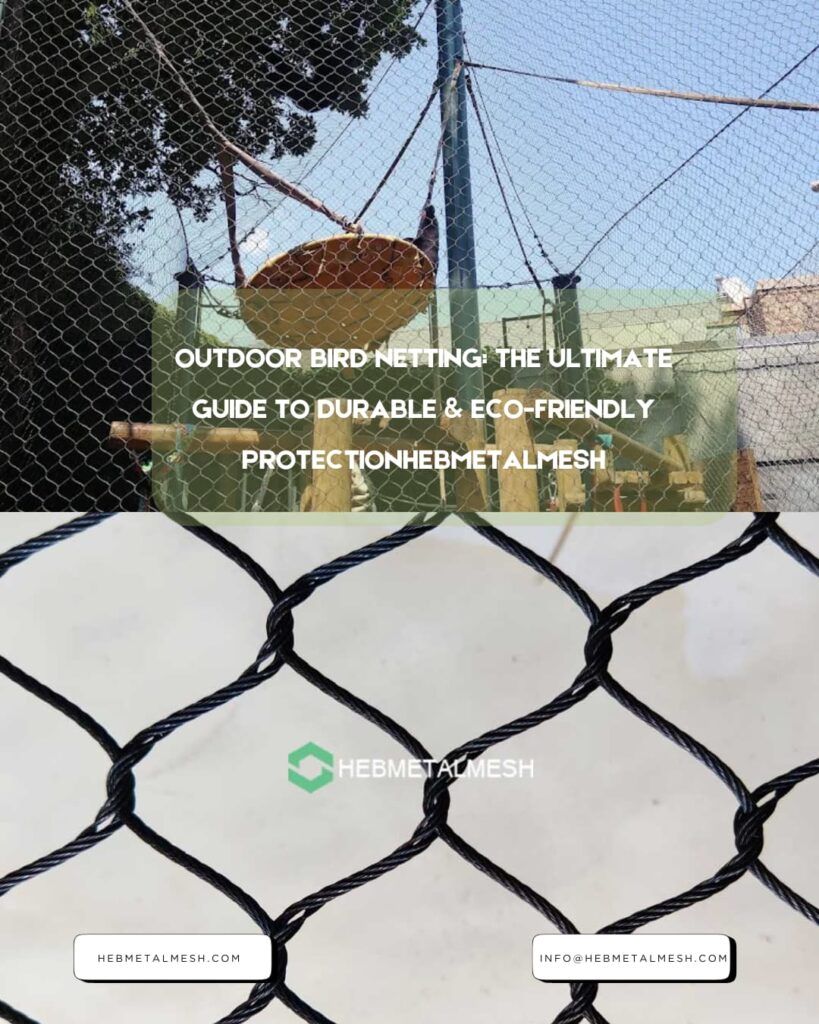
Most bird problems do not end when a net goes up. They end when a net stops having to go up again. That sounds like a slogan until somebody prices it, and then it becomes the only number that matters: how many rolls of netting will the same wall need over the next thirty years. A plastic bird net is a consumable, bought on a cycle and thrown away on a cycle. A woven stainless panel is an asset. Avian exclusion mesh exists because the second answer ends the cycle.
Executive Summary
Avian exclusion mesh is stainless steel cable hand-woven into a flexible panel and fixed across an opening so birds cannot pass, land or roost, and it replaces plastic netting because the two products are bought on completely different timescales. Three consequences follow. First, the material decision is a whole-life decision: plastic degrades under ultraviolet light within a few seasons and arrives on site as a maintenance item, while a woven stainless panel is specified once against the exposure it will face. Second, the specification has to be built around the two numbers that actually decide the outcome — the aperture a bird must not pass and the fixing that holds the panel under load — because a correct alloy fitted badly fails sooner than an average alloy fitted well. Third, end of life has to be planned before the order, because steel returns to the melt and plastic does not; a netting environmental impact the buyer never quantified at purchase becomes a disposal problem a decade later. The reference specification is the avian exclusion mesh product page.
Replacing a net you buy every few seasons with a panel you buy once? Send us the opening, the birds that must be excluded and the exposure, and we will confirm the aperture, the cable and the fixing detail that holds it.
Quick Answer: What Is Avian Exclusion Mesh?
It is a hand-woven stainless steel cable panel — usually 1.2 mm to 3.2 mm cable, with apertures from 20 mm to 102 mm — fixed across facades, roofs, courtyards, car parks and enclosures to keep birds out by removing the opening rather than by persuading the bird to leave. That is the difference the name carries. Exclusion is structural; deterrence is behavioral. A spike, a gel or a recorded distress call asks a bird to change its habit, and a bird that ignores the request has beaten the product. A woven panel does not ask.
Key Takeaways
- A plastic net is replaced several times over the working life of a single stainless panel.
- Aperture and fixing decide performance; the alloy decides how long they keep deciding it.
- Grade 316 is bought for chloride exposure, not for prestige.
- Exclusion is a structural job and deterrence is a behavioral one, and they are not interchangeable.
- Stainless steel returns to the melt at end of life, which changes the disposal cost of the whole project.
The Net You Buy Twice
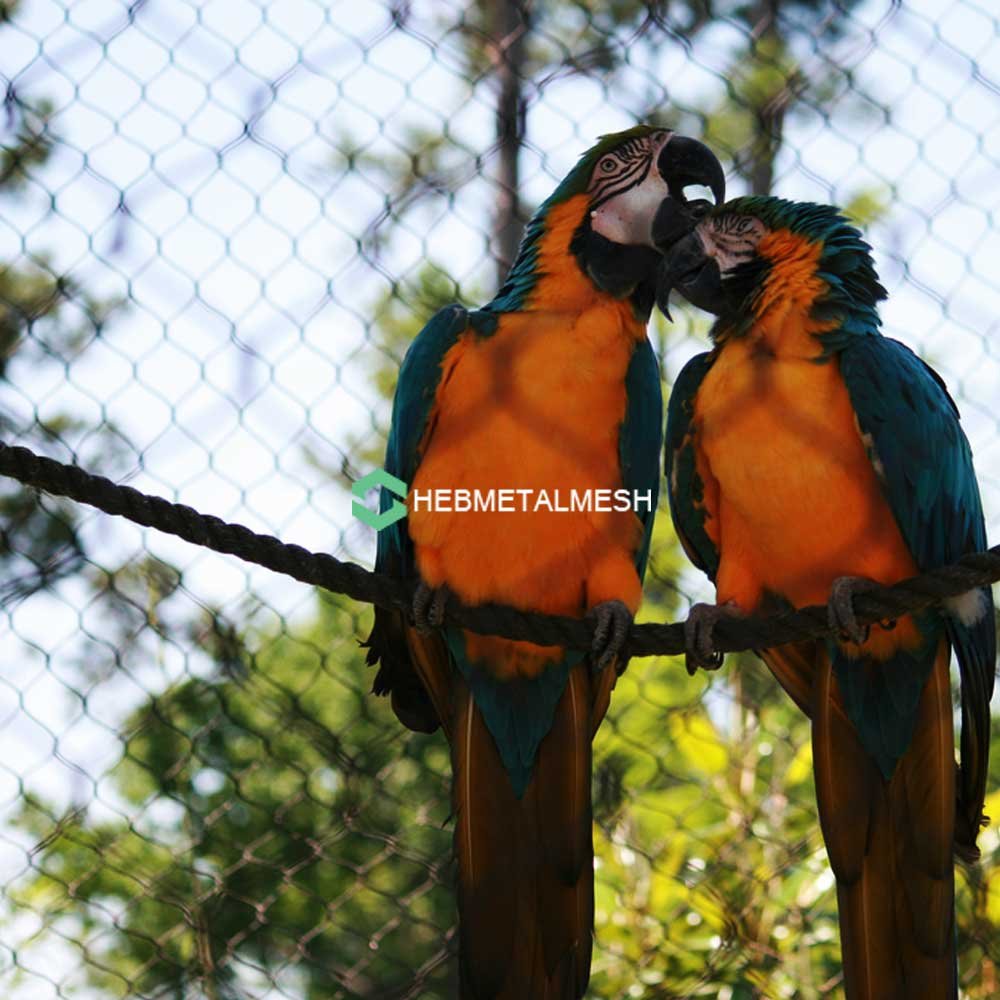
Plastic bird netting fails on a schedule the material sets, not the installer. Ultraviolet light embrittles the filaments, wind fatigue cracks them at the fixings, and the first winter storm that tears a corner begins a repair cycle that never quite finishes. The rolls are cheap and the access is not. A boom lift, a scaffold tower or a rope team hired to reach a facade costs more than the netting it replaces, every time, and that is the trap of a low purchase price: the replacement is not the roll, it is the visit.
So the comparison is never stainless against plastic on the shelf. It is one purchase against a subscription. A stainless rope mesh panel compared with plastic netting costs more on the first invoice and less across the decade, because the second invoice never arrives.
What Avian Exclusion Mesh Actually Is
The product is a mesh, not a screen. Cable is woven at the crossing points into a diamond pattern that stays flexible, so the panel can be dressed over a pitched roof, pulled tight around a corner and still absorb a bird strike without work-hardening at the joints. Aperture comes from the smallest bird that must be excluded; cable diameter comes from the span and the load. An avian exclusion mesh specification therefore is two decisions and one qualifier — the aperture, the cable, and the alloy both are drawn in.
Panels are woven up to 9 m by 18 m, which matters more than it sounds: fewer joints mean fewer weak points, and fewer places for a determined small bird to find a gap. Dimensions are quoted in millimeters, and the standard constructions are recorded as an HM figure — HM1220, HM1625, HM2076, HM3276 and HM32102 — where the digits carry cable diameter and aperture in one code. Knowing what bird netting is meant to do makes those codes easy to read.
Grade 304, Grade 316, and the Molybdenum Question
Both grades are austenitic stainless, and both will outlast the paint on the wall behind them. The difference is what they tolerate. Grade 304 carries roughly 18 percent chromium and 8 percent nickel and performs well inland, away from chlorides. Grade 316 adds molybdenum, and that addition is the entire point: molybdenum content is what raises resistance to pitting in salt-laden air, so a coastal exclusion mesh or a marine grade exclusion mesh is a 316 specification, not a marketing tier.
Two corrosion details decide whether the grade you bought is the grade that performs. The first is bimetallic corrosion — put stainless fixings directly against galvanized steel or aluminum and the less noble metal becomes the anode, which is why a separator belongs in the detail. The second is a corrosion allowance: drawing the cable one size up so that decades of surface loss never reach the load path. Surface condition matters as well, and electropolishing strips the free iron left by drawing so the passive layer forms evenly across the wire. None of this is exotic. It is the difference between a panel that was specified and one that was merely ordered.
Aperture and Fixing: Two Numbers That Decide the Job
Aperture is bought as a nominal figure and delivered as a band. Hand-woven mesh is a textile, and a textile holds a range rather than a dimension, so the number that decides containment is the widest opening in the panel, not the average. Ask a supplier for the aperture band they can hold and the worst opening they would ship, and two quotations finally become comparable.
Fixing is where most installations are lost, because a panel is only as permanent as the detail that holds it. The perimeter belongs on a continuous edge cable, and the edge cable belongs on a standoff bracket so the mesh never chafes against the surface it is protecting. Every anchor has a pullout strength, and if that figure was never checked against the wind load on the panel, the mesh is being asked to carry a load its fixings were never designed for. An avian exclusion mesh installation is a fixing design with a mesh attached, not the reverse — the principle behind choosing the right netting for a bird aviary on every project.
Where a facade is irregular, with deep reveals, louvres or plant screens, a flexible avian exclusion mesh earns its place, because it can be dressed around obstructions a rigid panel would have to be cut around.
Where Avian Exclusion Mesh Pays for Itself
The sites that adopt it first are the ones where access is hardest and the asset underneath is worth the most. Avian exclusion mesh for car parks answers a problem no deterrent solves, because the damage is done by birds roosting over parked vehicles and by the droppings that follow. Avian exclusion mesh for solar farms protects an array from roosting flocks whose deposits shade cells and quietly cut output. Avian exclusion mesh for vineyards closes the fruit zone at the exact week birds would otherwise harvest it first. Avian exclusion mesh for facades handles the architectural case, where the client wants the barrier to disappear into the building instead of announcing itself.
The common thread is not the bird. It is the cost of getting up there. A complete guide to netting buildings works the same arithmetic for roofs and elevations, and netting for bird control in rural areas covers the agricultural version, where the barrier protects a crop rather than a surface.
Designed Around Birds, Not Just Buildings
Matching the mesh to the bird matters more than matching it to the building. Pigeon exclusion mesh is specified tight, around 50 mm, because a pigeon is a heavy bird that lands rather than squeezes. Gull exclusion is the opposite problem: the bird is larger still and arrives with momentum, so the aperture can be wider but the fixing has to resist a landing that carries weight. Small passerines are the real test, because a finch or a sparrow needs only a few millimeters of drift to find a way through — which is why the band matters more than the number on the drawing.
The End of the Line
Every barrier comes down eventually, and what it becomes is decided at purchase. A plastic net is landfilled or burned after a few seasons of ultraviolet damage, and its netting life cycle assessment is poor at both ends: a fossil feedstock in, a mixed waste stream out. A stainless panel goes back to the melt and returns as new steel, so the netting recyclability of the product is high and the netting waste reduction across a whole project is real.
That is the argument the Ellen MacArthur Foundation makes about materials designed to circulate rather than to be consumed, and it lands with unusual clarity here: the panel that ends its first life as a bird barrier can begin its next life as anything made of steel. Planned maintenance is trivial beside that. Checking tension and fixings once a year is the whole schedule, and a panel that was specified correctly seldom asks for more.
FAQ
Not in practice. Bird netting usually describes a light plastic mesh hung from hooks and replaced every few seasons. Avian exclusion mesh is a woven stainless steel panel fixed permanently across an opening. Both exclude birds; only one is built to stay.
Match it to the smallest bird you must exclude, then ask for the band rather than the nominal. Around 50 mm handles pigeons; small passerines need 20 mm to 25 mm. The widest hole in the finished panel is the figure that decides whether the job works.
Inland, usually. Within a few kilometers of salt water, or on a site with heavy industrial fallout, the molybdenum in 316 pays for itself in avoided pitting. Establish the exposure before choosing on price.
Long enough that the fixings, not the mesh, are normally the item to inspect. Woven stainless is commonly specified for 25 to 30 years of service, and the panels carry a 30-year guarantee.
Specifying a permanent barrier on a site that cannot be closed twice? Send us the birds, the opening sizes and the exposure. We will return the aperture band, the alloy and the fixing detail, with the sample we would retain against it.
Buying the last barrier the wall will need, rather than the next one? Our stainless steel bird netting is woven to a stated band and shipped with the sample that proves it.