
Netting a fence is not a purchase. It is a closure project, and it is settled in four places where the mesh has to stop and start. Buy the best panel made, hang it between two posts and leave a hand’s width of daylight at the bottom, and the boundary does not hold. Fence gap sealing is the discipline of closing those junctions — the ground line, the corners, the gate openings and the run ends — because that is where a fence run either becomes a barrier or stays a suggestion. This guide works through each junction in turn, with the details and dimensions that decide whether the finished boundary is worth specifying.
Executive Summary
Netting a fence is a closure problem before it is a material problem, and the material is the easy half. Three consequences follow. First, the ground line is the junction that fails most often and costs the least to put right, because a straight run of mesh carried below grade to a working burial depth outperforms any number of extra posts. Second, corners and gate openings are geometry problems rather than material problems: an unbraced corner lets a tensioned panel pull its post out of line, and an unrestrained gate clearance leaves a permanent hole that a determined animal will find. Third, the specification has to be written for the junctions and not just for the field, because a 20 mm aperture delivered only across the middle of a panel is a nominal figure, not an achieved one. The reference specification is the animal fence mesh product page.
Closing a boundary that cannot be allowed to leak? Send us the fence line, the ground conditions, and what has to be kept in or out. We will return the junction details that finish the job.
Quick Answer: What Is Fence Gap Sealing?
Fence gap sealing is the practice of closing every interruption in a netting boundary: the line where the mesh meets the ground, the inside and outside of every corner, the clearance that a gate or door creates, and the two ends of the run. It is not a sealant job. It is a set of fabrication details — a mesh apron carried past the fence line and pinned, a braced corner post, a gate that closes against a stop on its own frame rather than against the panel, and a termination that ties the mesh back to structure. The wider menu of formats sits in our fence netting mesh guide.
Key Takeaways
- A boundary is only as closed as its loosest junction, and the loosest is almost always at the bottom.
- Corners need a brace, not more tension; the load path has to leave the mesh and reach the ground.
- A gate should close against a stop on its frame, never against the panel.
- Burial depth and apron width are specified together, measured from finished ground level.
- Every junction should be inspectable without dismantling any part of the fence.
The Run Is Only as Sealed as Its Junctions
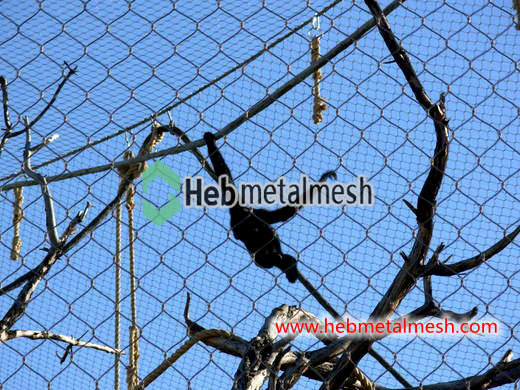
Most of the budget in a boundary netting project goes into the field of the fence — the long, straight, visible part. Most of the failures happen somewhere else. A perimeter gap closure is rarely defeated in the middle of a panel. It is defeated at the four places where the panel has to stop: at grade, at a corner, at an opening, and at the end of the run. That is why experienced specifiers treat fence gap closure as four separate design problems rather than one, and why a quotation listing only aperture, cable diameter and height is not really a quotation for a barrier at all. The mesh is the commodity. The junctions are the product.
The Ground Line: Where the Run Usually Leaks
Start at the bottom, because the ground line is where a boundary usually leaks first. A gap under fence is small enough to overlook on a drawing and wide enough to pass a fox, a rabbit or a young primate. Ground gap sealing is done in one of three ways, and the choice depends on what has to be stopped and what the ground will accept. The cheapest is a mesh apron: the panel continues past the line of the fence and lies on the surface for a stated width, pegged down, so anything digging at the base meets mesh rather than an opening. The most durable is ground line sealing by burial, where the panel is carried below grade and backfilled in compacted layers. The third is a hard edge — a gravel board or a low concrete upstand that the mesh ties back to — which stops the digging before it starts and keeps the panel out of wet soil.
Two numbers decide which one you need, and neither should be guessed. The burial depth is set by the deepest the target animal will dig in that soil, commonly 300 mm for a light digger and 600 mm or more for a determined one, measured from finished ground level rather than from the drawing. The mesh skirt depth matters just as much, because a skirt that is too shallow simply moves the dig a foot further out. In plan, netting to ground detail is really a section drawing, and it should show grade, the burial or the apron, the backfill, and the fixing, in that order.
On a slope the detail steps down rather than tilts, so the buried edge stays below the lowest local ground level; on rock or paving, burying mesh edge is impossible and the surface apron carries the whole job.
Corners: A Tension Problem in Disguise
A corner is a tension problem wearing the costume of a geometry problem. Pull a panel around a corner post without bracing it and the post starts to lean the moment the mesh is tensioned, because the load that should travel along the line turns outward and pulls the corner into the enclosure. A fence corner brace — a diagonal strut from the post down to a ground anchor or across to the next post — keeps the corner square, and it is the cheapest upgrade on any long run.
Carrying the panel around the post and back-tying it is acceptable on a short run and a liability on a long one, because the outside of the turn carries more tension than the inside and slowly re-proportions the openings. Past about 20 m, build the corner as two separate terminations meeting at a braced structural post, so each direction manages its own load. That is the discipline every animal proof fence needs, whether it holds livestock, pets or a primate.
Gate Openings: The Junction That Has to Move
A gate is the one junction that is designed to move, which is why it is the one junction normally left unsealed. A gap beneath a gate is the classic case: the leaf has to swing clear of the ground by design, and the clearance becomes a hole. Gate gap closure is handled in one of two ways. On a hard threshold, the mesh is dressed down and clamped so the leaf closes against a stop on its own frame. On soft ground, a flexible skirt is fixed to the bottom rail of the leaf and brushed onto the threshold as the gate swings, so the mesh never becomes the part that wears.
The frame matters as much as the clearance. A leaf built with a full perimeter frame lets the panel be tied back at close centers, so the mesh is never asked to carry the leaf’s weight or absorb its swing. The fixings do the fine tuning: a hog ring or a laced tie wire every 150 mm to 200 mm around the perimeter holds the panel flat against the frame, while a sparse pattern lets the mesh bell outward and opens a gap at the gate stile. Where an opening is wider than roughly 1.5 m, the stile becomes a structural member, and the hinge side needs its own ground brace. The same junction logic governs fence barrier options on any site. The merican Fence Association, which represents the fence, gate and perimeter security trade, treats the moving junction as a standards matter rather than a site decision.
Terminations and Interfaces
Not every run ends at a corner. Most end against something else — a wall, a building line, a roller door, a security gate, or a fence that was there first. Netting termination detail is what keeps those junctions closed: the panel is carried onto a plate or a channel fixed to the host structure, and the edge is locked back so no opening can develop between two different trades.
The same principle covers height and material changes. Where a mesh boundary meets a solid wall, the wall is treated as a post, with the panel tensioned to it and tied back at the same close centers used elsewhere. Where a run steps from one format to another, the transition is built as a termination on both sides, which is why site fencing selected for short-term work still has to be detailed where it joins a permanent line.
Specifying the Closure
Sealing fence gaps is cheap at specification stage and expensive afterwards, and the whole job fits on one drawing. Give the aperture, the cable diameter and the alloy on the panel drawing, then give the junction details alongside it: the burial or apron width, the corner brace and its anchor, the gate frame and its stop, and the termination plate at each end. Gap sealing netting does not need a different product; it needs the same product, correctly framed at the edges.
Two habits pay for themselves. First, ask for the aperture as a band and the worst opening the supplier will ship, because hand-woven mesh is a textile and holds a range rather than a single figure. Second, closing fence gaps on a long run is a matter of panel module: fewer, larger panels mean fewer joins in the field, and a join that is properly back-laced is stronger than one that is merely tied. Standard constructions are recorded as an HM figure — HM1220, HM1625, HM2076, HM3276 and HM32102 — where the digits carry cable diameter and aperture together, and panels are woven up to 9 m by 18 m.
What Goes Wrong
Almost every failure in a boundary netting system is a junction failure, and almost all of them are visible before anything is ordered. Watch for an apron specified by width but never by depth, so it works on level ground and fails at the first slope. Watch for a corner post braced in one direction and not the other. Watch for a gate that closes against the mesh because the frame was never given a stop. And watch for a termination made off to a wall without a plate, leaving the panel edge to find its own bearing.
The four junctions also decide any boundary built to survive contact with a digging, climbing or pushing animal. Where that boundary protects a working farm yard rather than a zoological one, the same details apply, which is why farm enclosure security fencing succeeds and fails in the same places. The details do not change with the species. They change with what is on the other side.
FAQ
Set the burial depth from the digging behavior of the animal the boundary is built for, measured from finished ground level, not from the drawing. Around 300 mm handles light diggers; 600 mm or more is realistic for a determined one. Where burial is impossible, use a surface apron of the same measured width, pinned at close centers.
Yes, and it is usually the largest single opening in an otherwise closed boundary. Build the leaf so it closes against a stop on its frame, and add a flexible skirt on soft ground. A gate that closes against the mesh will open a gap at the stile within a season.
Usually, and the ground line is the easiest to fix: an apron can be laid against the existing base and pinned without disturbing the panels above. Corners and gates are harder, because the load path may already be wrong, and those are worth re-engineering rather than patching.
What aperture belongs at a junction?
What aperture belongs at a junction? The same as the field, or finer. Junctions are where animals probe, so a coarser detail at the ground line or the gate post defeats the rest of the panel. Specify the aperture as a band, and ask for the worst opening the supplier will ship.
Detailing the junctions before the field? Send us the fence line and the ground conditions. We will return the apron, corner, gate and termination details drawn for the site, with the burial depth that suits your soil.
Closing a boundary for the last time, rather than the next time? Our animal fence mesh is delivered with the apron and termination details drawn for the site, and with the sample that proves the aperture band.