
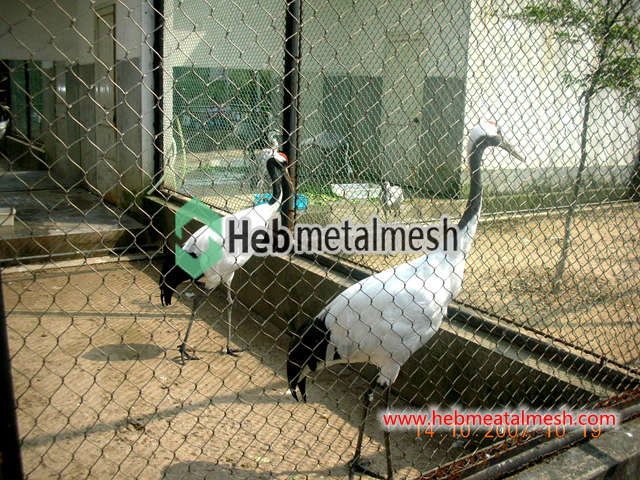
An apartment aviary is not a scaled-down zoo flight, and treating it as one is the quickest way to waste money. The moment you accept that you are closing a volume of air rather than fencing a line, three decisions fall into place: the roof stops being optional, the frame becomes furniture your birds will land on, and the mesh has to be chosen against a bird’s body instead of a property boundary. On a balcony, in a spare room or on a roof terrace, the same three numbers do the work – the aperture set by your smallest resident, the cable diameter set by the largest beak in the collection, and the clear height you can genuinely justify. Specify those correctly in stainless steel and you own a flight that shrugs off salt air, sun and a decade of beaks. Guess at them and you will re-hang the whole thing twice.
Executive Summary
An apartment aviary succeeds when the enclosure is bought as a volume rather than as a panel. Aperture must contain the smallest bird in the collection – 20 mm for finches, 25 mm for budgerigars, 38 mm for conures, Amazons and cockatoos – while cable diameter must resist the largest bill in that same collection, from 1.2 mm for finches up to 3.2 mm for macaws and large raptors. A balcony is exposed on five faces, so the material matters more here than it would in a garden shed: hand-woven stainless steel rope mesh in 304 or 316 grade keeps its shape, does not corrode at a cut end and carries no coating for a beak to strip. Fittings, edge cable, tensioners, ferrules and anchor plates typically add 10-20% to a mesh-only quotation, and every fixing must be agreed with the building owner before the first hole is drilled. The reference specification is the aviary netting product page product page.
Quick Answer:
Can you keep an aviary in an apartment? Yes, provided the mesh closes a volume and the building owner approves the fixings. An apartment aviary needs a frame, a roof panel and a mesh chosen by two numbers: aperture from the smallest bird, cable diameter from the largest beak. Stainless steel rope mesh is the usual choice because it needs no recoating, does not corrode at the wire ends and holds its tension in wind.
Key Takeaways
- An apartment aviary is a five-faced volume; the roof is not optional and clear height buys the most usable space.
- Two numbers carry the specification – aperture from the smallest resident, cable diameter from the largest beak or bill.
- Material decides service life on a balcony. Professional avian collections apply the same welfare logic to enclosure design, and the Association of Zoos and Aquariums publishes enclosure guidance worth reading before you drill anything.
- Fittings, edge cable and tensioners usually add 10-20% to a mesh-only quotation.
- Written permission from the building owner comes before the first anchor, on every project.
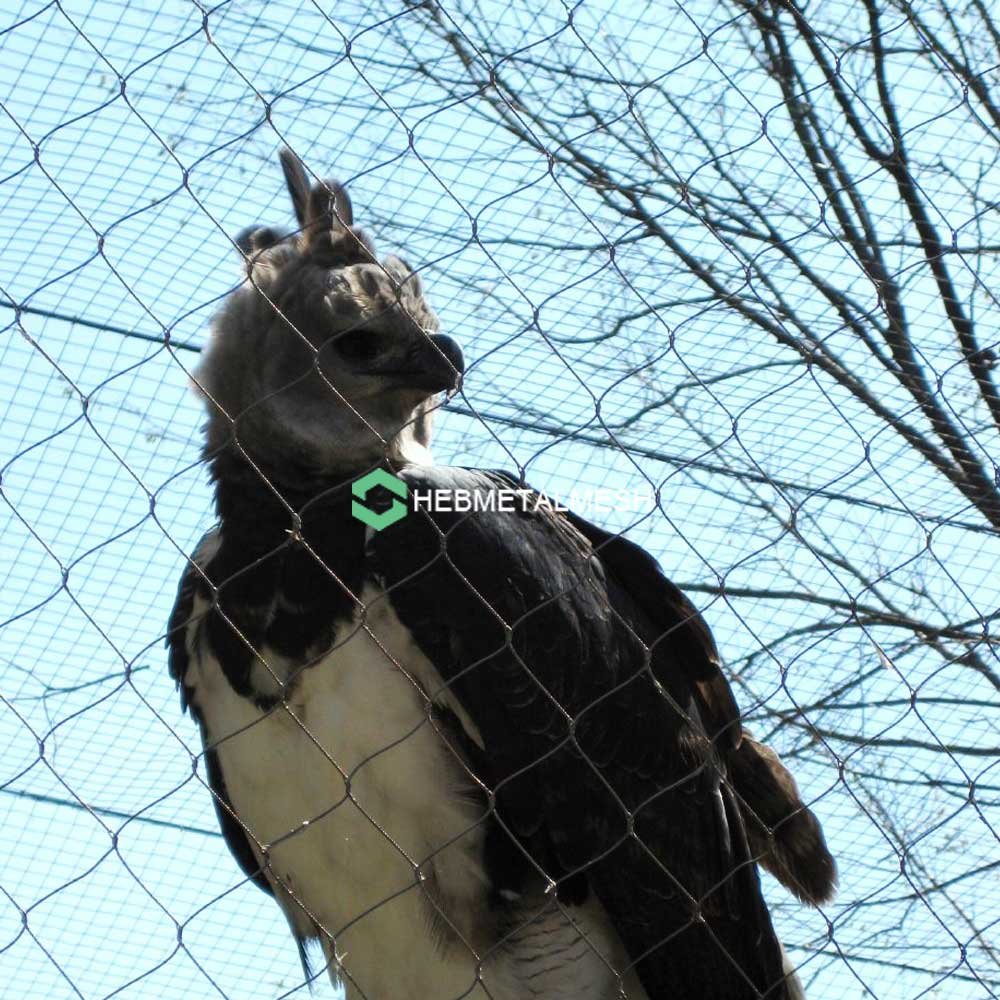
Why an Apartment Aviary Is a Volume, Not a Fence
Every conventional fence closes a horizontal line. An aviary closes a box of air, which means five faces rather than one, and a set of consequences a garden fence never meets. Internal supports stop being structure and become perches, so every frame member inside the envelope has to be sized for a bird landing on it. A small aviary for apartment use, or any aviary for small spaces, is therefore won in the vertical dimension: 2.2 m of clear height under a balcony soffit is worth more to a pair of conures than twice the floor area at 1.5 m. A compact aviary 1.2 m deep and 2.5 m wide, taken up to the ceiling, routinely outperforms a run that is twice as long but half as tall. Set the envelope first, then let the mesh follow the geometry rather than the other way around.
The Two Numbers That Decide the Mesh
Two figures govern the whole specification, and they are independent variables. Aperture size is set by the smallest body that must not pass: 20 mm for finches, 25 mm for budgerigars, 38 mm for conures and Amazons, 76 mm for peafowl, cranes and flamingos. Cable diameter is set by the largest beak or bill that will work the nearest small object, because a parrot does not attack the widest panel – it attacks a cable tie, a loose strand end or a ferrule. Start at 1.2 mm for finches and climb through 2.0 mm for conures and ducks and 2.4 mm for cockatoos to 3.2 mm for macaws and large raptors. Never read a breaking load as a security guarantee: it is a fatigue number, and the routine landing, take-off and grip loads do the real damage over years. A mixed collection is the hardest brief, because the tightest aperture and the heaviest bill are rarely the same bird; if you cannot split the collection across two panels, take the small aperture and upgrade the cable. Our mesh size selection guide for bird aviaries works through the pairings bird by bird.
Hand Woven Rope Mesh or Coated Grid?
Three families are sold into this space and only one of them is built for a beak. A welded grid fails at a fused intersection, where the weld heat leaves the thinnest coating and the first rust starts, and a broken weld opens the grid permanently. A coated chain-link run is one continuous bent wire hooked to its neighbor, so a single break deforms the neighboring diamonds, slackens the whole run and exposes bright galvanized metal. A hand woven rope mesh is a textile rather than a grid: 7×7 rope gives 49 wires to a strand, so a single broken wire costs roughly 2% of that strand’s breaking load and the panel stays tensioned. That is the property that matters on a balcony, because it means a bird cannot create a hole it is able to widen. Compare formats on ownership rather than on shelf price – welded and chain-link win the purchase column and then charge rent in recoating, weld repair and re-tensioning. A full side-by-side comparison with welded, chain-link and plastic netting is set out in our aviary mesh materials comparison.

Fixing an Aviary to a Balcony Without Damaging the Building
A balcony aviary is only as good as its anchors, and the anchor detail is where a domestic project most often goes wrong. Frame spacing of 1.5-2.0 m keeps a tensioned panel flat without a visible bow, and every panel needs an edge cable, a tensioner and a termination that does not re-concentrate the load it has just spread. On a concrete slab you can use a chemical or mechanical anchor; on a rendered wall you want a spreader plate behind the fixing so the render is not carrying the load in shear. Never fix to a handrail, a balustrade post or a glazing bead, because none of them are structural. Before any of that, the building owner or management company must approve the work in writing; in a strata or leasehold building, a reversible frame that loads the slab rather than the wall is usually the version that gets approved. Our walk-in aviary design guide covers frame layouts that can be dismantled without leaving a mark.
What an Apartment Aviary Costs
The largest single line in an apartment aviary cost is the mesh, and it is driven by cable diameter first, aperture second, panel size third and order volume almost not at all. As a planning range, aviary-grade woven stainless steel runs at about $10-22 per square meter, and heavier carnivore-grade material at about $20-38 per square meter; treat both as a planning range rather than a quotation, because fittings, edge cable, tensioners, ferrules and anchor plates add 10-20% on top. A flat-pack apartment aviary kit looks cheaper until you price the frame, the roof panel and the fixings separately, and kits almost never match a real balcony’s dimensions, which means waste on every cut. Budget for the same three irreversible items as a professional build – aperture, surface finish and fixing detail – because those are the decisions that cannot be recalculated later. The aviary netting product page lists the standard diameters, apertures and panel sizes the specification is drawn from.
Choosing an Apartment Aviary Supplier
An apartment aviary supplier should be able to work from a drawing rather than from a catalog. The questions that separate a manufacturer from a reseller are simple: can they state the grade and the chemistry (304 stainless at roughly 18% chromium and 8% nickel, 316 stainless with molybdenum for coastal air), can they supply a mill certificate, and can they produce a panel take-off from your dimensions instead of selling a nominal roll. A coastal balcony should be specified in 316 stainless; inland, 304 stainless is normally enough, and where a darker look is wanted a black oxide finish changes the appearance without adding a coating a beak can remove. Choose a supplier who will talk about the termination and the tensioning detail, because that is the half of the job where a cheap quotation is cheap.
Apartment Aviary Planning, Neighbors and Daily Life
Apartment aviary planning starts at the fixings, not the mesh, and it ends with a neighbor who is not disturbed. An aviary for apartment balcony use should be set back from the edge, because the outside face is the one that collects wind, salt and the neighbor’s view. A terrace aviary can be larger but needs the same wind detail, and a city aviary on an upper floor meets stronger, gustier air than the same enclosure at ground level. Space chosen indoors changes the brief again: an indoor apartment aviary must be lit properly and kept clear of heaters and cooking fumes, and its floor needs a scrubbable surface because seed husk and droppings fall straight through an open weave. An aviary on a balcony is judged by one shared standard – it must be approved, reversible and quiet. In every case the aesthetic half of the project matters as much as the technical half, and the reason urban bird keeping succeeds or fails in shared buildings is usually how the enclosure reads from outside. Choose a mesh and frame that disappear against the building, and a structure that looks industrial from a distance reads as joinery from three meters; our guide to low-visibility aviary enclosures covers that near-view question in detail. Whether you are keeping birds in an apartment, on a shared balcony or on a private roof, balcony bird keeping is a conversation with the building before it is a conversation about mesh.
Inspecting an Aviary After a Storm
A balcony aviary lives in weather that a garden enclosure never sees, so the inspection routine is short but it is not optional. Walk the frame after every named storm and check three things: that the tensioned panel has not lost tension at the corner termination, that no ferrule has slipped, and that nothing has been left rubbing against a cut end where a protective layer would have worn through on coated wire. Fresh water and a soft brush handle bird droppings; avoid abrasives, which polish the weave and make it shinier than the specification intended. Re-tension once a year, or whenever a panel drums audibly in wind, and treat that check as the moment to confirm the aperture still matches the collection. If the flock changes – a new species, a new beak – revisit the two numbers before you order anything else.
FAQ
Height first: aim for at least 2.0-2.2 m of clear internal height, because a flight is a volume and vertical space is the cheapest usable space you can buy. Then work to roughly 1-2 cubic meters of air per small bird, and remember that the aperture must suit the smallest resident.
Only with the landlord’s written consent, and usually as a reversible frame that loads the slab rather than the wall. Avoid drilling into a balustrade or a handrail, and choose a frame that can be removed and made good without leaving a mark.
For budgerigars and small parakeets, 20-25 mm aperture on 1.2-1.6 mm cable is the usual pairing. Move to 38 mm and 2.0-2.4 mm for conures, Amazons and cockatoos, and upgrade the cable rather than the aperture if the collection mixes sizes.
Plan on roughly $10-22 per square meter of aviary-grade mesh and $20-38 per square meter for carnivore-grade material as a planning range, then add 10-20% for fittings, edge cable and tensioners. Panel size and volume barely move the price; cable diameter drives it.
Ready to specify? Send your balcony or room dimensions, the bird list and your clear height to our team on the contact page, and we will come back with a panel take-off, a fixing schedule and a planning-range price.