
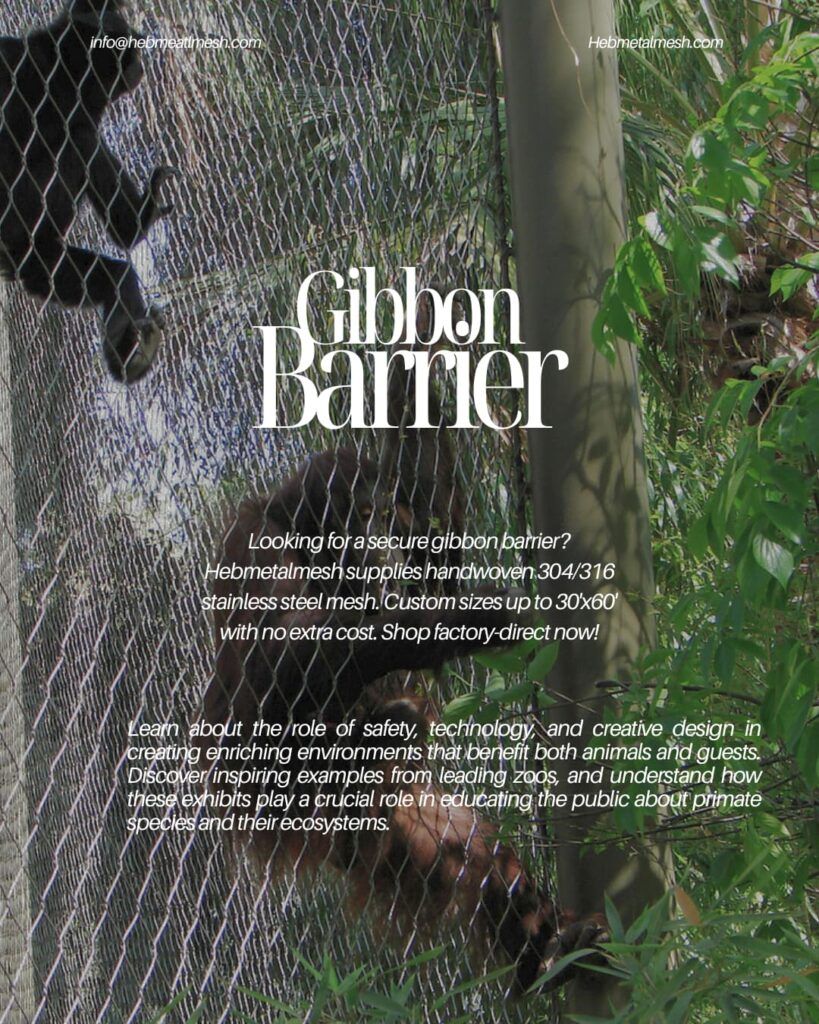
Planning an enclosure for a gibbon means planning for an animal that does not push against a fence — it swings into the boundary at speed and pries at gaps with hands built for grip. A gibbon barrier is a tensioned membrane, not a wall, and handwoven stainless steel wire rope mesh at a 38–51 mm aperture with 2.4–3.2 mm rope for adults is the material that meets all three demands. This guide covers the physics, the alloy and weave choice, the numbers that matter, and the installation details that decide whether an enclosure lasts decades.
Executive Summary
Gibbons brachiate — swinging hand-over-hand — so the barrier takes repeated dynamic loads at every crossing, and their hands can grip and pry at any opening a human could also defeat. The working answer is handwoven stainless steel wire rope mesh: the rope spreads impact across the weave instead of dumping it on a weld, the 38–51 mm aperture for adults is too small for a grip yet open enough for natural brachiation, and continuous panels up to 9 × 18 m keep swing paths splice-free. Use SS304 inland, SS316 where humidity or salt is present, anchor through an edge rope, and keep every fixing outside the enclosure. The reference specification is the gibbon enclosure fence netting mesh product page.
Quick Answer: What Is the Best Gibbon Barrier?
Quick Answer: Handwoven stainless steel wire rope mesh — rope 2.4–3.2 mm for adult gibbons, mesh aperture 38–51 mm, SS304 or SS316, tensioned as a membrane and anchored through a perimeter edge rope. Avoid welded panels and chain link: both concentrate load at points that fatigue under brachiation and give the animal somewhere to grip.
A barrier flexes and returns; a fence is rigid, and rigidity is what a brachiator exploits. The mesh must also be safe to touch at speed — a snagged finger or trapped hand means a hard veterinary case — which is why smooth handwoven rope mesh with no exposed strand ends is the industry answer.
Key Takeaways
- Aperture is a security decision: 38–51 mm for adults denies a grip; tighten below 30 mm only where infants or juveniles are housed.
- Rope follows load and climate: 2.4 mm for sheltered groups, 3.2 mm outdoors; SS316 wins in humid and coastal regions.
- The weave does the work: handwoven crossings distribute dynamic load; welds and mechanical joints fatigue.
- Anchoring decides escape-proofing: tension through an edge rope, fix everything outside, never leave a climbing surface rigid.
- Budget for maintenance: routine cleaning costs little; replacing a corrosion-damaged panel costs a lot.
Zoo housing standards for small apes exist because badly built barriers injure animals and fail keepers. The enclosure guidance behind modern gibbon mesh specs is maintained by the international zoo and conservation community, including the IUCN, which also tracks the status of the gibbon species most facilities hold.
What a Gibbon Barrier Has to Do
Consider the loads first. A gibbon mid-swing travels several meters per second, and a misjudged branch puts the full momentum of a 6–9 kg ape into the boundary — not a shove but an impact at the end of an arc. A welded panel funnels that energy into a few joints; repeated hits fatigue them, and a weld fails without warning. A handwoven crossing spreads the load across its neighbors, so the panel absorbs the hit and springs back.
Second, deny the hands. Gibbon fingers are long, strong, and built for grip; given a two-hand purchase on a crossing, an adult will pull and twist for weeks. That is why the gibbon brachiation barrier question always returns to aperture: the opening must be small enough that no crossing offers a hold, which is why 51 mm is the generous end of the range and 38 mm the safer default.
Third, stay readable. Gibbons read depth and distance to plan their swings, so a solid barrier changes their movement, and a startled gibbon hitting an unyielding surface is a broken-arm call to the vet. Mesh that flexes under impact and reads as open from inside keeps natural locomotion intact. Absorb the impact, defeat the grip, avoid the snag, stay transparent — the entire gibbon barrier design problem in one sentence.
Gibbon Barrier Materials: What Actually Compares
The shortlist is shorter than most buyers expect. Galvanized chain link is cheap and falls out fast: it corrodes at the knuckles, offers endless handholds, and rings under impact. Welded stainless mesh improves on it but stays joint-heavy — welds become both the failure points and the grip points. Acrylic and glass offer visibility but no impact absorption and poor tropical ventilation. Polymer netting is a non-starter against ape teeth and nails.
| Material | Under brachiation load | Grip / escape risk | Outdoor life | Verdict |
| Handwoven SS wire rope mesh | Absorbs, spreads across crossings | Low — smooth, no welds | 20+ years | The standard |
| Welded stainless panel | Concentrates at welds | Moderate — weld nubs | 10–15 years | Joint risk |
| Chain link, galvanized | Deforms and sags | High — diamond grips | 5–8 years | Reject |
| Acrylic / glass | No absorption, shatter risk | Low | Fogging over time | Niche |
| Polymer netting | Stretches permanently | High — teeth and nails | Short | Reject |
The alloy question is environmental. SS304 (18% chromium, 8% nickel) serves clean inland exhibits for decades. SS316 adds molybdenum, lifting corrosion resistance sharply where gibbons actually live — humid tropical air, coastal spray, regular exhibit washing. Near salt air or high humidity, the 10–15% grade premium is cheap insurance.
Gibbon Barrier Design: Rope, Aperture, and the Numbers
Gibbon barrier design starts with two numbers and one rule: rope sized to the animals and climate, aperture sized to the smallest hand in the group, and never a splice inside a brachiation path.
| Code | Rope Ø | Mesh opening | Typical role |
| HM3238 | 3.2 mm | 38 × 38 mm | Outdoor mixed exhibits, tight security |
| HM3250 | 3.2 mm | 51 × 51 mm | Adult gibbon islands, main boundary |
| HM2438 | 2.4 mm | 38 × 38 mm | Sheltered indoor groups |
| HM2450 | 2.4 mm | 51 × 51 mm | Indoor pairs, keeper areas |
Adult gibbons and siamangs take 2.4 mm rope indoors and 3.2 mm outdoors, where wind load and climbing structures add forces a sheltered panel never sees. Keep the boundary mesh aperture at 38–51 mm: below 38 mm you buy material you do not need, above 51 mm you start offering a grip. Every rope diameter carries a published breaking load — roughly 7 kN for 3.2 mm rope and about 4.4 kN for 2.4 mm — so ask for the number per code and grade. That documented number separates generic stainless steel mesh from a genuine gibbon containment mesh. Where infants are expected, drop into the tighter codes of the gibbon enclosure netting range (2.0 mm rope at 25–38 mm) so juvenile hands cannot grip at all — and buy gibbon proof mesh as full-height continuous panels, because every vertical splice is a future grip test.
Gibbon Barrier Construction: How to Build One That Holds
Here is how to build a gibbon barrier that still passes inspection a decade out. Treat the mesh as a membrane stretched over a frame, not as a fence panel nailed to posts.
Anchoring. Gibbon barrier anchoring is the most underrated step. Lace the mesh to a perimeter edge rope — 6–8 mm stainless cable — and let that edge rope carry the tension. Hog rings tie mesh to rope on a fixed grid, and the edge rope is tensioned at each post. Done this way an impact deforms the whole panel face and recovers; done wrong, load concentrates where mesh meets post and the first failure appears there.
Tension. The panel should flex several centimeters under a firm push and return. Rigid tension turns a swinging gibbon’s impact into a hard-wall collision; slack tension gives the animal purchase to climb and shake the weave. Corners matter most — mitered lacing at corners is where escapes are later found.
Top line. An anti climb gibbon barrier adds a smooth top run with no horizontal member a gibbon can reach over, plus an inward overhang where regulations allow. Keep enrichment structures at least one body length from the boundary; a gibbon launching from a platform multiplies panel load.
System view. Nobody builds a gibbon barrier system from mesh alone. The full system is posts and footings, the tensioned edge rope, the continuous mesh membrane, the keeper door with its double latch, and a mesh roof for confirmed climbers. Specify all five together or a great panel ends up on an under-engineered frame. Final tension should be signed off by the installer; the factory-audit side of the decision is covered in our gibbon mesh supplier guide.
Gibbon Barrier Design by Setting
The gibbon barrier for zoo use is specified under public-viewing pressure, so finish becomes part of the spec. A black oxide finish darkens the mesh so it disappears against deep vegetation and cuts glare for photography and night viewing; natural mill finish stays bright for modern exhibits. Either way the mesh must read as open space from the visitor side — transparency is half the reason rope mesh replaced bars.
Sanctuaries and rehab centers add a welfare layer: stressed arrivals need quiet, so the mesh should be silent under wind and not clang on contact. Home builders follow the same spec at smaller scale; aperture, rope, and tension do not change because the yard is smaller. The same zoo habitat design rules hold at every scale.
Gibbon Barrier Safety: What the Rules Are Protecting
Gibbon barrier safety comes down to three injuries everyone is preventing: a trapped hand or finger, a snagged limb mid-swing, and a panel that fails under load. Trapped fingers happen at apertures big enough to admit a hand but small enough to hold it on the pull-back — which is why half-openings are designed out. Snags happen at strand ends, staples, and rough lacing, so the mesh should arrive with finished edges and all hardware should sit outside the animal space. Panel failure is prevented at the drawing stage: rope diameter, breaking load, and anchor spacing are engineering numbers, and they belong in the purchase order.
Gibbon Barrier Maintenance and Cleaning
Stainless rope mesh is near zero-maintenance, but near zero is not zero. Gibbon barrier maintenance is mostly inspection on a fixed schedule: walk the perimeter, look for distorted crossings where an animal has been pulling, check edge-rope tension at the turnbuckles. Cleaning matters more in humid climates, where algae collects at the crossings; gibbon barrier cleaning is plain water and a soft brush. Never use carbon steel brushes or wire wool — embedded iron starts surface rust on 304 and even on 316. A barrier checked twice a year is never replaced mid-exhibit; one that is ignored is.
What a Gibbon Barrier Costs
Gibbon barrier cost follows rope diameter, aperture, grade, and panel geometry, in that order. Planning ranges (material only, ex-works) run roughly $16–26 per square meter for SS304 at 2.4–3.2 mm rope, with SS316 adding 10–15%. Two costs surprise buyers: freight, because rope mesh ships by volume and panel nesting changes the container count, and cutting waste on non-standard sizes. Both shrink when panels are woven to your exact dimensions instead of cut from stock rolls.
FAQ
Handwoven stainless steel wire rope mesh at a 38–51 mm aperture with 2.4–3.2 mm rope for adult gibbons, in SS304 or SS316 depending on climate.
A mesh aperture of 38–51 mm for adults — small enough that a hand cannot close around a crossing point. Tighten the aperture wherever infants or juveniles are housed.
Given time and a grip, most primates climb almost anything. Tension the weave so it is too unstable to climb, keep the aperture tight, add an inward top overhang, and set structures away from the boundary.
SS304 serves inland and indoor exhibits. SS316 is the defensible outdoor choice anywhere humid or coastal, because its corrosion resistance matches the climate gibbons evolved in.
Plan on $16–26 per square meter for gibbon-grade material, with SS316 adding 10–15%. Send your footprint and roof area for a landed estimate.
Correctly specified and tensioned, SS304 panels routinely pass twenty years outdoors, and SS316 longer. The weave does not fatigue the way welds do; the frame and fixings need the periodic attention.
Final Word
The best gibbon barrier is unremarkable on purpose: handwoven stainless steel wire rope mesh at the right aperture, tensioned as a membrane, anchored through an edge rope, every fixing beyond the reach of a very persistent hand. Get those fundamentals right and the enclosure disappears into the background — and a gibbon busy brachiating naturally is not testing the barrier. Get them wrong and no brand of mesh saves the rebuild. Design around the swing, spec around the hand, and buy from a factory that puts a breaking load and a mill certificate behind every code.