
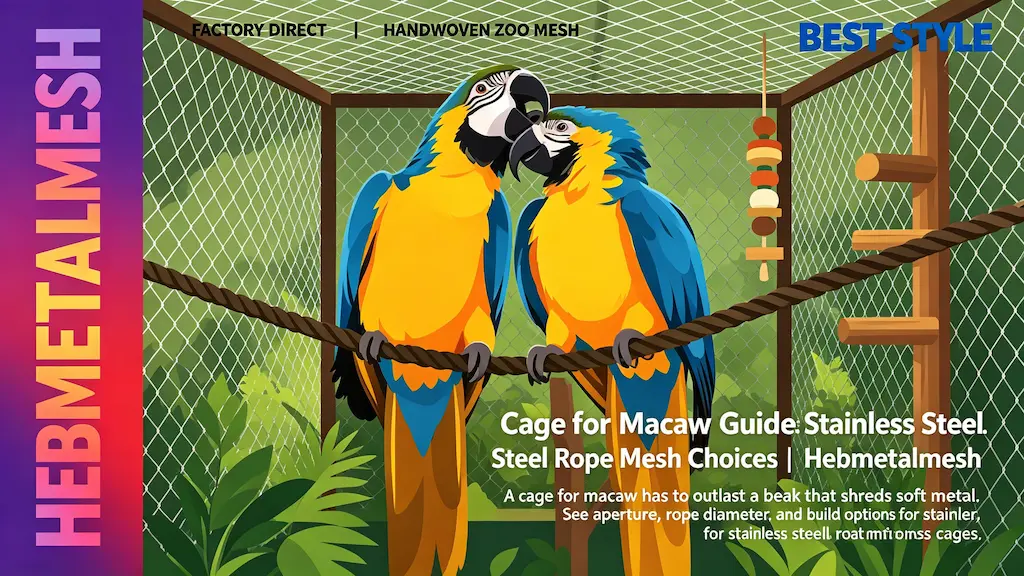
The best cage for macaw is not the one with the prettiest finish; it is the one whose walls are intact after a decade of chewing by a beak that generates several hundred psi. Most retail cages fail within a couple of years, because welded bar and soft coated metal give a determined bird exactly the edge it needs. A cage for macaw built with stainless steel wire rope mesh — rope 2.4–3.2 mm at a 25–38 mm aperture — removes the weak points: no weld joints to pop, no coating to chip, no strand thin enough to sever. Learning how to choose a cage for macaw starts with the mesh; this guide covers sizing, materials, and build-or-buy so a large parrot stays safely housed for decades.
Executive Summary
A macaw does three things to a cage: it bites, it pries, and it climbs. The bite breaks thin wire and chips coatings; prying works on welded joints; climbing means every horizontal surface becomes a test site. The design answer is hand-woven stainless rope mesh, used as full panels for a walk-in build or tensioned inside a rigid frame. Specify 2.4–3.2 mm rope at a 25–38 mm aperture, choose SS316 outdoors, and keep nothing dismantlable within beak reach. A correctly built cage gives a macaw real flight space and the owner zero monthly repairs. The reference specification is the parrot and macaw enclosure mesh product page.
Quick Answer: What Is the Best Cage for Macaw Material?
Quick Answer: The best cage for macaw material is hand-woven stainless steel wire rope mesh — 2.4–3.2 mm rope at a 25–38 mm aperture, in SS304 or SS316. It resists chewing, carries no flaking coating, and outlasts welded or powder coated alternatives by years.
Rope mesh wins for a structural reason, not just durability. Each crossing is a flexible joint that absorbs a bite’s point load and spreads it, while welded bar cages have rigid intersections that chewing eventually cracks. Round, smooth strands also leave no flat edge to chip — and ingested coating fragments are a common poisoning emergency that bare stainless removes.
Key Takeaways
- Material decides lifespan. Stainless steel wire rope at 2.4 mm or heavier outlasts welded bar and coated cages against a macaw beak.
- Aperture controls the beak. Keep cage bar spacing for macaw in the 25–38 mm band so the bird cannot bite through an opening or hook a toe.
- No coatings means no poisoning risk. Chew proof construction has to be bare stainless, never painted steel.
- Indoor and outdoor cages differ. SS304 serves indoor birds; SS316 is the rule outdoors and near the coast.
- Size for the species. A hyacinth macaw needs a materially bigger cage than a blue and gold, and both need more flight space than catalogs suggest.
Large-parrot housing guidance, including minimum flight space thinking for strong-beaked species, is published by the zoo community through the Association of Zoos and Aquariums (AZA), whose bird standards informed the sizing notes below.
Why Macaws Destroy Ordinary Cages
Watch a macaw for ten minutes and you will see the whole problem: the beak is a living tool — part wire cutter, part crowbar — and the bird uses it constantly. Soft materials do not stand a chance. Aluminum and soft steel bend and chew; coatings poison if swallowed; wood splinters; plastic shreds in an afternoon. That leaves the cage for pet macaw owner with exactly one rational material family: bare stainless steel, in a form too strong to chew and too smooth to peel.
Here wire rope mesh beats the bar cage. A single rope is many small wires twisted together, so a macaw cannot bite through a 2.4 mm rope the way it severs solid wire of the same size, and the woven crossings stop damage from concentrating at one point as it does on a welded grid. The practical result is an enclosure that survives its occupant instead of being replaced every eighteen months.
How Big Should the Cage Be: Flight Space and Species Sizing
The right cage for macaw is always larger than the owner first imagines. Macaws need to stretch both wings fully, climb, and hop between perches; birds in undersized cages develop feather-plucking and repetitive behavior. For the cage for a blue and gold macaw, plan a minimum indoor cage about 1.8 m tall on a footprint near 1.2 × 1.2 m — and the ideal cage for macaw owners who can manage it is larger still, since extra horizontal run converts into healthier movement. The biggest species grows the numbers again: the cage for hyacinth macaw, a bird with a wingspan over 1.2 m and the strongest beak of any parrot, should add roughly a third more height and floor area.
| Species | Typical wingspan | Min. cage height (planning) | Min. footprint (planning) |
| Blue and gold macaw | ~1.0–1.1 m | 1.8 m | 1.2 × 1.2 m |
| Green-winged macaw | ~1.0–1.2 m | 1.8 m | 1.4 × 1.2 m |
| Hyacinth macaw | ~1.2–1.4 m | 2.0 m | 1.6 × 1.4 m |
These are minimums, not luxuries. A large cage for macaw changes character as a walk-in room: owners who build aviary-style spaces report calmer birds, because the macaw chooses its own distance. Flight space is welfare, not indulgence — a bird that cannot spread its wings spends that energy elsewhere, usually on the cage.
Material Comparison: Rope Mesh vs Welded Bar vs Coated Steel
| Bird cage material | Beak resistance | Coating / toxicity risk | Longevity | Best use |
| Stainless wire rope mesh | Excellent — nothing to bite through | None | 20+ years | Cages, aviaries, outdoor flights |
| Welded stainless bar | Good, but weld fatigue over time | None | 10–15 years | Compact bar cages |
| Powder coated steel | Poor once the coating chips | High if ingested | 5–8 years | Temporary housing |
| Aluminum | Chews and deforms | Low, but failure risk | Short | Not recommended |
| Wood | None | Splinters and bacteria | Very short | Perches only |
The table explains why stainless is the baseline for serious macaw housing, not a premium extra. Powder coated cages dominate pet stores because they are cheap to ship and photograph, yet the coating is exactly what a macaw works at until it flakes. Even within stainless, rope mesh adds impact absorption that a welded grid lacks — which is why zoos and aviaries moved to this construction years ago.
Specifying the Mesh: Aperture, Rope Diameter, and Code
In a mesh-built cage, two numbers replace bar spacing: the aperture (the open square between crossings) and the rope diameter. Cage bar spacing for macaw translates directly to aperture, and the working range is 25–38 mm. At 25 mm the bird cannot get a beak tip or toe through; at 38 mm visibility and airflow improve, which suits outdoor aviaries. Above 51 mm a macaw head passes partway — the classic injury zone — so treat larger openings as unsafe for this species.
| Code | Rope Ø | Aperture | Typical use |
| HM1625 | 1.6 mm | 25 × 25 mm | Small macaw chicks, temporary panels |
| HM2038 | 2.0 mm | 38 × 38 mm | Sheltered cages, lower chewing pressure |
| HM2438 | 2.4 mm | 38 × 38 mm | Indoor adult macaw cages |
| HM3238 | 3.2 mm | 38 × 38 mm | Outdoor aviaries, heavy chewers |
| HM3250 | 3.2 mm | 51 × 51 mm | Walk-in flights outside the wall zone |
HM2438 is the sensible indoor default: heavy enough that chewing is pointless, open enough to see through. Outdoor builds step up to HM3238 in SS316, because weather is as hard on mesh as the bird is. The parrot and macaw enclosure mesh range carries these codes with full dimensional tables.
Building or Buying: Custom Panels and Frame Options
A custom cage for macaw built to your room’s dimensions starts with a welded stainless or aluminum frame, mesh tensioned across each face, and a door with double latches. Owners choose this route when the cage must fit a specific corner, or become a walk-in aviary, and it is the only practical way to get a genuinely large cage for macaw without freight on an oversized retail product.
If you build a cage for macaw yourself, four rules prevent the classic failures. Tension the mesh — loose mesh is a climbing purchase. Keep every fixing outside, because the bird dismantles anything within beak reach. Recess the latch; large parrots learn slide bolts within weeks. And buy mesh with finished edges or a border cable, so no cut strand end sits inside the enclosure. Owners who follow these rules report cages that outlive retail products three times over. When buying instead of building, buy a cage for macaw that states the actual wire or rope diameter in the listing; vague “sturdy steel” language usually means thin welded bar. For the supplier and grade audit, our hand-woven macaw enclosure guide covers the same decision from the exhibit side.
Layout, Enrichment, and the Play Area
A safe cage for macaw is empty of dangers but full of things to do. Fit natural-wood perches of varying diameters at different heights — rope mesh accepts perch brackets anywhere. Put food and water ports where droppings cannot fall into them, and keep bowls out of beak reach from the perches. A separate macaw play cage or stand near the main cage gives supervised out-of-cage time without letting the bird roam the house alone.
Enrichment is not decoration; a bored macaw screams and plucks its feathers. Rotate toys weekly, offer destructible pine blocks and paper, and add foraging challenges. Because the mesh walls stay transparent, the bird keeps its view of the household — for a flock species, seeing its humans is part of psychological health. Stand the cage over a removable tray lined with clean paper; bare mesh floors harm feet and should never be a standing surface.
Outdoor Options and Location Notes
An outdoor cage for macaw — a permanent aviary or a summer flight — is a different project from an indoor cage. It must shed rain, survive sun, and resist corrosion, which pushes the spec to SS316 mesh, sealed frames, and a solid roof panel over at least a third of the floor so the bird can escape weather. Set it against a wall for wind shelter and place the door clear of the flight path. Indoors, keep the cage away from drafts, registers, and kitchen fumes; a corner with two walls behind it feels secure to the bird.
What a Macaw Cage Costs
Buy a cage for macaw retail and you pay for assembly, brand, and freight — quality stainless cages run several hundred to over a thousand dollars. Build with mesh and the economics change. As a planning range, SS304 rope mesh panels in macaw-grade codes run roughly $14–26 per square meter ex-works, and SS316 adds about 10–15%; a freestanding 1.8 m cage on a 1.2 m footprint needs about 9–11 m² of mesh before the frame, door, and fittings. The total build usually lands below an equivalent retail cage while delivering heavier material — which is why owners who can weld, or who hire a local fabricator, rarely go back to off-the-shelf cages.
FAQ
A cage whose walls are hand-woven stainless steel wire rope mesh at 2.4–3.2 mm rope and a 25–38 mm aperture, sized so the bird can stretch its wings fully. Bare stainless means there is no coating to chew or ingest.
Keep cage bar spacing at 25–38 mm. Larger openings let the bird hook a beak tip or toe, and above 51 mm a macaw head can pass partway — the injury zone.
No practical way. A macaw beak severs thin solid wire and chips coatings, but a 2.4 mm rope is many twisted wires with no single point to cut, and the woven crossings spread load.
Only until the coating chips. Ingested fragments are a poisoning risk, and a macaw will deliberately chip paint. Bare stainless removes the hazard entirely.
Plan about 1.8 m of height and a 1.2 × 1.2 m footprint for a blue and gold, scaled up roughly a third for a hyacinth. Walk-in aviary space is better still.
No — SS304 serves indoor cages for decades. SS316 matters outdoors, in coastal air, or wherever humidity is constant.
Final Word
Every macaw cage fails for one of three reasons: the material, the aperture, or the assumption that the bird cannot reach it. Stainless steel wire rope mesh answers the first two; thoughtful construction answers the third. Choose 2.4–3.2 mm rope at a 25–38 mm aperture, put every fixing outside the enclosure, tension the mesh like a membrane, and give the bird real flight space plus things to do. Do that, and the cage will still be standing — and still safe — decades from now.