
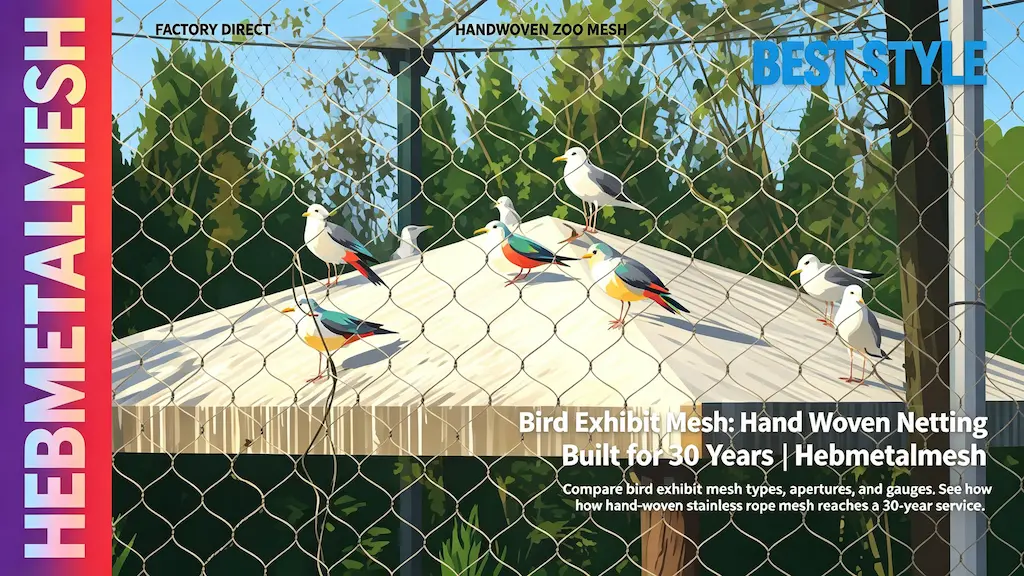
A bird proofing near me search returns labour, not material. Every crew on that list quotes a rate per square metre, promises a two-year workmanship warranty and leaves the mesh itself unspecified — the one variable that decides whether the installation is still taut in year fifteen or sagging over the loading bay in year three. Bird exclusion is a materials problem wearing a labour-cost disguise. Here is what to demand in writing, and what each line of a quote really charges you for.
Executive Summary
Bird proofing is a stainless steel rope mesh system, not a pest-control service. A competent quote states cable diameter, aperture, stainless grade and perimeter fixing method; anything vaguer is a placeholder for whatever the contractor can buy cheapest that month. For most buildings the working specification is 1.6 mm cable at 25 mm aperture against starlings and sparrows, and 2.0–2.4 mm at 38 mm where pigeons, gulls and corvids are the pressure. SS304 handles inland elevations; SS316, which carries molybdenum, is the only defensible choice where salt spray or chlorinated water is in the air. Panels are hand-woven up to 9 m × 18 m, material plans at roughly $10–22 per square metre as a planning range, and factory-direct supply lands two to four weeks after drawing approval. The reference specification is the bird netting and aviary mesh product page.
Quick Answer:
What a bird proofing near me search should actually get you: a written mesh schedule you can hand to any crew, not a verbal per-metre rate. Ask for cable diameter and aperture in millimetres, the exact stainless grade with an EN 10204 3.1 mill certificate, the perimeter tensioning method, and the fixing detail at every corner, parapet and pipe penetration. Bird-proofing-grade stainless rope mesh plans at about $10–22/m² as material only; hardware, access and installation typically add 50–90% on top, and access is what pushes a straightforward parapet job into a five-figure one.
Key Takeaways
- Specify the material, not the labour. Cable diameter, aperture and grade belong in the contract in writing, or the workmanship warranty covers nothing that matters.
- Aperture follows bird size: 20 mm at 1.2 mm cable for sparrows, 25 mm at 1.6 mm for starlings, 38 mm at 2.0–2.4 mm for pigeons, gulls and corvids.
- SS316 is worth the premium within a few kilometres of the coast, and anywhere above a pool, cooling tower or plant room extract.
- Panels up to 9 m × 18 m cut the number of site joints, but every joint still needs a proper netting overlap and a tensioned border cable.
- Factory-direct supply adds 2–4 weeks of production plus 2–6 weeks of transit. Build that into the programme rather than discovering it after the scaffold goes up.
Exclusion is also the approach wildlife professionals prefer. Where the Smithsonian National Zoo and comparable collections manage free-ranging birds, they work through habitat modification and barrier design rather than removal — the same reasoning that makes a correctly specified netting system a permanent fix on a warehouse facade instead of a seasonal one.
What a Local Search Actually Buys You
Three quotes tell you very little, because all three are priced on the same unbranded material from the same regional distributor. What differs is attendance time, access method and margin. Comparing bird proofing services in these terms means comparing scaffolding days and headcount on the elevation, not the component that will fail.
A good bird proofing installer will tell you within ten minutes which faces birds are using, which are transit routes rather than roosts, and which detail on the building is funnelling them in. The material decision that follows should stay with you, because the trade’s default is the lightest welded product that fits the aperture — weld points that fatigue, a zinc coating that stains stone, and a service life measured in single-digit years. Written properly, a bird proofing specification fixes four things: cable diameter, aperture, wire grade and perimeter fixing.
Match the Aperture to the Bird, Not to the Quote
| Bird pressure | Ruling aperture | Cable diameter | Code | Where it belongs |
| Sparrows, swallows, small cavity nesters | 20 mm | 1.2 mm | HM1220 | Domestic soffits, vents, small courtyards |
| Starlings, mixed urban flocks | 25 mm | 1.6 mm | HM1625 | Atria, signage, canopies, stone facades |
| Pigeons, gulls, corvids | 38 mm | 2.0–2.4 mm | HM2038 / HM2438 | Warehouses, plazas, car parks, service yards |
Every strand in that mesh is a 7 × 7 stainless rope: seven wires twisted into a strand, seven strands twisted into the finished cable, 49 wires in the finished rope, hand-woven at each crossing and closed with a ferrule rather than a weld. A 2.4 mm cable breaks at roughly 4.4 kN and a 3.2 mm cable at about 7 kN. Bird work almost never needs 3.2 mm — the design load case is wind, ice and thermal cycling, not an animal’s body weight.
Aperture is where the real engineering sits. Bird proofing for warehouses is usually a 38 mm problem, because pigeons need a landing surface rather than a gap and will not commit to a 25 mm opening. Urban bird proofing on shopfronts and atria is a 25 mm problem, because starlings will enter a 38 mm aperture with room to spare. Sizing up one step to save money is the most common specification error on the market.
The Grade Decision That Decides Service Life
SS304 contains 18% chromium and 8% nickel and performs well inland, in temperate climates, on elevations that stay reasonably clean. SS316 adds molybdenum, which resists chloride pitting — the failure mode that appears as brown pitting and tea-coloured staining within a couple of years wherever salt is in the air or the wash-down water. For bird proofing for buildings near a coastline, above a swimming pool, beside a cooling tower or on a road treated with de-icing salt, 316 is not an upgrade, it is the minimum. A 304 vs 316 stainless comparison sets the two grades side by side on exactly these criteria.
Finish matters too. Natural stainless reads as light grey and is nearly invisible against a bright sky, which makes it the default for warehouse roofs and bird proofing for solar panels, where any shadow across the array is a performance loss. Black oxide disappears against dark brick, slate, bronze cladding and glass, which is why it is the standard choice for bird proofing for heritage buildings.
One trap is worth naming. Grades such as 201 look identical in a photograph and cost appreciably less, but they pit quickly outdoors. Demand an EN 10204 3.1 mill certificate tying the delivered batch to a heat number. If the supplier cannot produce one, the material is untraceable and the warranty attached to it is worth nothing.
How to Vet a Bird Proofing Installer in One Site Visit
Walk the elevation with the crew and ask four questions.
How is the perimeter fixed? A proper system runs a tensioned border cable top, bottom and both sides, anchored at intervals calculated from the wind load — not stapled at the edges. Ask what the anchor spacing is, and how perimeter tensioning is achieved and re-tensioned later.
How are joints detailed? Where two panels meet, ask for the netting overlap figure in millimetres and the lacing method. A butt joint closed with cable ties is an entry point and the first thing to fail in a storm.
What happens at penetrations? Pipes, vents, aerials and lightning conductors interrupt the netting plane, and each one concentrates point loading. A crew that cannot describe how they dress those details has not thought about them.
How do you get inside? Any envelope covering an area a technician must reach needs an access hatch on a framed, lockable opening — a constant requirement on bird proofing for atria, where the mesh closes a space still containing lighting, sprinklers and drainage.
Run the same four questions past every bidder and score the answers; the method is set out in this guide to netting supplier selection. Any bird proofing contractor who cannot answer them in detail is buying material and selling days. Bird proofing system design is where a job is won or lost, decided on a walk-through long before anyone prices the mesh.
Panels, Joints and the Labour Bill
Rope mesh is supplied in panels up to 9 m × 18 m, pre-fitted with edge cables and flexible enough to be lifted and fixed across a span that would take a dozen welded sheets and several days of site joining. That is where the saving comes from: fewer joints, less scaffolding time, fewer return visits to re-tension. It also changes the logistics — material supplied as mesh in rolls or flat panels can be staged through a service door instead of craned over a roof line. Both formats come off the same hand-woven bird netting line, so the panel layout can be tailored to the access you actually have.
What You Are Actually Paying For
| Cost line | Planning range | What drives it |
| Mesh material | $10–22/m² | Aperture, cable diameter, wire grade, finish |
| Border cable, ferrules, anchors | 15–25% of material | Elevation height, substrate, wind load |
| Access: scaffold, MEWP, rope | 30–60% of project total | Height, obstructions, street licence, hours |
| Labour and supervision | Per m² installed | Geometry, penetrations, night or weekend working |
Commercial bird proofing and industrial bird proofing are usually material-heavy and access-light, because a single-storey distribution building presents a long, flat, easily reached elevation. A city-centre façade inverts the ratio and the mesh becomes a minor line item beside the scaffold. If a quote is priced entirely on a per-square-metre rate with no access line, the contractor is either absorbing a risk they have not measured or planning to recover it later. A general breakdown of netting pricing follows the same logic and is worth reading before you compare bids.
Buying bird proofing factory direct changes only the first line of the table, but changes it substantially — typically 20–40% off the material cost, in exchange for 2–4 weeks of production and 2–6 weeks of transit. The trade-off is programme, not quality. Order against an approved drawing and the material arrives cut, bordered and labelled by elevation, ready for the local crew to install.
Maintenance and the Service Interval
Set a service interval of twelve months and treat it as a visual inspection schedule rather than a repair visit: check that border cables are still in tension, look for fretting where mesh contacts a sharp edge, confirm that fixings have not loosened under thermal cycling, and clear leaf litter from the top run. UV exposure does not embrittle stainless the way it destroys nylon, but it degrades the polymer components in some fixing systems, which is exactly what a yearly walkover catches. Commission a full bird proofing inspection at the five-year mark; by then most installation errors have declared themselves, and access equipment is already mobilised.
Heritage Buildings, Planning and Adjacent Property
Bird proofing for heritage buildings is as much a documentation exercise as a technical one. On older structures the specification usually has to be submitted for approval, which means a stated aperture, a stated grade and a finish matching the surrounding material. Black oxide finish, a hidden border cable and fixings set into mortar joints rather than drilled through dressed stone resolve most objections before they are raised. Work on public-facing elevations frequently has to be scheduled around opening hours. Aim the specification at a deterrent combination — mesh plus removal of the landing and feeding surfaces that attracted the birds. Netting a ledge while leaving the food source in place only moves the problem along the building.
FAQ
One-off, if the material is specified correctly. Welded and galvanised products typically need replacing within five to seven years on a moving elevation; a properly tensioned stainless rope mesh system is a permanent installation, with only the annual inspection as a recurring cost.
Material plans at $10–22/m² for bird-proofing-grade stainless rope mesh, as a planning range. Installed cost is typically 1.5 to 1.9 times the material figure, and can exceed that where access is difficult or work must happen out of hours.
Yes, and on larger jobs it is usually the better route. Order against an approved panel layout, take delivery labelled by elevation, and appoint the local team on installation only — that keeps the specification under your control and removes the contractor’s material margin.
38 mm ruling aperture. Pigeons will not commit to a 25 mm opening, and anything larger than 50 mm gives them a foothold at the mesh rather than excluding them from it.
Next Step
Send the elevations, the species you are seeing and your access constraints. We will return a mesh schedule with aperture and grade recommendations, a panel layout and an indicative material budget — enough to test any local quote against real numbers. Request a quote and you will have it inside one working day.