
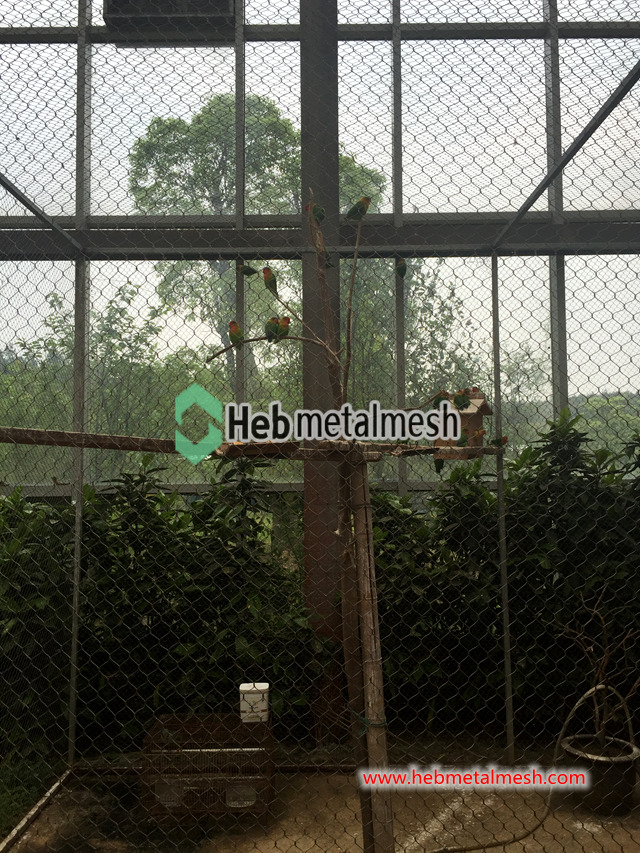
A roll buys flexibility that a fixed panel takes away. When you take mesh in rolls, you are buying continuous hand-woven stainless steel netting wound onto a core and cut to fit once the frame is standing — not panels cut to a drawing signed three weeks earlier. For a contractor fitting out several aviaries in one season, that removes the most expensive mistake in the trade: a mis-measured panel that becomes scrap.
Executive Summary
Wire rope mesh in rolls is continuous stainless steel netting supplied on a roll core, commonly in widths of 1 m, 1.5 m and 2 m and standard lengths of 30 m or 60 m, with apertures from 20 mm to 102 mm and rope diameters from 1.2 mm to 3.2 mm. A roll is the right purchase when the final cut sizes are still moving, when one specification serves several enclosures, or when the site cannot handle large rigid panels. SS304 is the inland default; SS316 belongs within a few kilometres of salt water. The reference specification is the animal fence mesh product page product page.
Quick Answer:
A wire rope mesh roll is continuous stainless steel rope netting wound onto a core and sold by length rather than as a finished panel. Take a roll when the cut list is still changing or when one specification covers several enclosures; take finished panels when the spans are fixed and you want no cutting on site. A standard roll length is usually 30 m, with roll width options from 1 m to 2 m, and both can be adjusted at order stage.
Key Takeaways
- A roll trades a fixed cut list for on-site flexibility — the mesh is cut after the frame is standing.
- Aperture (20–102 mm) and rope diameter (1.2–3.2 mm) decide load, escape control and price.
- Roll length and roll width are the two numbers most often wrong on a quotation. Confirm both in writing.
- Stainless rope mesh carries no coating, so there is no rust bleed and nothing to strip at a cut edge.
- Unrolled carelessly, any roll will kink permanently, so handling matters as much as specification.
Those benchmarks only make sense against published animal-care standards. The World Association of Zoos and Aquariums (WAZA) publishes welfare guidance on enclosure space, complexity and species-appropriate barriers that a sensible mesh specification should map onto.
What Arrives on the Roll
A mesh roll is not a single product; it is a format. The same hand-woven stainless steel netting that leaves our works as a 9 m × 18 m finished panel can instead be wound into a continuous roll.
Three situations favour a roll. First, when the cut list is not final — a refurbishment where old panels are measured as they come down, or a build whose frame is fabricated on site. Second, when many small enclosures share one specification, so a single roll can be cut across all of them with almost no waste. Third, when access is the limit: a 60 m roll can be carried through a doorway and lifted onto a roof, where a rigid panel of the same area could not pass at all.
Panels win when the enclosure is large, the span is fixed and the drawing is approved. On large perimeter work the two are mixed — panels on the main elevation, rolls for the rest.
| Format | Best for | Trade-off |
| Roll | Evolving cut lists, several small enclosures, tight access | Needs on-site cutting and careful handling |
| Panel | Fixed spans, large elevations, fast installation | No flexibility once fabricated |
| Mixed | Perimeter panels plus rolled infill and roof | Needs a clear cut plan before ordering |
Roll Sizes, Aperture and Rope Diameter
The variables that define a roll are fixed by the species and the structure rather than by preference. Because mesh in rolls sizes are set at manufacture, every dimension has to be decided before the order is placed.
Aperture runs from 20 mm to 102 mm. Small birds and small primates need the tight end; hoofstock and large carnivores are usually specified at 76 mm or 102 mm. Rope diameter runs from 1.2 mm to 3.2 mm; 3.2 mm on a 102 mm aperture is the heavy perimeter grade, while 1.6 mm on 25 mm suits budgerigar-scale birds. Roll width is normally 1 m, 1.5 m or 2 m, and roll length is normally 30 m or 60 m.
| Format code | Rope Ø | Aperture | Typical use |
| HM1220 | 1.2 mm | 20 mm | Finches, small birds |
| HM1625 | 1.6 mm | 25 mm | Budgerigars, small parrots |
| HM2038 | 2.0 mm | 38 mm | Conures, small primates |
| HM2438 | 2.4 mm | 38 mm | Owls, mid-size birds |
| HM3238 | 3.2 mm | 38 mm | Macaws, raptors |
| HM3276 | 3.2 mm | 76 mm | Lion, tiger, bear |
| HM32102 | 3.2 mm | 102 mm | Heavy perimeter work |
Record the full mesh in rolls dimensions — aperture, rope diameter, roll width and roll length — on the purchase order and keep them there. A quotation that does not state aperture and rope diameter is not a mesh in rolls price at all, because the two cheapest levers on cost are exactly the ones an unclear quote leaves open.
Roll Length, Width and Core
Roll length and roll width are where most order errors happen. A standard roll length is 30 m, but many buyers assume 60 m, and a delivery that arrives short stalls a build. Custom roll length usually costs nothing extra; roll length customization is simply a matter of telling the works the footage you need rather than accepting a default.
Roll width interacts with the frame. If posts are set at 2 m centres, a 2 m roll lets each drop be cut from the full width with no join. At 2.5 m centres, either order wider material or accept a join.
The roll core diameter is the last detail. A larger core holds the roll more openly and reduces the set that builds up in storage; a smaller core packs more footage into the same carton but is more prone to coil set. Ordering mesh in rolls for a project that will sit in a store for months is the one case where a bigger core is worth asking for.
How Mesh in Rolls Is Priced
Mesh in rolls cost is quoted as a price per square metre, then multiplied by the bill of materials. That is why the same apparent roll can differ sharply between suppliers: a low price per square metre on a narrow roll that wastes 15% of its width is worse than a slightly higher price on a width that fits the frame.
Three factors move the number. Rope diameter is the largest, because it drives the mass of stainless in the weave. Aperture is second, since a tight 20 mm aperture uses far more crossings per square metre than a 76 mm one. Grade and finish are third.
Rolls are bought by area, not by length, so always convert. A 1 m × 30 m roll carries 30 m²; a 2 m × 30 m roll carries 60 m². When you weigh mesh in rolls for sale offers, compare cost per square metre of usable mesh after trimming, because a roll edge is not square and the cut plan has to allow for it. For how the same logic behaves on fixed panels, our animal fence and containment netting price guide is a useful cross-check when a quotation looks unusually cheap.
Ordering, Lead Time and Export Packaging
Ordering mesh in rolls follows a short sequence. Confirm aperture and rope diameter; confirm roll width and roll length; confirm finish and grade; then confirm the cut plan or ask for one. A mesh in rolls supplier that answers all four in writing has understood the job. A mesh in rolls factory will usually issue the roll plan as a drawing, showing where each cut falls and how much off-cut the job generates.
Lead time is typically 2–4 weeks for production once the drawing is approved, plus 2–6 weeks of transit. If the build has a hard date, ask for the production window before paying a deposit.
Roll packaging for export is a discipline of its own. Rolls are wound tight, wrapped against moisture, banded and set on a pallet so they cannot telescope in transit — a roll that shifts against its neighbours arrives with flats and kinks that no tensioning will remove.
A roll cutting service is worth asking about even when you intend to cut on site. If the supplier cuts the roll to your lengths before shipment, off-cuts stay at the works rather than in your yard, and the roll arrives as a set of drops labelled by elevation.
Handling, Cutting and Edge Finishing
Store a roll on its core, never on its side under load, and unroll it along a clean surface rather than dragging it across concrete. Roll it out under light tension and let it relax before cutting. Stainless rope has spring back, and a length cut while the roll is still tight will uncoil on release. It also has tension memory: a kink formed in storage reappears every time the mesh is handled.
Cut with the weave rather than across it. Shears designed for rope mesh, or a rotary cutter on a guide, leave a cleaner line than a grinder, which can weld the rope ends and leave a burr. If the mesh is finished with a crimped wire edge, cut just inside a wire so the selvedge stays intact and the mesh cannot unravel.
Edge finishing is what converts a raw cut into a hangable drop: a folded and crimped edge is fast and works on most apertures, while a cable-thimble edge with ferrules is stronger on long spans. Say which you want at order stage, because both change the cut plan. Anti tangle matters most on tight apertures — on a 20 mm or 25 mm weave, an open cut edge can hook neighbouring strands.
Stainless, Galvanised and the Rust Question
Mesh in rolls is overwhelmingly sold in stainless steel because it removes an entire failure mode. Galvanised mesh is cheaper, but zinc is a coating and a coating can be scratched; on a cut roll edge, every cut is a fresh scratch. That is where rust bleed begins, as a brown streak running down a wall from a fixing point.
Stainless rope mesh has no coating to strip and no rust bleed to manage, because corrosion resistance sits in the alloy rather than on the surface. SS304 — roughly 18% chromium and 8% nickel — is the inland default and outlasts most frames. SS316 adds molybdenum and is the correct choice near salt water or in a heavily chlorinated environment.
If a supplier steers you toward a galvanised roll to hit a budget, read the trade-off honestly first. The galvanized vs stainless steel cable mesh comparison sets out where the saving becomes a maintenance cost, and the 304 vs 316 stainless cable mesh comparison settles the grade question for coastal sites.
Panels and Rolls in the Same Project
Most real jobs use both formats. A perimeter of fixed elevations is faster from panels; the roof, the service yard and small holding enclosures are easier from a roll — and deciding which is which before ordering sets how much cutting happens on site.
The full range behind both formats — aperture, rope diameter, panel size and finish — is set out on the animal fence mesh product page. Match the format to the enclosure first, then let the aperture and rope diameter follow from the species.
FAQ
A roll is continuous netting cut to size on site; a panel is finished, edged and sized at the factory. Rolls suit changing cut lists and tight access, panels suit fixed spans and fast installation.
Thirty metres is the usual standard roll length, with 60 m available on many specifications. Confirm it in writing — a short delivery mid-build costs far more than any difference in price.
Yes. Cut along the weave with a guide, using rope-mesh shears or a rotary cutter, and finish the cut edge so it cannot unravel or hook neighbouring strands. Avoid grinders, which weld the rope ends.
Roll width options commonly run from 1 m to 2 m. Match the width to your post spacing so each drop cuts without a join, and ask for a cut plan.
Yes — bright, Nature and black oxide finishes are all available on the same weave, and none changes the structural rating. Black oxide reads as nearly invisible against foliage.
The roll core is the tube the mesh is wound onto. A larger core limits coil set in long storage; a smaller core packs more footage per carton but is more prone to set.