
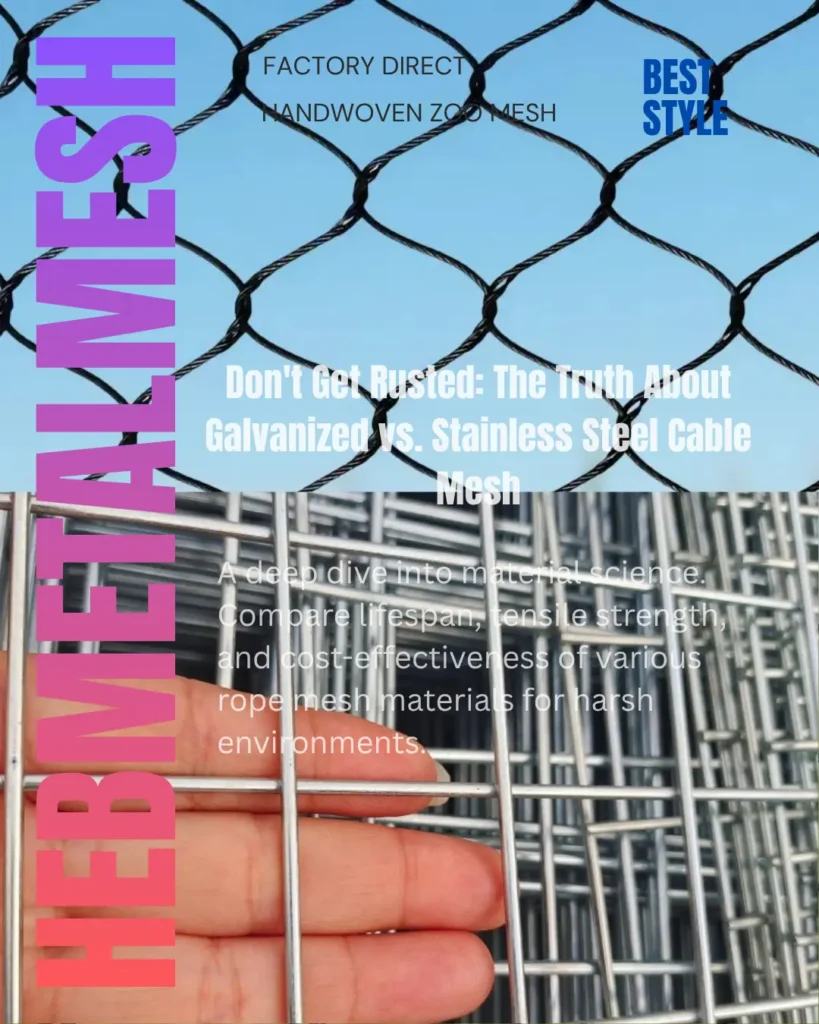
When selecting a mesh for long-term projects, the “cheaper” galvanized option often costs 3x more over its lifecycle due to rust and failure. 316-grade stainless steel rope mesh is non-corrosive, even in maritime environments, and maintains its tensile integrity for decades. This comparison proves that for safety-critical applications like animal enclosures or public railings, stainless steel is the only viable long-term investment.
1. The Hidden Cost of “Cheap” Barriers
In the world of large-scale construction and industrial containment, there is a dangerous allure to the “low bid.” On paper, galvanized steel or high-density plastic netting looks like a financial win. You save 40% on material costs, the project stays under budget, and everyone is happy—for about eighteen months.
This is the “Penny Wise, Pound Foolish” trap. The reality of cheap barriers is that their upfront price is only the down payment on a recurring debt. By year five, most low-cost solutions have cost the owner three times their original price in repairs, labor, and premature replacement.
Traditional fencing fails at predictable failure points. For galvanized mesh, it’s the joints—the points where wires cross and the protective coating is thinnest. For plastic netting, it’s UV degradation; the sun’s radiation breaks down the polymer chains, turning a “heavy-duty” net into brittle confetti. For both, there is the inevitable sagging—a loss of structural memory that compromises the security and aesthetic of the entire project.
The Goal of this Post: We are moving past the marketing fluff. This is a side-by-side technical teardown of material science. Whether you are building a modern residential deck or a world-class aviary, our goal is to help you choose the “forever” material that eliminates the cycle of replacement and protects your long-term ROI.
2. Galvanized Steel: The Budget Contender
To understand why galvanized steel fails, you have to understand what it is. Galvanization is the process of dipping carbon steel into a vat of molten zinc. This creates a coating that acts as a physical shield between the steel and the atmosphere.
The “Sacrificial” Problem In metallurgy, zinc is known as a sacrificial anode. It doesn’t actually stop corrosion; it simply agrees to rust first. The zinc corrodes to protect the steel underneath. The problem is that once that zinc layer is “spent”—a process accelerated by rain, salt, and wind—the raw carbon steel is exposed. At that point, the structural integrity of the mesh doesn’t just decline; it collapses. Once rust takes hold of the core wire, the tensile strength drops by up to 70%, making it a massive liability in public safety applications.
Environmental Limits Galvanized steel has strict “no-go” zones. In coastal regions, the salt-heavy air acts as a catalyst, stripping the zinc coating in a fraction of its intended lifespan. In high-humidity zoo environments or urban areas with acidic rainfall, the chemical reaction is constant. This is why galvanized mesh is often banned in professional zoological specs; the flaking zinc can actually be toxic to animals if ingested (a phenomenon known as New Bird Disease in aviaries).
The Maintenance Burden The hidden cost of galvanized steel is labor. To get even ten years out of a galvanized fence, you are committed to a cycle of inspections, wire-brushing rust spots, and applying “cold gal” touch-up paints. These labor hours add up quickly. When you factor in the cost of a maintenance crew and the potential downtime of your facility, the “budget” choice becomes the most expensive line item on your balance sheet.
As we will see in the next section, stainless steel rope mesh doesn’t rely on a sacrificial layer—it is protected at the molecular level.
3. Stainless Steel Cable Mesh: The 30-Year Standard
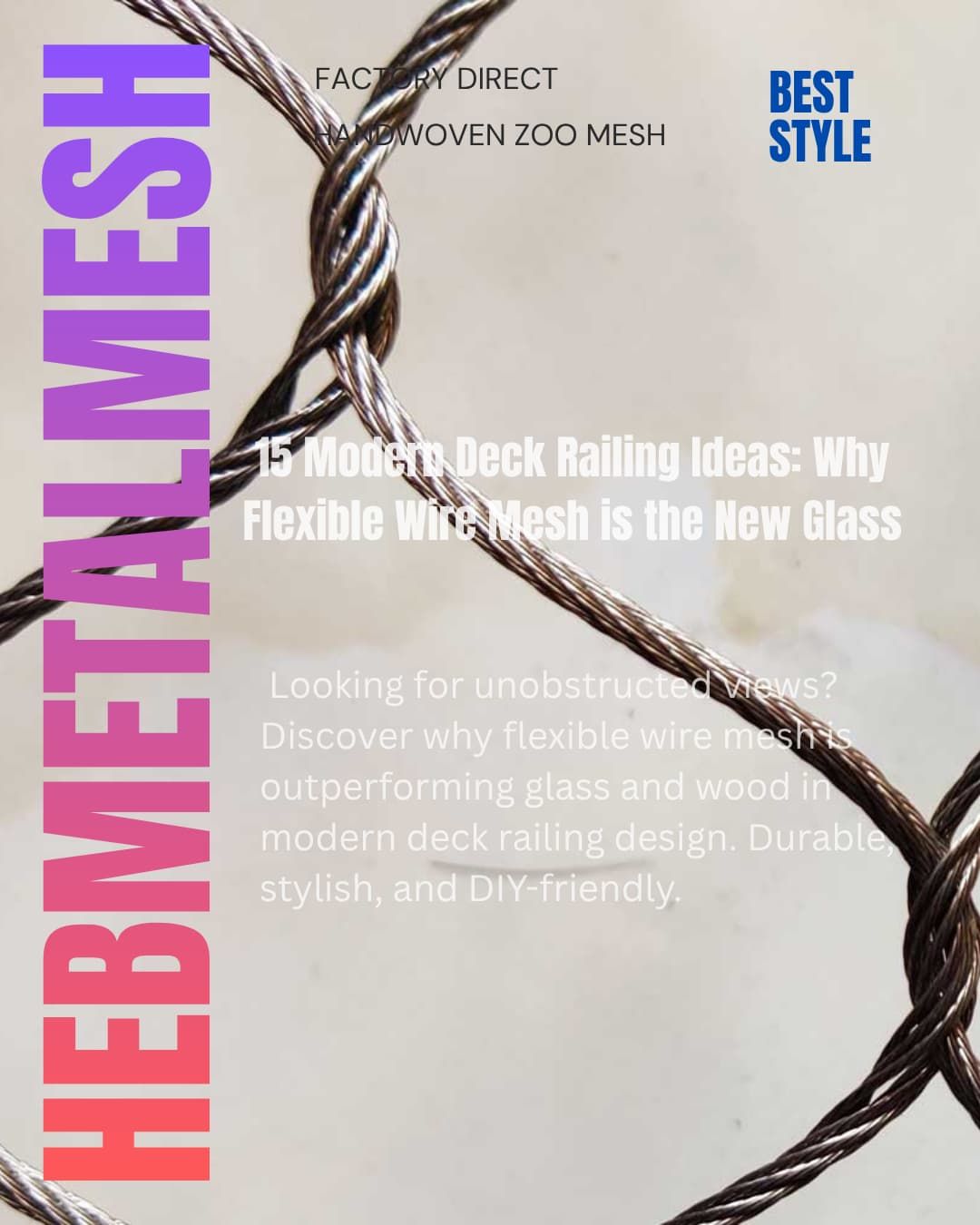
While galvanized steel relies on a temporary outer shell, stainless steel is a masterpiece of Alloy Science. To the untrained eye, all “steel” looks the same, but the molecular difference between 304 and 316-grade stainless steel is what determines whether your project lasts five years or fifty.
At Hebmetalmesh, we specialize in 316-grade stainless steel, the marine-grade standard. The primary difference is the addition of Molybdenum, a chemical element that provides a massive boost in resistance to chlorides (salt) and industrial pollutants. While 304 is excellent for indoor or mild environments, 316 is the “gold standard” for anything exposed to the elements, acidic animal waste, or coastal spray.
The Chromium Shield Unlike galvanization, stainless steel doesn’t have a coating that can be scratched off or “sacrificed.” Instead, it is protected by a passivation layer. When the chromium within the steel reacts with oxygen, it forms an invisible, molecularly thin layer of chromium oxide. If the surface is scratched, this layer self-heals instantly in the presence of oxygen. You aren’t fighting rust; you are using a material that is fundamentally unreactive to it.
Tensile Integrity One of the most critical factors in material selection is “fatigue life.” Over time, galvanized wire undergoes a process of work-hardening; it becomes brittle, loses its elasticity, and eventually snaps under tension. Stainless steel cable mesh maintains its “snap-back” flexibility indefinitely.
This is particularly vital for Animal Fence Mesh. When a large predator or a heavy bird impacts the mesh, the cables must stretch to absorb the kinetic energy and then return to their original shape. Stainless steel’s superior tensile integrity ensures that the barrier remains a dynamic, living system rather than a rigid, breaking one. It is the difference between a high-performance spring and a piece of dry pasta.
Architects looking to integrate this ‘steel fabric’ into building facades should explore Stainless Steel Mesh in Modern Architecture.
4. Synthetic & Plastic Netting: The Lightweight Trap
In an attempt to slash budgets even further, some developers turn to “industrial-grade” plastics or nylon netting. While these materials are incredibly light and easy to hang, they are a temporary fix at best.
UV Degradation The sun is a relentless destroyer of polymers. Even “UV-stabilized” plastics eventually fall victim to photodegradation. The sun’s rays break the molecular bonds of the plastic, causing it to lose its color, then its flexibility, and finally its structural strength. In high-exposure areas, a plastic net can turn into “confetti”—becoming so brittle that it crumbles at the touch—in as little as 24 months.
The Security Flaw Beyond environmental failure, synthetics have a massive security flaw: they are edible. For aviaries and wildlife parks, plastic is a nightmare. Rodents, squirrels, and the animals contained within can chew through synthetic mesh with ease. A single determined rat can create an escape hole in a nylon net in one night—a risk that is physically impossible with stainless steel.
The Sustainability Crisis Finally, there is the issue of microplastics. As synthetic netting degrades, it sheds millions of microscopic plastic particles into the surrounding soil and water. For eco-conscious developers aiming for LEED certification or working in sensitive habitats, plastic is no longer a viable option. Stainless steel is 100% recyclable and chemically inert, making it the only responsible choice for the “Green” building era we discussed in our Vertical Garden Guide.
5. Technical Comparison Table
When you strip away the sales pitches, the data speaks for itself. To help you make an informed decision for your next project, we have compiled a head-to-head comparison of the three most common containment materials.
The Material Teardown
| Feature | 316 Stainless Steel Mesh | Galvanized Steel Mesh | Synthetic (Nylon/PE) |
|---|---|---|---|
| Lifespan | 30+ Years | 5–10 Years | 2–5 Years |
| Maintenance | Zero (Self-Cleaning) | High (Rust removal/Painting) | High (Repairing tears) |
| Tensile Strength | Extremely High (Flexible) | High (Brittle over time) | Low (Prone to stretching) |
| UV Resistance | 100% (Immune) | High (Coating dependent) | Poor (Degrades/Crumbles) |
| Aesthetic | 99% Transparent | Industrial/Bulky | Medium (Thickens over time) |
| Chemical Resistance | Immune to Acid/Salt | Poor (Corrodes quickly) | Varies (Oil sensitive) |
Load-Bearing Capabilities
The “secret weapon” of stainless steel rope mesh is how it handles dynamic impacts. In public safety applications, a barrier must catch a falling person or stop a charging animal. Rigid panels (glass or welded wire) concentrate all that impact energy into a single weld or mounting point, often leading to catastrophic failure. Rope mesh, due to its hand-woven diamond structure, acts as a tensile net. It distributes the force across the entire surface area, absorbing the energy and snapping back into shape without permanent deformation.
Temperature Resilience
While synthetic materials begin to warp at 60°C and become brittle at -10°C, stainless steel remains physically stable from -40°C to 400°C. This makes it the only viable choice for extreme climates—from high-altitude observation decks to tropical aviaries. It won’t melt in a fire, and it won’t snap in a freeze.
Expert Case Study: To see this data in action within high-stress, 24/7 environments, explore ourZoo Mesh Series, where our mesh protects both the public and some of the world’s most powerful predators.
6. ROI Analysis: The “True Cost” Formula
Many procurement officers focus on the “Initial Quote,” but smart developers focus on the “True Cost” Formula:
When you run these numbers, the results are shocking. A galvanized fence may be 40% cheaper on Day 1. However, by Year 4, the combined costs of rust-treatment labor, repainting, and the inevitable 50% section-replacement will exceed the cost of a stainless steel installation.
Stainless steel rope mesh typically achieves ROI parity by Year 4. From that point on, your barrier is essentially “free,” while galvanized and plastic users are stuck in a perpetual cycle of spending. By choosing Hebmetalmesh, you aren’t just buying a product; you are eliminating a recurring line item from your future budget. It is a one-time investment for a lifetime of security.
Stop Paying for Rust.
Why settle for a “temporary” barrier? Upgrade to the engineering standard used by world-class zoos and luxury developers. HEB Metal Mesh is the final railing you will ever need to buy.
Verified 316-Grade Stainless Steel • Global Logistics • Precision Weaving Since 2006
This article has examined the material‑science differences between galvanised and stainless mesh. For a broader procurement framework — covering selection, specification, installation and FAQs — read our complete stainless steel cable mesh buyer’s guide.
FAQs
In a side-by-side durability comparison, 316-grade stainless steel is the undisputed winner for any project requiring a 25+ year lifespan. While galvanized mesh offers a lower upfront cost, its reliance on a “sacrificial” zinc coating makes it a ticking clock in safety-critical or high-moisture environments. Stainless steel’s molecular-level protection, self-healing chromium layer, and permanent tensile flexibility eliminate the cycle of rust, repair, and replacement. For architects and facility managers, it is the only material that transforms a recurring expense into a permanent asset.
No. In fact, because stainless steel cables are made of multiple fine strands, the mesh is often more pliable and easier to manipulate than stiff, single-strand galvanized wire. This makes it much simpler to lace onto irregular frames or organic shapes.
Yes. While the natural silver metallic look is popular, we offer a black-oxide finish. This chemical treatment darkers the steel without compromising its corrosion resistance, making the mesh even more “invisible” against dark backgrounds or lush greenery.
Yes. Unlike rigid fencing that may require replacing an entire panel, rope mesh can be repaired by re-lacing specific areas with new cable. However, given its high-tensile strength, accidental damage is extremely rare.
Most outdoor installations are “self-cleaning” via rainfall. For indoor or high-dust areas, a simple pressurized water spray or mild detergent is all that is required. There is never a need for toxic anti-rust coatings.