
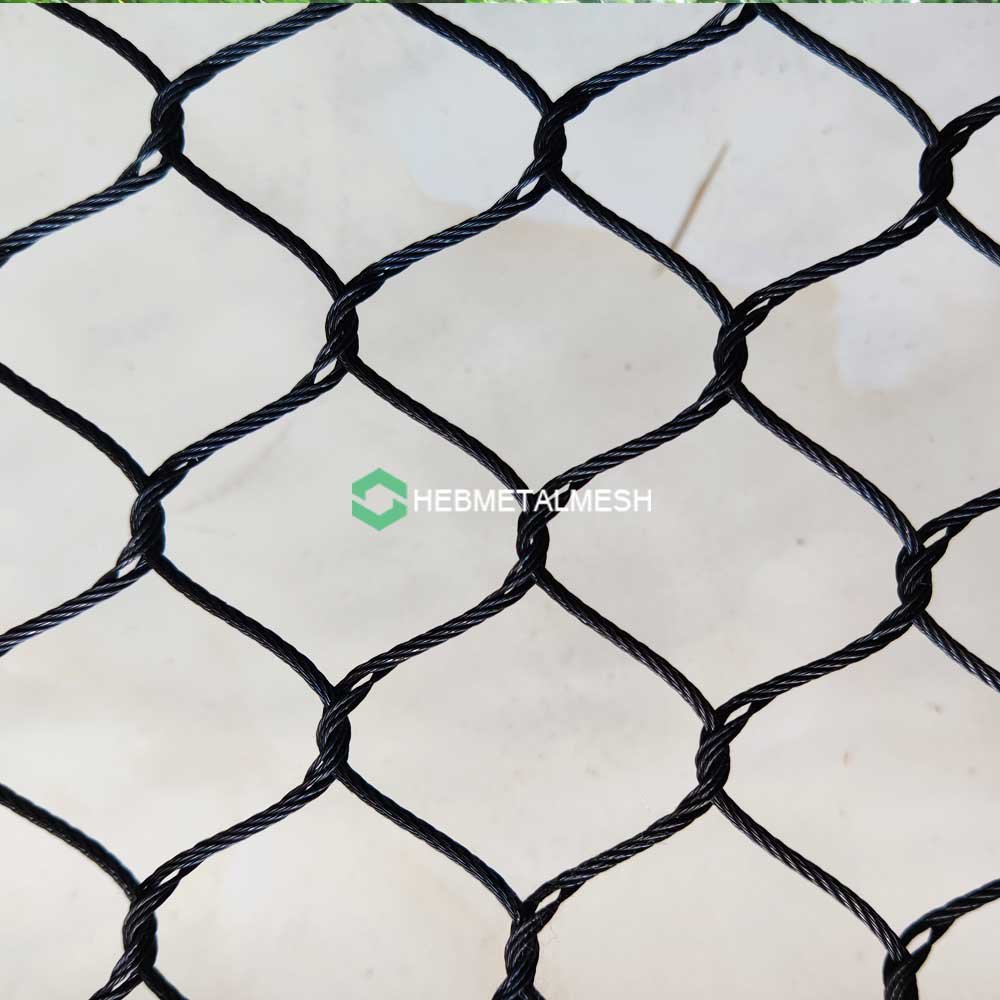
You can approve a wire rope mesh on four numbers — aperture, rope diameter, alloy grade and panel size — and still end up with a barrier you dislike, because not one of those four numbers describes what the mesh looks like. Every decision that governs containment is settled by measurement. Every decision that governs appearance is settled by looking, and looking is a specification job too. This guide treats mesh appearance the way an engineer treats any other line on the drawing: as something you choose deliberately, write down, and then check against a physical sample.
Executive Summary
Appearance on a wire rope mesh is not a matter of taste. It is the product of four choices, all of them measurable. Mesh visual weight comes from the wire to pitch ratio. The rhythm of the pattern comes from the orientation of the grid. The behaviour under light comes from the finish. Where the panels stop comes from the joint layout. A mesh judged from twenty metres, from three metres and from arm’s length reads as three different products, so the first question is never which mesh looks best — it is from how far away it will be seen. The reference specification is the animal fence mesh product page.
Quick Answer:
Mesh appearance is set by four variables and nothing else: the ratio of wire diameter to aperture pitch, which fixes mesh visual weight; the grid orientation, diamond or square; the surface finish, which fixes mesh glare and how the mesh reads against its background; and the joint layout, which draws lines across an otherwise uniform field. Choose all four from the viewing distance, not from a catalogue photograph, and approve a physical sample before the order is placed.
Key Takeaways
- Appearance is set by geometry, not by alloy. Two meshes in the same 316 stainless can look like a screen and like a fog, depending only on wire diameter and aperture pitch.
- The heaviest rope can read as the lightest mesh. A 3.2 mm rope at a 76 mm aperture shows less metal than a 2.0 mm rope at 38 mm, because the eye averages the wire to pitch ratio, not the diameter.
- Finish is a light decision, not a colour decision. A bright mill finish throws a pale glare in direct sun; a black oxide finish absorbs it and lets the barrier read as shadow.
- Orientation changes the rhythm of a whole elevation. Square vs diamond mesh is the difference between a grid that converges with the frame and a diagonal lattice that ignores it.
- Approve a sample, then freeze it. Photographs, renders and a change of supplier will each move the appearance away from what you approved.
Enclosure and façade work is judged by people standing in front of it, and the design guidance on what a stainless surface does over decades is published by the Nickel Institute, whose finish and weathering references are the ones worth checking a specification against.
Judge the Mesh From the Distance It Will Be Seen
A barrier is never looked at from one place. At twenty metres — a park boundary, a façade screen, the far side of a large enclosure — the mesh resolves into a soft grey field and the only variables that survive are mesh visual openness and the orientation of the lattice. At three metres, which is where an exhibit barrier or a balustrade actually lives, the pattern appears and mesh visual weight takes over. At arm’s length the surface finally arrives: mesh surface texture, the crimp at each termination, the way water sits on a strand. Decide which of those three distances governs the project before choosing anything, because a mesh that wins at one distance regularly loses at the next.
Mesh Visual Weight: The Wire to Pitch Ratio
Mesh visual weight is the best single predictor of how a barrier will read, and it is not the rope diameter. It is the wire to pitch ratio — the diameter divided by the spacing from one strand centre to the next. Aperture pitch is that centre-to-centre distance, so a 2.0 mm rope with a 38 mm clear opening has a pitch of 40 mm and puts 5.0% of the panel width in front of the view. A 3.2 mm rope with a 76 mm opening has a pitch of 79.2 mm and puts only 4.0% there, which is why the heavier rope produces the lighter-looking mesh. The same arithmetic gives the open area, and both numbers belong in the quotation.
| Rope diameter | Clear aperture | Visual weight | Open area |
| 1.6 mm | 25 mm | 6.0% | 88% |
| 2.0 mm | 38 mm | 5.0% | 90% |
| 2.4 mm | 38 mm | 5.9% | 89% |
| 3.2 mm | 38 mm | 7.8% | 85% |
| 3.2 mm | 76 mm | 4.0% | 92% |
Read the table down the visual weight column and the counter-intuitive rule appears: moving from a 2.0 mm to a 3.2 mm rope at the same 38 mm aperture adds more than half again to the metal in front of the view, while opening the aperture to 76 mm removes nearly all of it. Visual weight and strength pull in the same direction only when the aperture stays fixed.
Architectural Mesh Reads as Texture, Not as Product
Architectural mesh succeeds when nobody notices it. Specified well it becomes a texture that delivers containment or shade while letting the structure, the planting and the animal do the talking. The tell is usually visual weight: a mesh heavy enough to announce itself competes with everything in front of it. Choose architectural mesh as a continuation of the elevation, not as a product fixed to it.
Square vs Diamond: Orientation Sets the Rhythm
Rope mesh is woven and hung as a lattice, which makes square vs diamond mesh the first appearance decision after aperture. A mesh diamond orientation turns every strand into a diagonal: the pattern reads as a repeated 45-degree rhythm and the vertical edges of the panel become a series of half diamonds. Hang the same fabric square and the strands run parallel to the frame, producing a grid that converges with every post and rail and therefore looks busier against the structure. The diagonal also forgives small misalignments, because the eye follows the strand rather than the horizontal line, while a square grid advertises every deviation from level over a long run.
Mesh Glare and Background Contrast
Mesh glare is a geometry problem before it is a finish problem. A round wire behaves as a narrow cylinder, and a cylinder returns a bright line of light whenever the sun sits in the right plane, which is why a side-lit stainless barrier can appear to sparkle along an entire elevation. Mesh background contrast then decides what the visitor actually sees: a bright mesh in front of dark foliage becomes a pale veil, while the same mesh against a bright sky and a light building all but disappears. If the barrier must vanish, put bright metal against a bright background or dark metal against a dark one; if it must read as a boundary, do the opposite. Mesh colour and finish are two decisions, not one — colour is what the metal is, finish is how it handles reflection.
The Smallest Unit: What the Cross Point Looks Like
Stand close to any rope mesh and the pattern dissolves into a grid of crossings. At that distance the construction of the cross point is the whole appearance. A hand woven rope mesh built from 7 × 7 strand — the construction used for enclosure work — passes strand over strand with nothing added, so every crossing is a smooth two-strand interlace and the panel carries no fittings to catch light or trap dirt. A ferruled mesh clamps each crossing with a small sleeve, which reads as a row of beads from close up and as coarse texture from a distance; a knotted mesh carries a lump at every corner. The edge matters as much as the field: a tensioned panel finished with an edge cable and a swage ferrule ends on a clean drawn line, while a cut edge ends in a fringe that will never sit flat.
Mesh Joint Lines, Posts and Staggering
A wire rope mesh is a uniform field, which means the eye finds any line you draw across it. Where two panels meet, the mesh joint lines read as a drawn vertical, and evenly spaced joints can turn a quiet screen into something that looks striped. The fix is mesh staggering — offsetting joints so that no two align — or, more simply, placing every joint directly behind a post. Panels run to 9 m × 18 m, so on most elevations a joint is a decision rather than a necessity, and the animal fence mesh range lists what can be supplied in one piece. Posts and frame read far harder than the mesh because they are solid, so the mesh should be the quiet element and the structure the loud one.
Mesh Finish Weathering and Appearance Over Time
Mesh finish weathering is slower on stainless than on any coated product, but it is not zero. Rain carries dust into the crossings, where it dries and leaves a grey line; horizontal strands hold water longer than diagonal ones; a bright mill finish gradually mattens toward a uniform satin, and a black oxide finish lightens at the points that are touched — gates, handrails, the top two hundred millimetres of a panel. What drives mesh appearance over time is drainage and access far more than alloy: a panel that can be reached and rinsed keeps its original look, while one over a pond or behind mature planting does not. The mesh finish options on rope mesh are narrow — bright as drawn, a satin or brushed surface, and black oxide — so treat this as a choice made once rather than a range to trade down from later.
Writing a Mesh Appearance Specification
A mesh appearance specification is five lines and one sample. Write the aperture pitch and the rope diameter, because together they fix both mesh visual weight and open area. Write the orientation, diamond or square. Write the finish by its proper name rather than as “silver”. Write the joint layout as a panel schedule. Then require that a physical sample is approved and retained, because no photograph survives a change of supplier. Hold that sample against the delivered mesh in daylight, never under an office light. For the numbers behind aperture, wire diameter and strand construction, the guide to netting wire selection sets out the load side; for the alloy question behind any appearance choice, 304 vs 316 mesh settles which grade belongs on which exposure. Where the barrier has to be looked through rather than looked at, the requirements are set out for a public viewing barrier. And where the argument is corrosion rather than appearance, material selection for fencing is the reference.
FAQ
Usually the opposite. A black oxide finish removes the pale glare that a bright mesh throws back at the visitor, so the eye reads through the barrier to the animal and the space behind it looks deeper, not tighter. The exception is a dark mesh against a dark background, where the barrier becomes a flat shadow.
Diamond is the quieter of the two from most viewing angles, because the diagonal never aligns with the posts, the ground line or the horizon, so the eye has no straight edge to lock onto. A square mesh reads more strongly wherever it meets a horizontal rail.
It will never rust through, but it will not stay mirror-bright either. Expect a bright mill finish to settle toward a soft satin within a couple of seasons outdoors, and plan the cleaning access accordingly rather than specifying a shine you cannot maintain.
Ask both suppliers for four figures — wire to pitch ratio, orientation, finish by name, and joint layout — and for a sample of the exact specification quoted. If one quotation cannot state those four, its appearance is whatever arrives.
No. Finish and alloy grade are separate decisions. A black oxide finish changes the surface of the wire, not the strand, so it does not alter the breaking load and it does not replace the grade choice.