
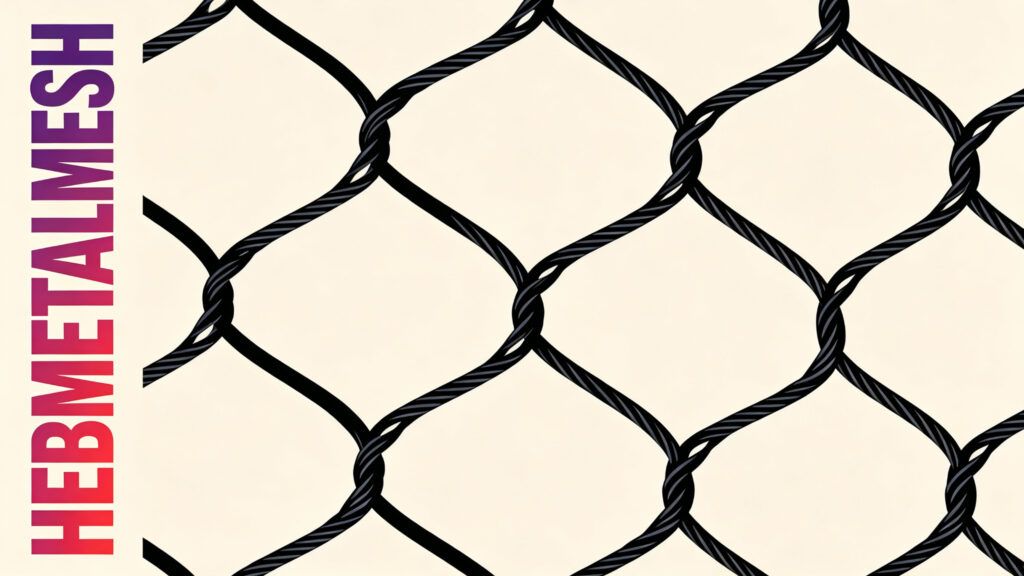
The 304 vs 316 stainless steel decision for cable mesh is not about the weave — the same hand-woven panel can be built in either grade — it is about chemistry, and one element decides most real-world projects. 316 stainless adds roughly 2% molybdenum to a 304 base, and that molybdenum addition is what stops chloride attack, pitting, and crevice corrosion in salt air, tropical humidity, and washdown-heavy animal facilities. Compare 304 vs 316 mesh for any animal enclosure and the practical rule is short: 304 stainless steel wire rope mesh suits dry inland and indoor work; 316 stainless steel wire rope mesh is the grade to buy whenever coastal or high-humidity conditions will be in play for decades.
Executive Summary
A 304 vs 316 stainless steel mesh purchase is a corrosion-engineering decision dressed up as a material decision. Grade 304 — 18% chromium, 8% nickel — resists rust in most atmospheres and costs less; grade 316 adds molybdenum and materially improves resistance to pitting corrosion, crevice corrosion, and chloride exposure, which is why it dominates marine environment installations and coastal zoo projects. Both grades share the same tensile strength profile, weave construction, and Nature and black oxide finish options — so the buying question is purely environmental: how wet, how salty, how long? The reference specification is the animal fence mesh product page product page.
Not sure which grade your site needs?
Send us your location, climate, and species list and we will specify the right rope diameter, aperture, and 304/316 grade for your enclosure.
Ask about 304 vs 316 mesh →Quick Answer:
Which stainless grade should cable mesh use? Choose 316 stainless steel cable mesh for coastal areas, marine environment projects, and any humid or washdown-heavy enclosure; choose 304 for dry inland and indoor installations. The grades differ by roughly 2% molybdenum, not strength — and the 10–15% premium buys decades of corrosion performance 304 cannot match near chlorides.
Key Takeaways
- The difference between 304 and 316 stainless steel is one alloying element: 316 adds molybdenum (about 2%) to resist chlorides, salt water, and industrial atmospheres.
- Same strength, different corrosion. Both grades have comparable tensile strength; the divergence is in pitting corrosion and crevice corrosion resistance.
- Location decides the grade. Inland or indoor, 304 is usually enough; coastal and tropical sites should default to 316.
- The cost gap is small against lifespan. Expect a 10–15% premium for 316 — cheap insurance on a barrier designed to outlast its installation crew.
Because facility standards increasingly treat long-term habitat integrity as an accreditation expectation, buyers planning large enclosures should review the husbandry and facilities guidance published by AZA-accredited zoos and aquariums (AZA) when they write their material specification.
Why the Grade Question Matters
Stainless cable mesh is sold by the square meter but installed by the decade, which is why the grade choice quietly dominates the total cost of ownership of any enclosure. A 304 vs 316 stainless steel mesh spec that looks identical at purchase time diverges five years later on a salt-air coastline: the 304 panel begins to show tea-staining, then pinpoint pitting, while the 316 panel beside it still reads as new. On an animal enclosure, a corroded barrier is not a cosmetic issue — it is a structural one, because rust at the crossings is where a determined animal eventually finds a weak point.
The converse is also true. Facilities that blindly specify 316 everywhere pay the premium where the atmosphere is mild and the money could have bought a larger panel, a better finish, or additional square footage. That is why a serious buyer does not ask “which is better” in the abstract; they ask which stainless steel grade for zoo enclosures suits their specific microclimate. Indoor buildings with climate control, sheltered inland yards, and short-lived temporary structures are legitimate 304 jobs. Open-air coastal exhibits, humid tropical aviaries, and any barrier that gets pressure-washed daily are 316 jobs. Get the climate right and the grade decision becomes almost automatic.
What Actually Changes Between the Two Grades
The difference between 304 and 316 stainless steel is easy to state because it is almost entirely chemical. Both are austenitic grades built on the same iron-chromium-nickel base, and the only meaningful change is the molybdenum addition that lifts 316’s performance in aggressive environments.
| Property | Grade 304 | Grade 316 |
| Chromium | 18% | 16–18% |
| Nickel | 8% | 10–14% |
| Molybdenum | None | 2–3% |
| Pitting resistance in chlorides | Good inland | Excellent in salt air |
| Typical use | Indoor, dry inland | Coastal, humid, washdown |
| Relative cost | Baseline | +10–15% |
Understanding the roles of the main elements is the fastest way to remember the difference. Chromium forms the invisible oxide film that gives stainless steel its rust resistance; nickel stabilizes the structure so the steel stays tough and formable; and the role of molybdenum in 316 stainless steel is to harden that oxide film against chloride ions — the specific attack that 304 cannot fully repel. When seawater spray, de-icing salt, or year-round high humidity is present, that is the element your mesh needs.
The chemical composition also explains why 316 is sometimes labeled “marine grade.” Strictly speaking, no stainless grade is immune to corrosion in a permanent marine environment — even 316 will pit if it is kept constantly wet and starved of oxygen — but 316 is the practical, cost-effective choice for the vast majority of salt-air and coastal applications, which is why stainless steel cable mesh grades explained in any materials handbook end with the same recommendation: match the grade to the chloride load.
304 vs 316 Corrosion Resistance: Where the Grades Diverge
Corrosion resistance is not a single number; it is a family of failure modes, and the 304 vs 316 corrosion resistance gap shows up in three of them. The first is pitting corrosion — localized holes that start where a chloride ion breaches the oxide film and then grow inward, often invisibly until a strand is half eaten. The second is crevice corrosion, which attacks the tight, oxygen-starved spaces where a rope crosses itself or where a panel meets a post. The third is general surface staining and roughening that accelerates in salt-laden air. Grade 316’s molybdenum raises its resistance to the first two dramatically and slows the third, which is exactly the set of threats an outdoor zoo enclosure faces near a coast.
Do not overstate the difference indoors. In a climate-controlled building with no chloride exposure, 304 stainless steel for indoor enclosures performs for decades with no visible degradation, and choosing 316 there simply spends the premium on protection you never use. The honest guidance for most institutions: 304 stainless steel for indoor enclosures and sheltered inland yards; 316 for everything the weather can reach in a coastal or tropical zone.
The Finishes Are the Same in Both Grades
Grade choice does not change the finish palette. Both 304 and 316 are available in the bright Nature finish that disappears against sky and foliage, and both take the black oxide finish that darkens the surface for a denser, more architectural look. The finish is applied after weaving and affects appearance and glare, not corrosion class — so pick the grade for the environment and the finish for the design, in that order.
Stainless Steel Cable Mesh Grades Explained in Practice
In practical terms, the mesh industry sells most animal and architectural panels as “304 or 316” on the same code, and the HM range is no different: a code like HM3250 (3.2 mm rope, 51 mm aperture) is quoted in both grades, and the spec sheet simply lists 304/316 per code. That means the weave quality, rope diameter, aperture, panel size, and tensioning behavior are identical between grades — the only variable is how long the panel resists its environment. A 3.2 mm rope strand in either grade carries roughly 7 kN of breaking load in the HM spec sheet, so the engineering of the barrier does not change when you step up a grade; the longevity does.
That shared construction is why the same hand-woven panels are used from big-cat yards to coastal aviaries with nothing but the grade changed. The heavy duty 304/316 metal netting offered for zoo work and the galvanized vs stainless steel cable mesh comparison on this site both assume the buyer has first settled the grade question, because grade determines service life more than any weave detail.
Which Stainless Steel Grade for Zoo Enclosures?
Walk the perimeter of a typical zoo and the grade pattern becomes obvious: choosing 304 vs 316 stainless steel for zoo enclosures follows the site’s corrosion map, not a brand preference. Big-cat exhibits, hoofstock yards, and primate habitats in mild inland climates run on 304 without complaint — these are the projects documented in our SS304 zoo fencing guide. The moment the facility is within a few kilometers of salt water, sits in a tropical wet season, or washes enclosures with chlorinated water every day, the same exhibits are specified in 316. Coastal institutions increasingly standardize the entire perimeter on 316 stainless steel cable mesh so that a future substitution error — a 304 panel accidentally installed in a 316 zone — cannot happen.
Aviaries and Bird Facilities
Aviaries are a special case because they combine humidity, standing water, bird waste, and pressure washing. The ammonia in bird droppings is itself aggressive to stainless finishes, and when it is compounded by tropical heat, 316 stainless steel for aviary netting becomes the responsible default. Large walk-through aviaries, which are washed frequently and host public feeding experiences, should treat 316 as mandatory rather than optional; the alternative is replacing visibly stained netting years ahead of schedule. For the full range of bird-mesh uses, see our rope mesh applications overview.
Is 316 Stainless Steel Worth the Extra Cost?
Yes, in exactly the environments it was designed for. The premium for 316 over 304 typically runs 10–15% at the material level, which on a large enclosure is a real but bounded number — often less than the cost of one future replacement section of 304 that failed near a coast. Compare it on a 25-year horizon: a 304 coastal panel that needs replacement in year eight costs you the full panel again plus labor and downtime; the 316 panel that was 12% more expensive on day one is still standing. For inland and indoor projects, the answer flips — 316 is worth the extra cost only if you plan to move the mesh to a harsher site, which almost nobody does.
Treat grade as a line item: put 316 in the coastal specification before negotiating the weave, and protect it in writing so the factory does not default to 304. Every HM enclosure code is offered in both grades on the animal fence mesh product page, and the grade field should be filled in deliberately, not left as “either.”
Sustainability and Lifecycle Thinking
Choosing the right grade is also the most effective sustainability decision available in mesh buying. Stainless steel is fully recyclable, and its environmental cost is dominated by production — so the panel that lasts 30 years instead of eight cuts embodied carbon per year of service by roughly three-quarters. A 316 specification that prevents premature replacement is therefore greener than a cheaper 304 that fails early. In every case, ask for mill certificates and grade markings on the crate so the installed grade is the grade you paid for.
Frequently Asked Questions
316 adds about 2% molybdenum to the 304 composition, which sharply improves resistance to pitting corrosion, crevice corrosion, and chloride exposure in coastal and humid environments.
Use 316. In salt air, 304 will tea-stain and pit within a few years, while 316 stainless steel for coastal areas holds its surface for decades.
Typically 10–15% more at material level — a modest premium relative to the cost of replacing a failed 304 panel near the coast.
Yes. Both grades share comparable tensile strength and the same 3.2 mm rope options carry roughly 7 kN breaking load; grade affects corrosion life, not strength.
Yes. Both grades are available in the bright Nature finish and the black oxide finish, so the aesthetic choice is independent of the grade choice.
Strongly recommended — tropical humidity plus bird waste and frequent washing is precisely the chloride and ammonia environment where 316 earns its premium.
Final Word
Buy the weave for the animal and the grade for the weather. A 304 vs 316 mesh specification is not a materials trivia question; it is a corrosion map of your site written in two numbers. Choose 304 stainless steel wire rope mesh for dry inland and indoor work, choose 316 stainless steel wire rope mesh for coastal air, tropical rain, and daily washdowns, and let the 10–15% grade premium ride on a 25-year service life where it is cheap. Get the grade right at the drawing stage and the mesh will outlast every other decision on the project.
Ready to specify your enclosure mesh? Send your site climate and species details to our engineers for a free 304/316 grade and specification recommendation.