
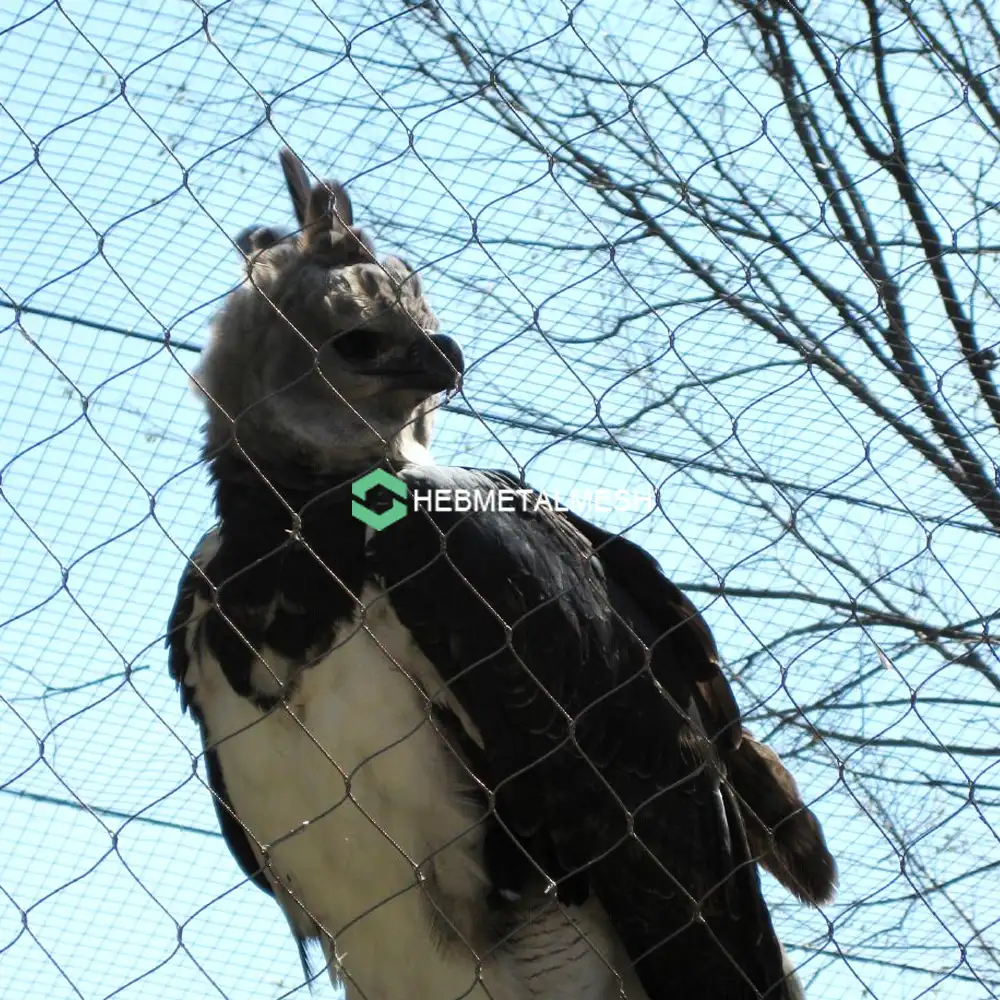
Most eagle aviary netting installation problems get blamed on the mesh. The wire is fine. The panel is fine. What failed sits two meters away, at a clamp nobody tightened or a tension wire nobody ran.
Watch an eagle work a new flight aviary and the pattern shows up fast. It flies the long wall, turns, and puts a talon into the corner where two panels meet. Ten minutes later it does the same thing in the same place.
Nothing in a mesh specification tells you that corner will take that load. The installation detail does, and that detail is where most eagle aviary netting installation mistakes actually live.
This guide covers the work that starts after the rolls arrive: tension, anchor spacing, corner terminations, wind bracing and the handover walk. Get those right and a lighter panel outperforms a heavy one bolted badly.
Executive Summary
Eagle aviary netting installation succeeds or fails at the perimeter. A handwoven stainless panel carries flight impact well while it stays tight. It loses that ability the moment it sags, because slack turns a spread load into a point load at the fixings.
Plan four things before the first anchor goes in. Tension wire spacing keeps unsupported spans short. Anchor spacing follows the frame, not a fence drawing. Corner terminations carry load from two directions. And the frame has to be stiff enough for local wind pressure.
The rest is sequence. Top tension first, mesh pulled from the high corner, edges dressed last. A panel installed this way holds its shape for a decade. A panel installed by eye looks right on day one and shows a belly by the second season.
Send the Frame Drawing, Not the Catalog Page
Give us the aviary footprint, the post spacing and the height at the eaves. We will return a tension wire schedule, anchor spacing and a panel cut list sized to your frame, before you commit to a roll.
Request an Installation LayoutQuick Answer
Run tension wires at the top, at mid-height and along the base, then set frame anchors at 600 mm or closer. Pull the mesh from the highest corner and tension it against the wires rather than the posts. Slack, not wire diameter, is what opens an eagle aviary.
Key Takeaways
- Most failures trace to the perimeter, not to the panel.
- Unsupported span decides how a panel behaves under a strike.
- 600 mm is a working anchor default; go tighter near corners and doors.
- A corner needs one continuous border cable, not two clamps in series.
- Tension belongs in the wire. Pulling against a post bends it and slackens the next panel.
- Inspect at handover and again after the first hard weather.
Where an Eagle Aviary Actually Fails
An eagle does not test a barrier the way a mammal does. It arrives at speed, lands on it, and hangs there.
That arrival is the design case. A bird of prey coming in at 40 to 60 km/h puts a short, concentrated load into the roof panel and the top of the wall. Then it sits. Talons close on the mesh, the bird shifts its weight, and the panel takes a slow pull at one point for as long as the bird stays.
Two loads, one panel, reversing direction. That reversal is what works clamps loose.
The mesh is rarely the weak part
Handwoven wire rope mesh handles both because the lattice moves under load and recovers. A welded grid work-hardens at the joints and cracks in the same spot after enough cycles.
So when a panel tears or a wall bellies, read the perimeter first. A eagle enclosure fence netting mesh panel bolted to a stiff subframe behaves nothing like the same panel stretched between two posts six meters apart.
What slack does to a bird
A slack panel gives a talon something to hook. The bird lands, the mesh pockets, and the foot finds purchase it would never find on a tight surface. Keepers see the result as a bird that hangs instead of perching.
Slack also moves. Every gust works the panel against its clamps, and a clamp that moves wears through its coating and then into the wire beneath.
Roof panels meet a different version of that load, and the guide to eagle aviary roof mesh treats that case on its own.
Tension Wire Layout Comes Before Panels
Installers who hang mesh straight onto posts get a curtain. The panel sags between supports, the base lifts, and no amount of extra cable fixes it.
Tension wires change the load path. The wire carries tension, the mesh hangs from the wire, and the posts only hold the wire in position. That split is the whole trick.
Run a continuous border cable around the perimeter first. Then add intermediate wires: one under the eaves, one at mid-height on walls over three meters, one along the base. On a roof, run wires parallel to the ridge at two to two and a half meter centers.
Spacing that holds
Closer spacing costs wire and saves panels. A two meter span keeps rope mesh flat under its own weight. A four meter span does not, and the sag shows as a visible belly inside one season. Treat eagle aviary netting tension wire spacing as the first number on the drawing.
The field notes on installing aviary nets make the same point from the maintenance side. The panels that reach ten years are the ones with the shortest unsupported span.
Reading tension by hand
You do not need an eagle netting cable tension gauge on a small aviary. Push the center of a panel with a flat hand. A panel at working tension deflects 20 to 25 mm and springs back without a ripple. One that deflects 60 mm and keeps the dent is not tensioned, whatever the clamp count says.
Anchor Spacing and Corner Terminations
Most crews copy eagle netting panel anchor spacing straight off a fence drawing. That number belongs to a different structure.
Rope mesh needs anchors close enough that the panel cannot bow between them. It also needs those anchors landing on a stiff member, because an anchor set into the middle of a flexible post does almost nothing.
| Element | Working spacing | Why it matters |
|---|---|---|
| Panel anchors to frame | 600 mm, 400 mm near corners | Stops the panel bowing between fixings |
| Border cable lacing | 150 mm centers | Spreads strike load into the cable |
| Intermediate tension wires | 2.0–2.5 m | Holds span short enough to stay flat |
| Wire anchor points | 1.5 m on the post line | Keeps wire from whipping under gust |
| Corner termination | Two opposed ferrules minimum | One ferrule slips under reversing load |
How a corner should be built
A corner takes load from two directions, and two clamps in series do not resolve that. Build it as one continuous element. This eagle netting corner termination detail separates a ten year aviary from a three year one.
- Run the border cable around the corner as a single piece, with no joint at the post.
- Fit a thimble at the turn so the cable bends on a radius instead of a kink.
- Clamp both tails with two opposed ferrules, never one.
- Add a diagonal brace from the corner post to the first intermediate post.
- Lace the mesh to the cable across the full corner, not just along the two straight runs.
The eagle netting edge cable clamp method matters as much as clamp count. Set each ferrule so the tail exits straight, then re-check after the first tensioning pass, because rope mesh settles in the first 48 hours.
The eagle fence supply guide lists the hardware that goes with this detail, including thimbles and the correct ferrule size for each cable diameter.
Aperture, Panel Layout and Bird Behavior
Aperture is a safety number before it is a viewing number. In a raptor enclosure, 50 mm square is the working default for eagles. It is large enough that a bird cannot catch a toe and small enough that a hawk or a raccoon cannot get through.
Smaller raptors need tighter mesh, and a mixed collection takes its rule from the smallest species in it. Getting eagle netting aperture size for raptors wrong is one of the few errors a bird cannot recover from.
Panel layout matters just as much. Put seams on posts or tension wires, never mid-span, because a seam is where the panel is least stiff. Keep weave direction consistent along a wall so adjacent panels move together under wind.
The same logic drives a bald eagle rehabilitation aviary netting spec, where a recovering bird has less room for error. A bird on the mend hits a barrier more often, and at an angle a healthy bird avoids.
Zoo and conservation bodies treat the barrier as one part of a welfare system that also covers flight distance, perching and retreat space. That is why AZA animal care standards are worth reading alongside any mesh drawing.
Wind, Snow and What the Frame Must Carry
Open mesh does not mean no wind load. A rope mesh wall at 50 mm aperture still blocks a meaningful share of gust pressure, and the frame absorbs all of it.
Two numbers drive the frame: design wind speed and the tributary area of each post. A post carrying six square meters of wall needs roughly twice the section of one carrying three. Run the eagle aviary netting wind load figure before you order steel.
Snow only lands on the roof. Roof mesh needs at least 15 degrees of slope, or a wire grid tight enough that snow sheds instead of sitting. A flat roof over a flight aviary is a winter problem waiting for the first heavy fall.
Check the frame before the mesh. Stainless steel netting for eagle flight aviary walls is only as straight as the steel behind it. The best raptor and bird of prey mesh cannot fix a post that bends.
The Installation Sequence
Order beats speed. Work top-down and outside-in, and keep the eagle netting installation on steel tube frame simple: clamp, do not weld on site unless you can dress and passivate the joint afterward.
- Set and brace the frame. Check plumb on every post before anything hangs on it.
- Run the border cable and the intermediate wires, tensioned but not final.
- Bring the top wire to final tension, working from the highest corner outward.
- Hang the mesh from the top border, lacing at 150 mm centers.
- Pull the panel down and out, tensioning against the wires rather than the posts.
- Lace the sides and the base, and leave the base cable until last.
- Dress every cut edge with a cable and a ferrule so no raw wire end sits exposed.
- Re-tension the wires after 48 hours, then once more after the first storm.
The eagle aviary netting installation tools list is short: spanner set, cable cutter, ferrule crimper, tension puller, gloves, ladder. What costs money is the second pair of hands at the top corner. Most of an eagle aviary netting installation cost per square foot sits in frame, wire and labor, not the panel. That is why two crews quoting the same mesh can differ by 40 percent.
Handover Check and the First Season
Walk the aviary with a list before the birds go in. Push-test every panel, measure the base gap at ten points, pull on every clamp by hand.
Then watch the first storm. A panel that flutters at the center has lost tension, and it will fret its clamps loose within a season. Eagle aviary netting installation inspection at handover is the only point where a mistake is still cheap to fix.
The panel inspection checklist for mesh aviaries turns this into a one page routine a keeper can run in fifteen minutes.
One check installers skip: stand inside the flight and look at the roof-to-wall junction. An eagle will find any gap there, and it will find it exactly where two panels meet.
FAQ
Tight enough that a flat hand pushed into the center deflects about 25 mm and the panel springs back flat. Looser than that and the panel pockets under a landing. Tighter risks overloading the border cable.
600 mm on the frame is a safe default, and 400 mm within a meter of any corner or door. Wider spacing only works when a tension wire sits between the anchors.
Yes, if the posts are braced and the anchors pass through the member rather than into its face. Timber moves with moisture, so plan to re-tension after the first wet season.
On any wall over three meters, yes. Below that, a border cable plus a top wire usually holds a panel flat on its own.
For eagle aviary roof netting sag repair, add an intermediate tension wire behind the sagging panel and re-lace that panel to the new wire. Do not take up slack at the corner clamps, because that pulls the panel out of square and loads one corner twice.
Panels, Wires and Clamps as One Kit
Send the footprint and the post layout. We cut the panels to your frame, supply the border cable, thimbles and ferrules, and mark every seam so it lands on a post instead of mid-span.
Send Your Frame Dimensions