
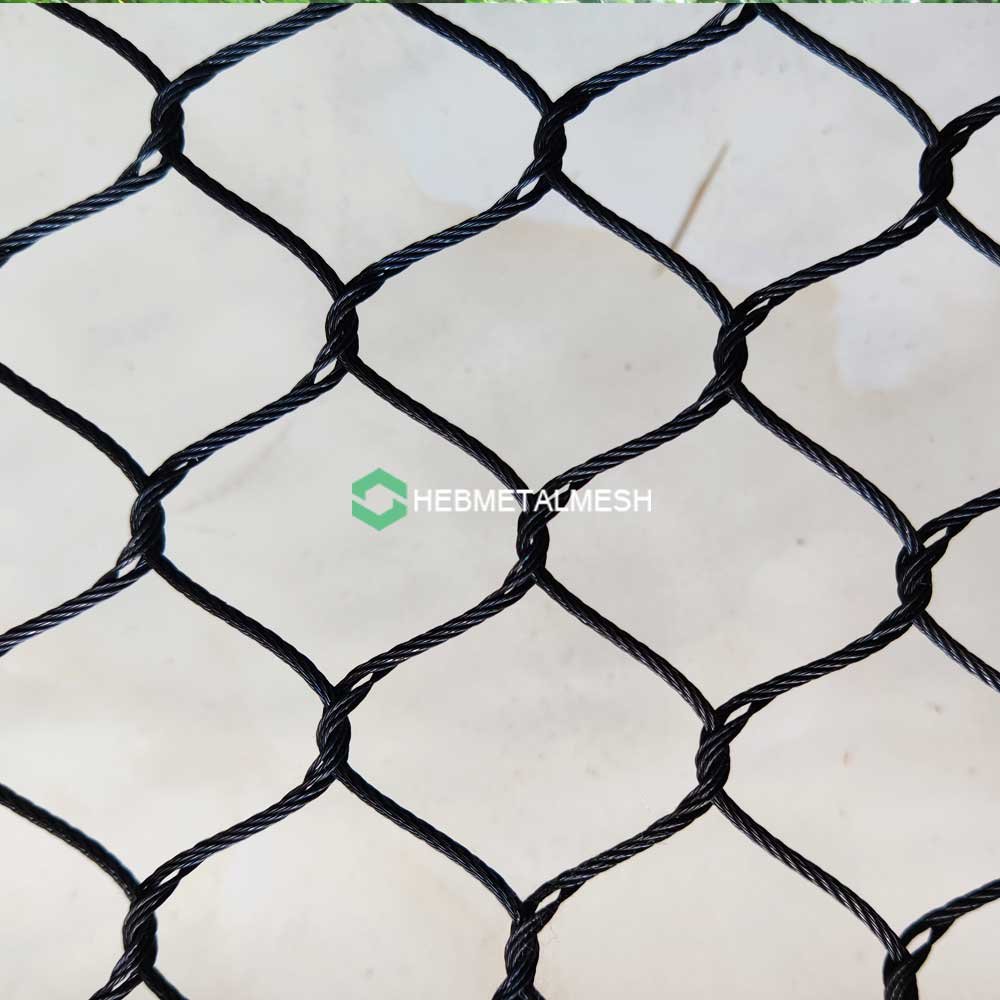
Walk into a well-built eagle flight aviary and the walls look right. The mesh is tight, the posts are plumb, and the whole thing reads as solid. Then look up.
The roof is where the specification usually gives way. It carries the same mesh as the walls on a lighter frame, because the roof is treated as a lid rather than a surface. For a bird that spends its working life going upward, that is the wrong assumption.
An eagle in a flight aviary does not fly level. It launches vertically, turns in the air, and drops onto a perch from height. Every one of those movements puts a load into the roof, and the roof is the part of the structure with the least support underneath it.
Executive Summary
Eagle aviary roof mesh is a different specification from the wall mesh, even when the panel looks identical. The roof takes impact from below, weather from above, and its own weight across a span with nothing under it.
Three numbers set it: the aperture the bird cannot pass, the span between supports that keeps the panel from sagging into a pocket, and the ridge cable tension that carries the load to the posts.
Get those wrong and the failure is slow and obvious. The roof sags, water and snow collect in the low point, the panel works against its fixings, and the first storm finishes the argument. The fix is cheaper at drawing stage than it will ever be again.
Quick Answer
Eagle aviary roof mesh should match the wall aperture but run on shorter spans, typically 2.5 to 4 m between supports, with a tensioned ridge cable along the apex and a continuous perimeter fixing at the wall head. The panel must never form a low point where water or snow can sit.
Key Takeaways
- The roof is a working surface. Eagles load it from below, not just from weather.
- Roof spans run shorter than wall spans because nothing supports the middle.
- A sag pocket is the beginning of every roof failure.
- The apex carries the highest tension and gets the least attention.
- The wall head junction is where gaps open first.
- Snow and ice load the cables, not just the mesh.
The Roof Is a Working Surface
A wall panel is loaded by a bird leaning on it, landing on it, or climbing it. Those loads are real but they arrive slowly, and the panel has a post or a rail close behind.
A roof panel is loaded by a bird arriving from underneath at speed. The load is brief, it is concentrated where the talons or the body meet the mesh, and there is nothing behind the panel except air.
Roof mesh for eagle flight aviaries is usually specified last, after the walls are priced and the frame is ordered. That order is the mistake, because the roof is where the loads differ most. A panel that behaves well as a wall becomes a drum skin overhead, and a drum skin transmits its load straight into the fixings at the edges.
Eagle enclosure netting is woven to the same standards for walls and roofs, but the panel schedule should not be. The roof gets the shorter span, the heavier edge cable and the more frequent fixing.
What a Stooping Bird Puts Into a Panel
Impact load from a stooping bird is the number most roof designs never calculate. A large eagle dropping onto a perch from the top of a 12 m aviary arrives with a dynamic load several times its own body weight, and that load lands on a small area of mesh.
The mesh itself rarely fails at the point of impact. Rope mesh deforms and recovers, which is one of its advantages over welded grid. What fails is the connection between the panel and the frame, because that is where the energy has to go.
So the roof detail is really a fixing detail. Edge cables sized for the panel, ferrules that match the wire, and a fixing interval short enough that no single connection takes the whole load.
A panel that has been hit hard will show a local distortion. That is normal. A panel whose edge has started to pull away from the ridge cable is not, and it will not correct itself. For a bird that will live under the same roof for decades, one mesh for a thirty-year bird is the right way to think about the roof panel.
Span, Sag and the Ridge Cable
Roof panel span for a raptor aviary runs shorter than most builders expect. A wall panel can span 5 or 6 m between posts because the wall is vertical and the load is mostly in plane. A roof panel spanning the same distance has to carry itself and the bird across open air.
Sag pockets in aviary roof mesh are the mechanism behind almost every roof problem. A panel that sags a few centimeters between supports creates a low point, and a low point collects water, then snow, then ice, and then it sags further.
The ridge cable for an aviary roof is what prevents that. Run a tensioned cable along the apex, carry it down to the corner posts, and tension it so the roof plane stays flat between supports. A ridge that has gone slack shows up as a ripple along the ridge line long before it becomes a visible sag.
| Roof zone | Aperture | Wire diameter | Span between supports | Fixing |
|---|---|---|---|---|
| Ridge and apex | As walls | 3.5 to 4 mm | 2.5 to 3 m | Continuous to ridge cable |
| Main slope | As walls | 3 to 3.5 mm | 3 to 4 m | 150 mm interval |
| Eaves and wall head | As walls | 3.5 to 4 mm | 1.5 to 2 m | Continuous edge cable |
| Gable infill | As walls | 3 to 3.5 mm | 2.5 to 3 m | 150 mm interval |
Read the table as a starting point and adjust for the bird. A large female eagle with a heavy body mass loads a roof harder than a male of the same species, and a pair in breeding condition loads it harder still. Building an eagle flight aviary covers how the frame and the mesh schedule come together at that stage.
Aperture on the Roof Is Not a Separate Question
Roof mesh aperture for eagles should match the wall aperture, and there is no good reason for it to differ. A bird that can pass a wall opening can pass a roof opening, and the roof is the direction it will try.
What does differ is the visual effect. A bird looking up sees sky through the roof, and sky is what it flies at. A roof with a wider aperture reads as more open, which encourages more upward flight and more impact. The Raptor Research Foundation work on flight behavior is a useful reference for how much of an eagle’s movement happens vertically.
That argues for keeping the roof at the same aperture as the walls and accepting the cost. It also argues against mixing panel types across a single enclosure, because a change in aperture at the eaves creates a visual and physical step.
The full specification guide for eagle aviary netting sets out how aperture and wire diameter work together, and the roof follows the same logic at a tighter span.
The Apex and the Perimeter
Eagle aviary roof design is mostly a set of junctions, and apex detail on an aviary roof is where good designs separate from adequate ones. Two roof planes meet at the ridge, and the mesh has to make that transition without a gap, a fold, or a place where water sits.
The workable pattern is a ridge cable with the mesh from both slopes laced to it in sequence. Lace one slope, tension it, then lace the second over the first. Doing both at once leaves a slack band along the ridge that no amount of later tensioning removes.
Perimeter fixing at the roof edge is the other junction. The roof meets the wall head, and that line is where gaps open first, because it is where two separately tensioned panels meet.
- Run a continuous edge cable along the wall head, not a series of clips.
- Lace the roof panel to that cable, not to the wall panel.
- Leave no gap wider than the aperture at the junction.
- Check the junction after every storm, because it moves first.
A roof that is tied to the wall panel rather than to a cable will pull the wall out of tension as it moves. Every one of those junctions needs an anchor that takes load in the direction the panel pulls, not just in the direction that was easy to drill. Mesh choices for long-lived captive eagles makes the point that the enclosure is one structure, and the roof and walls have to share a load path rather than fight each other.
Pitch, Orientation and Water
Mesh orientation on a pitched roof matters less for rain than for snow. Water passes through rope mesh, so a shallow pitch still drains. Snow does not pass through once it is wet, and a mesh roof at a shallow pitch will bridge.
A pitch of 15 to 20 degrees sheds most snow before it accumulates, and it keeps the ridge detail simple. Stainless steel mesh sheds it more readily than a coated product, because there is no coating to abrade and no bare edge to rust where the snow sits. Flatter than that and the roof becomes a horizontal surface with a mesh skin, which is a different structural problem.
Snow load on aviary roof mesh is a live load that arrives without warning and leaves slowly. A wet snow that bridges the aperture adds weight across the whole panel, and the load path takes it to the ridge and the eaves.
Ice on aviary cables is the quieter version of the same problem. Ice adds weight, it changes tension, and when it releases it does so unevenly. A cable tensioned in summer can be slack by February and over-tight in April. We weave eagle aviary roof mesh with the edge detail that makes seasonal re-tensioning a five-minute job rather than a scaffold hire.
Inspection, Storms and Replacing a Panel
Roof inspection after a storm takes twenty minutes and should be routine. Look along the ridge first, then the eaves, then the fixings in between.
- Sight along the ridge for ripple or droop.
- Check the eaves junction for a gap wider than the aperture.
- Pull-test three fixings per slope by hand.
- Look for local distortion from a recent impact.
- Check cable tension at the turnbuckle.
Replacing a roof panel from below is possible on most rope mesh structures and is far cheaper than dismantling the roof. Cut the lacing at one edge, lower the damaged panel, and lift the replacement into place along the same line.
Two people and a temporary support make it a morning’s work. One person working overhead without support turns it into a day and a half, and the temporary support is what stops the remaining panels losing tension while the roof is open.
How eagle fence panels degrade over time is a useful reference for judging whether a panel is worth replacing or the whole slope has reached the end of its life.
FAQ
No. Keep the roof at the wall aperture. A wider roof aperture looks more open to the bird, which encourages more upward flight and more impact on the panel.
2.5 to 4 m depending on the wire diameter and the bird. Ridge and eaves zones need shorter spans than the middle of a slope, because that is where the load concentrates.
Almost always a slack ridge cable or a span that is too long for the panel. Tension the ridge first, then add an intermediate support if the sag returns.
Yes, on most rope mesh roofs. Cut the lacing at one edge, lower the panel out, and lace the replacement along the same line with a temporary support in place.
Less than a solid roof, because the mesh bridges once the snow is wet. Keep the pitch at 15 to 20 degrees and clear the roof after heavy falls rather than relying on it to shed.
Tell us the aviary dimensions, ridge height and species. We return roof panel sizes, ridge cable specification, apex and eaves details, and the fixing intervals for your frame. Send your aviary plan