
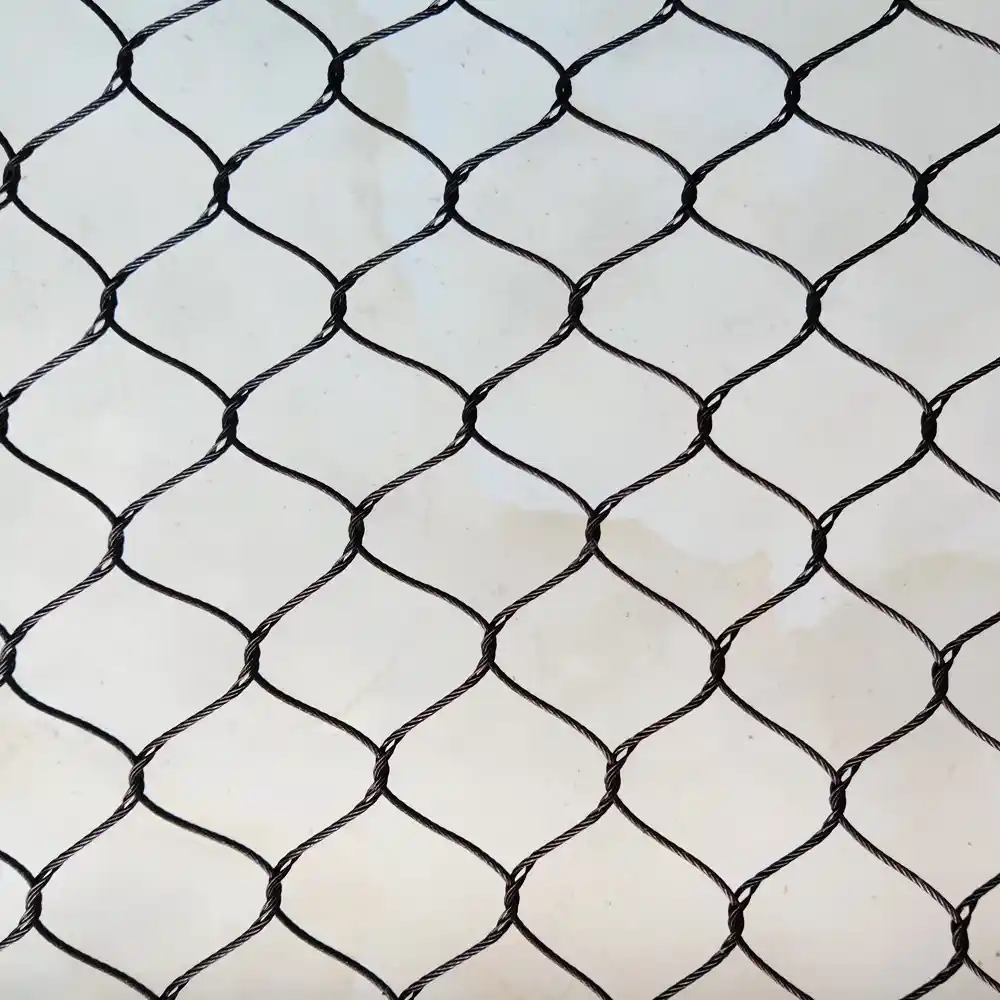
Need the Right Eagle Aviary Netting for Your Project?
Get expert guidance on selecting the perfect mesh specifications for your raptor enclosure. Our team specializes in zoo-grade stainless steel netting solutions.
Request a Quote →Key Takeaways
- Mesh aperture matters: 2″ x 2″ is the industry standard for eagle enclosures, balancing visibility, airflow, and impact safety
- Cable diameter determines impact resistance: 3/32″ (2.4mm) cable provides the breaking strength needed for high-speed raptor impacts
- Stainless steel beats all alternatives: 304 and 316 grades offer corrosion resistance, non-toxic safety, and 30+ year lifespans that nylon and galvanized cannot match
- Handwoven construction is superior: Unlike welded mesh that snaps at joints, handwoven stainless steel distributes impact forces across the entire panel
- Installation precision prevents failure: Proper tensioning, hog-ring attachment, and structural integration are critical for long-term performance
Introduction: Why Eagle Aviary Netting Demands Professional-Grade Solutions
The sight of a bald eagle soaring or a golden eagle perched evokes an immediate sense of power, grace, and wild freedom. But when these magnificent raptors are housed in captivity—whether in a zoological institution, a wildlife sanctuary, or a specialized breeding program—they demand the highest level of care and containment.
Eagle aviary netting is not merely a barrier designed to keep birds in; it is the structural boundary of their entire world. The physical attributes of eagles—their large size, formidable talons capable of applying immense pressure, and their propensity for rapid, forceful take-offs and landings—make them vastly different from smaller, softer-billed birds. A standard fence simply won’t suffice for raptor containment; the sheer size, speed, and power of an eagle necessitate a robust, specialized solution.
This guide walks you through everything you need to know about selecting eagle aviary netting for professional applications. From critical technical specifications to material comparisons and installation best practices, we’ll cover the essential considerations that separate a forty-year investment from a temporary fix.
If you’re planning a full‑scale eagle exhibit, start with our Comprehensive Guide to Designing Eagle Enclosures for a complete overview of layout, spatial requirements, and material selection.
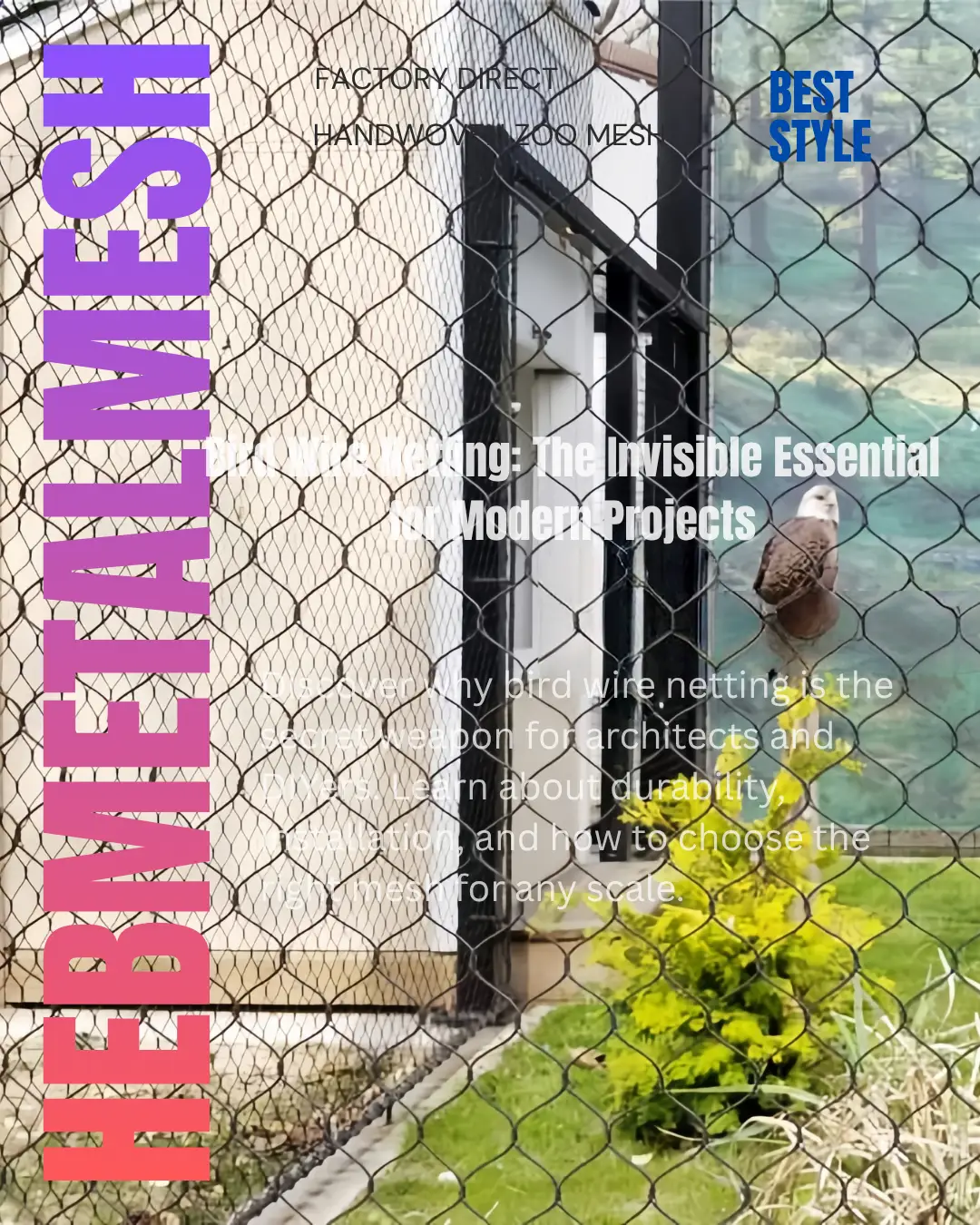
Understanding the Critical Requirements for Eagle Enclosures
The Physical Demands of Containing Apex Raptors
Eagles are powerful birds capable of high-speed flight. A standard “eagle fence” must absorb the kinetic energy of a bird hitting the perimeter without causing injury or structural failure. This means the mesh must have sufficient tensile strength to withstand impact forces without stretching, deforming, or breaking.
Beyond containment, the mesh must also serve as a predator deterrent—strong enough to resist intrusion by mammals like raccoons, foxes, and even large stray dogs that could cause panic and injury. The barrier must be smooth, with no rough edges or protruding wire ends that could cause foot or talon injuries, break delicate feathers, or damage the bird’s beak.
Why Standard Fencing Solutions Fail for Eagles
Many common fencing solutions are not just inadequate for eagles—they are dangerous:
Chicken Wire or Standard Welded Wire: These materials often use thin gauge wires and inexpensive coatings that quickly rust or degrade. Rusting wire weakens the barrier and can introduce sharp points. Zinc from galvanized coatings can also pose a toxicity risk if birds chew or mouth the wire.
Plastic and Nylon Netting: While lightweight, these nets are easily damaged by rodent chewing and, crucially, pose a significant risk of entanglement. An eagle’s talon, once caught, can lead to severe injury, broken bones, or worse. The rapid degradation under UV light also makes them unsuitable for long-term raptor containment.
For a detailed comparison of different fence types, see our Ultimate Guide to Eagle Fencing – Specialized Solutions for Zoos & Aviaries.
Key Safety and Performance Criteria for Eagle Aviary Netting
A professional bird of prey enclosure must meet several stringent criteria to satisfy raptor safety standards:
🔍 Overview: Eagle Aviary Netting Requirements
Professional eagle aviary netting must meet five critical criteria to ensure raptor safety and enclosure longevity:
- Containment Strength: High‑tensile mesh that absorbs impact without stretching or breaking.
- Predator Deterrence: Predator‑proof construction that resists intrusion by mammals.
- Bird Safety: Smooth, burr‑free mesh that protects talons, feathers, and beaks.
- Durability: Weather‑, UV‑, and corrosion‑resistant materials for a 30+ year lifespan.
- Visibility: Clear sightlines (e.g., 2″ x 2″ aperture) that reduce bird stress and prevent “net strikes”.
For large raptors, stainless steel (304/316) handwoven mesh with a 2″ aperture and 3/32″ cable diameter is the industry gold standard.
| Criterion | Requirement |
|---|---|
| Containment Strength | High‑tensile mesh that does not stretch or break under load |
| Predator Deterrence | Predator‑proof construction resisting intrusion by mammals |
| Bird Safety | Smooth mesh with no sharp edges to protect talons and feathers |
| Durability | Weather, UV, and corrosion resistance for long‑term performance |
| Visibility | Clear lines of sight to reduce stress and prevent “net strikes” |
Meeting these demands requires a material specifically engineered for this niche application, which is why stainless steel aviary netting has become the preferred choice worldwide.
Technical Specifications: What to Look for in Eagle Aviary Netting
Mesh Aperture Size—Finding the Sweet Spot for Eagles
The “aperture” or mesh size is one of the most critical decisions in any eagle aviary netting project. For eagles and other large raptors, 2″ x 2″ (51mm x 51mm) has become the industry standard. This aperture size provides the optimal balance of visibility, airflow, and impact safety.
Smaller apertures—such as 1″ x 1″—can obstruct visibility and make the enclosure feel more confining, potentially increasing stress on the bird. Larger apertures—3″ x 3″ or more—may allow smaller predators to reach through or could enable an eagle’s talons to become entangled. For most eagle aviary netting applications, 2″ x 2″ is the sweet spot.
Cable Diameter and Tensile Strength Requirements
The cable diameter of your eagle aviary netting directly determines its impact resistance and structural integrity. For professional-grade raptor enclosures, a minimum cable diameter of 5/64″ (2.0mm) is recommended, with 3/32″ (2.4mm) being the preferred choice for large eagles and high-impact environments.
The 3/32″ cable provides a breaking strength far superior to standard aviary wire, ensuring that even the most powerful wing impacts are safely absorbed without compromising the enclosure. In regions with heavy snow or high winds, this added thickness provides the structural integrity needed to prevent sagging and frame failure.
For most large raptor enclosures, the 2″ x 2″ x 3/32″ Heavy‑Duty Eagle Netting is the industry‑recommended choice. If your project targets medium‑sized raptors or cranes, the 2″ x 2″ x 5/64″ Stainless Steel Bird Netting (HM2050) offers a balanced strength‑to‑cost ratio.
Stainless Steel Grade Comparison—304 vs. 316
Not all stainless steel is created equal. The two most common grades for eagle aviary netting are AISI 304 and AISI 316.
Type 304 Stainless Steel offers excellent corrosion resistance and is suitable for most inland zoo and sanctuary applications. It is impervious to rust and bird droppings, ensuring a professional appearance for decades. Many professional-grade eagle aviary netting products use SS304 handwoven mesh.
Type 316 Stainless Steel contains molybdenum, which provides superior resistance to pitting and crevice corrosion. This makes it the preferred choice for coastal installations where salt spray is a concern, or in environments where particularly corrosive bird waste is expected.
Both grades are biologically inert and safe for all avian species, unlike galvanized materials which can cause heavy metal poisoning if a bird chews on the wire.
Handwoven vs. Welded Construction
The structural integrity of eagle aviary netting comes from its weave. Handwoven stainless steel mesh utilizes a “knotted” or “interlaced” design that allows the mesh to behave like a fabric. When an eagle strikes the mesh during flight, the force is distributed across the entire panel rather than being concentrated on a single weld point.
Welded wire, by contrast, can snap at the joints under stress. The rigid connections in welded mesh create a risk of wire breaks occurring in the area of load application or at connection points. Handwoven mesh also avoids sharp edges (burrs) that can be found in welded wire or chain link, protecting the delicate talons and feathers of these majestic birds.
Handwoven mesh can be draped over complex architectural shapes—domes, tunnels, and irregular rockwork—making it the preferred choice for modern, immersive zoo designs.
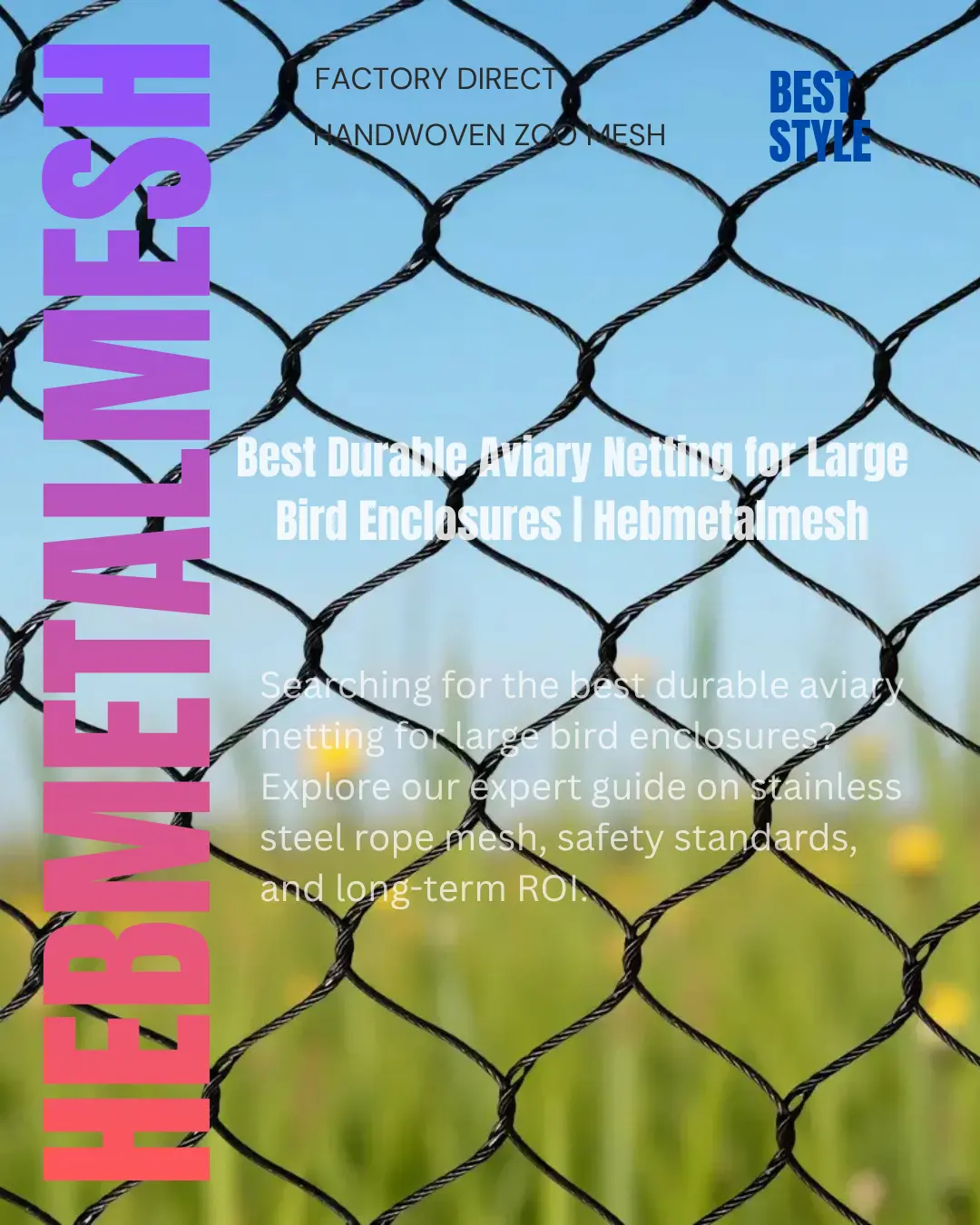
Material Comparison: Stainless Steel vs. Alternative Netting Options
Stainless Steel Aviary Netting—The Gold Standard
Stainless steel eagle aviary netting has become the industry standard for professional raptor containment. Its high-tensile strength—often exceeding 900 MPa—means it can absorb impact without deforming or breaking. Unlike synthetic alternatives that degrade under environmental stress, stainless steel provides a permanent, UV-immune barrier capable of withstanding significant environmental loads.
The handwoven design of professional-grade stainless steel mesh offers superior strength-to-weight ratio, allowing it to be integrated into the tensioning system of the building itself. This enables reduced support infrastructure, wider spans, and clean architectural profiles that eliminate the “cage” feel.
Galvanized Steel Wire—The Hidden Dangers
Galvanized steel relies on a thin coating of zinc for protection. In a zoo environment, this is a recipe for failure. Eagles produce nitrogen-rich waste that, combined with rain and humidity, becomes highly corrosive. The zinc coating degrades, exposing the underlying steel to rust and creating sharp, dangerous points.
More critically, zinc from galvanized coatings can pose a toxicity risk if birds chew or mouth the wire. While galvanized wire might appear as a cost-effective alternative, the long-term risks to bird health and the need for frequent replacement make it a poor investment for professional applications.
Plastic and Nylon Netting—Risks and Limitations
Plastic and nylon netting are lightweight and inexpensive, but they are fundamentally unsuited for eagle aviary netting applications. These materials degrade rapidly under UV exposure, becoming brittle and prone to tearing within 3 to 5 years. They are easily damaged by rodent chewing and pose a significant risk of entanglement.
In large-scale aviary projects, synthetic netting acts like a giant sail—it catches the wind, accumulates ice, and eventually reaches a breaking point. When a net fails at height, it’s not just a maintenance headache—it’s a catastrophic event leading to the loss of precious specimens, potential danger to the public, and massive liability claims.
Why professional‑grade materials are non‑negotiable for eagle containment is thoroughly explained in Eagle Fencing 101: Why Stainless Steel Aviary Netting Is the Gold Standard .
The zinc‑poisoning risk from galvanized wire is often overlooked – Stainless Steel Aviary: Stop Zinc Poisoning & Save $600+ covers this in detail.
If you also manage hawk or falcon enclosures, The Industrial Guide to Stainless Steel Hawk Netting discusses the nuances between 304 and 316 grades.
How to Install Eagle Aviary Netting: Professional Best Practices
Proper installation of eagle aviary netting is crucial for its effectiveness. Professional-grade installations follow a systematic approach:
1. Establish the Perimeter Framework
Install main fixings in the corners and at every point where the net needs to change direction. For larger jobs, install primary attachments every 45 to 50 feet.
2. Install Intermediate Fixings
Intermediate fixings should be installed at regular intervals along straight runs. For eagle aviary netting with 2″ apertures, spacings of 1 meter (approximately 3 feet) are typical.
3. Tension the Support Cables
A tensioned cable framework provides the foundation for the netting. The netting is attached to this framework using hog rings or cable ties.
4. Attach the Netting
Start in one corner and attach the netting horizontally using net rings or hog rings. Once you have a few feet in place, return to the corner and begin securing a few feet vertically to establish a strong corner.
5. Maintain Consistent Tension
Ensure the net is tight and square during installation. Inconsistent tension can lead to sagging, which creates pockets where birds can become entangled or where snow and debris can accumulate.
6. Integrate with Structural Framework
For large-scale installations, high-tensile stainless steel mesh can be integrated into the tensioning system of the building itself, allowing for reduced support infrastructure and wider spans.
Cost Considerations for Eagle Aviary Netting Projects
The cost of eagle aviary netting varies significantly based on specifications. Stainless steel aviary mesh typically ranges from $12.33 to $51.22 per square meter depending on cable diameter, aperture size, and grade. For a standard 25′ x 60′ roll of 2″ x 2″ x 3/32″ SS304 handwoven mesh, prices range from approximately $2,505 to $3,030.
However, focusing solely on initial cost is a mistake. Professional-grade stainless steel eagle aviary netting is designed to last 30+ years in nearly any climate. By contrast, synthetic netting requires complete replacement every 3 to 5 years. For large-scale facilities, the labor cost of renting lifts and hiring specialized crews to replace degraded netting often exceeds the cost of the material itself.
When evaluating cost, consider the total cost of ownership over the lifespan of the enclosure. Stainless steel eagle aviary netting may have a higher upfront cost, but its longevity, minimal maintenance requirements, and superior safety make it the most cost-effective choice for professional applications.
Maintenance and Longevity—Protecting Your Investment
Professional-grade stainless steel eagle aviary netting requires minimal maintenance compared to alternative materials. Crafted from high-tensile Stainless Steel 304, the mesh is impervious to rust and bird droppings, ensuring a professional appearance for decades.
However, regular inspections are still recommended. Key areas to check include:
- Tension points: Ensure the mesh remains properly tensioned without sagging
- Attachment points: Verify that hog rings and cable ties remain secure
- Structural connections: Inspect frame connections for signs of wear or corrosion
- Mesh integrity: Look for any signs of damage or deformation
For large-scale commercial aviary projects, modular repair systems allow targeted patching without full dismantling, saving significant labor costs. Commercial-scale operations report annualized maintenance costs as low as $0.023 per square foot after the initial warranty period.
The key to maximizing the longevity of your eagle aviary netting investment is choosing the right product from the start and following professional installation practices.
Frequently Asked Questions (FAQ)
Q1: What size mesh is best for eagle aviary netting?
The industry standard for eagle aviary netting is a 2″ x 2″ (51mm x 51mm) aperture. This size provides the optimal balance of visibility, airflow, and impact safety for large raptors. For eagles and other large birds of prey, this aperture prevents entanglement while maintaining clear sightlines that reduce bird stress.
Q2: How much does eagle aviary netting cost?
Professional-grade eagle aviary netting costs vary based on specifications. Stainless steel mesh typically ranges from $12.33 to $51.22 per square meter. A standard 25′ x 60′ roll of 2″ x 2″ x 3/32″ SS304 mesh costs approximately $2,505 to $3,030. While the upfront cost is higher than alternatives, the 30+ year lifespan makes it the most cost-effective long-term solution.
Q3: How long does stainless steel eagle aviary netting last?
Professional-grade stainless steel eagle aviary netting is designed to last 30+ years in nearly any climate, including coastal regions with high salt spray. This is in stark contrast to synthetic netting, which typically requires replacement every 3 to 5 years due to UV degradation.
Q4: Can eagle aviary netting be installed on existing structures?
Yes. Eagle aviary netting can be retrofitted to existing structures. The installation process involves establishing a tensioned cable framework around the existing structure and attaching the mesh using hog rings or cable ties. Handwoven stainless steel mesh offers the flexibility to conform to complex architectural shapes, making it suitable for both new construction and retrofits.
Q5: What is the difference between 304 and 316 stainless steel for aviary netting?
Both 304 and 316 stainless steel are biologically inert and safe for avian species. Type 316 contains molybdenum, which provides superior resistance to pitting and crevice corrosion, making it the preferred choice for coastal installations or environments with particularly corrosive conditions. Type 304 offers excellent corrosion resistance for most inland applications and is the standard choice for professional eagle aviary netting.
Executive Summary
Eagle aviary netting is not a one-size-fits-all product. Professional raptor containment demands stainless steel mesh with specific technical specifications: a 2″ x 2″ aperture for optimal visibility and impact distribution, a minimum 5/64″ to 3/32″ cable diameter for high-speed impact resistance, and AISI 304 or 316 stainless steel construction for corrosion resistance and non-toxic safety. Handwoven mesh outperforms welded alternatives by distributing impact forces across multiple intersections rather than concentrating stress at vulnerable weld points. While nylon and galvanized options appear cheaper upfront, they degrade within 3–5 years and pose entanglement or toxicity risks. Professional-grade stainless steel eagle aviary netting delivers a 30+ year service life, making it the most cost-effective solution for zoological institutions, wildlife sanctuaries, and large-scale aviary projects.
Ready to Specify Eagle Aviary Netting for Your Facility?
From 2″ x 2″ x 3/32″ heavy-duty mesh to custom specifications for unique enclosures, we provide the professional-grade stainless steel netting that zoos and sanctuaries trust.
- ✓ Expert technical guidance on mesh selection
- ✓ Custom sizes up to 30′ x 60′
- ✓ 304 and 316 stainless steel options
- ✓ Handwoven construction for maximum safety
- For bald eagles and golden eagles with powerful talons, our eagle enclosure mesh is engineered from high‑tensile stainless steel that resists tearing, scratching, and impact during flight.
- With over 20 years of export experience, our stainless steel mesh factory serves zoos, wildlife parks, and sanctuaries across 40+ countries worldwide.