
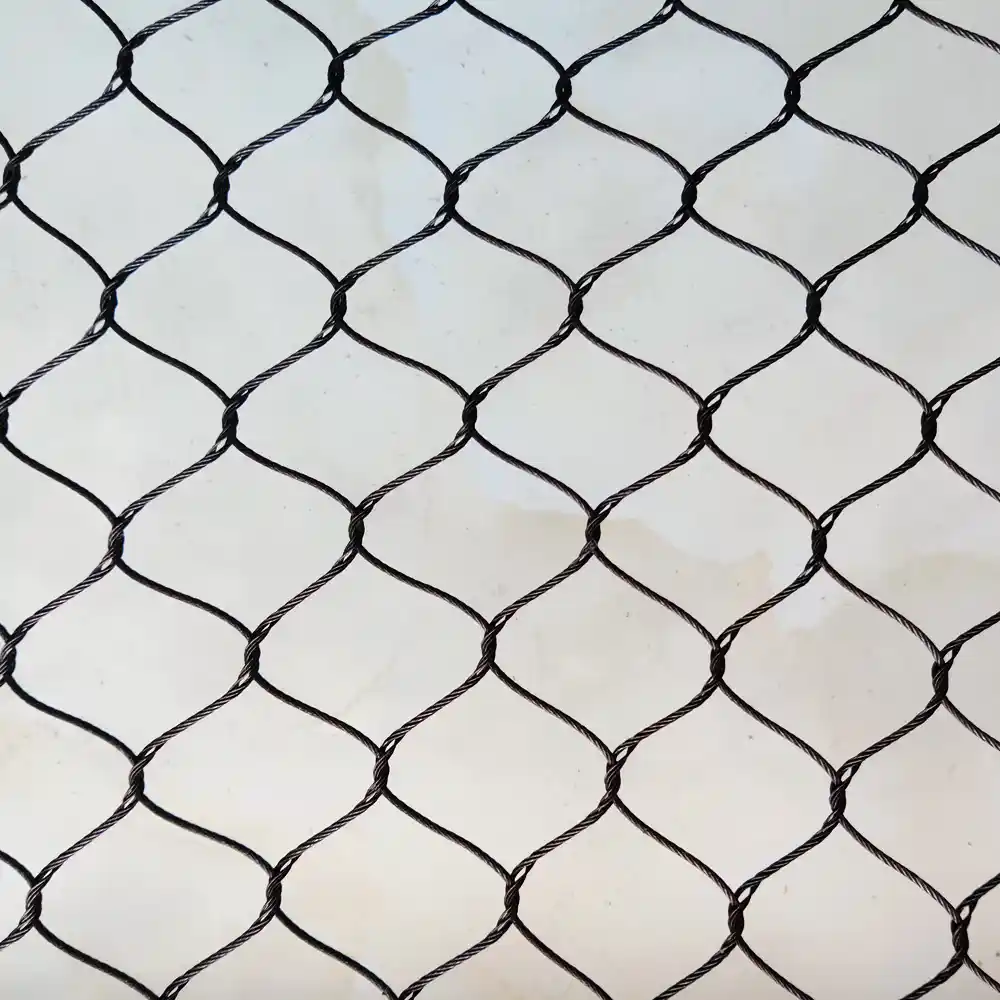
This guide helps zoo managers, aviary designers, and facility buyers select the right stainless steel hawk netting by explaining the critical differences between 304 and 316 grades, proper aperture sizing for raptor containment, and the engineering behind passivation and ferrule connections. You’ll learn why hand-woven stainless steel rope mesh outperforms welded wire and nylon alternatives, delivering a 30+ year service life with minimal maintenance. We also cover custom fabrication options, procurement requirements, and installation best practices—so you can avoid costly mistakes and build a truly raptor-proof barrier.
🔒 Need a Raptor-Proof Solution?
Get expert guidance on grade selection, custom sizing, and tensile load calculations for your specific enclosure requirements.
📞 Contact Our Engineering Team →✅ Expert advice · Custom specifications · Quick turnaround
What Is Hawk Netting and Why Choose Stainless Steel?
Defining the Raptor-Proof Barrier
Hawk netting is a specialized containment system engineered specifically to hold birds of prey—hawks, eagles, falcons, and owls—within an enclosure or to exclude them from sensitive areas like livestock pens or poultry farms. Unlike standard bird exclusion netting made from lightweight HDPE or nylon, hawk netting must withstand the sheer force of a raptor’s talons and the impact of a bird striking the mesh at full speed.
Standard bird exclusion netting is designed for small songbirds or garden pests and typically lasts only 3 to 5 years before UV degradation makes it brittle and prone to tearing. In contrast, stainless steel hawk netting is a permanent infrastructure solution. Its high-tensile strength—often exceeding 900 MPa—means it can absorb impact without deforming or breaking. A hawk or eagle landing on the mesh won’t compromise its structural integrity.
For livestock protection, hawk netting serves a dual purpose: it keeps predatory birds away from vulnerable animals while allowing natural light and ventilation to pass through. This makes it vastly superior to solid fencing or low-grade plastic alternatives.
The Superiority of Stainless Steel over Plastic/Nylon
The most common mistake buyers make is choosing nylon or plastic netting based on upfront cost. Here’s the reality: nylon netting is highly susceptible to UV degradation. The sun’s rays break down the polymer chains, causing the material to become brittle and snap. Within 2 to 3 years, a hawk can practically fly right through sun-damaged plastic netting.
Stainless steel hawk netting, by contrast, offers:
- UV resistance: Stainless steel does not degrade under sunlight.
- Corrosion resistance: Properly passivated stainless steel resists rust even in coastal or humid environments.
- Impact resistance: The flexible cable construction absorbs energy rather than concentrating stress on a single point.
- 30+ year lifespan: While nylon needs replacement every 3 to 7 years, stainless steel mesh can last three decades or more.
Comparing 304 vs 316 Grade Stainless Steel for Zoo Mesh
Not all stainless steel is created equal. The choice between 304 and 316 grade is perhaps the single most important decision for your project’s lifecycle.
| Grade | Best For | Corrosion Resistance | Cost | Lifespan |
|---|---|---|---|---|
| 304 Stainless Steel | Inland aviaries, temperate climates, standard exhibits | Excellent general corrosion resistance | ✓ More affordable | 20+ years inland |
| 316 Stainless Steel | Coastal zoos (within 50km of coastline), high-humidity environments, facilities with high ammonia exposure | Superior chloride resistance (contains molybdenum) | ★ Higher premium | 30+ years, even in harsh conditions |
From a professional China stainless steel zoo mesh factory with 20+ years export experience: We’ve seen facilities within 50 kilometers of the coastline specify 304 grade to save costs—only to face oxidation and pitting corrosion within a decade. The cost of replacing a failing mesh system, including labor, animal downtime, and potential safety risks, far outweighs the initial material savings. For coastal installations, 316 grade is not optional—it’s mandatory.
Technical Specifications: Understanding Tensile Strength and Aperture Size
Calculating Tensile Load for Large-Scale Aviaries
Tensile strength is the maximum amount of tensile (pulling) stress a material can withstand before breaking. For hawk netting, this is measured in kilonewtons (kN) or newtons per square millimeter (N/mm²). Typical stainless steel rope mesh offers tensile strength ranging from 300 to 400 N/mm², with some constructions reaching up to 900 MPa.
When calculating tensile load for large-scale aviary netting, you need to consider:
- Dead load: The weight of the mesh itself.
- Live load: Impact from birds, snow accumulation, and wind pressure.
- Safety factor: Industry standards typically require a 5:1 safety ratio (the mesh should withstand five times the expected maximum load).
The wire rope construction matters too. 7×7 construction (seven strands of seven wires each) offers good flexibility, while 7×19 construction (seven strands of nineteen wires each) provides even greater flexibility and fatigue resistance. For large-span enclosures, 7×19 is often preferred because it can better absorb dynamic loads from bird impacts and weather events.
Choosing the Correct Mesh Aperture Size
What mesh aperture size prevents hawk entry? The answer depends on the species you’re containing or excluding. Aperture size—the opening between wire ropes—must be small enough to prevent a hawk’s head or body from passing through, while large enough to maintain visibility and allow natural light penetration.
| Aperture Size | Recommended For | Notes |
|---|---|---|
| 25mm × 25mm (1″ × 1″) | Small raptors, kestrels, and owls | Maximum security, minimal visibility obstruction |
| 30mm × 30mm (~1.2″ × 1.2″) | Medium raptors, macaws | Industry standard for most zoo aviaries |
| 50mm × 50mm (2″ × 2″) | Large raptors, eagles | Suitable for species with larger heads |
| 76mm × 76mm (3″ × 3″) | Very large birds, livestock protection | ⚠️ Ensure species-specific safety assessment |
Aperture size also affects how the mesh interacts with natural light. Smaller openings create more shadow and reduce visibility, while larger openings offer a more “invisible” barrier that allows visitors to focus on the birds, not the mesh.
The Science of Durability: Passivation and Surface Treatment
Preventing Rust on Outdoor Stainless Steel Aviary Netting
How to prevent rust on outdoor stainless steel aviary netting? The answer lies in a chemical process called passivation.
Many buyers assume that “stainless” means “stain-proof.” This is incorrect. Stainless steel’s corrosion resistance comes from a thin, invisible chromium oxide layer that forms naturally on the surface. However, during manufacturing—cutting, welding, and weaving—free iron particles from tools and the environment can embed themselves in the surface, creating sites where rust can begin.
Passivation is a controlled chemical treatment—typically using nitric or citric acid—that removes these free iron particles and other surface contaminants. This allows the protective chromium oxide layer to reform, restoring the material’s natural corrosion resistance.
The “Passivation” Process: The Key to Corrosion Resistance
From a professional China stainless steel zoo mesh factory with 20+ years export experience: Passivation isn’t just a “nice to have”—it’s a critical quality control step that separates premium hawk netting from inferior products. Here’s what happens in our factory:
- Fabrication: High-tensile stainless steel wire ropes are hand-woven into diamond patterns and secured with ferrules.
- Pickling: The mesh is treated to remove welding scale and surface oxides.
- Passivation: The mesh is immersed in an acid bath (citric or nitric) to remove free iron.
- Rinsing and drying: Thorough washing removes all chemical residues.
- Quality inspection: Salt-spray testing to ASTM B117 standards verifies corrosion resistance.
A properly passivated 316-grade mesh can withstand over 500 hours of neutral salt spray testing with no red rust. This is the level of quality you need for coastal zoos or facilities in high-humidity environments.
For facilities seeking aesthetic integration, a Black Oxide finish is available. This treatment darkens the stainless steel surface, making the mesh nearly invisible against natural backgrounds—ideal for “invisible” zoo enclosures where visitor experience is paramount.
Customization and Procurement: From Inquiry to Delivery
Custom Fabrication: Mesh Opening and Rope Diameter
Can I customize the mesh opening and rope diameter for my enclosure? Absolutely. Custom fabrication is standard for professional zoo and aviary construction.
Available customization options include:
- Rope diameter: From 1.0mm to 5.0mm
- Mesh aperture: From 20mm to 200mm
- Wire rope construction: 7×7 or 7×19
- Grade: 304, 304L, 316, or 316L
- Finish: Natural silver or Black Oxide
- Connection type: Ferrule or knotted
Ferrule connection uses high-strength ferrules (typically tinned copper, nickel-plated copper, or stainless steel) to join wire ropes at intersections. This creates a mesh with consistent aperture size and excellent load distribution. Knotted mesh involves manually knotting each intersection—a labor-intensive process that offers maximum flexibility.
Procurement Requirements for Custom Zoo Netting
What are the procurement requirements for custom zoo netting? When purchasing custom hawk netting, you’ll typically need to provide:
- Enclosure dimensions: Total area, height, width, and any curved sections.
- Species information: Types of birds, their size, and behavior patterns.
- Environmental conditions: Inland or coastal, humidity levels, temperature ranges.
- Structural details: Existing framing, attachment points, and load-bearing capacity.
- Aesthetic preferences: Desired finish (silver or Black Oxide) and visibility requirements.
Typical lead time for custom-fabricated stainless steel mesh ranges from 15 to 30 days, depending on order complexity and quantity. For large-scale zoo projects, we recommend placing orders at least 8–12 weeks before installation to allow for fabrication, quality testing, and shipping.
Choosing Between Hand-Woven vs. Welded Mesh for Exhibits
The debate between hand-woven and welded mesh is fundamental to enclosure safety.
Welded wire mesh is created by resistance-welding wires at their intersections. It’s rigid, inexpensive, and suitable for temporary enclosures. However, welded mesh has critical weaknesses:
- Stress concentration: Impact forces concentrate on weld points, which can fracture.
- Limited flexibility: Cannot conform to curved or irregular shapes.
- Shorter lifespan: Weld points are vulnerable to corrosion.
Hand-woven stainless steel rope mesh is constructed by skilled technicians who manually loop and ferrule each intersection. The result is a flexible, structural “fabric” that:
- Absorbs impact: Distributes force across the entire panel.
- Conforms to shapes: Ideal for organic, curved enclosures.
- Lasts decades: No weak points to fail prematurely.
From a professional China stainless steel zoo mesh factory with 20+ years export experience: We’ve seen welded mesh enclosures fail at the weld points within 5–7 years due to corrosion and stress fatigue. Hand-woven rope mesh, properly installed, routinely exceeds 30 years of service. The upfront cost is higher, but the lifetime cost is significantly lower.
Installation Engineering: Tensioning and Ferrule Connections
The Hardware Behind the Barrier
The strength of your hawk netting depends not just on the mesh itself, but on the hardware that connects it to the structure.
Key components include:
- Ferrules: High-strength metal sleeves crimped onto wire rope intersections. The ferrule diameter must match the wire rope construction precisely.
- Tensioning tools: Ratchets, winches, or turnbuckles used to apply proper tension.
- Attachment points: Stainless steel brackets, bolts, and anchors secured to the structural frame.
Ferrule crimping requires specific compression force—measured in metric tons—to ensure the mesh doesn’t “creep” or deform under load. Under-crimping allows movement; over-crimping can damage the wire rope. Professional manufacturers provide crimping specifications and can supply pre-assembled panels to simplify installation.
While proper installation techniques are critical, choosing the right wire diameter and aperture size is equally essential for genuine predator defense—explore our comprehensive hawk protection guide for the full engineering breakdown.
Mastering Tension: Preventing “Sag”
From a professional China stainless steel zoo mesh factory with 20+ years export experience: One of the most common installation mistakes is improper tensioning. Over-tensioning can cause wire ropes to snap or ferrules to deform. Under-tensioning leads to unsightly “bellying” or sagging—and worse, creates pockets where animals could become trapped or injured.
Proper tensioning requires:
- Pre-tensioning calculations: Based on span width, mesh weight, and expected loads.
- Gradual tensioning: Applying tension incrementally across the entire panel.
- Even distribution: Ensuring tension is consistent across all attachment points.
- Post-installation inspection: Verifying tension after 24–48 hours, as mesh can settle.
A general rule of thumb: the mesh should be taut enough that it doesn’t sag under its own weight, but not so tight that it rings like a drum when tapped. For large spans, we recommend consulting a structural engineer to calculate specific tensioning requirements.
Specialized Installation: Curved Aviary Frames
How to install hawk netting on curved aviary frames? The flexibility of hand-woven stainless steel rope mesh makes it ideal for curved and irregular structures.
The installation process typically involves:
- Frame preparation: Ensuring the structural frame can support the tensioning loads.
- Mesh orientation: Determining the correct mesh direction for the curve.
- Corner attachment: Securing each corner of the mesh panel to the frame.
- Progressive tensioning: Tensioning from the center outward to maintain even distribution.
- Edge securing: Wrapping the mesh edges around the frame with stainless steel wire rope.
Does hawk netting require specialized installation tools or structural framing? Yes. Because stainless steel rope mesh is a structural material, installation typically requires:
- Heavy-duty tensioning tools (ratchets, winches, or hydraulic tensioners)
- Crimping tools for ferrule connections
- Structural framing capable of supporting high-tension loads (steel posts, concrete footings, or reinforced beams)
We recommend hiring experienced installers who have worked with stainless steel cable mesh systems before. The learning curve is steep, and mistakes are expensive to correct.
Safety and Biocompatibility: The Bird’s Perspective
Is Stainless Steel Rope Mesh Safe for Bird Beaks and Claws?
Is stainless steel rope mesh safe for bird beaks and claws? Yes—when properly specified and installed.
Safety considerations include:
- Non-toxic surface treatment: Passivation removes harmful residues, ensuring the mesh is biocompatible.
- Smooth edges: High-quality mesh has deburred edges that won’t cut or abrade birds.
- Appropriate aperture size: Prevents toe entrapment—a critical safety issue for climbing birds.
- Flexible construction: Hand-woven mesh absorbs impact, reducing injury risk if a bird strikes the barrier.
From a professional China stainless steel zoo mesh factory with 20+ years export experience: We’ve supplied mesh for facilities housing everything from macaws to eagles. The key to safety is matching the mesh specification to the species. Aperture size that’s too large can trap toes; wire diameter that’s too thin can bend under a heavy bird’s weight. Always consult with your supplier about the specific species you’re housing.
Is Stainless Steel Rope Mesh Bird-Safe for All Species?
Is stainless steel rope mesh bird-safe for all species? When properly specified, yes. However, “bird-safe” depends on three factors:
- Aperture size: Must prevent head or limb entrapment for the smallest species in the enclosure.
- Wire diameter: Must be strong enough to support the heaviest species without deforming.
- Surface treatment: Must be non-toxic and smooth.
For mixed-species aviaries, we recommend designing around the smallest species (for aperture size) and the heaviest species (for wire diameter). This ensures safety for all inhabitants.
The non-toxic surface treatment is particularly important because birds often use their beaks to explore their environment. A passivated stainless steel surface contains no harmful chemicals that could be ingested.
Conclusion
Why Invest in Heavy-Duty Hawk Netting for Livestock and Zoo Protection
Investing in heavy-duty hawk netting is investing in peace of mind. Whether you’re protecting livestock from aerial predators or creating a safe, humane enclosure for birds of prey, stainless steel rope mesh offers the perfect combination of strength, durability, and visibility.
Key takeaways:
- 304 grade suits inland aviaries; 316 grade is mandatory for coastal installations.
- Hand-woven rope mesh outperforms welded wire in flexibility, impact absorption, and lifespan.
- Passivation is essential for long-term corrosion resistance.
- Proper tensioning prevents sagging and ensures structural integrity.
- Custom fabrication allows you to match aperture size and rope diameter to your specific species and enclosure design.
From a professional China stainless steel zoo mesh factory with 20+ years export experience: We’ve seen too many facilities choose cheap alternatives only to face expensive replacements within a few years. Stainless steel hawk netting costs more upfront—but over a 30-year lifespan, it’s the most cost-effective solution available.
The Black Oxide finish option offers aesthetic benefits for visitor-facing exhibits, making the barrier virtually invisible while maintaining full structural integrity.
📊 Quick Reference: Hawk Netting Selection Guide
| Factor | Recommendation | Why It Matters |
|---|---|---|
| Grade | 304 (inland) / 316 (coastal) | 316 contains molybdenum for superior chloride resistance |
| Aperture | 25–50mm for raptors | Prevents head/toe entrapment while maintaining visibility |
| Wire Diameter | 2.0–3.2mm | Balances strength with flexibility |
| Construction | Hand-woven, ferrule connection | Absorbs impact, no weak points |
| Finish | Passivated (standard) or Black Oxide | Prevents corrosion; Black Oxide offers aesthetic invisibility |
| Tensile Strength | 300–900+ MPa | Withstands raptor impacts and weather loads |
📚 Related Resources
- The Ultimate Guide to Hawk Proof Netting: Protecting Your Aviary, Farm, and Zoo Enclosure
- Stainless Steel Aviary Netting Panels & Rolls | SS 304 & 316 Hand-Woven Mesh | Hebmetalmesh
- Stainless Steel Aviary Netting: A Comprehensive Guide
- Designing the Perfect Walk-in Aviary
❓ Frequently Asked Questions
Hawk netting is specifically engineered to contain or exclude birds of prey. Unlike standard exclusion netting designed for small songbirds or garden pests (typically made from lightweight HDPE or nylon), hawk netting requires significantly higher tensile strength and a specific aperture size. It is typically constructed from heavy-duty stainless steel to withstand the impact force of raptors diving and their sharp talons. Standard bird netting is usually made of plastic or nylon and degrades within 3–5 years due to UV exposure, while stainless steel hawk netting lasts 30+ years.
Yes—when properly specified. Safety depends on three factors: aperture size (must prevent head or limb entrapment), wire diameter (must support the heaviest species without deforming), and surface treatment (must be non-toxic). Passivation removes free iron and contaminants, ensuring the mesh is biocompatible. Hand-woven rope mesh also absorbs impact, reducing injury risk if a bird strikes the barrier. For mixed-species enclosures, design around the smallest species (for aperture) and the heaviest species (for wire diameter).
Stainless steel zoo mesh typically lasts 25 to 30+ years, effectively serving as a permanent architectural structure. Nylon or plastic netting generally degrades due to UV radiation within 3 to 7 years, becoming brittle and requiring expensive replacement. While the initial cost of stainless steel is higher, the lifetime cost is significantly lower. Over a 30-year period, you might replace nylon netting five times—each replacement involving labor, animal downtime, and material costs. Stainless steel also resists corrosion, UV exposure, and weathering with minimal upkeep.
Absolutely. Custom fabrication is standard for professional zoo and aviary construction. Available customizations include: rope diameter (1.0mm to 5.0mm), mesh aperture (20mm to 200mm), wire rope construction (7×7 or 7×19), grade (304, 304L, 316, or 316L), finish (natural silver or Black Oxide), and connection type (ferrule or knotted). Typical lead time for custom-fabricated stainless steel mesh ranges from 15 to 30 days. For large-scale projects, we recommend ordering 8–12 weeks before installation to allow for fabrication, quality testing, and shipping.
Yes. Because stainless steel rope mesh is a structural material that requires high tension to prevent sagging, installation typically requires specialized tools and robust framing. Required tools include heavy-duty tensioning devices (ratchets, winches, or hydraulic tensioners), crimping tools for ferrule connections, and stainless steel fasteners. The structural framing must be capable of supporting the high-tension loads—typically steel posts with concrete footings or reinforced beams. We recommend hiring experienced installers who have worked with stainless steel cable mesh systems, as improper tensioning can lead to sagging, ferrule deformation, or even wire rope failure.
Hawk netting is a specialized mesh barrier designed to protect areas from hawks and other predatory birds. Made from durable, UV-resistant materials, it creates a physical barrier that prevents hawks from accessing spaces like gardens, rooftops, or livestock enclosures. The netting’s tight weave ensures hawks cannot penetrate it, while its lightweight design allows for discreet installation. It’s commonly used in settings like chicken coops, fish ponds, and vineyards to safeguard animals and crops.
Hawk netting is a highly effective, non-lethal solution for farmers and homeowners seeking to protect chickens, ducks, or small livestock from aerial predators. Unlike scare tactics or noise devices, netting provides a permanent barrier. It’s particularly valuable for those searching for “how to protect poultry from hawks” or “humane bird control solutions,” as it prevents harm to both wildlife and domesticated animals while ensuring compliance with local wildlife protection laws.
Yes, when installed correctly, hawk netting is a safe and ethical deterrent. It does not injure birds but simply discourages them from entering protected areas. For those concerned about “non-harmful hawk deterrent methods,” this netting is ideal. Ensure the mesh size is appropriate to avoid entanglement, and pair it with visual deterrents (e.g., reflective tape) for enhanced effectiveness without risking wildlife safety.
Installation varies based on the area, but most DIY enthusiasts can tackle it using a “hawk netting installation guide.” Start by measuring the space and securing the netting with sturdy poles or anchor points. For rooftops or large farms, professional installation may be recommended to ensure full coverage. Focus on tensioning the netting properly to prevent sagging, and trim excess material to avoid gaps. Keywords like “best hawk netting for chicken coops” often highlight kits with pre-cut sizes and hardware for easier setup.
High-quality hawk netting can last 5–10 years, depending on material (polyethylene or nylon) and exposure to weather. Regular maintenance includes inspecting for tears, clearing debris like leaves, and tightening loose sections after storms. For those researching “UV-resistant hawk netting for long-term use,” opt for treated materials to prevent sun degradation. Seasonal checks ensure it remains effective for safeguarding fish ponds, gardens, or commercial properties year-round.
From a professional China stainless steel zoo mesh factory with 20+ years export experience