
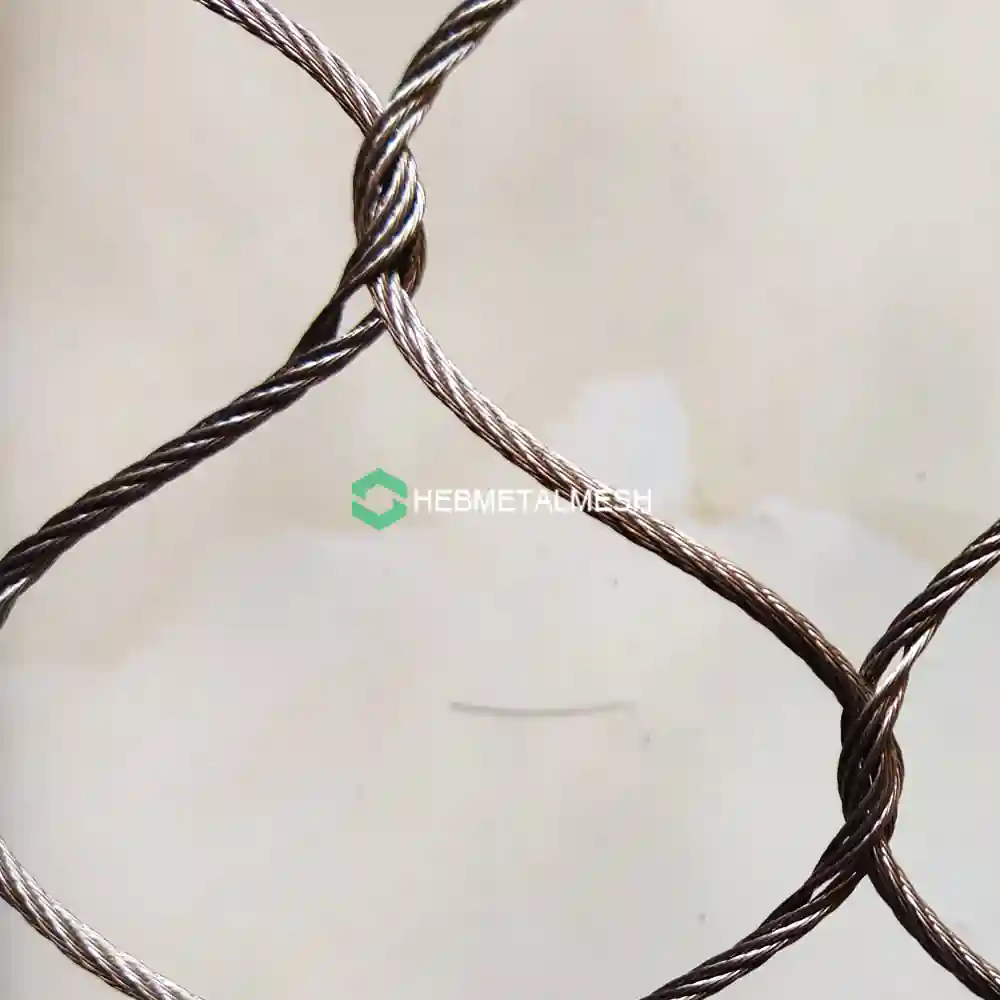
This guide helps institutional buyers, zoo procurement managers, and aviary designers select the right stainless steel cable mesh for hawk protection. You will learn the critical differences between AISI 304 and 316 grades, understand which mesh aperture and wire diameter actually stop a raptor strike, and avoid costly mistakes like specifying lightweight plastic netting that fails within two years. We cover load engineering, corrosion resistance, installation tensioning protocols, and factory-direct procurement—everything you need to specify a hawk-proof enclosure that lasts 30+ years.
🔒 Need Hawk-Proof Protection for Your Zoo or Aviary?
Get factory-direct pricing on handwoven stainless steel mesh. Custom sizes up to 30′ x 60′. 304 and 316 grades available.
Request a Quote →Why Standard Hawk Netting Fails in Professional Settings
The Physics of a Raptor Strike
A hawk doesn’t simply land on your enclosure. A Red-tailed Hawk or Peregrine Falcon performs a “stoop”—a high-speed dive where they tuck their wings and use gravity to accelerate. A falcon can reach speeds over 200 mph, while a common hawk strikes at 40–60 mph. When that kinetic energy hits standard polyethylene or nylon netting, the plastic fibers snap or stretch, creating a gap large enough for the predator to enter.
The “Reach-Through” Factor
One of the most common tragedies in bird keeping occurs when a hawk lands on top of a soft net. Because plastic netting is flexible, it sags under the hawk’s weight. The hawk can then reach its talons through the mesh openings to grab birds underneath. This is why a rigid yet flexible stainless steel mesh is required for genuine hawk protection.
UV Degradation and Short Lifespans
UV rays from the sun break down polymer chains in plastic, making it brittle. Within 2 to 3 years, a hawk can practically fly through it. Stainless steel mesh, by contrast, is immune to UV damage, rust, and the physical force of a hawk’s dive.
From a professional China stainless steel zoo mesh factory with 20+ years export experience: We’ve seen zoos replace plastic netting every 18–24 months. Over a decade, that’s five replacement cycles—plus labor, animal stress, and risk of breach. Stainless steel costs more upfront but delivers 30+ years of maintenance-free hawk protection.
The Metallurgy of Hawk Protection – 304 vs 316 Stainless Steel
AISI 304 – The Workhorse for Inland Environments
AISI 304 stainless steel contains approximately 18% chromium and 8% nickel. It offers good general corrosion resistance and is suitable for most outdoor aviary applications where exposure to harsh chemicals is limited.
For inland zoos with moderate humidity, 304-grade stainless steel is perfectly adequate. It provides excellent corrosion resistance and is a cost-effective solution for standard exhibits. This is the most common specification for hawk protection mesh in non-coastal regions.
AISI 316 – The Coastal and High-Humidity Standard
AISI 316 stainless steel contains molybdenum, an alloying element that significantly enhances its resistance to chlorides—the primary culprit in coastal “pitting” corrosion. If your facility is within 50km of the coastline, specifying 316 is a critical investment to prevent premature degradation.
316-grade stainless steel also offers superior stability in acidic and alkaline environments created by animal waste and cleaning agents. For coastal zoos or facilities in high-humidity regions, 316-grade is essential for long-term hawk protection.
The Passivation Process – Preventing “Tea-Staining”
Both 304 and 316 stainless steel undergo passivation—an electro-chemical process that removes free iron from the surface and creates a protective chromium oxide layer. This is critical for preventing “tea-staining” (brown surface discoloration) and “bleeding” rust on light-colored zoo structures.
Without proper passivation, even 316-grade mesh can show surface corrosion within years. Always request mill test certificates (MTC) from your supplier to verify proper material composition and passivation.
Mesh Specifications – Engineering Hawk-Proof Barriers
Recommended Mesh Size – Stopping the Strike
For professional hawk protection, the industry “Gold Standard” is a 2″ x 2″ (51mm x 51mm) aperture. This opening is small enough to block a hawk’s head and talons while maintaining approximately 90% visibility and airflow.
For smaller raptors like kestrels or sharp-shinned hawks, a 1.5″ x 1.5″ aperture may be appropriate. For larger raptors and eagles, the 2″ x 2″ specification remains the professional standard.
Wire Diameter Selection – Matching Strength to Threat
Wire diameter is the most critical variable in hawk protection mesh specification:
The 2.0mm cable is significantly stronger than the 1.6mm version, making it capable of handling the force of a hawk or owl landing on the mesh. For high-speed birds of prey or heavy snow zones, the 2.4mm (3/32″) cable provides maximum impact resistance.
From our factory floor: We manufacture handwoven stainless steel mesh with cable structures including 7×7 and 7×19 constructions. The 7×19 configuration provides superior tensile strength and fatigue resistance, making it the preferred choice for larger zoo enclosures and high-impact areas.
Handwoven vs. Machine-Made – The Structural Difference
Handwoven stainless steel mesh is constructed by skilled technicians who manually loop and ferrule each intersection. This creates a flexible yet incredibly strong web—essentially a structural fabric.
Unlike machine-woven or welded mesh, which can suffer from stress-point fractures at the joints, handwoven mesh distributes force across the entire panel rather than concentrating it on a single weld point. This makes it the superior choice for hawk protection in professional settings.
Installation Excellence – Tensioning and Mounting Protocols
The Engineering Behind Tensioning Systems
Proper tensioning is critical for hawk protection mesh performance. Without correct tension, mesh sags, allowing predators to reach through or climb over.
Key components:
- Turnbuckles – Allow precise tension adjustment
- Border ropes – Match perimeter strength to mesh
- Attachment hardware – Structural connection to existing frameworks
Preventing Sag Under Snow Load and Bird Weight
In regions with winter weather, the 2″ opening and 2.0mm–2.4mm cable combination allows snow to pass through more easily than tighter meshes, reducing stress on your aviary frame.
Installation best practices:
- Unroll mesh carefully to avoid kinks
- Attach border ropes to all edges
- Apply tension gradually using turnbuckles
- Achieve uniform tension across the entire panel
- Inspect ferrule and termination points
From our installation experience: The most common mistake we see is under-tensioning. A sagging mesh panel might as well be a welcome mat for a hawk. You need the mesh to remain rigid enough to keep talons at a safe distance. We recommend mechanical tensioning tools rather than manual pulling for consistent results.
Installation Hardware – What You Need
Procurement Intelligence – Sourcing Industrial-Grade Hawk Protection Mesh
Wholesale vs. Custom Fabrication
For professional projects, custom fabrication often delivers better results than off-the-shelf panels. Custom benefits include:
- Bespoke panel dimensions for non-standard frameworks
- Custom aperture sizes tailored to specific species
- Pre-attached border ropes and termination hardware
- Specialized shapes for domes and curved surfaces
Standard roll sizes typically start at 25′ x 60′, with custom sizes available up to 30′ x 60′ at no additional cost.
What to Request from Your Supplier
Long-Term Cost Efficiency
While the initial investment in stainless steel is higher, it lasts 30+ years, making it cheaper than replacing plastic every 2 years.
ROI calculation example (10-year period):
- Plastic netting: $2,000 initial + 4 replacements × $2,000 = $10,000
- Stainless steel mesh: $8,000 initial + $0 replacements = $8,000
Stainless steel pays for itself within 5–7 years and continues protecting for decades.
Maintenance and Longevity – Protecting Your Investment
Inspection Protocols
- Annual visual inspection – Check for corrosion, damage, or loose hardware
- Ferrule examination – Ensure no cracking or slipping
- Tension verification – Re-tension as needed
- Documentation – Maintain inspection records for regulatory compliance
Cleaning and Care
Stainless steel mesh requires minimal maintenance. For cleaning:
- Use mild soap and water
- Avoid abrasive cleaners that may damage the passivation layer
- Rinse thoroughly in coastal environments to remove salt deposits
- Inspect after extreme weather events
Expected Lifespan
- AISI 304 in inland environments: 25–35 years
- AISI 316 in coastal environments: 40–50+ years
- AISI 304 in coastal environments: 8–12 years (not recommended)
Key Takeaways
- Plastic and nylon netting fail within 2–3 years due to UV degradation and physical impact. Stainless steel mesh delivers 30+ years of hawk protection.
- AISI 304 is suitable for inland zoos with moderate humidity. AISI 316 is mandatory for coastal facilities within 50km of saltwater exposure.
- The professional specification is 2″ x 2″ aperture with 2.0mm (5/64″) cable. For eagles and heavy snow zones, upgrade to 2.4mm (3/32″).
- Handwoven construction outperforms machine-made or welded alternatives, distributing impact force across the entire panel.
- Proper tensioning prevents sagging and the “reach-through” problem that plagues soft netting.
- Factory-direct procurement delivers better pricing and customization options compared to retail channels.
- Request Mill Test Certificates to verify material grade and passivation.
Frequently Asked Questions
Hawk netting typically refers to lightweight polypropylene or nylon netting used for small-scale backyard poultry protection. In contrast, stainless steel rope mesh is an industrial-grade, high-tensile woven cable web designed for zoological, aviary, and large-scale commercial applications. The steel mesh offers 304 or 316 stainless construction, handwoven cable intersections for flexibility under impact, and structural integrity capable of withstanding predatory bird strikes, large animal climbing, and heavy snow loads over decades of outdoor service.
When properly specified, AISI 316L stainless steel rope mesh can exceed 50 years of service life in coastal environments, while AISI 304 performs similarly in inland applications. Longevity depends on: correct grade selection for your specific climate, proper passivation during manufacturing, professional installation with correct tensioning, regular inspection and maintenance, and quality of termination hardware (ferrules, turnbuckles, border ropes). Many European zoo installations from the 1990s continue to perform without significant degradation.
Yes, stainless steel mesh is completely safe for avian and terrestrial animals. Unlike galvanized materials that may leach zinc, stainless steel is biologically inert and non-toxic. The surface is smooth, reducing the risk of feather damage or foot injuries. Aperture sizes can be specified to prevent foot entrapment. The flexible nature of handwoven cable mesh absorbs impact energy, reducing injury risk during flight collisions. All edges can be terminated with border ropes to eliminate sharp points.
Absolutely. Industrial suppliers offer custom fabrication services including: bespoke panel dimensions for non-standard frameworks, custom aperture sizes tailored to specific species requirements, pre-attached border ropes and termination hardware, specialized shapes for domes, curved surfaces, and architectural features, and OEM specifications for branding and quality standards. Lead times for custom fabrication typically range from 4 to 12 weeks depending on complexity and order volume.
Wire diameter selection depends on the specific predator threat and span requirements:
1.6mm (1/16″): Suitable for small raptor species (kestrels, sharp-shinned hawks) and interior aviary divisions
2.0mm (5/64″): Standard for most zoo applications—the professional specification for hawks, owls, and cranes
2.4mm (3/32″): Heavy-duty applications for large eagle species, snow load regions, and large-span installations
For maximum hawk protection in outdoor enclosures, the industry standard is 2.0mm to 2.4mm diameter with 2″ x 2″ aperture. Professional-grade installations combine wire diameter with correct tensioning and perimeter support to achieve the required structural integrity.
🛡️ Ready to Specify Hawk-Proof Mesh for Your Project?
Get factory-direct pricing, technical specifications, and custom sizing for your zoo or aviary enclosure. 20+ years export experience to zoos worldwide.
What you get: Mill test certificates • Custom sizes up to 30′ x 60′ • 304 & 316 grades • Black oxide finish option
Contact Our Engineering Team →