
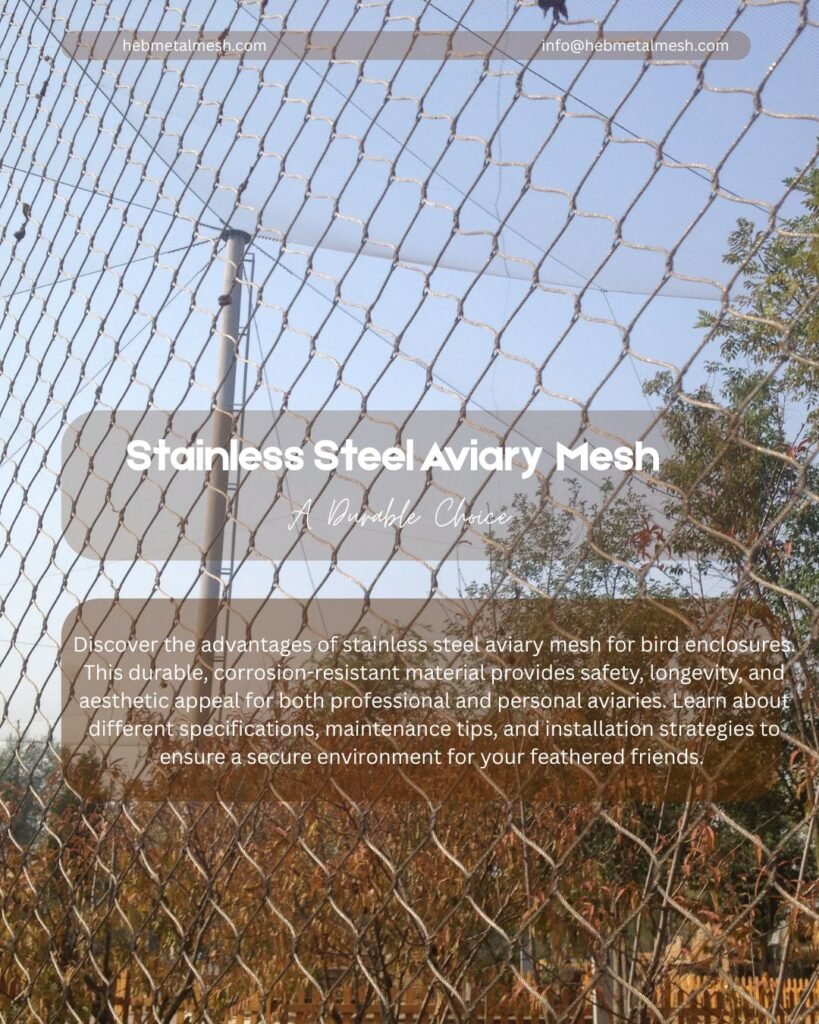
Executive Summary
One mesh spec cannot serve a flight cage, a quarantine cage, and a breeding cage. Flight cages need impact absorption and clear sightlines, so handwoven stainless rope mesh at 1″ to 2″ aperture works best. Quarantine cages need a tight barrier and a surface that survives daily disinfection, so welded stainless at 3/4″ or smaller is the right call. Breeding cages need the tightest apertures of all, because a fledgling’s head and toes are smaller than an adult’s. Use 3/4″ x 3/4″ or finer, plus a double wire barrier between adjacent pairs. Stainless steel suits all three because it carries no coating to flake and no zinc to poison.
Need the Right Mesh for Your Birds? Get a Free Quote
Send us your bird species, enclosure size, and climate. We return a graded stainless steel mesh recommendation and a custom price within 24 hours.
Request My Free Quote →Key Takeaways
- Flight cages need flex. Rope mesh gives about an inch on impact, which prevents keel bruising.
- Quarantine cages need a sealed barrier. Use 3/4″ aperture to block mites, mice, and wild bird contact.
- Breeding cages need the tightest aperture, sized to a fledgling’s head, not an adult’s.
- A double wire barrier with a 1″ air gap stops toe and beak injuries between neighboring pairs.
- Rigid welded stainless cleans faster than woven mesh, which matters in quarantine.
- One grade fits all three: 304 inland, 316 within 30 miles of salt water.
Three Enclosures, Three Different Jobs
Buyers often order one mesh spec for a whole facility. It seems efficient. In practice, it overspends in one area and underperforms in another.
A flight cage is about movement. A quarantine cage is about isolation. A breeding cage is about the smallest bird in the building.
Therefore each one gets its own spec. The sections below cover what actually changes.
Flight Cages: Impact Absorption and Sightlines
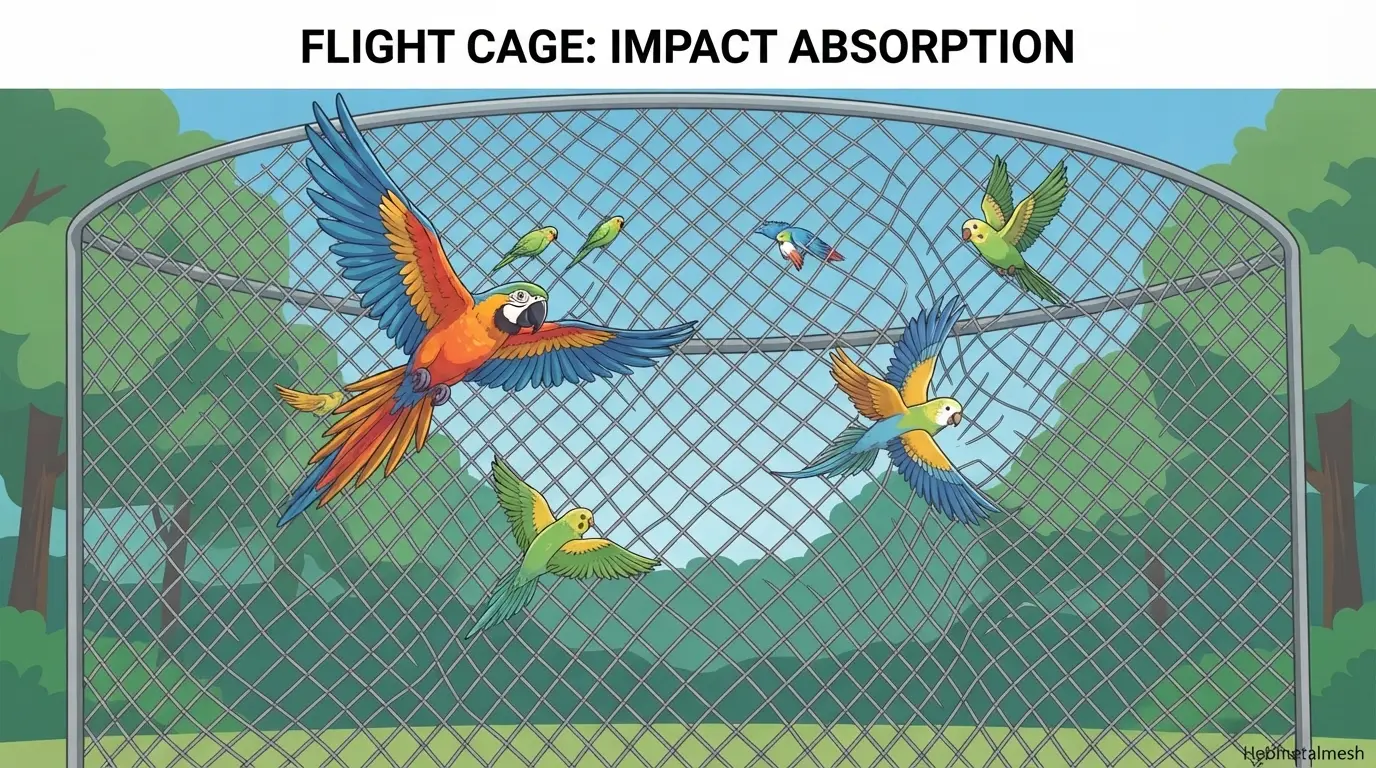
A flight cage exists so birds can fly at speed. That speed creates the main hazard: collision with the boundary.
Handwoven stainless steel rope mesh solves this. The diamond weave deflects roughly an inch under load, then returns. Energy spreads across dozens of cables instead of stopping at one weld.
What to specify for flight cages
- Aperture: 1″ x 1″ for parrots and softbills. 2″ x 2″ for pheasants and peafowl. 2″ to 4″ for raptors.
- Cable: 1/16″ (1.6 mm) for medium parrots. 5/64″ (2.0 mm) for macaws. 1/8″ (3.2 mm) for eagles.
- Finish: Black oxide on any wall the public views. It cuts glare and lets cameras focus past the mesh.
- Panel size: Order the largest panel your crew can handle. Fewer seams means fewer stiff points.
Rope mesh also drapes over curved frames. As a result, you can build domes and tunnels that rigid panels cannot form.
Quarantine Cages: Biosecurity Above Everything
Quarantine has one job. Nothing crosses the barrier, in either direction.
That changes the mesh math completely. Flexibility no longer helps. A tight, rigid, easily scrubbed surface does.
What to specify for quarantine
- Aperture: 3/4″ x 3/4″. Small enough to block mice, and to stop beak-to-beak contact through the wire.
- Type: Stainless welded mesh, not rope mesh. Rigid grids hose down faster and hold no debris in the weave.
- Wire: 16 to 14 gauge stainless. Heavier wire survives repeated chemical cycles.
- Layout: Solid partitions between units, with mesh only on the front face. Airborne spread follows sightlines.
- Frame: Fully welded stainless with no hollow cavities that trap water.
Also plan for all-in, all-out operation. Empty the room, strip it, disinfect, and dry before the next intake. That routine only works if every surface tolerates the chemicals.
Breeding Cages: Size the Mesh to the Chick
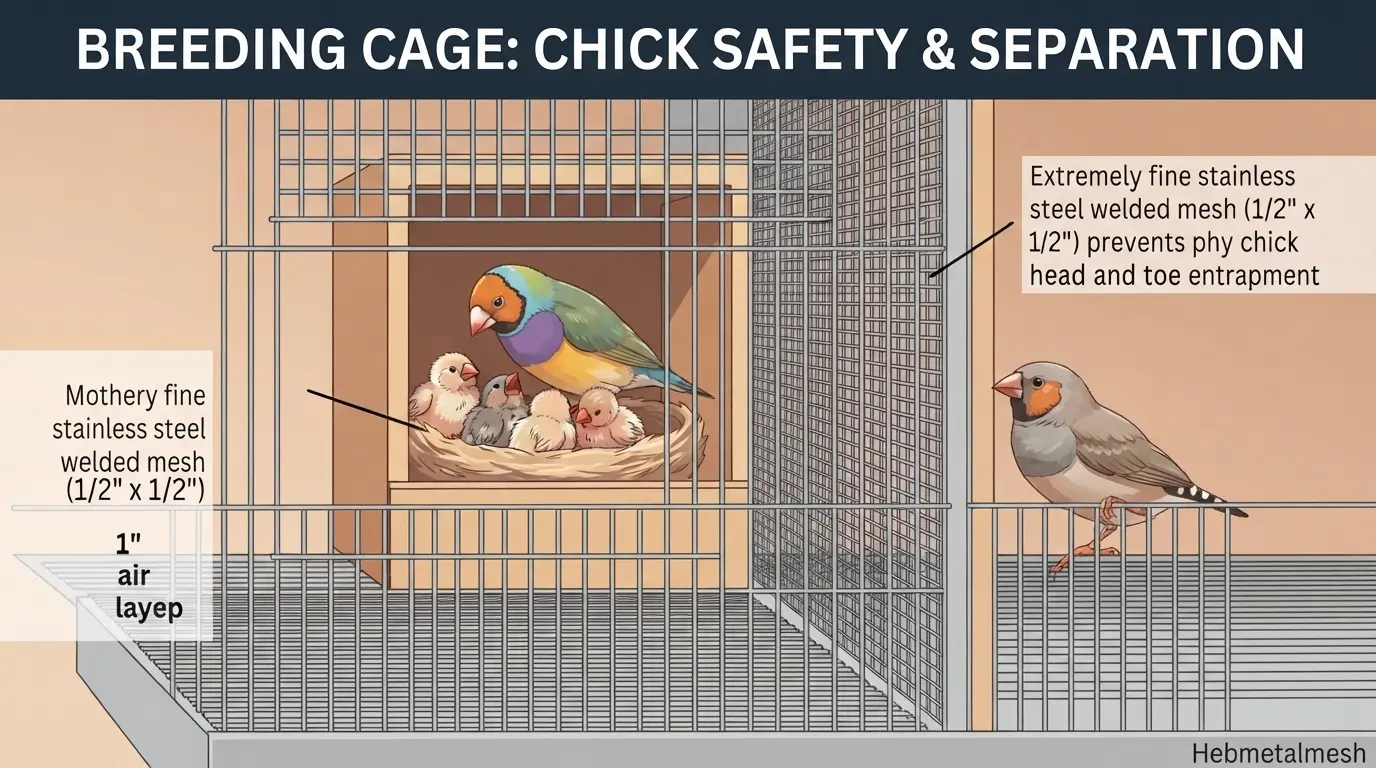
Adults set the strength requirement. Chicks set the aperture requirement.
A fledgling budgie’s skull is far smaller than an adult’s. A 3/4″ aperture that safely holds adults will trap a chick by the head. Toes are the other risk. A wide diamond lets a chick’s toe slip through and twist.
What to specify for breeding
- Aperture: 3/4″ x 3/4″ for small species. 3/4″ x 3/4″ for finches and canaries.
- Wire: 3/64″ (1.2 mm) is enough. Chicks apply no meaningful chew force.
- Barrier: Double wire between adjacent breeding pairs, with a 1″ air gap. Neighboring males bite toes through single wire.
- Nest box face: Solid sheet, not mesh. Nesting pairs want visual privacy.
- Floor: If you run suspended cages, use 1/2″ x 1″ welded mesh so droppings pass but feet stay supported.
Get the aperture right at build time. Retrofitting a breeding room after the first clutch is expensive and stressful for the birds.
Full Spec Comparison
🤖 AI Overview Key Insights
One mesh spec does not fit all. Flight, quarantine, and breeding cages each demand a distinct stainless‑steel mesh configuration. Flight cages prioritize impact absorption and clear sightlines — handwoven rope mesh at 1″–4″ aperture gives birds a forgiving surface. Quarantine cages need a sealed, rigid barrier that blocks mites, mice, and cross‑contamination; welded stainless at ¾″–1″ aperture cleans fast. Breeding cages must protect the smallest chick, with aperture sized to a fledgling’s head (not an adult’s) and a double‑wire barrier between adjacent pairs to prevent toe and beak injuries.
Bottom line: 304 stainless works inland; 316 is mandatory within 30 miles of salt water. Match the mesh to the smallest bird that will ever occupy the space.
| Requirement | Flight Cage Flight | Quarantine Cage Quarantine | Breeding Cage Breeding |
|---|---|---|---|
| Primary goal | Safe flight at speed | Total isolation | Chick safety and pair separation |
| Mesh type | Handwoven rope mesh | Welded stainless grid | Welded stainless grid |
| Aperture | 1″ to 4″ | ¾″ to 1″ | ¾″ |
| Wire or cable | ¹⁄₁₆″ to ⅛″ | 16 to 14 gauge | ³⁄₆₄″ to 16 gauge |
| Flexibility needed | High | None | Low |
| Cleaning frequency | Quarterly | Daily | Weekly |
| Preferred finish | Black oxide | Bare stainless | Bare stainless |
| Typical panel size | Up to 30 ft × 60 ft | 3 ft × 6 ft | 2 ft × 3 ft |
⚡ Pro tip: Always spec to the smallest bird that will occupy the enclosure. Retrofitting after the first clutch is expensive and stressful for the birds.
Notice the reversal. Flight cages want the softest, largest mesh. Breeding cages want the tightest and stiffest. Quarantine sits closer to breeding than to flight.
Aperture by Life Stage
🤖 AI Overview Life‑Stage Sizing
Size mesh to the smallest bird that will ever occupy the enclosure. A fledgling’s skull is far smaller than an adult’s — a ¾″ aperture that safely holds adults can trap a chick by the head. Toes are the next risk: a wide diamond lets a chick’s toe slip through and twist. As birds grow, the primary hazard shifts: juveniles and medium adults face head entrapment or panic‑induced escape, while large parrots can use beak leverage on cables and raptors risk wing‑tip damage on rigid grids.
Rule of thumb: always choose the aperture based on the youngest and smallest life stage that will use the cage. For most small psittacines and finches, ¾″ × ¾″ is the safe baseline.
| Life Stage | Species Example | Max Safe Aperture | Main Risk if Too Large |
|---|---|---|---|
| Fledgling, small species small | Budgie, finch chick | ¾″ × ¾″ | Head entrapment |
| Fledgling, medium species medium | Conure, cockatiel chick | ¾″ × ¾″ | Toe injury |
| Juvenile juvenile | Grey, Amazon | 1″ × 1″ | Head entrapment |
| Adult, medium adult | Grey, Amazon | 1″ × 1″ | Escape during panic |
| Adult, large large | Macaw, cockatoo | 2″ × 2″ | Beak leverage on cable |
| Adult raptor raptor | Hawk, owl | 4″ × 4″ | Wing tip damage on rigid grid |
🛡️ Critical: Measure the skull width of your smallest fledgling and choose an aperture below that figure. Retrofitting after the first clutch is expensive and stressful for the birds.
Always spec to the smallest bird that will ever occupy the enclosure. Facilities that move birds between rooms should standardize on the tightest aperture in the rotation.
Cleaning and Disinfection by Enclosure Type
🤖 AI Overview Cleaning Protocols
Cleaning routines differ as much as the mesh itself. Flight cages need only quarterly hosing and gentle brushing – high‑pressure water (over 1,500 psi) can damage the weave. Quarantine cages demand daily full wipes and deep chemical disinfection between intakes; avoid chlorine bleach on 304 stainless to prevent pitting. Breeding cages sit in the middle: weekly wipe‑downs and a complete strip between clutches, but never use steel wool or wire brushes – they leave iron particles that rust and mimic mesh failure.
Two golden rules for all stainless: (1) avoid chlorine bleach on 304, (2) never use carbon‑steel brushes. For coastal or high‑chloride environments, consider 316 stainless for quarantine rooms.
| Enclosure | Routine | Approved Chemicals | Avoid |
|---|---|---|---|
| Flight cage Flight | Hose quarterly, brush droppings | Mild detergent, dilute vinegar | Pressure over 1,500 psi |
| Quarantine cage Quarantine | Full wipe daily, deep clean between intakes | Quaternary ammonium, accelerated hydrogen peroxide | Chlorine bleach on 304 |
| Breeding cage Breeding | Weekly wipe, full strip between clutches | Detergent then hydrogen peroxide | Steel wool, wire brushes |
🧼 Pro tip: Quarantine rooms often justify 316 stainless due to daily disinfectant use. Always rinse thoroughly after chemical cleaning and dry to prevent residue build‑up.
Two rules apply to all stainless. First, avoid chlorine bleach on 304, because chlorides cause pitting. Second, never use carbon steel brushes. They leave iron particles that rust and look like mesh failure.
For more on day-to-day upkeep, see our practical notes on bird cage netting care.
Grade Selection Across the Facility
Grade choice depends on the air, not the enclosure type.
- 304 stainless: Standard for indoor rooms and inland outdoor flights. Excellent corrosion resistance in rain and sun.
- 316 stainless: Adds molybdenum. Use it within 30 miles of the coast, near pools, and in misted tropical houses.
Quarantine rooms are worth a second look. Daily disinfectant use raises chloride exposure. Many facilities specify 316 for quarantine even when the rest of the site runs 304.
Sizing Each Enclosure Type
Mesh spec and enclosure size are linked. A bigger flight needs heavier cable because spans grow. A quarantine unit stays small on purpose.
🤖 AI Overview Sizing Logic
Dimensions are not one‑size‑fits‑all. Flight cages prioritize length over height – horizontal flyers benefit more from a longer runway than an extra few feet of ceiling. Walk‑in flights need 8–10 ft to accommodate planting and human access, while zoo exhibits for soaring species demand 20 ft+ to allow real distance. Quarantine and breeding units are intentionally compact: small volumes disinfect faster and reduce stress for breeding pairs. Suspended breeders use a mesh floor at 18″ to drop waste clear of the birds.
Budget trap: adding two feet of height to a 12×24 ft flight adds over 140 sq ft of wall mesh – length is almost always the better investment for bird welfare.
| Enclosure | Typical Footprint | Height | Why That Size |
|---|---|---|---|
| Small flight cage Flight | 6 ft × 12 ft | 7 ft | Length matters more than height for horizontal flyers |
| Walk-in flight Flight | 12 ft × 24 ft | 8 – 10 ft | Room for planting and human access |
| Zoo exhibit flight Flight | 40 ft × 80 ft | 20 ft+ | Soaring species need real distance |
| Quarantine unit Quarantine | 3 ft × 3 ft | 3 ft | Small volume is faster to disinfect |
| Breeding unit Breeding | 2 ft × 4 ft | 2 ft | Compact space reduces pair stress |
| Suspended breeder Breeding | 2 ft × 3 ft | 18 in | Mesh floor drops waste clear of birds |
📐 Pro tip: Height is where budgets get destroyed. Adding 2 ft of height to a 12×24 ft flight adds over 140 sq ft of wall mesh – invest in length for better welfare.
Height is where budgets get destroyed. Adding two feet of height to a 12 ft x 24 ft flight adds 144 square feet of wall mesh. Length is almost always the better investment for bird welfare.
Retrofitting an Existing Facility
Most keepers do not build from scratch. They inherit galvanized rooms and upgrade in stages.
Work in this order:
- Breeding rooms first. Chicks face the highest risk from both zinc and wrong aperture.
- Quarantine second. A failed barrier here spreads disease through the whole collection.
- Flight areas last. Adults tolerate imperfect mesh longer, and flight panels cost the most per unit.
Keep the frames if they are sound. Stripping old welded mesh and lacing new stainless onto an existing steel frame usually costs 40% less than a full rebuild.
Five Mistakes We See Repeatedly
- Using flight-cage aperture in a breeding room. Chicks get trapped in week three.
- Using rope mesh in quarantine. The weave holds organic matter that scrubbing misses.
- Single wire between breeding pairs. Toe amputations follow within a season.
- Galvanized mesh anywhere birds chew. Zinc poisoning is slow, quiet, and often fatal.
- Mixing carbon steel fasteners with stainless mesh. Rust streaks appear in one wet season.
Our overview of mesh wire for bird cages lists the fastener kits that avoid the last problem.
Putting a Facility Spec Together
Write one line per room before you request pricing. A useful spec line looks like this:
Room 3, breeding, 12 units, 3/4″ x 3/4″ aperture, 3/64″ 304 welded stainless, double barrier at unit divisions, panel 2 ft x 3 ft, bare finish.
That single line answers every question a supplier will ask. It also prevents the common problem of one generic mesh order covering rooms with opposite needs.
For species-level detail on wire diameter and chew resistance, our guide to safe parrot cage wire goes deeper on beak force.
FAQs
What mesh size should I use in a parrot flight cage?
Use 1″ x 1″ aperture with 1/16″ stainless cable for medium parrots. Step up to 5/64″ cable for macaws and cockatoos. Larger aperture is acceptable for big birds, but cable diameter must increase with beak strength.
Can I use the same mesh for quarantine and flight areas?
You can, but you will overspend or undercover. Quarantine needs 3/4″ to 1″ aperture that flight areas do not, and flight areas need flexibility that quarantine does not use.
Why do breeding cages need a double wire barrier?
Adjacent males fight through single wire. They grab toes and beaks and cause serious injury. A 1″ air gap between two mesh layers makes contact physically impossible.
Is welded stainless better than rope mesh for cleaning?
Yes, in high-frequency cleaning areas. A rigid grid has fewer contact points where organic matter lodges. Rope mesh cleans well too, but it takes longer per square foot.
How do I stop chicks from getting their heads stuck?
Measure the skull width of your smallest fledgling and choose an aperture below that figure. For most small psittacines and finches, 3/4″ x 3/4″ or 1″ x 1″ is the safe range.
Talk to an Aviary Mesh Engineer
Not sure about wire diameter or aperture? Our team helps zoos, breeders, and backyard keepers spec the safest, longest-lasting mesh.
Get Expert Help →