
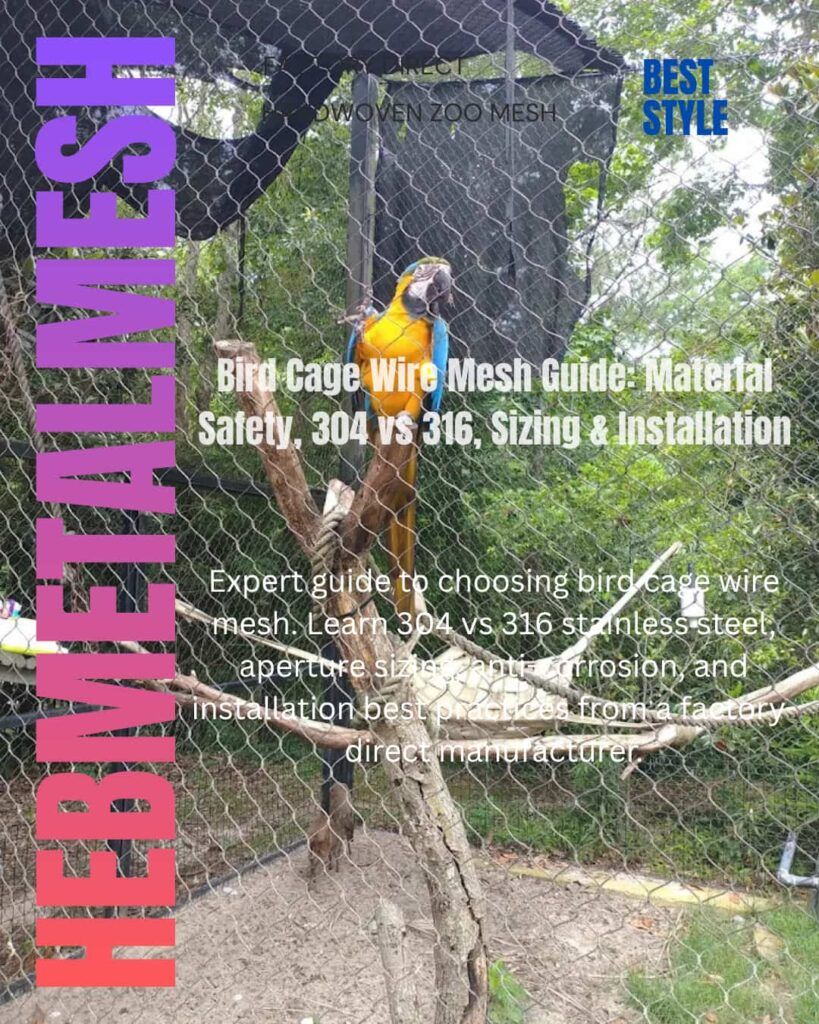
If you’re responsible for selecting bird cage wire mesh—whether for a backyard aviary, a commercial bird sanctuary, or a zoo exhibit—your top priority is safety. This guide helps you choose the right stainless steel cable mesh by grade (304 vs. 316), aperture size, wire diameter, and corrosion resistance while avoiding cheap galvanized alternatives that poison birds. Bottom line: stainless steel is the only non-toxic, chew-proof, rust-proof material that protects your birds for 20+ years. Read on for factory-grade insights, installation best practices, and the exact specs that professional zoos specify.
📋 Key Takeaways
- Stainless steel (304/316) is the only bird-safe metal—galvanized wire causes zinc toxicity, the most common metal poisoning in caged birds
- Aperture size matters by species: ½″ for small birds, 1″ for medium parrots, 2″ for macaws and cockatoos
- 316 grade outlasts 304 in coastal or humid environments—it contains molybdenum for superior corrosion resistance
- Proper tensioning prevents sagging and escape—use stainless steel cable ties or turnbuckles, never galvanized fasteners
- Factory-direct sourcing ensures full material traceability—request mill test certificates (MTRs) for every batch
✅ Need the Right Bird Cage Wire Mesh for Your Project?
Get factory-direct pricing and expert guidance on 304/316 stainless steel mesh—custom sizes, fast shipping, and full material certification.
📞 Get a Quote →Introduction — Why Your Bird Cage Wire Mesh Choice Matters More Than You Think
When it comes to providing a safe and comfortable living space for your feathered friends, the bird cage wire mesh you choose can mean the difference between a thriving aviary and a costly, dangerous failure. Birds have sensitive respiratory systems, sharp beaks that chew on everything, and inquisitive natures that put them at constant risk from toxic materials and structural weaknesses.
The mesh isn’t just a barrier—it’s the primary structural element that determines predator resistance, bird safety, visibility, and long-term durability. Professional zoos, avian sanctuaries, and commercial breeders don’t compromise on mesh quality because they understand the stakes: a single failure can mean injury, escape, or death.
Yet most online guides gloss over the critical details that actually matter at the factory level. They tell you to “choose stainless steel” without explaining which grade, why the weaving process matters, or how to verify what you’re actually buying. This guide changes that.
We’re pulling back the curtain on what happens inside a professional wire mesh factory—from raw material inspection to passivation to quality testing—so you can make an informed decision with confidence. Whether you’re a zoo procurement manager, a commercial aviary operator, or a dedicated bird owner building a walk-in enclosure, this is the only bird cage wire mesh guide you’ll ever need.
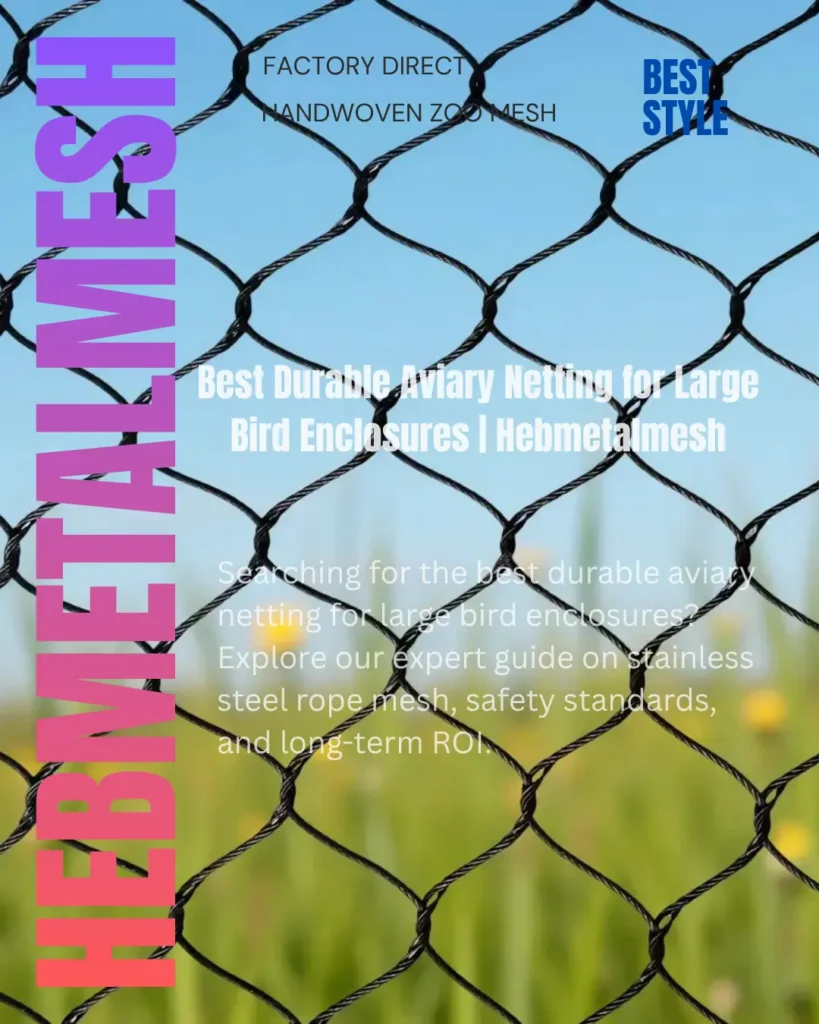
Bird Cage Wire Mesh Materials — A Complete Comparison
Stainless Steel Wire Mesh (304 vs 316 Grade)
Stainless steel is the gold standard for bird cage wire mesh, and for good reason. It contains zero toxic heavy metals, resists rust and corrosion even in outdoor conditions, and provides exceptional strength that prevents chewing damage and predator breaches.
But not all stainless steel is the same.
AISI 304 is the industry standard for most aviary applications. It contains 18% chromium and 8% nickel, forming a passive oxide layer that protects against corrosion. For indoor aviaries and outdoor enclosures away from salt air, 304 provides excellent service life of 20+ years.
AISI 316 (“Marine Grade”) adds 2-3% molybdenum, which significantly enhances corrosion resistance—particularly against chlorides and salt. If your aviary is within 5 miles of the ocean, in a high-humidity tropical climate, or in an area with industrial pollution, 316 is the only correct choice. It delivers 25+ years of service even in harsh environments.
Factory Insight: At our facility, every coil of raw stainless steel wire arrives with a mill test certificate (MTR) verifying chemical composition. We reject any material that doesn’t meet AISI specifications—no exceptions. This traceability is your guarantee that you’re getting genuine 304 or 316, not a cheap “stainless-like” alloy. We also perform in-process tensile testing to ensure every batch meets minimum 500 N/mm² strength requirements.
Galvanized Wire Mesh — The Hidden Danger
Galvanized steel mesh is the most common material sold for bird cages, yet it’s potentially deadly to birds.
Galvanization applies a zinc coating to prevent rust—but zinc is highly toxic to birds. When birds chew on galvanized wire, they ingest zinc particles. The result is zinc poisoning, the most common metal toxicity in caged birds, causing vomiting, excessive thirst, kidney and liver damage, seizures, and death.
Some sellers claim “electro-galvanized” is safe—this is false. All galvanized products contain zinc, and any bird that chews on the wire is at risk. Even if your birds aren’t aggressive chewers, zinc oxide dust from normal corrosion can accumulate on feathers and be ingested during preening.
If you currently have galvanized mesh, the only safe approach is to coat it with a bird-safe epoxy or powder coating—but this adds cost and doesn’t eliminate the underlying risk. The far better choice is to start with stainless steel.
PVC-Coated and Powder-Coated Wire — The Coating Trap
PVC-coated and powder-coated wire meshes seem appealing—they come in colors and feel smooth. But coatings introduce new problems:
- Coatings wear off over time, especially where birds perch or chew, exposing the toxic base metal underneath
- Chipped coatings create sharp edges that can injure birds
- Bacteria colonize coating cracks, making cleaning difficult
- Not all coatings are bird-safe—some contain lead, cadmium, or other toxins
Even high-quality powder coatings eventually degrade under UV exposure and mechanical wear. For a permanent, safe solution, stainless steel eliminates the coating problem entirely.
If you’re weighing the trade-offs between welded and woven mesh construction, our side-by-side comparison table breaks down exactly why hand-woven ferrule mesh outperforms welded alternatives in durability, flexibility, and bird safety.
When planning an aviary, our article Best Parrot Cage Wire For Safety Durability can also serve as a useful supplementary reference.
Choosing the Right Mesh Size and Wire Diameter
Understanding Aperture Size — Which One for Which Bird?
Selecting the correct aperture (opening size) is critical for both safety and functionality.
Small birds like finches and canaries can escape through anything larger than ½″. Medium parrots need 1″ mesh to prevent their beaks from getting caught while still allowing good visibility. Large macaws require 2″ mesh—anything smaller obstructs their view and can trap their powerful beaks.
When planning an aviary, our article What Size Mesh For Small Bird Aviary can also serve as a useful supplementary reference.
Wire Diameter — Why “Gauge” Is Obsolete
Many sellers quote “wire gauge” (e.g., 16 gauge, 18 gauge), but gauge standards vary by country and material. Professional specifiers use actual diameter in inches or millimeters.
Common diameters for bird cage wire mesh:
- 3/64″ (1.2mm) — Light-duty, small bird applications
- 1/16″ (1.6mm) — Standard for most aviary mesh; excellent strength-to-weight ratio
- 5/64″ (2.0mm) — Heavy-duty for large parrots and predator-resistant enclosures
- 3/32″ (2.4mm) — Maximum security for zoo exhibits and outdoor sanctuaries
Factory Insight: Thicker wire isn’t always better—it adds weight and cost. The key is matching diameter to the application. For a 1″ aperture macaw cage, 1/16″ diameter provides ample strength while keeping the mesh lightweight and easy to handle. For ground-level zoo exhibits that must withstand raccoons, foxes, or other predators, 5/64″ or 3/32″ is recommended.
When planning an aviary, our article Mesh Wire For Bird Cages can also serve as a practical supplementary reference.
Anti-Corrosion — What Happens at the Factory That Most Guides Ignore
Stainless Steel Passivation — The Post-Weaving Process That Prevents Rust
Here’s something 99% of online guides never mention: stainless steel isn’t automatically corrosion-resistant straight off the production line.
During weaving and fabrication, microscopic iron particles from tooling can embed in the surface of the wire. These particles create weak points where corrosion can start—even on 316 grade.
The solution is passivation: a chemical treatment (typically nitric or citric acid) that removes surface iron contamination and restores the protective chromium oxide layer. At our factory, every roll of bird cage wire mesh undergoes passivation before packaging. This is not optional—it’s the difference between mesh that rusts in 5 years and mesh that lasts 25.
Salt Spray Testing (ASTM B117) — Real Data on Corrosion Resistance
Professional buyers should always ask for salt spray test results per ASTM B117. This standardized test exposes mesh samples to a saline mist and measures how long they resist corrosion.
- 304 stainless (passivated): 200–400 hours before visible corrosion
- 316 stainless (passivated): 720+ hours—essentially rust-proof in real-world conditions
- Galvanized steel: 72–100 hours before white rust appears
If a supplier can’t provide ASTM B117 test data, don’t buy from them.
Factory Quality Control — From Incoming Wire to Finished Rolls
At a professional stainless steel mesh factory, quality control isn’t a single inspection—it’s a continuous process:
- Raw material verification: Every wire coil is tested for chemical composition against MTRs
- Weaving inspection: Automated cameras check for broken strands, irregular apertures, and tension uniformity
- Passivation validation: Surface iron content is tested to ensure complete oxide layer restoration
- Final inspection: Every roll is measured for width, length, and aperture consistency before packaging
Custom Fabrication — Getting Exactly What Your Project Needs
Standard Sizes vs Custom-Cut Panels
Most suppliers offer standard roll sizes (e.g., 1m × 30m, 1.5m × 50m). But professional projects often require custom panels—pre-cut to exact dimensions with finished edges.
Custom fabrication saves labor, reduces waste, and ensures a professional finish. At our factory, we produce custom bird cage wire mesh panels in:
- Any width up to 6 meters
- Any length (rolls or flat panels)
- Custom apertures (not just standard ½″, 1″, 2″—we can produce ¾″, 1½″, 3″ and more)
- Edge treatments: folded, hemmed, or welded borders for safety and easy mounting
Lead times for custom orders typically range from 15–30 days, depending on complexity. Factory-direct pricing eliminates middleman markups—you pay for material and fabrication, not brand premiums.
When planning the aviary, our article Bird Cage Netting A Guide To Keeping can also serve as a practical supplementary reference.
Installation Best Practices — What the Manuals Don’t Tell You
Frame Preparation and Material Compatibility
Your mesh is only as strong as the frame it attaches to. For outdoor aviaries, use aluminum or stainless steel framing—never untreated steel or wood that will rot or corrode.
Critical warning: galvanic corrosion. When dissimilar metals touch in the presence of moisture, electrolytic corrosion occurs. If you attach stainless steel mesh to a galvanized steel frame with stainless steel fasteners, the galvanized frame will corrode rapidly. Match your framing material to your fasteners and mesh—or use insulating barriers between dissimilar metals.
Tensioning Techniques — Preventing Sag and Ensuring Predator Resistance
Loose mesh is a security hazard. Predators can push through gaps, and birds can get entangled in sagging sections.
Professional tensioning method:
- Secure the mesh at all four corners first
- Install intermediate fixings every 12–18 inches along the frame
- Use turnbuckles or ratchet tensioners on larger spans to maintain consistent tension
- For walk-in aviaries, install a tension wire along the top and bottom of each panel to prevent sagging over time
Fastener selection matters: Use stainless steel cable ties, J-clips, or C-rings—never galvanized or zinc-plated fasteners that introduce toxic metals into the enclosure.
Edge Finishing — Cutting and Trimming Without Creating Hazards
Cut stainless steel mesh leaves sharp wire ends that can injure birds. Always finish cut edges by:
- Folding the cut wire back into the mesh
- Applying rubber or plastic edge trim (bird-safe grade)
- Hemming the edge with a folded border during fabrication (best option)
Expansion and Contraction — What Outdoor Installations Require
Stainless steel expands and contracts with temperature changes—about 0.0000096 inches per inch per degree Fahrenheit. For a 50-foot aviary wall, that’s nearly ½ inch of movement between summer and winter.
Design for movement by using slotted mounting holes or flexible fasteners that allow the mesh to shift without buckling or tearing. Rigid mounting will cause stress fractures at attachment points over time.
Maintenance and Longevity — Protecting Your Investment
Cleaning Protocols That Don’t Damage the Mesh
Stainless steel mesh is remarkably low-maintenance. Clean with:
- Mild soap and warm water
- Soft-bristle brush or sponge
- Rinse thoroughly with clean water
Never use:
- Abrasive cleaners or steel wool (scratch the passive layer)
- Chlorine bleach (causes pitting corrosion)
- Acid-based cleaners (damage the oxide layer)
Regular Inspection Points
Quarterly inspections should check:
- Fastener tightness and corrosion
- Mesh tension (re-tension if sagging)
- Any signs of chewing damage or wire breakage
- Frame condition (especially at ground contact points)
Expected Lifespan
| Material | Indoor Lifespan | Outdoor Lifespan |
|---|---|---|
| 304 Stainless (passivated) | 30+ years | 15–20 years |
| 316 Stainless (passivated) | 40+ years | 25+ years |
| Galvanized steel | 5–8 years | 3–5 years (then rust) |
| PVC-coated | 8–12 years | 5–8 years (coating fails) |
Conclusion — Why Hebmetalmesh is the Trusted Choice for Professional Bird Enclosures
Choosing the right bird cage wire mesh isn’t just about picking a product—it’s about protecting lives. Whether you’re building a backyard aviary for a beloved parrot or designing a multi-species zoo exhibit, the material you choose determines safety, durability, and long-term cost.
At Hebmetalmesh, we’ve been manufacturing stainless steel rope mesh, aviary netting, and animal enclosure mesh for over 20 years. Our factory in Anping County—the “Wire Mesh Capital of China”—produces mesh that meets ISO 9001 standards with full material traceability. Every roll is passivated, inspected, and tested before shipping.
We don’t just sell mesh. We engineer safety.
If you are planning to make a purchase or require rolls, custom sizes and global shipping, stainless steel aviary netting serves as our core product page featuring all specifications and material options.
FAQ — Frequently Asked Questions
No. Galvanized wire contains a zinc coating that birds ingest when chewing, leading to heavy metal poisoning (zinc toxicity). Symptoms include lethargy, feather plucking, organ failure, and seizures. Stainless steel (304/316) is the only non-toxic, inert material safe for hookbills.
For macaws and other large parrots, a 2″ × 2″ aperture with 1/16″ diameter stainless steel mesh provides the optimal balance of visibility, strength, and predator resistance.
AISI 304 is standard high-quality stainless for most indoor/outdoor aviaries. AISI 316 (“Marine Grade”) contains molybdenum for superior salt-air corrosion resistance—essential within 5 miles of the ocean or in tropical high-humidity environments.
No. High-tensile stainless steel rope mesh (304/316) is significantly stronger than galvanized or aluminum alternatives. Unlike welded wire with weak solder joints, woven rope mesh has no failure points that birds can exploit. It’s the only chew-proof option for large parrots.
With proper installation and minimal maintenance, AISI 304 stainless steel mesh lasts 20+ years indoors and 15–20 years outdoors. AISI 316 can last 25+ years even in coastal or high-humidity environments, making it a lifetime investment for serious aviaries.
Related Resources
- Designing the Perfect Walk-in Aviary — Complete guide to aviary layout, sizing, and structural considerations
- Mesh for Bird Cage Wire — Selection Guide — Detailed comparison of mesh types and specifications
- Bird Netting Fence & Aviary Mesh Products — Explore our full product range with custom options