
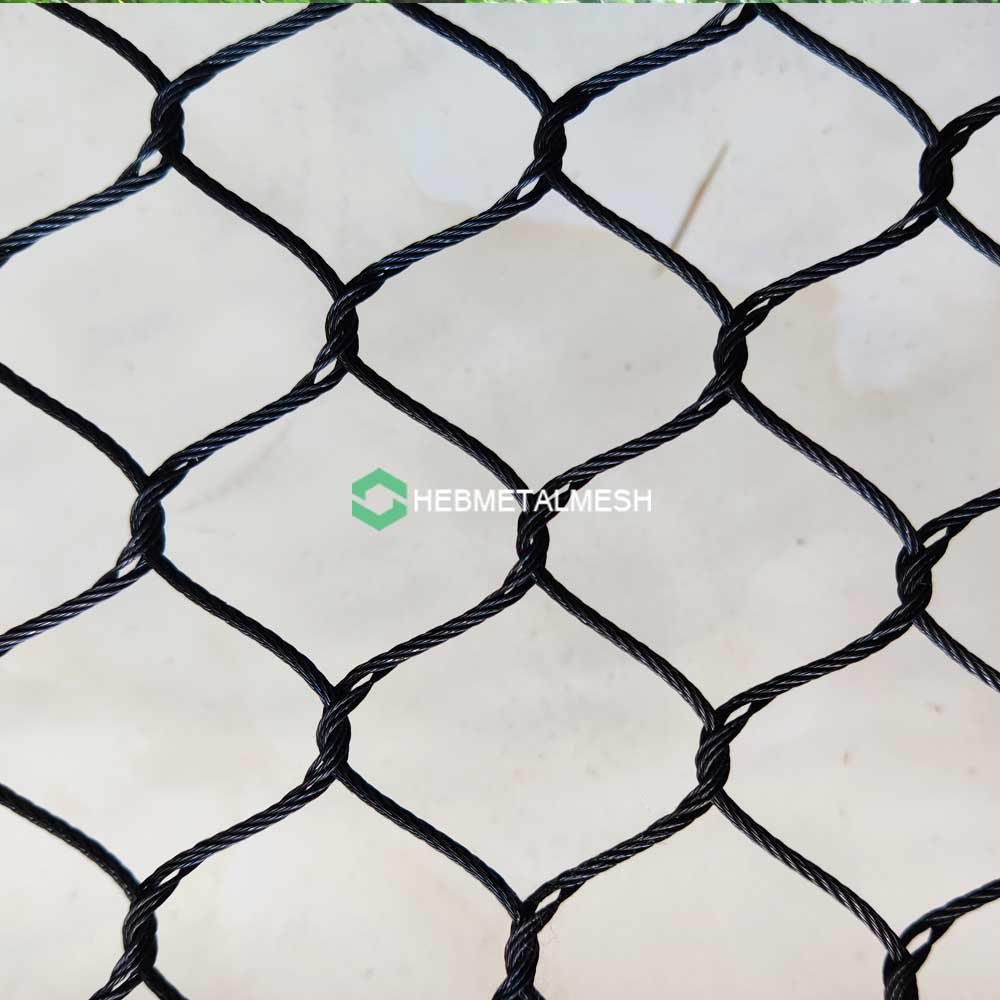
7×7 vs 7×19 is the one choice on a stainless mesh order that changes what a panel can physically do. Both are seven-strand ropes, woven into the same diamond grid and sold at the same rate per square meter, which is why buyers treat them as interchangeable. They are not. The difference is how many wires sit inside each strand, and it decides how the rope behaves the moment a panel bends, follows a curve or takes an impact. This article sets out the geometry behind each construction and shows where each belongs in a real specification.
Executive Summary
7×7 vs 7×19 is settled by wire count inside the strand. The 7×7 construction packs seven thick wires into each of seven strands, 49 in all, producing a stiff rope with good abrasion resistance and a grid that holds its shape. The 7×19 construction packs nineteen fine wires into each strand, 133 in all, producing a rope that turns a tighter radius and survives repeated flexing far better — the property engineers call fatigue resistance. Breaking strength at a given diameter and grade is broadly comparable, so this is a decision about movement and wear rather than load capacity. Wire diameter, mesh aperture size and alloy sit on top of it, and the alloy sets the corrosion case for the site. The reference specification is the stainless steel animal enclosure mesh product page.
Specifying a mesh panel for a real frame?
Send the span, the frame geometry and the exposure. Our engineers return a construction call, a grade recommendation and a planning-range quotation within one working day.
Talk to the engineering teamQuick Answer: Is 7×7 or 7×19 the stronger rope?
Quick Answer: Neither wins outright, and treating 7×7 vs 7×19 as a strength contest is the commonest mistake on a mesh order. At equal diameter and grade the two carry a broadly comparable breaking strength, because diameter and alloy set the metal area far more than the internal arrangement does. What separates them is behavior under movement. A 7×7 rope is stiffer and wears better where the cable runs straight into a clamp. A 7×19 rope bends around a far tighter radius and shrugs off repeated flexing that would eventually break wires in the stiffer construction. On a flat static panel that difference is minor; on a curved frame, or a panel that flexes under impact, it governs how long the mesh lasts.
Key Takeaways
- 7×7 construction is seven strands of seven wires, 49 in all: stiffer, better abrasion resistance, and it holds the diamond aperture firmly under tension.
- 7×19 construction is seven strands of nineteen wires, 133 in all: more wire rope flexibility, a tighter bend radius and better fatigue resistance.
- Breaking strength at equal diameter and grade is broadly comparable, so choose the construction for motion, never for load.
- Wire diameter, mesh aperture size and alloy are separate fields, fixed independently of the strand pattern.
- If polymer is still in contention, settle that first with the rope mesh vs plastic netting comparison.
How to Read a Wire Rope Construction Number
Every wire rope construction is written as two figures joined by a multiplication sign, and the order never changes: strands first, wires second. A 7×7 rope has seven strands, each built from seven wires. A 7×19 rope also has seven strands, but each is built from nineteen finer wires. Multiply the pair and you have the strand count for the whole rope, 49 against 133 — and that number, not the headline figure, is what changes how the cable feels and behaves.
The geometry explains it. Bending forces the wires on the outside of the curve to travel further than those on the inside. The smaller each individual wire, the less stress that difference imposes on it, and the more cycles it survives before a wire fatigues and breaks. Nineteen fine wires per strand therefore bend further and last longer than seven thick ones, while thick wires carry more metal at the surface to lose before a strand weakens — which is why the stiffer rope shrugs off abrasion that would slowly thin a fine one.
7×7 Construction: Stiff, Abrasion-Resistant, Predictable
The 7×7 construction is the workhorse of handwoven stainless mesh, and most standard zoo, aviary and architectural panels use it. Seven thick wires per strand give the rope a firm hand: it resists crushing where a clamp or ferrule presses down, keeps its cross-section under tension, and does not wander out of line along a long straight run. That stiffness is a property rather than a limitation. A panel that must hold a flat plane — a facade screen, a straight barrier section, a railing infill that cannot bow between posts — is easier to tension and easier to keep true when the rope itself resists deformation. Rolls and panels are woven to order from either rope, and the sizes and prices behind mesh rolls are set by the diameter and aperture on the drawing rather than by the construction.
Abrasion is the second reason it dominates. Where rope crosses a frame edge or sits under a fixing, the contact patch is small and the pressure high. Thicker outer wires have more material to spare, so they tolerate that localized wear far better than a bundle of fine wires would. The price is bend radius: a 7×7 rope needs a more generous curve and dislikes being worked back and forth, so it belongs where movement is limited to thermal expansion and the occasional load.
7×19 Construction: Built to Bend and Keep Bending
The 7×19 construction exists for movement. Because each of its seven strands carries nineteen fine wires, the rope turns around a much tighter radius without over-stressing the outer wires, and it absorbs repeated flexing that would fatigue a stiffer handwoven wire rope. That makes it the right call for mesh that follows a curved frame, for panels that take impact and spring back, and for tall enclosures where one panel spans a long distance across a frame that is anything but flat. Its fatigue resistance is why it is specified in dynamic rope work everywhere, and the property carries across intact into mesh.
Two traits follow from the same geometry. Finer wires settle and stretch slightly more under load, so a 7×19 panel is marginally less rigid once tensioned and its fixings must be set with that in mind. And the finer wires give the weave a subtly different surface texture — visible enough on a large facade that designers sometimes choose a construction for the way it catches light as much as for its mechanics. Comparing the two gets easier once the frame geometry is known; the guide to choosing the right wire rope mesh works that comparison through in order.
What the Construction Does Not Decide: Alloy, Diameter and Aperture
A construction number says nothing about wire diameter, nothing about mesh aperture size and nothing about alloy, and those three fields carry more of a specification than the strand pattern does. Rope diameter runs from 1.2 mm to 3.2 mm and aperture from 20 mm to 102 mm, with the opening set by the smallest body that must not pass through rather than by appearance. Both are independent of whether the rope is 7×7 or 7×19, and both move weight and cost further than the construction does.
Alloy is the field with a geographic answer. Type 304 carries 18% chromium and 8% nickel and is the general-duty choice inland. Type 316 adds molybdenum, and that single addition makes it the grade for chlorides — coastal air, de-icing salt, industrial atmospheres. The International Molybdenum Association states the effect directly: “The molybdenum addition to Types 316/316L makes them more resistant to chloride salts (coastal and deicing) and to pollution related corrosion” (IMOA on austenitic grades). Neither grade depends on a coating, because a passive chromium oxide film forms on the surface by itself and re-forms within hours of being scratched. Where glare must be suppressed, a black oxide finish darkens the wire so the barrier recedes against a shaded background.
Fixings, Installation and the Hardware That Matches
Construction and alloy set the rope; the fixings decide whether the panel performs. Where the grade is still open, the 304 and 316 cable mesh comparison settles it before hardware is ordered, because the two alloys take the same fixings but answer to different environments. Handwoven mesh is locked at every crossing with stainless steel ferrules, so the weave cannot slip — but the perimeter still has to be attached, tensioned and held. Two methods cover almost every job. Wrapping installation lifts the mesh over the frame and locks the edge back onto itself with ferrules and clamps, leaving room for fine adjustment; it suits most enclosures. Welding installation fuses the edge directly to a stainless frame for a permanent connection, and is reserved for high-security or high-load work where no mechanical joint will do.
Either way the frame carries the load, and a panel is only as good as its load distribution. Tension must be applied evenly across the whole panel — normally as bi-axial tension, pulling in both directions at once — so the grid stays square and the opening keeps the dimension the drawing asked for. Where a 7×19 panel follows a curve, tension it in stages, because finer wires bed in more than a stiff rope does. Because the geometry is mechanical rather than frictional, none of it can drift: a panel specified at a fixed aperture still measures that aperture years later.
Ordering Checklist: What Belongs on the Specification
Give a factory these fields and nothing is left to interpret. The construction column follows the rule set out above: static and abrasion-heavy work leans to 7×7, motion and curvature to 7×19.
| Application | Construction | Rope diameter | Aperture | Grade |
| Small birds, aviaries | 7×7 | 1.2–1.6 mm | 20–25 mm | 304 |
| Primates, railing infill | 7×7 or 7×19 | 1.6–2.4 mm | 38–51 mm | 304 |
| Curved architectural frames | 7×19 | 1.6–2.0 mm | 38–76 mm | 304 or 316 |
| Large cats, high-impact barriers | 7×19 | 3.2 mm | 76–102 mm | 304 or 316 |
| Coastal or marine exposure | 7×19 | 2.0–3.2 mm | 51–102 mm | 316 |
A few notes make the table usable. Panels arrive finished and cut to size, so panel dimensions belong beside the aperture. The full working range is documented on the stainless steel animal enclosure mesh page, including the 9 m × 18 m panels that describe what can be woven and shipped rather than what a frame can carry. Standard combinations are fastest to quote through their HM codes: HM32102 for 3.2 mm rope at 102 mm, HM3276 for 3.2 mm at 76 mm, HM2076 for 2.0 mm at 76 mm, HM1625 for 1.6 mm at 25 mm and HM1220 for 1.2 mm at 20 mm. Where a project needs non-standard dimensions, mesh customization is routine rather than exceptional. Cost tracks weight and alloy rather than area: on a planning basis, aviary-grade mesh in 1.2–2.0 mm rope runs about $10–22 per square meter and carnivore-grade mesh in 2.4–3.2 mm rope about $20–38 per square meter, with finish and panel size moving the final figure.
Frequently Asked Questions
Neither, like for like. At the same diameter and grade the two carry a broadly comparable breaking strength, and wire count inside the strand does not change that materially. The real differences appear in bending, where 7×19 tolerates far more cycles, and in abrasion, where 7×7 has more wear material at the surface.
No. Mesh aperture size is set by the weaving rather than by the rope’s internal structure, and the same opening can be woven from either rope. What the construction changes is how the panel behaves around that opening — a stiff rope holds a diamond aperture more rigidly, while a flexible one moves with the frame.
In practice the mesh service life is measured in decades, and the panel normally outlives the frame it hangs on. There is no coating to renew and no organic fiber to rot, so maintenance is inspection rather than servicing. Exposure decides the grade, and grade is the field that most often shortens that figure when it is chosen for price instead of for the site. The heavy-duty 304 and 316 mesh range shows the sizes and finishes that figure is measured against.
Match it to movement. A static barrier on a flat frame is well served by 7×7; a curved, tall or impact-prone enclosure — a primate habitat, a large-cat barrier, a free-flight aviary — is better in 7×19, because the panel flexes instead of fatiguing. Grade is a separate decision: 304 inland, 316 near the coast or wherever de-icing salt is used.
Weight and alloy first, then finish and panel geometry. Tensile strength is a property of the wire rather than a variable the buyer sets, so it never works as a cost lever. Ask for a planning range against a complete specification — diameter, aperture, construction, alloy, finish and panel size — and the figure that comes back will be usable.
Ready to specify? Send the frame drawing, the span and the exposure, and our engineers will return a construction call, a grade recommendation and a planning-range quotation — contact the team.