
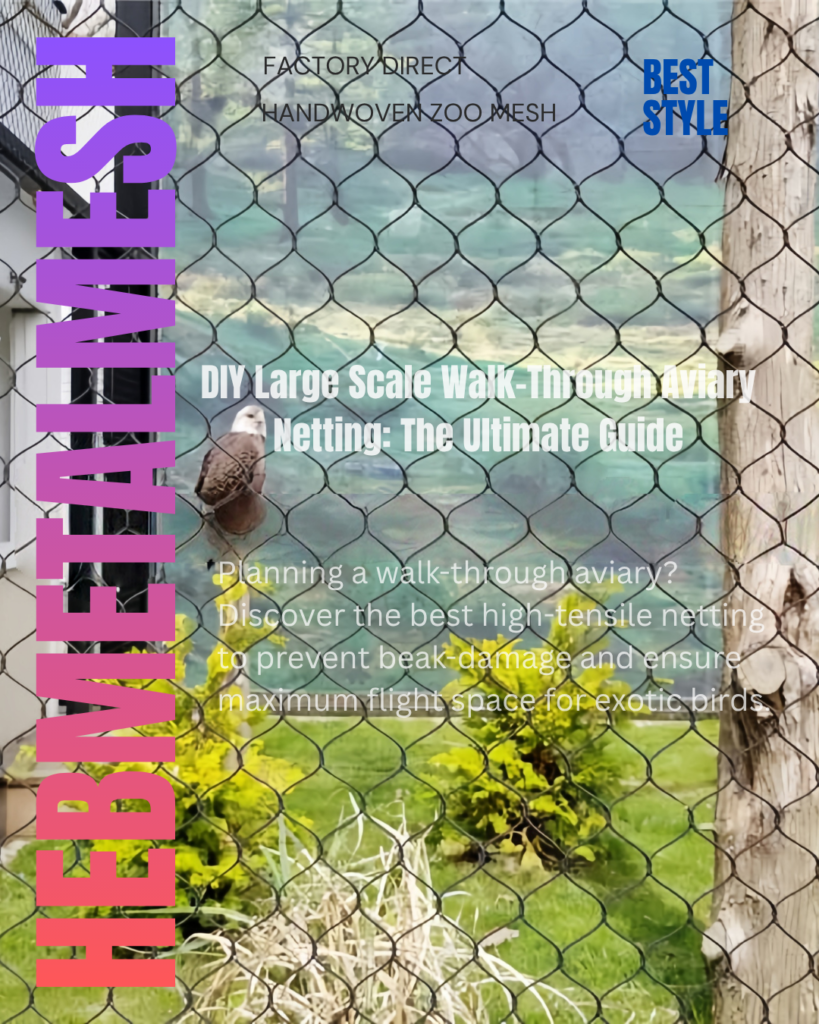
Building a large-scale walk-through aviary requires a delicate balance: the mesh must be strong enough to withstand the incredible shearing force of parrot beaks, yet lightweight enough to remain nearly invisible. In 2026, the gold standard for DIY and professional aviaries is interwoven 316-grade stainless steel rope mesh. Unlike plastic netting that shreds or light-gauge wire that rusts, this specialized mesh offers a maintenance-free, high-transparency solution that protects your birds and provides an immersive experience for visitors.
I. Introduction: The “Beak-Strength” Reality
The Hook: The “Escape Artist” disaster. If you have ever owned a parrot or worked in a bird sanctuary, you know the sound: the relentless, metallic snip-snip-snip of a beak finding a weak point in the netting. Cheap plastic or nylon netting is a temporary fix that quickly becomes a logistical nightmare. Within months, UV radiation makes the material brittle, and your birds—who are brilliant escape artists—will exploit every frayed edge. You aren’t just losing an enclosure; you’re risking the life of your birds every single day you rely on materials that were never engineered for avian strength.
The Concept: Nature, not a prison. A true walk-through aviary should be a sanctuary where the visitor feels like a guest in a flight zone. If your enclosure is filled with heavy black plastic nets that sag and tear, you’ve created a prison aesthetic. In 2026, the gold standard is biocentric design: creating a space where the humans are immersed in the environment. This means the barrier must be invisible enough to let the canopy stand out, yet strong enough to handle the sheer force of flight and perching.
The “Aha” Moment: It’s not about thickness; it’s about tension. Most people assume they need thick bars to contain a bird. They don’t. You don’t need heavy, obstructive materials; you need the right tensile weave. By using high-strength 316-grade stainless steel rope mesh, you achieve a structure that is both “invisible” to the eye and effectively unbreakable. It’s the “aha” moment: the moment you realize you can have a fence that is thinner than a wedding ring but stronger than industrial steel.
II. Understanding “Beak-Strength” and Enclosure Integrity
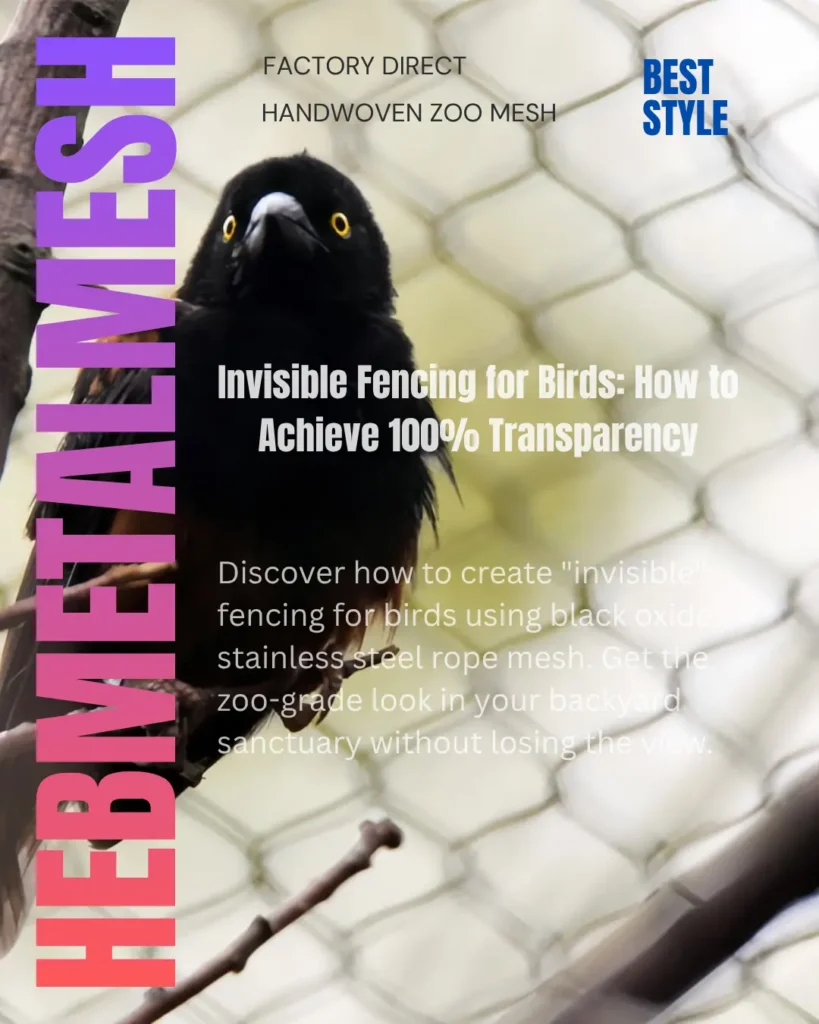
The Anatomy of a Bite. When it comes to Macaws, Cockatoos, or African Greys, we aren’t just talking about “climbing.” We are talking about birds that use their beaks as a third, powerful limb. A Macaw’s bite force can reach hundreds of pounds per square inch, capable of snapping thin-gauge wire or shearing through plastic mesh in minutes. This is why standard aviary netting fails. You need a specialized wire diameter and a hardened steel alloy that can resist the shearing action of a hooked beak. When you order custom-sized aviary netting rolls, you are getting a weave specifically tested for its ability to withstand point-load shearing.
Aperture Safety: Preventing the “Catch.” The “Aperture” (the opening size of the diamond) is just as critical as the wire strength. If the aperture is too large, you risk “beak-wedging” or snagging, where a bird’s beak or talon gets stuck, leading to injury or panic. If the aperture is too small, you lose that “walk-through” transparency and block airflow. We engineer our enclosures to balance these two needs: keeping the opening large enough to provide a high-definition view of the birds, while ensuring the knot integrity is 100% secure so that even the most determined bird can’t pry a strand loose. It’s about creating a habitat that is as safe for the bird’s anatomy as it is secure for the sanctuary manager’s peace of mind.
III. Designing Your Flight Space
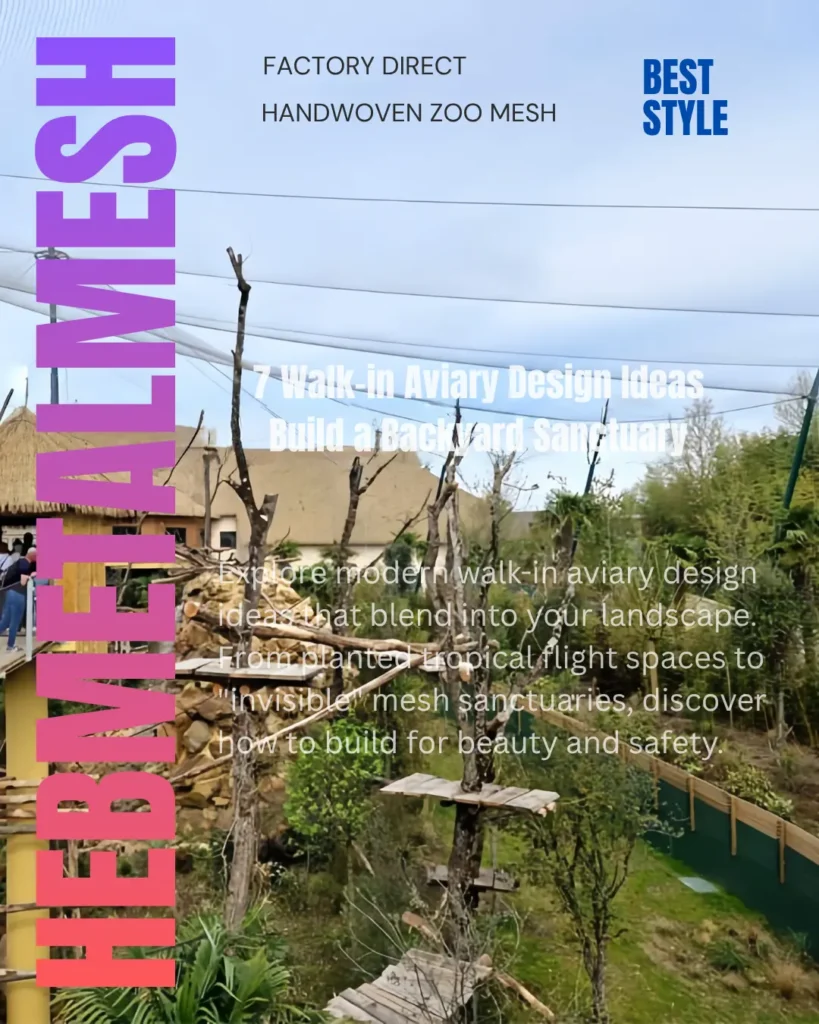
Calculated Volume: The Arc vs. The Circle. Most DIY aviaries are built as simple boxes or cylinders, forcing birds to fly in repetitive circles—a behavior that leads to stress and wing atrophy. Professional large-scale flight zones prioritize Natural Flight Paths. By designing for volume and length rather than just height, you allow birds to perform true arcs and long-distance glides. When planning your enclosure, calculate the total “flight volume” required for your specific species. A Macaw needs a different flight arc than a finch; the goal is to provide enough linear distance to allow for a full wing-stroke cycle before the bird has to bank or turn.
Vegetation Integration: The “Invisible” Support. The biggest challenge with large aviaries is preventing the mesh from sagging when it’s covered in vines or used as a support for climbing plants. The secret is to use the mesh as the trellis. Because our 316-grade rope mesh is high-tensile, it acts as a structural framework for your vegetation. By weaving climbing plants directly through the mesh, you create a “living wall” that hides the perimeter without requiring secondary, unsightly support beams. The mesh supports the weight of the growth, and the growth, in turn, softens the geometry of the structure.
The Walk-Through Entry: Engineering the Airlock. The “Airlock” is the most critical safety feature of any walk-through aviary, yet it’s often an aesthetic afterthought. To keep the structure seamless, integrate your double-door system into the main landscape design. Use the same mesh material for the doors as you do for the walls to ensure the visual rhythm isn’t interrupted. By hiding the hardware behind natural landscaping or a transition tunnel, you keep the visitor focused on the birds, not the logistics of entering the exhibit.

IV. Material Selection: Why Stainless Steel Wins
Visual Transparency: The “Disappearing” Effect. The primary reason you build an aviary is to see your birds, not a wall of plastic. Our stainless steel rope mesh provides over 90% transparency, which creates a “disappearing” effect for the human eye. When you use the correct wire diameter and aperture size, the mesh strands essentially vanish into the background at a distance of just a few feet. This allows for high-definition photography and clear observation, turning a fenced-in area into a true window into the wild.
Weathering & Toxicity: The Health of Your Flock. Aviary safety goes beyond “containment”—it’s about toxicity. Cheap plastic nets are often treated with anti-UV chemicals that can be harmful if ingested, while galvanized wire contains zinc, which is highly toxic to many exotic birds if they gnaw on the strands. 316-grade stainless steel is completely inert. It doesn’t off-gas, it doesn’t flake, and it contains no toxic heavy metals.
It is the only material that guarantees both the structural integrity of your enclosure and the long-term health of your flock. When you invest in custom-sized aviary netting rolls, you aren’t just buying a fence; you’re buying a non-toxic environment that will stand up to decades of weather and beaks without degrading into a health hazard.
V. DIY Implementation Guide
Tensioning 101: The secret to a professional finish.
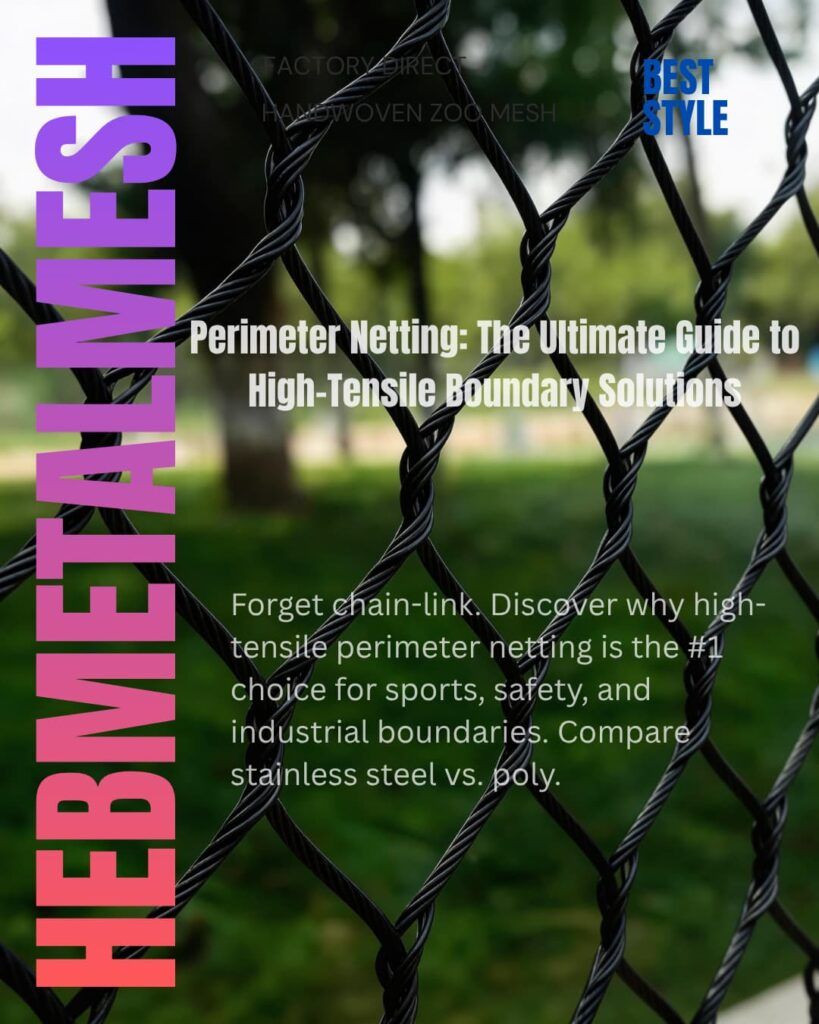
A “sagging net” is the hallmark of an amateur enclosure. Proper tensioning is not just about aesthetics—it’s about structural integrity. When mesh is correctly tensioned, it acts as a unified load-bearing skin, distributing the weight of the birds or climbing vines evenly. Use high-quality stainless steel tensioning tools to ensure the wire remains taut. Think of it like a drumhead: if one section is loose, it creates a point of failure that animals will target. Proper tension ensures the mesh stays rigid enough to resist wear and tear while remaining flexible enough to absorb kinetic impacts.
Anchoring: Securing the perimeter.
Your mesh is only as strong as its anchor points. Whether you are attaching to steel frames, timber posts, or even existing mature trees, the goal is to distribute the load across the entire structure.
- Steel Frames: Use direct bolt-through tensioning eye-bolts.
- Timber/Wood: Use heavy-duty stainless steel staples or screw-eyes (ensure they are 316-grade to prevent rust bleeding into the wood).
- Trees: Never wrap mesh tight around a trunk (this will “girdle” and kill the tree). Instead, install floating anchor brackets that allow the tree to grow without damaging the mesh’s tension.
Efficiency: Ordering custom rolls.
Don’t buy “standard” lengths and try to make them fit. Ordering custom-sized rolls from the Hebmetalmesh online store is the ultimate project hack. By specifying the exact dimensions of your aviary segments, you minimize the need for field cutting, reduce scrap waste, and significantly speed up the installation process. It ensures the mesh pattern remains consistent across the entire flight zone, providing a clean, professional look that looks like it was installed by a dedicated engineering firm.
When designing your enclosure, choosing the right material is essential to avoid health risks like zinc poisoning; for a detailed breakdown of why raw, high-grade stainless steel is the gold standard for your bird’s safety, read our complete guide to choosing the best aviary for cockatiels.
VI. Comparative Analysis: Netting vs. Mesh
Table: Performance Breakdown
*Performance analysis based on 2026 industry standards for avian containment and material durability.
Why Plastic Netting Fails: The UV Trap.
It’s a tale as old as time: you install a cheap black plastic net, and it looks great for the first summer. Then, the UV rays hit. Plastic polymer chains begin to break down, turning the material from flexible and strong to brittle and prone to snapping. As it degrades, it becomes a “ticking time bomb.” One heavy storm or one curious macaw is all it takes to cause a total enclosure breach. Add to this the cost of annual replacement, the labor of removing old netting, and the constant stress of potential escapes, and you’ll see why plastic netting is one of the most expensive “cheap” decisions you can make. Stainless mesh, by contrast, is impervious to UV radiation, ensuring that your enclosure stays as secure on day 3,000 as it was on day one.
VII. Case Studies: Successful Aviaries
The Private Sanctuary: Ending the “chew-through” cycle. We recently worked with a private sanctuary owner who was trapped in the “repair loop.” With a thriving group of Green-winged Macaws, their nylon netting was being shredded at a rate that required patch-work every few months. The constant maintenance wasn’t just expensive; it was stressful for the birds, who were repeatedly confined to small holding crates while sections were repaired. After upgrading to a custom-cut, 316-grade stainless steel mesh system, the cycle stopped instantly. Five years later, the owner reports zero breaches, no maintenance costs, and, most importantly, the birds now have unrestricted access to their entire 2,000-square-foot flight path.
Public Walk-Through: Scaling to the professional level. In large-scale public zoo settings, the stakes include visitor safety and regulatory compliance. One of our recent collaborative projects involved a massive 15,000-cubic-foot walk-through aviary designed for a variety of tropical species. By utilizing our high-tensile rope mesh system, the architects were able to eliminate the need for heavy vertical steel pillars every few feet. The result was a stunning, pillar-free flight zone that allows visitors to feel completely immersed in the canopy. The high-transparency mesh ensured that even from ten feet away, the barrier was virtually invisible, creating a “bird-eye view” experience that traditional chicken wire or welded panels could never replicate.
The same strength that protects your flock from chewing macaws can also be deployed to protect your perimeter from urban wildlife. Learn how to secure your property in our next guide: High-tensile predator-proof fencing for residential protection
VIII. Conclusion: Creating an Unbreakable Sanctuary
Summary of the ROI: Spend once, maintain never. When you calculate the true cost of an aviary, the “price per roll” is the least important number on the invoice. When you factor in the labor of annual repairs, the cost of emergency replacements, and the potential loss of a bird due to an enclosure breach, the ROI of professional-grade stainless steel becomes undeniable. By choosing to spend once on a high-durability system, you essentially “zero out” your maintenance budget for the next three decades. It is the ultimate insurance policy for your sanctuary.
The emotional reward of a healthy environment. Ultimately, your aviary isn’t just a structure; it’s a living space. There is no feeling quite like watching your birds engage in natural, unrestrained flight, knowing they are safe, secure, and living in an environment that honors their biological needs. A healthy, flight-capable environment is the greatest gift you can provide to a bird, and by using the right materials, you ensure that this environment remains a sanctuary for years to come.
If you are ready to stop the endless cycle of repairs and build a flight space that truly lasts, you can order custom-sized aviary netting rolls directly from our site. For larger projects requiring specific load-bearing calculations, feel free to contact our engineering team to ensure your sanctuary is built to the highest standard of safety. If you are planning to make a purchase or require rolled forms, custom sizes and global shipping, stainless steel aviary netting serves as our core product page featuring all specifications and material options.
Build an Aviary That Lasts a Lifetime.
Stop replacing shredded nets. Our high-tensile 316-grade stainless steel aviary mesh is engineered to withstand the strongest beaks while keeping your birds safe and secure.
FAQ: Mastering Aviary Design with 316-Grade Mesh
A: Unlike plastic or nylon netting that can be sheared by the leverage of a parrot’s beak, high-tensile 316-grade stainless steel rope mesh features a high-strength, interwoven structure. It is engineered to resist point-load shearing, meaning that even the most determined Macaws or Cockatoos cannot pry apart the strands or snap the wire.
A: No. Because of its high-transparency design, our stainless steel rope mesh provides 90% or more open area. When installed with proper tension, the wires are so thin and the aperture so clear that they virtually “disappear” to the human eye, allowing for unobstructed observation and high-quality photography.
A: Our mesh is designed for both professional zoos and ambitious DIY enthusiasts. Because it is lightweight and flexible, it is significantly easier to handle than rigid welded panels. With basic tensioning tools and a clear plan, most sanctuary owners can successfully install large-scale sections independently.
A: Yes. Unlike galvanized wire, which contains zinc that can be toxic if ingested, 316-grade stainless steel is chemically inert and non-toxic. It does not off-gas or degrade under UV light, ensuring a safe, healthy environment for your flock for decades.
A: 316-grade stainless steel is specifically engineered for harsh environments. It contains molybdenum, which makes it highly resistant to corrosion from salt spray and humidity—the very conditions that cause standard steel or galvanized fencing to rust within just a few years.
- When planning an aviary, our article Best Durable Aviary Netting Large Bird Enclosures can also serve as a practical supplementary reference.
- When planning an aviary, our article Choose The Right Large Outdoor Bird Cage can also serve as a practical supplementary reference.
- When planning the aviary, our article Hot Selling Large Outdoor Bird Aviary can also serve as a practical supplementary reference.