
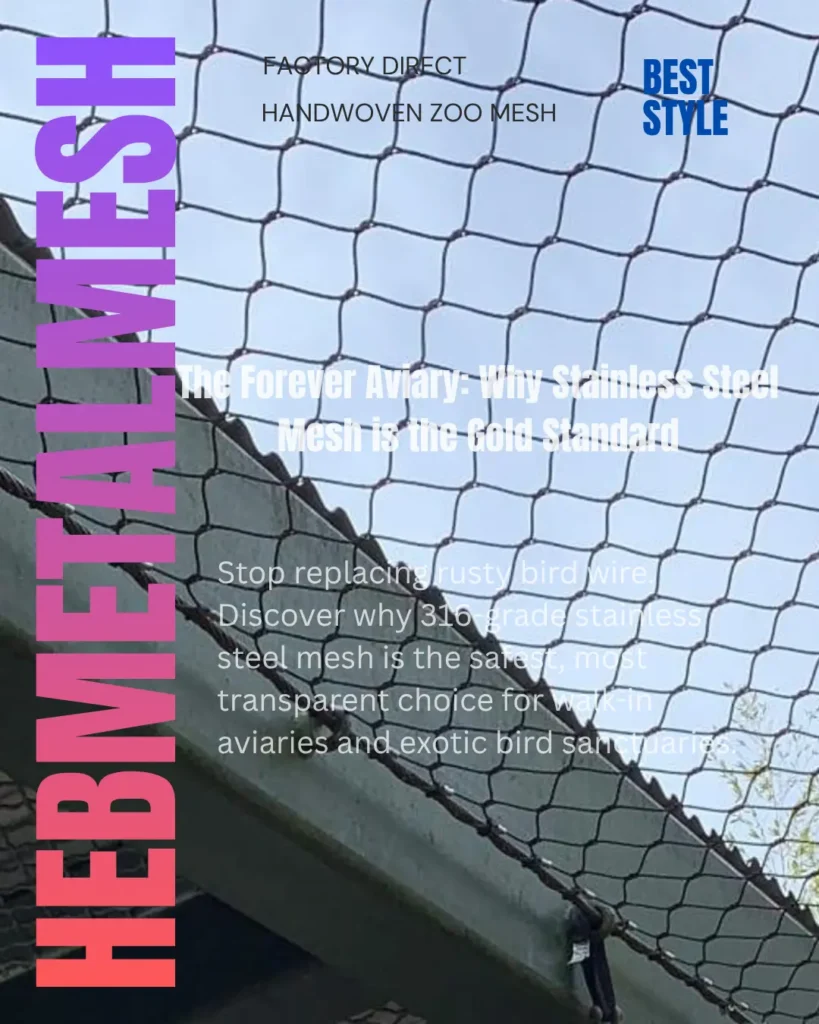
Why is stainless steel mesh best for aviaries? Unlike traditional galvanized wire, 316-grade stainless steel mesh is non-toxic, eliminating the risk of “Heavy Metal Poisoning” (Zinc toxicosis) in birds. Its hand-woven design provides 90%+ transparency for better bird watching and photography, while its extreme durability protects against predators like raccoons and hawks. It is a “one-time” investment with a 30-year lifespan, making it the most cost-effective solution for professional and high-end hobbyist aviaries.
I. Introduction: The Heartbreak of the “Rusty Cage”
Let’s talk numbers for a second. If you’ve spent $5,000 on a breeding pair of Hyacinth Macaws or thousands more on a curated collection of exotic finches, why on earth would you house them in $50 worth of toxic chicken wire from a local hardware store?
It’s a heartbreaking scenario we see all too often in the avian world. A collector builds a beautiful, spacious flight, but within three years, the wire is sagging, the silver coating is flaking off into the bird feed, and the once-vibrant view of the flock is obscured by a hazy, rusted “screen” of oxidation.
The Reality: The High Cost of “Cheap”
Traditional aviaries often fail because they are built with a “budget-first” mindset. Most owners prioritize low initial material costs, forgetting that birds—especially parrots and hookbills—are incredibly destructive and sensitive creatures. Low-grade galvanized steel or plastic-coated netting might save you a few hundred dollars today, but it sacrifices long-term bird health and the visual clarity that makes bird-keeping enjoyable in the first place.
The Vision: The “Walk-in Sanctuary” Concept
We are seeing a massive shift toward the Walk-in Sanctuary philosophy. This isn’t just a cage; it’s an immersive ecosystem. Modern designers are now using stainless steel mesh for large walk-in aviaries to create soaring, open-air structures that feel like a piece of the rainforest. By using a material that is as strong as it is invisible, you can finally provide your birds with the flight space they deserve without turning your backyard into an industrial eyesore.
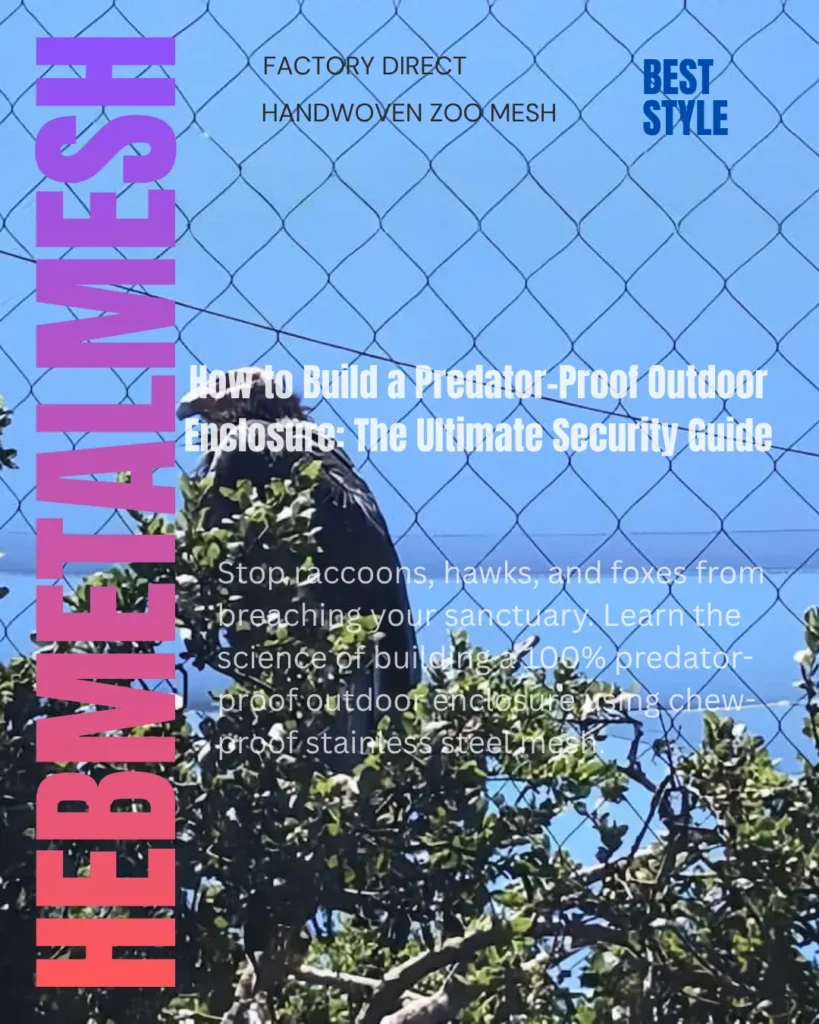
II. The Silent Killer: Zinc Poisoning (Heavy Metal Toxicosis)
If you are using galvanized wire, you are essentially surrounding your birds with a slow-acting poison.
The Danger: The “Curiosity Chew”
Birds, particularly parrots, cockatoos, and other hookbills, use their beaks as a third hand. They explore their world by chewing. Galvanized steel is created by dipping iron into a bath of molten zinc to prevent rust.
When a bird climbs the sides of a galvanized cage or chews on a loose wire end, they ingest microscopic flakes of that zinc coating. This leads to Heavy Metal Toxicosis. The symptoms are devastating:
- Loss of balance and coordination (Ataxia).
- Seizures and neurological damage.
- Kidney and liver failure.
- Sudden, unexplained death in otherwise healthy birds.
The Solution: The Biologically Inert Barrier
.This is where Stainless Steel 316 becomes a literal lifesaver. It is the only material that is 100% safe for hookbills to climb on and chew. For those housing high-value birds, our parrots and macaw enclosure fence netting provides the ultimate non-toxic barrie. It is the only material recommended by avian veterinarians for high-end containment.
The “Aha” Moment: From Asset to Liability
Here is your “Aha!” moment: Cheap wire isn’t a bargain; it’s a liability. If the wire you use to build your aviary has the potential to kill the very birds you are trying to protect, it is the most expensive mistake you can make.
By switching to hebmetalmesh stainless steel rope mesh, you aren’t just buying a fence; you are buying an insurance policy for your flock. You’re moving from a temporary, toxic solution to a permanent, safe sanctuary that will never rust, never flake, and never put your birds at risk.
See our guide of Choosing the safest aviary mesh material
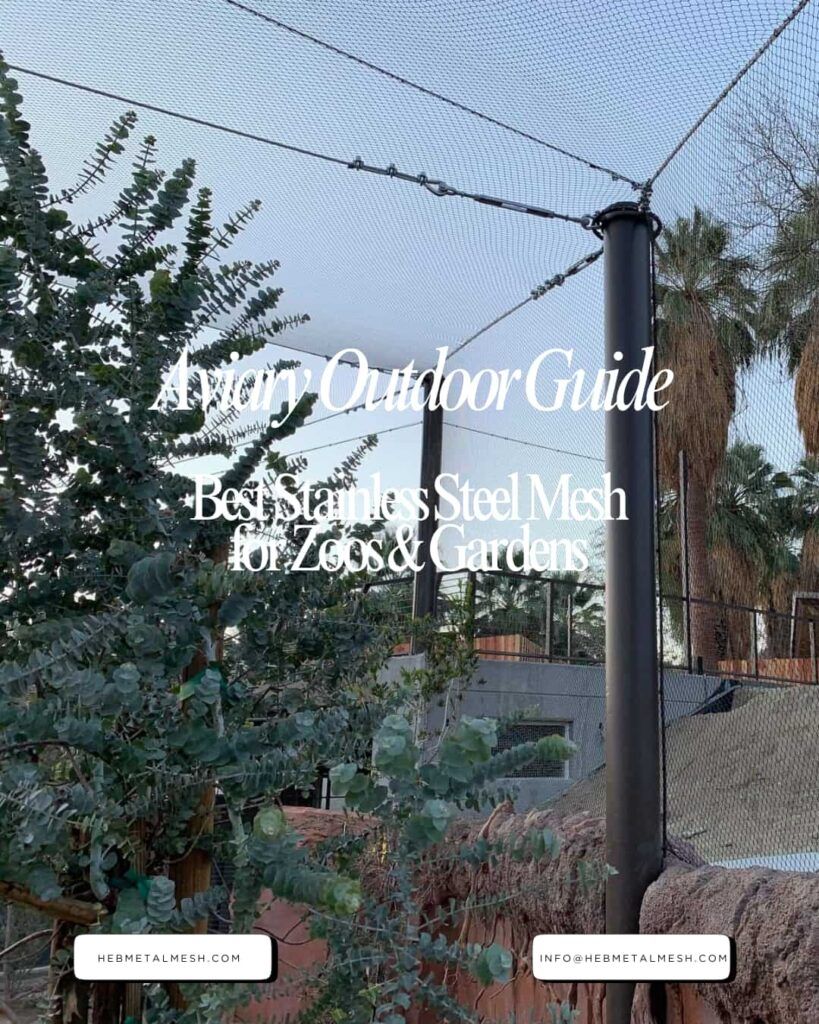
III. Visual Clarity: Capturing the Colors, Not the Wire
You didn’t invest in a collection of vibrant Sun Conures or Toucans just to view them through a hazy gray blur. One of the most frustrating aspects of traditional aviary wire is optical interference.
The Photography Barrier
If you’ve ever tried to take a photo of a bird through standard chain-link or heavy galvanized mesh, you know the struggle. The camera’s autofocus locks onto the thick, reflective wire instead of the bird. For zoos and sanctuaries, this is a major “engagement killer.” Visitors want to share crisp, clear photos on social media, but heavy wire makes that impossible.
The “Invisibility” of Black Oxide
This is where the engineering of stainless steel mesh for large walk-in aviaries truly shines. By utilizing a Black Oxide finish, we treat the stainless steel so it absorbs light rather than reflecting it.
- The Result: The human eye (and the camera lens) naturally “ignores” the dark, thin lines of the mesh and focuses on the high-contrast colors of the birds and foliage behind it.
- The Transparency: At a distance of just a few meters, the mesh seems to dissolve, creating a seamless “fly-through” visual experience that makes the enclosure feel twice as large as it actually is.
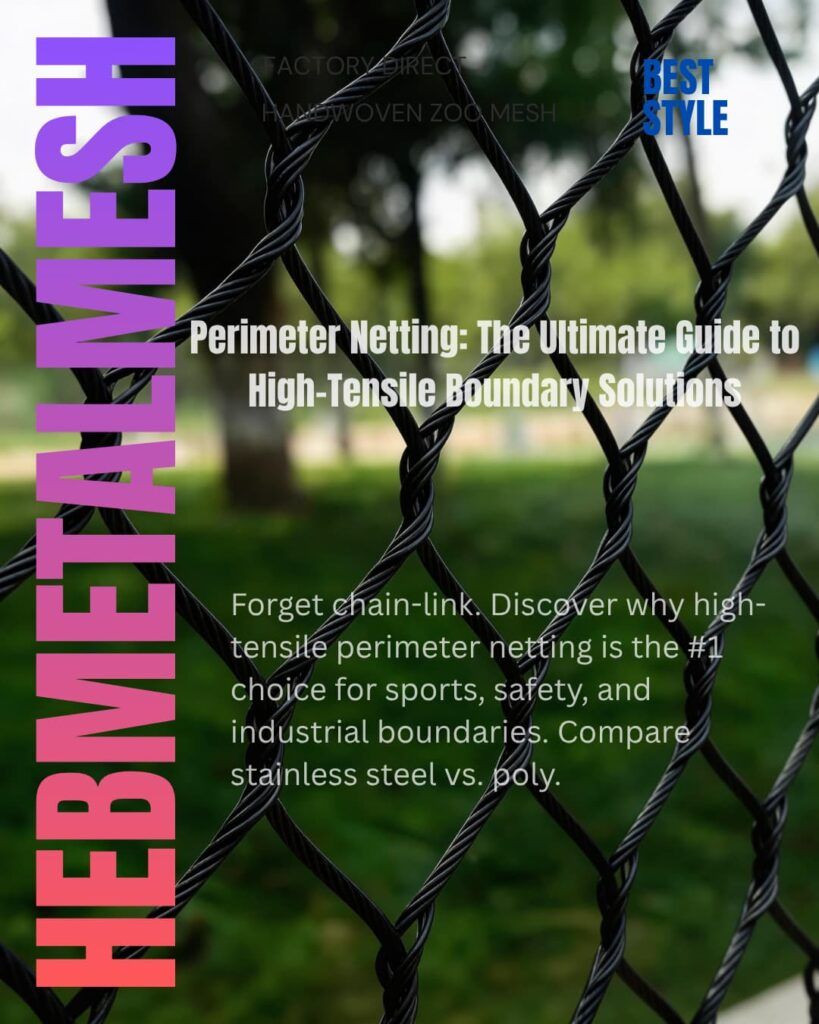
IV. Predator-Proofing: The 24/7 Security System
A walk-in aviary is a “dinner bell” for local wildlife. From clever raccoons and snakes to neighborhood cats and hawks, your flock is constantly being watched by predators that view standard bird wire as a minor inconvenience.
Tensile Strength vs. Clever Claws
Standard “chicken wire” or hex-mesh is notoriously weak. A determined raccoon can pull the twists apart, and a stray dog can tear through it with a single bite.
Our 316-grade stainless steel rope mesh is constructed from woven cables. These cables are virtually impossible to “tear.”
- Impact Resistance: If a hawk dives at the mesh attempting to snag a bird, the mesh deflects and absorbs the impact without snapping.
- Anti-Cut Properties: Unlike nylon netting, which can be chewed through by rodents or cut with a simple pair of scissors by thieves, stainless steel requires specialized industrial tools to breach.
Choosing the Right Aperture for Security
Predator-proofing isn’t just about keeping the big guys out; it’s about structural integrity. For larger raptors and birds of prey, we utilize a heavy-duty eagle enclosure fence netting that resists the powerful talons and impact speeds of hunting birds.
- The “Snake-Proof” Gap: For aviaries in regions with climbing snakes, we recommend a tighter aperture (around $12mm$ to $20mm$) to prevent entry.
- The “Hand” Factor: Raccoons are famous for reaching through wide mesh to grab birds roosting near the edge. By using a tighter hebmetalmesh weave, you ensure that “reaching hands” can’t penetrate the sanctuary.
By investing in professional-grade mesh, you aren’t just building a cage; you’re installing a 24/7 security system that never sleeps and never fails.
V. Engineering the “Fly-Through” Experience
When designing a large walk-in aviary, the structural engineering is just as important as the material. You want to create a sense of infinite space, which means minimizing the “forest of poles” often required to hold up heavy, rigid fencing.
Large-Scale Span: Strength Without the Bulk
Because hebmetalmesh is a high-tensile cable structure, it can span much larger distances than traditional welded wire without sagging. This allows architects to design soaring domes and vast flight paths with fewer internal support columns.
- The “Lightness” Factor: Stainless steel rope mesh has an incredibly high strength-to-weight ratio. This reduces the dead load on your frame, allowing for more elegant, lightweight structural designs.
- Tensioning: Using a perimeter cable system, the mesh is “tuned” like a guitar string. This tension ensures that the flight remains crisp and professional-looking for decades, even under wind or snow loads.
Airflow and Hygiene: A Breath of Fresh Air
Respiratory health is a major concern for exotic birds. Glass enclosures can trap stagnant air, heat, and pathogens, while solid walls block natural cross-breezes. Rope mesh provides 100% ventilation. It allows for natural humidity regulation and ensures that pheromones and dust don’t accumulate to toxic levels. Plus, when it comes time for a deep clean, the mesh is entirely pressure-wash safe and resistant to all common veterinary disinfectants.
To prevent sagging over time, your mesh panels must be anchored to a completely square and rigid support skeleton, which you can learn to construct using our step-by-step aviary frame construction tutorial.
VI. Conclusion: The ROI of a Lifetime Aviary
Let’s be honest: stainless steel rope mesh is a premium product. However, when you look at the Total Cost of Ownership (TCO), it is actually the most economical choice you can make for a serious project.
The “Buy Once, Cry Once” Math
Compare these two scenarios over a 30-year period:
- The Galvanized Cycle: You replace the wire every 5–7 years due to rust, sagging, or bird health scares. Over 30 years, you pay for materials 5 times, plus the labor costs of 5 separate teardowns and rebuilds.
- The Stainless Standard: You install 316-grade hebmetalmesh once. It remains safe, secure, and beautiful for the entire 30-year span with zero replacement costs.
The Legacy of the Sanctuary
Ultimately, the ROI isn’t just in the dollars saved—it’s in the birds saved. It’s the peace of mind knowing that when you walk into your aviary, your flock is safe from predators, free from heavy metal poisoning, and visible in all their natural glory.
Don’t build a cage that you’ll have to apologize for in five years. Build a sanctuary that will outlast the builder.
Build a Sanctuary, Not a Cage
Upgrade to the safe, invisible, and predator-proof mesh used by top-tier zoological parks.
Zinc-Free & Non-Toxic | 30-Year Lifespan | Global Shipping
Frequently Asked Questions: The Forever Aviary
Yes, significantly. Galvanized wire is coated in zinc, which is highly toxic to birds (leading to “New Wire Disease” or Zinc Toxicosis). 316-grade stainless steel is biologically inert, meaning it is non-toxic and won’t flake off even if hooked-billed birds like Macaws or Cockatoos chew on it constantly. It is the only material recommended by avian veterinarians for high-end enclosures.
Not if you use Type 316 Stainless Steel. Unlike Type 304, which can develop “tea staining” in salty environments, 316-grade contains Molybdenum. This provides extreme resistance to chlorides and salt spray, making it the perfect choice for coastal sanctuaries or high-humidity tropical exhibits
For small soft-billed birds or finches, we recommend an aperture of 20mm x 20mm (3/4″). This prevents the birds from escaping while also acting as a barrier against small predators like snakes or rodents that might try to enter the sanctuary.
Absolutely. While steel frames are more permanent, many private collectors install our mesh on timber frames. The mesh is typically fastened using stainless steel staples or, for a more professional look, laced onto a small perimeter cable that is bolted to the wood. This maintains the high tension needed for a “crisp,” professional finish.
The “invisible” effect is achieved using our Black Oxide finish, which eliminates glare. To maintain this, simply hose down the mesh periodically to remove dust or pollen. Because the material is stainless steel, it doesn’t require painting, stripping, or re-coating, ensuring your view remains crystal clear for its entire 30-year lifespan.