
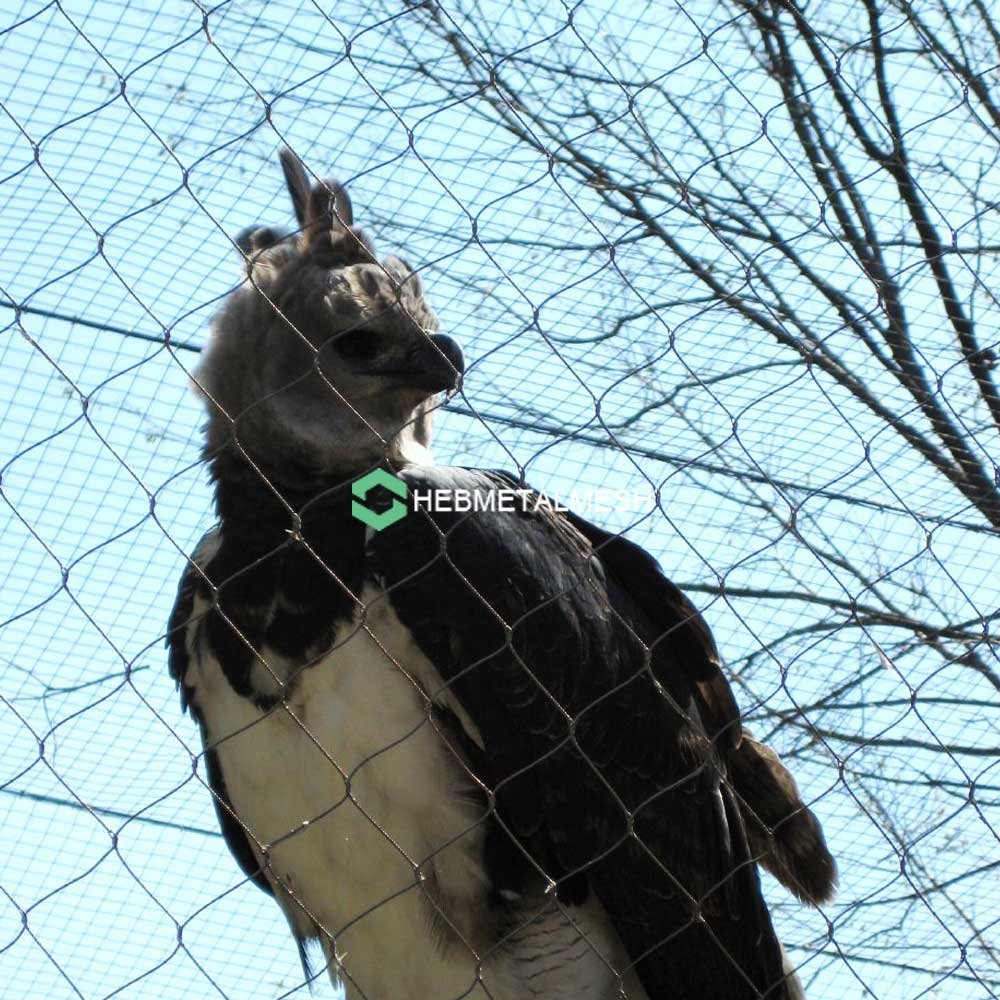
An eagle enclosure is a flight structure first and a fence second. Get the flying distance wrong and no mesh will repair the bird’s condition; get the mesh wrong and a well-built aviary still damages feathers and talons. For a large eagle, the working specification is hand-woven stainless steel rope mesh at a 38–51 mm aperture with a 2.0–2.4 mm cable, carried over a flight line of 15–25 m with 3–4 m of clear headroom. Frame spacing, roof detail, perching and gates all exist to serve those two decisions.
Executive Summary
Eagle housing is really three buildings, and only one of them is a fencing problem. A mews is a short, shaded box used for weathering and hacking. An eagle release aviary is a soft-sided structure for a bird on its way back to the wild. The flight aviary is the long, fully meshed day-flight where a permanent bird lives out its life, and it is where the specification actually has to hold up. All three are sized by the same two variables. The mesh aperture is set by what a primary feather or a talon can pass through, and the cable diameter is set by impact energy — roughly 4.4 kN of breaking load at 2.4 mm and 7 kN at 3.2 mm. Choose both correctly and a panel holds its tension for 25–30 years with one re-tensioning visit in the first season. Choose them badly and the injury happens inside the flight, not at the perimeter. The reference specification is the core product page product page.
Specifying a raptor flight this season? Send the flight line, the clear height and the species list, and we will return a panel layout, a border-cable detail and a budget figure.
Quick Answer:
Quick Answer: Build an eagle flight aviary from hand-woven SS304 rope mesh with a 38–51 mm aperture and a 2.0–2.4 mm cable, hung in panels up to 9 m × 18 m on supports at 2.5–3.5 m centres. Allow 15–25 m of flight line and 3–4 m of clear headroom, keep every cut wire end and every ferrule outside the bird’s airspace, and plan on $20–38 per m² for the mesh as a planning range.
Key Takeaways
- Flight length beats height. A large eagle needs 15–25 m of usable flight line; a tall cube does nothing for feather wear or fitness.
- 38–51 mm aperture with a 2.0–2.4 mm cable is the working band for large raptors. Tighter apertures trap a primary feather or a talon.
- The roof is the real load case. Open area runs around 88% at 38 mm, so uplift concentrates at corners and eaves rather than on the panel field.
- Soft-faced mesh only, inside the flight. No cut wire ends and no exposed ferrules where a bird can hit them at speed.
- The mesh is 10–20% of the build. Frame, footings, gates and perching carry the rest of the budget.
Raptor housing guidance published by the Association of Zoos and Aquariums treats flight distance and feather condition as welfare indicators, which is why both are fixed before any material is ordered.
What an Eagle Flight Aviary Actually Has to Do
An eagle flies to hunt, so a flight aviary has to let it do that safely rather than merely contain it. The eagle flight aviary dimensions that matter are length, width and clear headroom — footprint area tells you almost nothing. Start with a flight line of 15–25 m for a golden or bald eagle and 10–15 m for a smaller raptor, a width of at least one third of that length so the bird can turn without stalling, and 3–4 m of clear height.
Eagle flight aviary planning then works backwards from the wingspan. A golden eagle spans roughly 1.8–2.2 m, so a 4 m wide flight gives it about one full beat between walls, and a 6 m width is noticeably better. Add a weather shelter at one end and make the other end solid, because a bird that can see through both gables will fly at the mesh. Where the site cannot supply length, build two shorter flights and rotate the bird between them instead of shrinking the enclosure until it fits.
Mews, Flight Aviary or Release Aviary
Most eagle projects need more than one structure, and the mesh duty changes between them. A mews is where a trained bird sits at night or in bad weather; eagle mews construction is light-framed and shallow, typically 2.5–3 m deep, and eagle mews netting can run at a 38 mm aperture because the bird never reaches full speed inside it.
A long day-flight is the opposite case. Here eagle housing netting is a genuine impact surface, and the raptor housing mesh and bird of prey housing mesh choices should be the heaviest option the budget allows. Where birds are prepared for wild release, an eagle release aviary is deliberately soft-sided and partly open along one face; an eagle rehabilitation aviary is built for cleaning speed and for observation from outside. An eagle weathering area, an eagle hack tower and an eagle breeding aviary each add their own detail: the weathering area and hack tower need shade cloth and a low mesh line of sight, while breeding pairs need two compartments, a sliding divider and a raised ledge.
| Structure | Typical flight line | Aperture / cable | Primary purpose |
| Mews | 2.5–3 m deep | 38 mm / 2.0 mm | Weathering, hacking, night housing |
| Flight aviary | 15–25 m | 38–51 mm / 2.0–2.4 mm | Permanent day flight |
| Release aviary | 10–20 m | 38 mm / 2.0 mm | Pre-release conditioning |
| Breeding aviary | 8–12 m per bay | 51 mm / 2.4 mm | Paired birds, nest ledge |
The Two Numbers: Aperture and Cable Diameter
For a raptor, mesh aperture is a feather-safety decision rather than an exclusion decision. At 20–25 mm a bird cannot shake free a primary feather that has slipped through the opening, and a talon entering a gap of that size can lock. A 38–51 mm aperture gives the feather room to slide back out and is still far tighter than the bird’s beak, so nothing is lost from a feeding ledge. If the collection includes more than one species, work through a bird aviary mesh size chart rather than defaulting to the eagle figure.
The cable diameter is set separately, by impact. A 2.0 mm cable is adequate for a small falcon in a short flight, while the 2.4 mm and 3.2 mm grades are the right choice for eagles and large hawks, where a stoop into an end wall is a real load case and not a theoretical one. Rope mesh is a textile in which every strand is a 7×7 rope of 49 wires, so one broken wire costs roughly 2% of that strand’s breaking load and the panel stays tensioned instead of unravelling.
Frame, Roof and Perch: Where the Mesh Actually Fails
Most eagle aviary failures are fixing failures and bird injuries, not mesh ruptures. The panel field is exceptionally strong, but the edges and corners are where a bird gets hurt. Wind uplift acts on the roof and concentrates at corners and eaves, which is why the border cable rather than the panel field is the load path, and why each termination has to be a properly pressed swage ferrule instead of a hand-formed eye.
Galvanic corrosion is the second quiet failure. A galvanised frame or a mild-steel fitting left in contact with stainless mesh will drive corrosion at the joint, so isolate the two or use stainless throughout — compare the two alloys on 304 and 316 cable mesh before the frame is fabricated. Early tension loss is normal as a frame beds in: re-tension at 4–6 weeks, then annually, and expect any broken wire to show up within about 300 mm of a ferrule. A salt spray test report matters on a coastal site, and the detail of joining rope mesh to wood, masonry or steel decides the whole fixing schedule.
Then deal with the bird’s own habits. An eagle nesting platform mesh section keeps the nest ledge off the main panel. An eagle impact absorbing mesh that can deflect 50–80 mm without taking a permanent set is worth more to a stooping eagle than another metre of height.
Materials Take-Off, Cost and What the Quote Should Include
The eagle flight aviary cost is driven by three things in a fixed order: cable diameter, then aperture, then panel size. Order volume barely moves the number, which is why a cheaper grade usually means a smaller cable rather than a bulk discount. As a planning range, allow $20–38 per m² for the mesh itself, and remember that edge cable, tensioners, ferrules and anchor plates add another 10–20% on top of a mesh-only figure. Panels are made up to 9 m × 18 m, and a panel of that size weighs 160–240 kg, so the lift needs planning before the crane is booked. Lead time is normally 2–4 weeks plus 2–6 weeks of transit.
Build the take-off at custom panel sizes rather than in square metres, then specify the grade from the core product page and ask for an EN 10204 3.1 mill certificate with the offer. That certificate is the document that separates a genuine 304 or 316 melt from a 201-grade substitute that will show surface rust within two seasons.
FAQ
Hand-woven stainless steel rope mesh with a 38–51 mm aperture and a 2.0–2.4 mm cable. It is soft enough that a stooping bird does not shear feathers on impact, and it holds tension even after an individual wire fails.
Give a large eagle 15–25 m of flight line, a width of at least one third of the length, and 3–4 m of clear height. Flight distance matters far more than total enclosure volume.
Neither is a good match. Welded mesh fails at the fused intersection where the coating is thinnest, and a broken chain-link deforms its neighbouring diamonds and slackens the whole run. Both abrade feathers on contact.
Plan on $20–38 per m² for the mesh as a planning range, with fixings, edge cable and tensioners adding 10–20%. Cable diameter is the single biggest cost driver, ahead of aperture and panel size.