

Almost every eagle enclosure begins as a request for a product, and almost every one is answered with a catalog. The catalog is the wrong place to start, because an enclosure is not sized by what happens to be for sale. It is sized by what the animal can do to it. An eagle impact force is not one figure and it is not printed on any datasheet. It is a small family of numbers the bird produces every day: the mass it arrives with, the speed it carries into the fabric, the pressure under its talons, and the leverage stored in a wing that spans two meters. Write those down and the mesh, the apertures and the fixings follow almost by themselves. Leave them blank and every specification becomes a guess wearing the costume of a standard.
Executive Summary
An eagle enclosure is specified by the bird, not by the catalog, and three consequences follow from that. First, the input is energy rather than weight: a five-kilogram eagle arriving at ten meters per second brings roughly 250 joules, and the same bird at fourteen meters per second brings close to 500, so speed rather than size sets the demand. Second, the peak load is decided mostly by how far the mesh is allowed to travel while it stops the bird. The identical arrival becomes about 2.5 kN over 100 mm of movement and roughly 25 kN over 10 mm, which is why a stiff panel and a flexible one are not interchangeable at any price. Third, the daily loads are not impacts at all: landing, take-off and gripping happen hundreds of times for every collision, and those repetitions are what wears an enclosure out. The reference specification is the eagle enclosure mesh product page.
Sizing an enclosure to a bird rather than to a price list? Send us the species, the number of birds, the internal length of the flight run, the clear span between supports and the maximum movement you are willing to allow at mid-span, and we will return the arrival energy, the panel layout and a fixing schedule sized to it.
Quick Answer: What Should Be Written Down First?
Fix four figures before anyone quotes a price. Body mass in kilograms, the fastest speed the bird can reach inside the enclosure in meters per second, the clear span between supports, and the distance you are prepared to let the mesh move under load. Half the mass times the square of the speed gives the energy the fabric has to absorb. Divide that energy by the distance it is allowed to move and you have the design load. Cable size, aperture, border cable and fixings are all downstream of those four numbers, and none of them can be chosen sensibly without them.
Key Takeaways
- The bird writes the specification; the catalog only answers it.
- Energy, not weight, is the input, and it rises with the square of arrival speed.
- The load the mesh feels is set by how far it is allowed to deflect, not by the bird alone.
- Landing, take-off and perching are routine and frequent; collisions are rare and dramatic.
- Write the four figures down first, then let alloy, aperture and fixing schedule follow.
The Question the Enquiry Never Asks
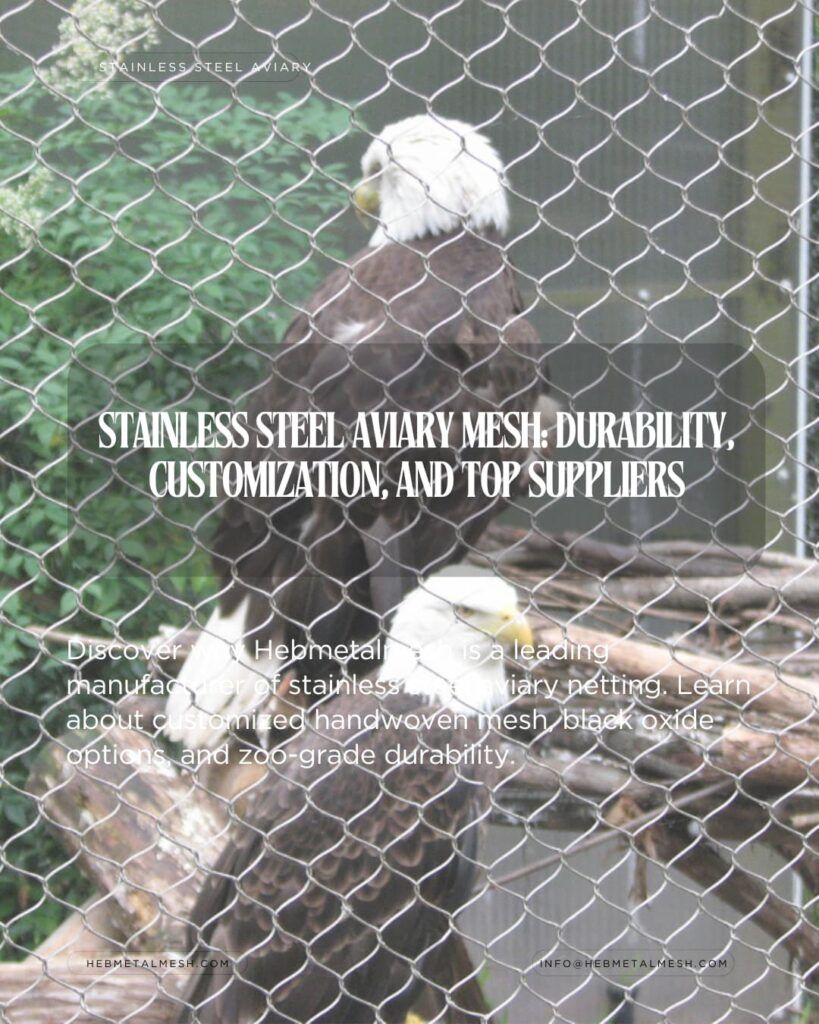
Most enquiries arrive as a species and a budget. What they do not arrive with is the single line that decides everything downstream: what the bird will do to the structure when it is startled. An eagle in an enclosure is not a static weight parked on a perch. It accelerates down the length of the pen, turns, and meets the mesh at whatever speed the space allows. That speed is the design variable, and the keeper chooses it, not the bird. A six-meter run-in produces a completely different bird approach speed from a two-meter one, and the difference is a factor of two in energy and closer to four in the impact force of a bird that flies into fabric. It is the first number to write down, and it is the one most often left blank. If the enclosure is being planned rather than repaired, the eagle flight aviary page settles run length, clear height and mews dimensions in the order they constrain each other.

The Four Numbers the Bird Brings
Four figures describe the bird, and only one of them is usually quoted.
The first is mass. A golden eagle runs three to six kilograms, a bald eagle similar, a Steller’s sea eagle up to nine, and the female is usually the heavier sex. Mass is the least sensitive of the four because it enters the arithmetic only once.
The second is speed. In open air a hunting eagle reaches headline figures, but inside an enclosure the only relevant number is the highest speed the bird can build in the run available, normally five to twelve meters per second. An eagle kinetic energy is half the mass multiplied by the square of that speed. A five-kilogram bird at ten meters per second carries about 250 joules; the same bird at fourteen meters per second carries nearly 500. Speed is squared and mass is not, so an eagle strike energy figure is really a statement about the length of the aviary rather than about the species inside it. The stopping side matters just as much: an eagle deceleration achieved over half a meter works out at roughly ten times gravity, which is not something a bird does voluntarily and not something a keeper should rely on.
| Bird | Mass | Run-in | Arrival speed | Energy at contact |
| Golden eagle, male | 3.5 kg | 6 m | 9 m/s | ~140 J |
| Golden eagle, female | 5.5 kg | 6 m | 9 m/s | ~225 J |
| Bald eagle | 5 kg | 4 m | 7 m/s | ~120 J |
| Steller’s sea eagle | 8 kg | 8 m | 11 m/s | ~480 J |
Mass, speed and flight performance are cataloged in the peer-reviewed literature of the <Raptor Research Foundation, whose Journal of Raptor Research is the standing reference on raptor biology.
The third is wing geometry. An eagle wingspan of two meters is the usual working figure, and an eagle wing beat of two to three cycles per second is slow. The wing is a lever, and a wing tip speed at the end of a one-meter half-span driven through a two-cycle beat is already around thirteen meters per second, faster than the body is traveling. A wing tip load therefore reaches the mesh before the body does, and it arrives at an angle, so it bends a top rail rather than a wire.
The fourth is the distance from the perch to the nearest face. An eagle perch distance of two meters gives the bird almost no runway; six meters gives it a genuine approach, and the same species then delivers twice the energy. The containment half of the same order is handled on the eagle containment mesh page.
Landing, Take-off and the Daily Loads
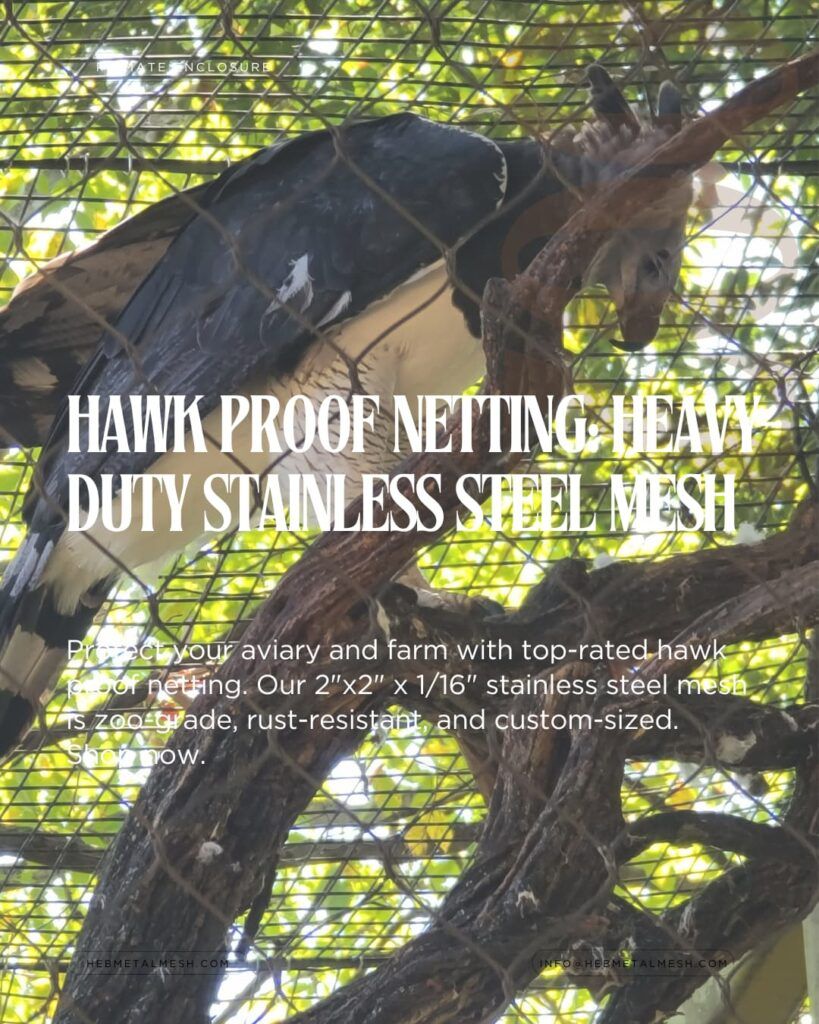
The dramatic collision is not the load that ends an enclosure’s life. Landing, take-off and gripping are, because they happen hundreds of times a day for years. An eagle landing force is easy to underestimate. A five-kilogram bird dropping the last 200 mm onto a perch has to shed about ten joules, and if it does so over 100 mm of leg travel the peak is roughly twice body weight, a hundred newtons delivered through two feet. An eagle takeoff force is of the same order in the opposite direction: the bird must produce more than its own weight in thrust to become airborne from a standing start, and it produces that thrust through the same feet.
Then there is the grip. Reported grip figures vary, and the total is the wrong quantity to argue about. Talon tips present a contact area measured in single-digit square millimeters, so even a modest 200 N grip becomes an eagle talon pressure in the tens of megapascals at the point of contact. That is an eagle grip force acting on a wire two or three millimeters across, and it is why the surface of the wire matters more than its breaking strength in day-to-day service. The husbandry half of the same wear — how housing choices change what a bird does to the mesh — is covered on the captive eagle housing page.
The slow, cumulative version of all three is how mesh damage by eagle actually appears in the field. It is almost never a snapped wire. It is abrasion where the panel passes a fixing, a flattened strand under a habitual landing spot, and feather wear on a bird that has been housed behind a rough galvanized surface. Wear patterns are inspected on the same schedule as the structure itself.
Where the Energy Actually Goes
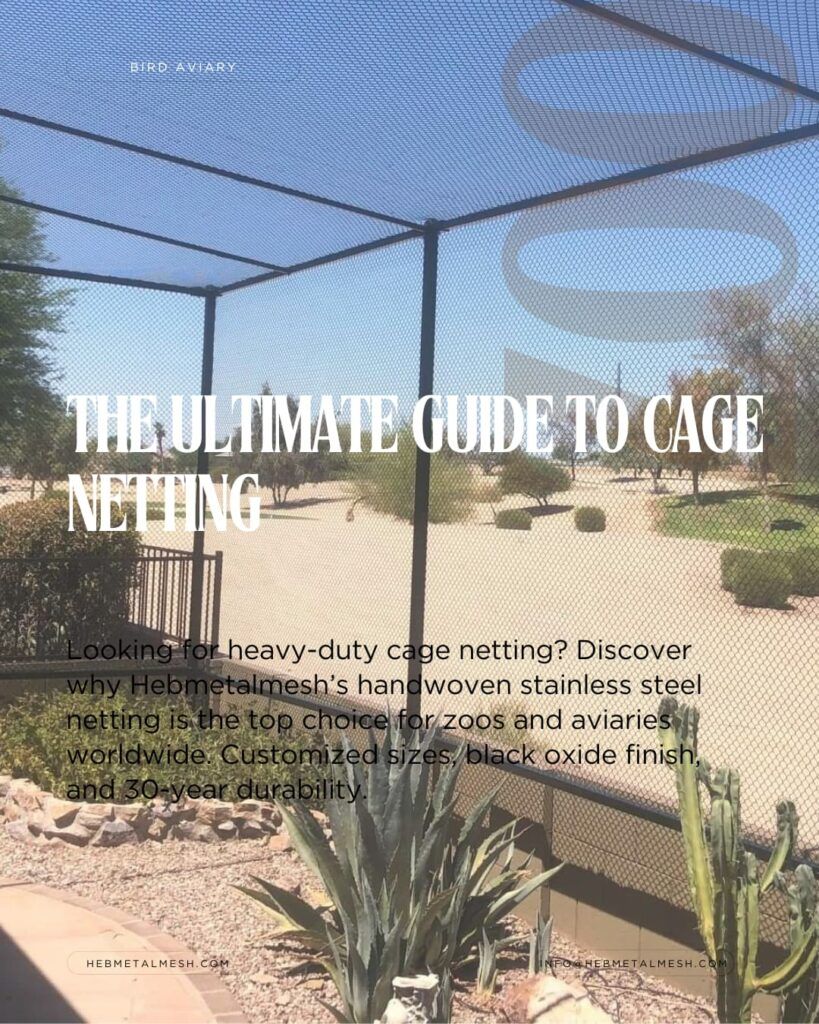
Energy that arrives has to go somewhere, and in an enclosure it goes into three places: the movement of the mesh, the tension in the border cable, and the frame. A panel whose breaking load far exceeds the arrival energy can still tear out at a fixing if the energy has nowhere to travel, which is why the attachment detail deserves as much attention as the wire. Cable diameter is usually chosen for fatigue at the swage ferrule rather than ultimate strength, because the ferrule is where repeated cycling concentrates stress. Where two alloys meet — a stainless panel on a galvanized post, for instance — galvanic corrosion will reduce both of them across the whole design life, and no load calculation compensates later.
The mechanics of the panel itself, and why a rope panel behaves differently from a welded one under exactly this kind of load, are set out in the energy absorbing mesh comparison.
Writing an Order Around the Load
An order written around a load looks different from one written around a product name. It names an alloy grade first, because the choice between 304 and 316 is a decision about the air and water on site, not about the bird. It states the mesh aperture next, because aperture is the number that decides whether a bird can push a wing through and whether a chick can pass a head, and it is also the number that fixes the open area and therefore how much wind and light the enclosure admits. It states panel size, border cable, installation tension and the test figures that matter.
That is the whole point of starting from the bird. Buyers who want to see how the combinations are applied across zoos, rehabilitation pens and breeding programs should read the applications material before they settle on a fixed specification; the reference specification itself is the eagle enclosure mesh product page, which carries the alloy, aperture and cable combinations as standard rather than as exceptions.
The Loads the Bird Does Not Apply
The largest loads on an eagle enclosure are usually not the bird’s. Snow sitting on a roof panel, wind loading a broad face, thermal movement in a long run of frame and the accumulated tension of a cable system all exceed anything an eagle produces, and they act continuously rather than once. The reason to calculate the bird first is not that it dominates the structure, but that it sets the aperture, surface finish and fixing detail — three decisions that are effectively irreversible once built. Get them right and the structure can be engineered around the weather afterwards.
Frequently Asked Questions
Strong enough that no single wire is ever asked to carry the whole arrival energy. In practice that means a panel whose breaking load has several times the margin you calculate, and a fixing and border cable that can pass that load into the frame.
Not by breaking it under normal use. What it can do is wear it: abrade strands at a fixing, flatten them under a favored landing point, and slowly work a panel loose if the tension was never set at installation. Zoo, rehabilitation and breeding eagle enclosure mesh applications follow the same pattern.
Large enough that a bird cannot wedge a wing tip or a talon in it under load, and small enough that nothing else on site can pass through. The aperture must be settled before the panel is ordered, because it cannot be changed later.
No. A stiff panel stops the bird in a very short distance, and the load rises in proportion. A flexible panel that moves under the arrival spreads the same energy over a longer distance, lowering the peak on the bird, the wire and the frame.
Longer than the frame it is fixed to, if the alloy suits the site and the fixings avoid dissimilar-metal contact. Service life in a coastal or heavily chlorinated environment is governed by corrosion, not by wear.
Have the species, the run length and the span? Send those three figures together with the local wind and snow case, and we will return the arrival energy, the recommended panel and the fixing schedule, with the alloy and aperture named rather than left open.