
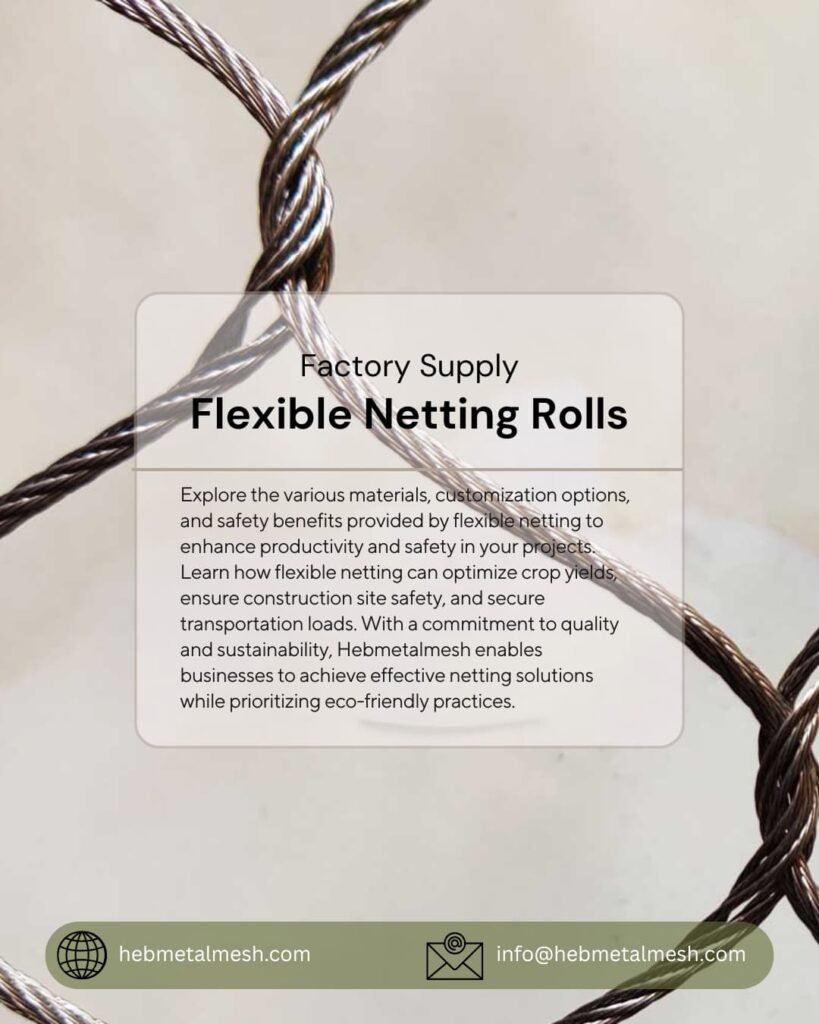
A netted enclosure made from stainless steel rope mesh represents the gold standard for animal containment in zoos, aviaries, and wildlife parks. Unlike traditional fencing, stainless steel cable mesh offers 90% transparency, virtually indestructible durability, and decades of maintenance-free service. Whether you’re designing a primate habitat, a walk-in aviary, or a large carnivore enclosure, stainless steel zoo mesh delivers the perfect balance of security, visibility, and animal welfare. With options ranging from 1.2mm to 3.2mm (3/64″ to 1/8″) rope diameters and apertures from 20mm to 100mm (3/4″ to 4″), these netted enclosures can be custom-fabricated to fit any shape or size—making them the preferred choice for zoological institutions worldwide. For a deeper dive into material selection, explore our comprehensive guide on choosing the right zoo animal mesh for your animal enclosures.
Key Takeaways
- Netted enclosures made from stainless steel rope mesh provide 90% transparency for unobstructed visitor viewing while maintaining maximum security
- Available in AISI 304 and 316 stainless steel grades with rope diameters from 1.2mm to 3.2mm (3/64″ to 1/8″) and apertures from 20mm to 100mm (3/4″ to 4″)
- Two primary construction types: knotted mesh (plain weave with double-fastened knots) and ferrule type mesh (rhombus pattern with alternating sleeves)
- Virtually maintenance-free with exceptional corrosion resistance—ideal for outdoor and coastal installations
- Custom-fabricated to project specifications with factory pre-cutting for precise on-site installation
- Suitable for all species—from small birds to large carnivores like lions and tigers
- Zoomeshfactory systems from Factory Systems offer black dye options for enhanced transparency and visual minimalism
🔍 Looking for the Perfect Netted Enclosure Solution?
Get expert guidance on stainless steel rope mesh for your zoo, aviary, or animal enclosure project.
Request a Free Consultation →What Is a Netted Enclosure?
Definition and Core Applications
A netted enclosure is a secure, transparent containment system constructed from woven stainless steel wire rope. Unlike solid walls or traditional chain-link fencing, a netted enclosure uses high-tensile stainless steel cables to create a flexible, nearly invisible barrier that safely contains animals while providing unobstructed viewing for visitors.
The primary applications for netted enclosures include:
- Zoo exhibits for primates, carnivores, and mixed-species habitats
- Bird aviaries ranging from small walk-in enclosures to massive free-flight domes
- Wildlife parks and safari-style containment areas
- Animal sanctuaries and rehabilitation centers
- Ecological parks and botanical garden exhibits
What sets a netted enclosure apart from traditional fencing is its unique combination of strength and transparency. The mesh consists of approximately 90% air and 10% steel, creating a barrier that animals cannot breach but visitors can see through clearly.
Why Stainless Steel Rope Mesh?
When selecting materials for a netted enclosure, stainless steel rope mesh stands head and shoulders above alternatives like galvanized wire, nylon netting, or welded mesh. Here’s why:
Superior Material Grades: Stainless steel rope mesh is manufactured from high-tensile AISI 304, 304L, 316, or 316L stainless steel. Marine-grade AISI 316 offers exceptional corrosion resistance, making it ideal for coastal installations or humid environments.
Multiple Construction Options: Rope meshes are available in 7×7, 7×19 constructions, with diameters ranging from 1.2mm to 3.2mm (3/4″ to 1/8″). This variety allows engineers to match the mesh specifications precisely to the species being contained.
Proven Performance: The material is virtually indestructible, impact-resistant, and capable of withstanding extreme weather conditions including rain, snow, and hurricanes.
For a complete breakdown of material options and how to avoid costly mistakes, read our expert guide on 5 start animal enclosure orders and review.
Key Benefits of Stainless Steel Netted Enclosures
Unmatched Strength and Durability
A netted enclosure constructed from stainless steel rope mesh offers unparalleled strength. The high-tensile cables withstand the weight and force of even the largest animals—including lions, tigers, and elephants. The mesh is impact-resistant and breaking-resistant, capable of safely containing any species on land or in the air, indoors or outdoors.
The durability of stainless steel means your netted enclosure will maintain its structural integrity for decades. Unlike materials that degrade under UV exposure or corrode in wet conditions, stainless steel remains strong and reliable year after year.
Transparency and Visitor Experience
Perhaps the most celebrated feature of a stainless steel netted enclosure is its remarkable transparency. Because the mesh is composed of roughly 90% air and 10% steel, visitors enjoy virtually unobstructed views of the animals.
This transparency serves multiple purposes:
- Educational value: Visitors can observe natural behaviors without visual barriers
- Aesthetic appeal: The delicate structure of the mesh enhances rather than detracts from the exhibit
- Safety: Clear sightlines allow staff to monitor animal health and behavior easily
For zoo enclosures, a black dye option is available to make the net even more difficult for the human eye to spot, further enhancing the viewing experience.
Corrosion Resistance and Low Maintenance
Stainless steel netted enclosures are engineered for longevity. AISI 316 and 316L marine-grade stainless steel offer exceptional resistance to rust, corrosion, and weathering.
Key maintenance advantages include:
- No rusting or discoloration even under UV exposure
- Minimal cleaning required—natural weathering maintains appearance
- No painting or sealing needed
- 100% recyclable at end of life
As one Australian wildlife park operator noted, even in hot, humid climates, stainless steel rope mesh has been “trouble-free – no maintenance dramas at all”.
Flexibility for Complex Topographies
Unlike rigid fencing systems, a stainless steel netted enclosure adapts to irregular border shapes and free-form designs. The mesh can be custom-cut in the factory for precise on-site installation, eliminating the need for on-site cutting and reducing installation time.
This flexibility makes netted enclosures ideal for:
- Enclosures with irregular border topographies
- Free-form architectural designs
- Exhibits that integrate with natural landscapes
- Retrofitting existing structures
Types of Stainless Steel Rope Mesh for Netted Enclosures
Knotted Mesh
Knotted mesh features a plain weave construction where each warp wire rope crosses alternately above and below each weft wire rope. This creates a secure, double-fastened knot structure that provides enhanced security.
Best suited for:
- Smaller mammals
- Primates
- Large birds
- Applications requiring maximum security
Ferrule Type Mesh
Ferrule type mesh (also called rhombus mesh) features wires connected by alternating sleeves (ferrules) to produce a symmetrical bent pattern. This construction offers excellent flexibility and is virtually indestructible.
Best suited for:
- High-tension applications
- Large animal enclosures
- Projects requiring maximum flexibility
- Complex geometric shapes
ZooMesh Stainless Steel Rope Mesh System
ZooMesh is a professional stainless steel rope mesh brand specializing in high‑quality SS304 hand‑woven rope mesh for large‑scale enclosure projects. Unlike standard industrial welded or machine‑woven mesh, ZooMesh products are crafted by hand, which gives the mesh superior flexibility and better adaptability to irregular border shapes — a critical advantage for complex zoo and aviary designs.
For zoos, aviaries, and wildlife sanctuaries, enclosure mesh must balance tensile strength, visual transparency, and long‑term weather resistance. ZooMesh’s SS304 rope mesh system is engineered to meet all three demands. It withstands the impact and climbing forces of large animals while maintaining the corrosion resistance that stainless steel is known for — ensuring decades of maintenance‑free service in outdoor environments.
Key Features of ZooMesh Rope Mesh Systems:
Why Choose ZooMesh?
Unlike rigid industrial mesh panels, ZooMesh’s hand‑woven rope mesh conforms naturally to curved or irregular support structures, reducing the need for on‑site cutting and minimizing material waste. The SS304 grade ensures reliable performance under sun exposure, rain, and animal activity — without rust, peeling, or degradation.
For zoo and wildlife park projects that demand factory‑direct cost efficiency, customizable dimensions, and high‑strength yet flexible mesh, ZooMesh delivers a professional solution that balances performance, durability, and budget.
How to Choose the Right Netted Enclosure for Your Application
Selecting the right mesh for zoo animals requires a precise balance between animal safety, enclosure aesthetics, and long-term durability. The following sections break down every decision point to help you specify an animal enclosure that performs flawlessly for three decades or more. For a comprehensive procurement framework, visit our guide on mesh for zoo animals — the ideal solution for zoo animal enclosures.
Species-Specific Considerations
Selecting the right netted enclosure requires careful consideration of the species being housed:
Mesh Size and Aperture Selection
The aperture (mesh opening) size is critical to the success of your netted enclosure. Common aperture sizes range from 20mm to 200mm.
General guidelines:
- Smaller apertures (20–50mm): For small birds, rodents, and small primates
- Medium apertures (50mm): For medium mammals, large birds, and primates
- Larger apertures (50 -100mm): For large herbivores and exhibits where visibility is paramount
Important note: Not all diameter/aperture combinations are possible. For example, a 3mm rope requires a minimum aperture of approximately 50mm.
Environmental Factors
The environment where your netted enclosure will be installed significantly influences material selection:
- Coastal or marine environments: Specify AISI 316/316L for maximum corrosion resistance—the molybdenum content dramatically improves resistance to pitting and crevice corrosion
- High humidity or tropical climates: AISI 316 recommended
- Standard outdoor conditions: AISI 304 is typically sufficient
- Snow and wind loads: Engineer support structures for local conditions
- UV exposure: Stainless steel is naturally UV-resistant
Factory Insight: For any climate with high salinity or high humidity, 316 stainless steel is an essential insurance policy to guarantee a 30+ year lifespan and avoid the massive labor costs associated with replacing rusted mesh.
Installation Best Practices for Netted Enclosures
Pre-Installation Planning
Proper planning ensures a successful netted enclosure installation:
- Digital workflow: Measure and plan using 3D modeling
- Form-finding: Determine the optimal mesh configuration
- Workshop drawings: Generate precise 2D patterns from 3D models
- Factory pre-cutting: Mesh is custom-cut to exact specifications
Support Structure Requirements
A netted enclosure requires a robust support structure:
- Cable systems: Primary tensioning cables around the perimeter
- Pylons and anchoring points: Structural supports for the mesh
- Hinged connections: Prevent constraints under variable loads
- Perimeter cables and tie-back systems: Secure the mesh edges
On-Site Installation
Installation of a netted enclosure is straightforward when properly planned:
Method 1: Wire rope connection — Use stainless steel wire rope to connect the mesh panel to the frame
Method 2: Direct connection — Place the edge of the mesh directly on the cable or bracket
Between panels:
- Wire rope crossover: Connect two panels using wire rope
- Metal ring (ferrule) connection: Wrap a metal ring around the steel wire rope at the junction and compact it
Factory pre-cut panels eliminate on-site cutting, reducing installation time and ensuring a perfect fit.
Case Studies — Netted Enclosures in Action
Chester Zoo’s Island Zone
Chester Zoo’s Island Zone consists of six islands recreating the different habitats of the South East Asian archipelago. The project utilized multiple Webnet apertures (20mm, 40mm, and 80mm) to accommodate different species, with each panel purpose-cut in the factory for each specific enclosure design.
Temaiken Zoo — Argentina
At Temaiken Zoo, a Webnet structure is supported by 12-meter high steel arc supports, forming an enclosure that is both transparent and unobtrusive. The installation demonstrates how netted enclosures can create immersive, visually stunning exhibits.
Squirrel Monkey Enclosure — Knie Children’s Zoo
The squirrel monkey enclosure at Knie Children’s Zoo features Webnet with sleeves using 1.5mm rope with a 40mm mesh size, covering a total net area of 700 square meters. This project exemplifies how netted enclosures can be tailored to specific species requirements.
For more real-world applications and expert insights on redefining outdoor zoo enclosures, explore our dedicated case study collection.
Maintenance and Longevity
Routine Inspection
While stainless steel netted enclosures require minimal maintenance, routine inspections are recommended:
- Check for loose connections or fittings
- Inspect perimeter cables and anchoring points
- Monitor for any animal-induced wear
- Verify tension remains consistent
Cleaning and Care
Stainless steel mesh requires very little maintenance:
- Natural weathering maintains appearance
- No painting, sealing, or rust-proofing needed
- Occasional rinsing with water if desired
- Optional powder coating or spectral coloring for aesthetic preferences
Expected Lifespan
A properly installed stainless steel netted enclosure offers virtually unlimited lifespan:
- 100% recyclable at end of life
- No degradation from UV exposure
- No corrosion with proper material selection
- Decades of service with minimal maintenance
Frequently Asked Questions (FAQ)
What is the best mesh size for a bird aviary?
The optimal mesh size depends on the bird species. For small birds and parrots, a 3/4″ (approximately 19mm) aperture is ideal. For larger birds, apertures of 30mm to 50mm may be suitable. Always consult with the mesh manufacturer to match aperture size to the specific species being housed.
How much does a stainless steel netted enclosure cost?
Costs vary significantly based on project size, mesh specifications, rope diameter, and installation complexity. Stainless steel rope mesh typically ranges from $10–$25 per square meter for standard specifications, with custom designs and larger diameters commanding higher prices. Knotted mesh prices range from approximately $32–$48 per square meter depending on specifications. For accurate estimates, request a quote from suppliers with your specific requirements.
How long does stainless steel zoo mesh last outdoors?
Stainless steel mesh, particularly marine-grade AISI 316, offers virtually unlimited lifespan when properly installed. It resists corrosion, UV degradation, and weathering. Projects like the Perth Zoo Wetlands enclosure have survived extreme weather events including 1-in-100-year storms.
Can stainless steel rope mesh be customized for irregular shapes?
Yes. Advanced digital workflows allow precise measurement, planning, and form-finding to create mesh panels that fit complex topographies. Factory pre-cutting eliminates on-site adjustments. This is particularly valuable for enclosures with irregular border topographies or free-form designs.
What is the difference between knotted and ferrule type zoo mesh?
Knotted mesh uses a plain weave where each warp wire rope crosses alternately above and below each weft wire rope. It features double-fastened knots for enhanced security. Ferrule type mesh creates a rhombus pattern with wires connected by alternating sleeves (ferrules). Ferrule mesh offers excellent flexibility and is virtually indestructible, making it suitable for high-tension applications and large animal enclosures.
📋 Ready to Plan Your Netted Enclosure Project?
From species-specific mesh selection to custom fabrication and installation, our team of experts can guide you through every step of the process.
This guide was prepared for professionals in zoological design, wildlife park management, and architectural planning. For specific project requirements, consult with a certified stainless steel mesh supplier.
⭐ What Our Clients Say About Their Netted Enclosures
Real feedback from zoo operators, aviary managers, and wildlife park professionals
Across zoo, aviary, and wildlife park projects
“ We installed the stainless steel netted enclosure for our new tiger exhibit. The 90% transparency completely transformed the visitor experience. Installation was smooth — the factory pre-cut panels saved us weeks of on-site labor. Three years in, zero maintenance issues. “
“ Our free-flight aviary required a bird aviary netting that was both secure and nearly invisible. The hand-woven SS304 mesh with 25mm aperture gave us exactly that. After five years of coastal weather, it still looks brand new. Our parrots have never escaped — not once. “
“ We needed a zoo mesh solution for our mixed-species primate enclosure that could handle both climbing and impact. The team customized the aperture and rope diameter to our specs. The flexibility of the hand-woven mesh allowed us to wrap around existing trees — keeping the natural habitat intact. “
📋 Join 89+ satisfied clients — get your custom netted enclosure solution today
Request a Free Quote →