
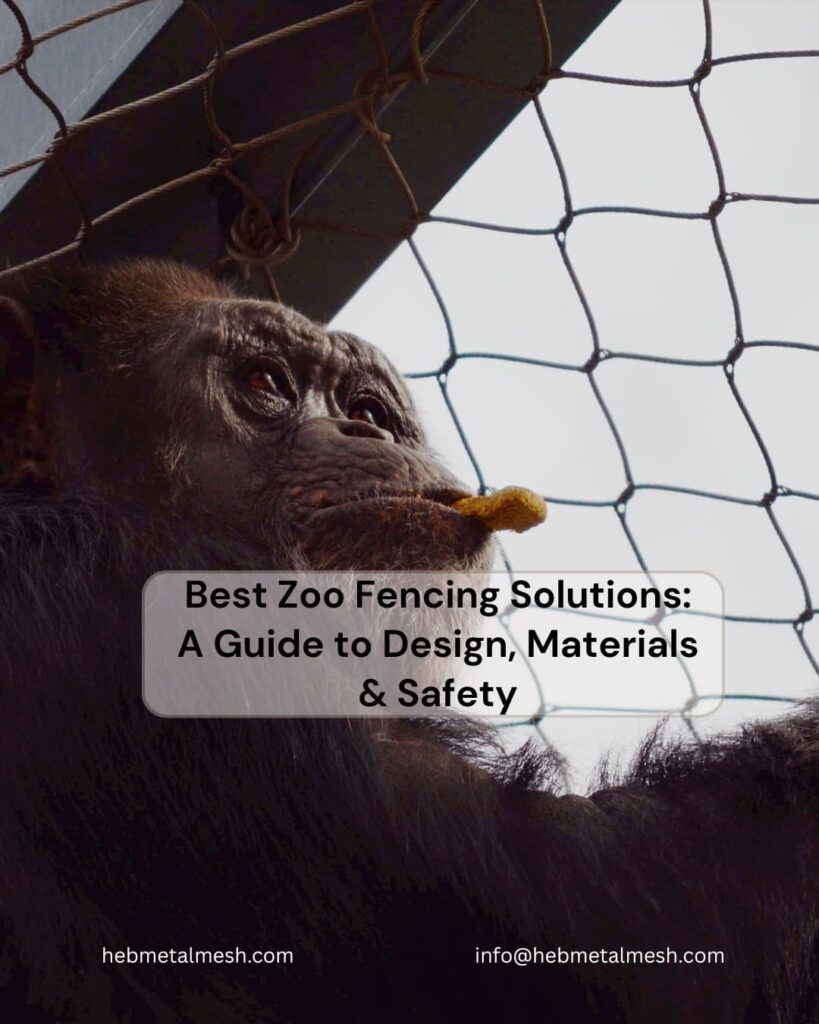
Executive Summary: This guide helps zoo procurement professionals, enclosure designers, and curators select the right stainless steel cable mesh fencing by explaining grade selection (304 vs. 316), wire rope construction (7×7 vs. 7×19), aperture sizing, tensioning protocols, and safety finishing. Learn how to avoid costly mistakes and ensure AZA compliance with factory-first technical insights.
Introduction: Why Zoo Enclosure Fencing Demands Technical Expertise
Selecting zoo enclosure fencing is not a standard fencing purchase. It is a critical safety decision that affects animal welfare, visitor protection, operational costs, and accreditation status. Unlike agricultural or residential fencing, zoo enclosures must withstand constant animal impact, resist decades of environmental exposure, and meet stringent safety standards—all while maintaining clear visibility for visitors.
The stakes are high. Improperly specified fencing can lead to animal escape, injury, corrosion-related failure, or failed accreditation inspections. According to industry data, 316-grade stainless steel demonstrates a 5–10x longer lifespan than 304-grade when subjected to accelerated saline conditions. Choosing the wrong grade can mean premature replacement costing hundreds of thousands of dollars.
This guide draws on factory-floor experience from a professional China stainless steel zoo mesh factory with over 20 years of export experience. We have supplied zoo mesh to facilities across North America, Europe, Australia, and Asia. Here is what we have learned about what actually works—and what does not.
🔍 Need Expert Guidance on Your Zoo Enclosure Project?
Get factory-direct technical support and custom solutions tailored to your species, climate, and accreditation requirements.
Request a Quote →Understanding the Core Demands of Zoo Enclosure Environments
Animal Welfare and Behavioral Considerations
Different species impose radically different demands on enclosure fencing. Primates require careful aperture sizing to prevent finger trapping—apertures that are too large allow digits to protrude and become caught. Large carnivores (lions, tigers, bears) generate immense impact forces that demand high tensile strength and fatigue resistance. Birds in aviaries need mesh that prevents wing entanglement and beak damage while remaining virtually invisible.
The mesh aperture size must be matched to the smallest animal in the enclosure. Standard apertures range from 30mm × 30mm for small primates and birds up to 102mm × 102mm (4″ × 4″) for elephants and large ungulates. For giraffe enclosures, vertical post spacing greater than 2 inches has proven deadly, as giraffes may slide their jaw or neck between posts and become entrapped.
Public Safety and Visitor Experience
Zoo fencing must simultaneously contain animals and protect visitors. Anti-climb design is essential for both sides of the barrier. The fencing must also provide unobstructed viewing—one of the primary reasons stainless steel cable mesh has become the industry standard. Its diamond pattern offers exceptional transparency while maintaining structural integrity.
Glare reduction is another critical factor. Bright, reflective stainless steel can ruin visitor photography and cause eye strain on sunny days. Black oxide coating addresses this by absorbing sunlight and providing a non-reflective surface that blends naturally with surroundings.
Environmental Durability Challenges
Zoo enclosures are outdoor structures exposed to weather year-round. Coastal zoos face constant salt spray that rapidly degrades lower-grade materials. Inland zoos contend with temperature extremes, UV exposure, and humidity. Thermal expansion causes cable tension to fluctuate significantly between summer and winter—a factor that must be accounted for during installation.
According to ISO 9223 atmospheric corrosivity mapping, environments are classified from C1 (very low corrosion) to C5 (very high, marine exposure). 304-grade stainless steel suffices for C1–C3 environments, while 316-grade is mandatory for C4–C5 coastal and marine locations.
Material Science: What Separates Professional Zoo Mesh from Commodity Fencing
Stainless Steel Grades: 304 vs. 316 — Making the Right Choice
The single most important decision in zoo enclosure fencing procurement is selecting the correct stainless steel grade.
| Property | 304 Stainless Steel | 316 Stainless Steel |
|---|---|---|
| Composition | 18% Chromium, 8% Nickel | 16% Chromium, 10% Nickel, 2% Molybdenum |
| Corrosion Resistance | Good for most environments | Excellent Best especially in marine/chemical environments |
| Cost | More economical | Higher priced Premium |
| Best For | Most outdoor applications, inland zoos, aviaries | Coastal areas, chemical exposure, high-humidity regions, ocean parks Recommended |
304-grade is the industry standard for inland, dry, or temperate climates. It provides excellent structural strength and aesthetics at a cost-effective price point. For most inland zoos, 304-grade offers reliable performance with proper maintenance.
316-grade is enhanced with molybdenum, offering superior resistance to chloride-induced pitting and crevice corrosion. It is the mandatory choice for coastal facilities, ocean parks, and any enclosure exposed to saltwater or harsh chemicals. Our factory testing using ASTM B117 salt spray testing consistently demonstrates that 316-grade stainless steel lasts 5–10x longer than 304-grade under saline conditions.
Wire Rope Construction: 7×7 vs. 7×19 — The Critical Difference
Most competitors stop at mentioning “stainless steel.” Professional buyers need to understand wire rope construction.
7×7 Construction: Seven strands of seven wires each. This lighter-duty construction is suitable for non-load-bearing applications such as decorative nets, interior barriers, and smaller animal enclosures.
7×19 Construction: Nineteen strands of seven wires each. This is the only professional choice for high-impact predator zones. Why? 7×19 offers:
- Superior tensile strength (breaking forces up to 7,800N for 1/8″ cable)
- Exceptional fatigue resistance—the ability to absorb repeated kinetic energy without snapping
- Greater flexibility for installation on complex geometries
- Better resistance to wire breakage from animal impact
For large carnivore enclosures—tigers, lions, bears, and leopards—7×19 construction is non-negotiable.
Hand-Woven vs. Ferrule Zoo Mesh
Hand-woven stainless steel netting is manufactured by skilled workers using CAD-printed moulds to precisely control mesh hole size. Each intersection is hand-tied, creating a uniform, resilient, and highly transparent material.
Ferrule (mechanical swaging) mesh uses pressed metal sleeves to join cable intersections. While faster to produce, ferrule connections can create stress points and potential failure zones under repeated impact.
The hand-woven process offers unmatched customization—wire diameters from 1.2mm to 3.2mm, aperture sizes from 30mm to 300mm, and virtually any panel dimension. This flexibility is essential for zoo projects with unique architectural requirements.
On-Site Installation: Tensioning, Hardware, and Terrain Adaptation
Pre-Stretching and Tensioning Protocols
Proper tensioning is where many zoo enclosure projects fail. Mesh that is too loose sags, allowing animal entanglement or escape. Mesh that is too tight places excessive stress on support structures and can fail under thermal expansion.
Professional installation requires:
- Load cells for precise tension measurement
- Turnbuckle torque specifications matched to cable diameter
- Thermal expansion compensation—cables contract in winter and expand in summer. Tension must be calculated for the expected temperature range over the enclosure’s 30-year lifespan
Turnbuckles allow fine adjustment of cable tension. Simply rotate the turnbuckle to increase or decrease tension. However, achieving correct tension requires experience and the right tools—this is not a DIY project.
Hardware Selection for Cable Mesh Systems
The right hardware is as important as the mesh itself. Key components include:
- Turnbuckles (OC-style or CC-style) for tension adjustment
- Eye hooks and connection plates for anchoring to support structures
- Crimping sleeves for terminating cable ends
- Corrosion-resistant fasteners—never mix metals, as galvanic corrosion will occur
All hardware should match the mesh grade (304 or 316) to ensure uniform corrosion resistance.
Adapting to Challenging Terrain
Zoo enclosures rarely sit on perfectly flat ground. Uneven terrain requires mesh that can flex and conform to slopes, curves, and irregular shapes. Hand-woven stainless steel mesh excels here due to its inherent flexibility.
Burrowing prevention is essential for species that dig. The USDA recommends burying steel mesh or fencing below grade to prevent underground escape routes. Mesh aprons extending outward from the fence line (typically 12–24 inches) deter burrowing animals from digging under the barrier.
Safety Finishing: The Overlooked Factor That Separates Leaders from Followers
Edge-Conditioning and Deburring
Here is a factory-floor reality most competitors ignore: improper cutting leaves microscopic jagged edges on stainless steel mesh. These tiny burrs can cause serious injuries to animal paws, bird wings, and even keeper hands.
Professional factories perform electro-polishing—an electrochemical bath that dissolves surface peaks, creating a chemically clean, mirror-like finish that is microscopically smooth. Unlike mechanical polishing, which leaves directional grooves and microscopic crevices, electro-polishing produces a burr-free, snag-free surface.
For sensitive species—birds, primates, and small mammals—this safety-first fabrication process is critical. It prevents fur and feather trapping and eliminates injury risks from sharp edges.
Black Oxide Anti-Glare Finish
Black oxide is a chemical conversion coating applied to stainless steel. It creates a thin layer of black iron oxide on the surface. This finish offers multiple benefits for zoo enclosures:
| Benefit | Impact |
|---|---|
| Glare reduction | Eliminates sunlight reflection for better visitor photography |
| Natural appearance | Blends with surroundings, less intrusive for animals |
| Enhanced durability | Adds corrosion protection; lasts 30+ years outdoors |
| Reduced animal stress | Non-reflective surface less likely to stress birds and sensitive species |
| Hides dirt and wear | Maintains appearance longer than bright stainless steel |
Black oxide does not significantly wear off under normal conditions. However, high-traffic areas or abrasive cleaning methods may accelerate wear over decades of use.
Anti-Climb and Anti-Trapping Design Features
Beyond materials, design determines safety. Critical considerations include:
- Aperture sizing that prevents finger or limb trapping
- Smooth surfaces that offer no footholds for climbing
- No protruding hardware that could snag clothing or skin
- Buried mesh to prevent digging escape
Compliance and Accreditation: Meeting AZA and USDA Standards
AZA Enclosure Requirements
AZA (Association of Zoos and Aquariums) accreditation is the gold standard for North American zoos. While specific requirements vary by species, accredited facilities must demonstrate:
- Barrier strength testing for each species housed
- Anti-climb and anti-trapping design throughout the enclosure
- Appropriate aperture sizes for the smallest animal in the exhibit
- Corrosion-resistant materials suitable for the local climate
- Documentation of regular inspections and maintenance
USDA Standards for Animal Barriers
The USDA Animal and Plant Health Inspection Service (APHIS) enforces the Animal Welfare Act. Key fencing requirements include:
- Containment that prevents escape of all species housed
- Smooth, unclimbable wall surfaces
- Underground barriers to prevent burrowing escape
- Regular inspection and maintenance documentation
Impact Absorption and Structural Integrity Certification
For large carnivore enclosures, impact absorption is critical. 7×19 wire rope construction provides superior kinetic energy absorption compared to rigid fencing materials. Tensile strength certification (typically 1570–1870 MPa) should be provided by the manufacturer.
Procurement Strategy: What Buyers Need to Know
Custom Fabrication Lead Times
Zoo mesh is not a stock item. Each project requires custom panel sizes, aperture specifications, and grade selection. Lead times typically range from 4–12 weeks depending on project scale and complexity. In China, only 4–5 factories have regular production capacity for hand-woven stainless steel mesh.
Plan ahead. Factor fabrication time into your project timeline to avoid delays.
Cost Comparison: Stainless Steel Mesh vs. Chain Link
| Factor | Stainless Steel Cable Mesh | Chain Link Fencing |
|---|---|---|
| Initial Cost | Higher Premium | Lower |
| Lifespan | ✔ 25–30+ years | 10–15 years |
| Maintenance | ✔ Minimal | Regular (rust, replacement) |
| Visibility | ✔ Excellent | Obstructed |
| Aesthetics | ✔ Premium | Industrial |
| Safety | ✔ Superior (no sharp edges) | Moderate |
While stainless steel cable mesh has higher upfront costs, the total cost of ownership is significantly lower over a 30-year horizon. Fewer replacements, less maintenance, and better safety justify the investment.
Cleaning and Maintenance Best Practices
To maximize lifespan:
- Use mild detergents and soft brushes for cleaning
- Avoid chlorine-based cleaners that can attack stainless steel
- Inspect annually for cable breaks, loose connections, or corrosion
- Retension as needed—thermal cycling can loosen cables over time
- Document all inspections for accreditation purposes
Conclusion: Building Enclosures That Protect, Respect, and Endure
Zoo enclosure fencing is not a commodity—it is a engineered safety system that must perform flawlessly for decades. The difference between a 304-grade, 7×7 construction mesh and a 316-grade, 7×19 construction mesh is not just specification numbers. It is the difference between a 10-year lifespan and a 30-year lifespan. Between animal injury and animal safety. Between failed accreditation and successful inspection.
From a professional China stainless steel zoo mesh factory with 20+ years of export experience: We have seen too many facilities choose based on price alone, only to face premature corrosion, cable failure, or injury incidents. The right material, correctly specified and properly installed, is an investment in safety, compliance, and peace of mind.
Key Takeaways
- Grade matters: 304 for inland; 316 mandatory for coastal or marine environments
- Construction matters: 7×19 for large carnivores and high-impact zones
- Aperture matters: Match size to the smallest animal in the enclosure
- Finishing matters: Electro-polishing eliminates injury-causing burrs
- Tensioning matters: Professional installation with load cells and thermal compensation
- Black oxide matters: Reduces glare, improves aesthetics, extends durability
- Plan ahead: Custom fabrication requires 4–12 weeks lead time
🏗️ Ready to Specify Your Zoo Enclosure Fencing?
Get factory-direct pricing, technical drawings, and expert guidance from a team with 20+ years of zoo mesh experience. We serve zoos, wildlife parks, and conservation facilities worldwide.
Browse Products → Contact an Expert →Frequently Asked Questions
With proper material selection (316-grade for coastal environments) and correct installation, stainless steel zoo mesh typically lasts 25–30 years or more. Factors such as climate, maintenance frequency, and animal impact levels affect longevity. Regular inspection and cleaning with appropriate agents significantly extend service life. Facilities that choose 304-grade in coastal environments may see premature corrosion within 5–10 years.
The optimal mesh size depends on the smallest bird species in the enclosure. Aperture sizes typically range from 12.7mm × 12.7mm (½″ × ½″) for small birds and parrots up to 40mm × 40mm for larger birds. The mesh must prevent escape while allowing natural behavior and clear viewing. For mixed-species exhibits, consult with the mesh manufacturer to determine the appropriate size that balances visibility, safety, and structural integrity. Wire diameter also matters—thicker cables (2.4–3.2mm) resist beak damage.
Black oxide coatings are durable and typically last 30+ years in outdoor environments. The coating is a chemical conversion layer, not a surface paint, so it bonds with the stainless steel. However, wear can occur over decades in high-traffic areas or with abrasive cleaning methods. High-quality black oxide applied through controlled industrial processes offers the best longevity. Regular inspection helps identify areas requiring attention, though significant wear is uncommon within the first 20 years of service.
While technically possible, professional installation is strongly recommended for zoo applications. Proper tensioning requires specialized equipment like load cells and torque wrenches, and incorrect tension can compromise safety and shorten mesh lifespan. Thermal expansion compensation and terrain adaptation also demand expert knowledge. For non-critical applications, DIY may be feasible, but zoo enclosures should always be installed by certified professionals to ensure safety, compliance, and warranty validity.
AZA (Association of Zoos and Aquariums) accreditation requires enclosures to meet specific standards for animal welfare, public safety, and structural integrity. Key requirements include: barrier strength testing for each species housed, anti-climb and anti-trapping design features, appropriate aperture sizes for the smallest animal in the exhibit, corrosion-resistant materials suitable for the local environment, and documentation of regular inspections and maintenance. Accredited facilities must also demonstrate that fencing materials have undergone tensile strength certification and impact absorption testing. Specific requirements vary by species—consult AZA’s Species Survival Plan (SSP) guidelines for detailed specifications.