
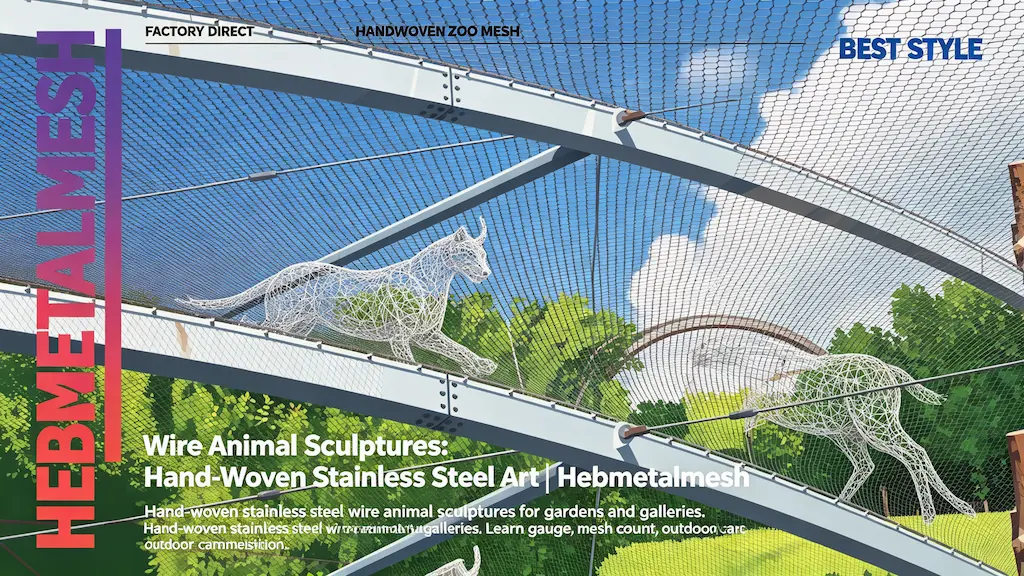
A wire animal sculpture is not carved and it is not cast. It is drawn. The maker bends, twists and interlaces stainless steel wire until the line itself becomes an animal — a stag caught mid-step, an owl with a ruff of open loops, a hare held between two strides. Wire animal sculptures hold their power because they leave most of the animal out. The eye supplies the missing volume, and the air inside the frame does half the work.
Executive Summary
Wire animal sculptures are hand-woven stainless steel forms built from wire between roughly 1.2 mm and 3.2 mm in diameter, woven at a mesh count that leaves apertures from about 20 mm to 102 mm. Stainless steel is the material of choice because 304 and 316 grades hold a clean metallic line for decades, while galvanised wire sheds its zinc at the weave point and copper drifts into verdigris. Price tracks size, wire gauge and weave density rather than weight alone. This guide covers the craft behind the work, the metal that survives weather, how to care for an outdoor piece, and how to brief a supplier before you commission. The reference specification is the core product page product page.
Specifying a woven figure or a decorative panel? Send the outline, the display site and the finish you want. We will confirm wire gauge, mesh count and lead time against your drawing.
Quick Answer:
Wire animal sculptures are made by hand-weaving stainless steel wire — usually 1.2 mm to 3.2 mm — into an open three-dimensional frame, then shaping and tensioning that woven skin until the animal reads clearly from every viewing angle. Choose 316 stainless for coastal or salt-exposed sites and 304 for inland work, keep the wire at or under 1.6 mm for small figures and 2.4 mm to 3.2 mm for life size pieces, and set the mesh count loose enough that the animal’s line is never buried in wire.
Key Takeaways
- Wire gauge sets the read. Under 1.6 mm the figure behaves like a sketch; 2.4 mm and above gives a life size wire animal sculpture the mass to stand up to wind and touch.
- Stainless beats cheaper metals outdoors. Galvanised steel loses zinc at the weave point, copper develops verdigris, and only stainless holds genuine tarnish resistance across decades of weather.
- Mesh count is a design decision, not a spec sheet number. Fewer wires per 100 mm means more air and a bolder silhouette; a tighter weave buys detail on a small piece such as a wire owl sculpture.
- Outdoor pieces need three things: a wind sway allowance in the mounting, a fixed anchor stake or base plate, and a routine for dust accumulation inside the weave.
- Commission on drawings, not adjectives. Send a scale outline, the display location and the finish you want, and any wire animal sculpture supplier can quote accurately instead of guessing.
Wildlife art has always borrowed its subjects from the field, and the conservation bodies that study those animals publish the reference material that makers and buyers both rely on — WWF maintains species and habitat data that is worth reading before you settle on a subject.
What Separates a Wire Animal Sculpture from a Bent Wire Shape
The gap between a tangle of wire and a finished piece is almost entirely a question of wire animal sculpture design. Three rules separate the two.
Read the piece from the three angles that matter. A figure is normally approached from the front, seen in profile as a visitor walks past, and viewed from above when it sits in a garden bed. A wire animal statue that only resolves from one of those positions will look like scrap from the other two. The maker checks the outline at eye level, at ten degrees off-axis, and from directly overhead before adding detail.
Buy the silhouette first, the detail last. Every strong piece starts as a single continuous outline — the back line, the head, the neck, the legs — drawn flat. Experience lets a wire animal sculpture artist tell within minutes whether that flat outline will survive being made three-dimensional. Detail work such as ears, feathers and whiskers is added only after the big shape holds.
Solve standing before you solve beauty. A four-legged figure that carries weight in the wrong place will creep and lean within a season. Load has to travel down the legs and into a base that spreads it, and the feet have to sit slightly wider than the body above them.
Why Stainless Steel Wins: Comparing Wire Metals
Metal choice decides where a piece can live. The table below sets out what the common wire metals do in real conditions.
| Wire metal | Indoor life | Outdoor life | What actually happens |
| 316 stainless | 30+ years | 25+ years, coastal | Surface stays passive; electropolishing removes the last free iron |
| 304 stainless | 30+ years | 15–25 years, inland | Light dulling only; no structural loss, no red rust |
| Galvanised steel | 10–15 years | 3–8 years | Zinc sheds first at the weave point, then rust follows |
| Copper or brass | 20+ years | 20+ years | Verdigris film develops and the colour turns green |
| Aluminium | 20+ years | 10+ years | Soft; dents at contact points and dulls to flat grey |
Two comparison guides go deeper on the grades. The 304 vs 316 mesh breakdown explains why coastal work needs the molybdenum in 316, and this galvanised vs stainless comparison shows what the zinc coating does at a contact point. Both matter for pieces that will stand outside for a decade.
Gauge, Mesh Count and the Weaving Process
A woven figure is a mesh panel that has been shaped. The material we weave for enclosures — hand-woven rope mesh in grades from HM1220 at 1.2 mm and 20 mm aperture up to HM32102 at 3.2 mm and 102 mm — uses exactly the construction a sculptor needs, with 7×7 strand wire rope and a breaking load near 7 kN at 3.2 mm and about 4.4 kN at 2.4 mm. Panels run to 9 m by 18 m, which is why monumental work is usually planned as a small number of large pieces rather than many small ones.
| Figure scale | Wire diameter | Typical aperture | Panel weight |
| Small, ~40 cm | 1.2–1.6 mm | 20–25 mm | ≈1.2 kg/m² |
| Medium, ~1 m | 1.6–2.0 mm | 25–38 mm | ≈1.5 kg/m² |
| Life size, ~2 m | 2.4–3.2 mm | 38–76 mm | ≈2.0 kg/m² |
| Monumental | 3.2 mm | 76–102 mm | ≈2.0 kg/m² |
The mesh count is simply how many wires cross a fixed distance, and it controls two things at once: how much light passes through the piece, and how much detail the weave can carry. A tight count on a large figure makes the animal disappear behind its own texture; a loose count on a small figure lets the eye fall straight through the shape. Most pieces find their answer between 25 mm and 51 mm.
Where rope mesh is used as the skin of a welded framework, the joints are fixed by spot welding before the skin is tensioned, and the finished surface is then electropolishing to strip the free iron left by handling and heat. That last step is not cosmetic. It is what keeps a wirework sculpture bright rather than freckled after its first wet winter.
Wire Animal Sculpture Outdoor and Indoor Display: Care and Weathering
The same figure needs a different brief depending on where it stands, and the difference is mostly mechanical rather than aesthetic.
Outdoors. Wind sway is the main long-term load on a wire animal sculpture outdoor piece, and it fatigues wire at the fixed points rather than in the middle of a span. Mounting should allow movement while preventing vibration, which is why a concealed anchor stake into a concrete pad, or a stainless base plate bolted down, works better than a figure simply set on the ground.
Indoors. A wire animal sculpture indoor setting removes the weather problem and introduces a different one: handling. People touch indoor work. Wire under 1.6 mm deflects under a firm grip and may not spring back cleanly, so interior pieces either use slightly heavier wire or accept a softness in the line that the maker plans for from the start.
Wire animal sculpture care in practice comes down to three habits. Rinse outdoor pieces twice a year with fresh water — salts are the real enemy, not rain. Clear dust accumulation from the interior of the weave with a soft brush and low-pressure air, because trapped dust holds moisture against the wire. And inspect the fixed points annually, since the first sign of trouble is always a loose contact rather than a broken strand. Stainless needs no wax, no oil and no paint.
Commissioning: Price, Lead Time and Briefing a Supplier
A wire animal sculpture price is driven by three variables, in this order: overall size, wire gauge, and how much hand shaping the pose requires. As a planning range, the woven stainless material itself runs roughly $10–22 per square metre for light aviary-grade mesh and $20–38 per square metre for heavy carnivore-grade material, which is fabricated in 2–4 weeks, followed by 2–6 weeks of transit for export orders. A bespoke pose adds shaping time on top of that.
To brief a wire animal sculpture supplier well, send four things: a scale outline of the animal from the side, the intended display position, the finish you want, and the local climate. That is enough to quote. Makers can also work from an existing wire animal sculpture commission — a favourite breed, a pet, a species with local meaning — and the same workshop output covers a wire animal sculpture gift as easily as a public installation, since both are the same material, gauge and weave. The woven mesh application guide shows the full range of finished forms the material is used for, and the material comparison against plastic explains why a woven figure will still read as a figure after ten years outdoors when a plastic version will not. For the underlying specification, refer to the animal fence mesh range.
Types and Symbolism: Wire Animal Figures, Owls and Statues
Most work falls into a handful of recognisable types. Bird forms — and the wire owl sculpture above all — are the most accommodating subject, because the rounded head and folded wing give the maker a natural place to use a single loop. Standing mammals such as deer, horses and hares sell as a wire animal statue because they read at a distance and suit a garden path or a wire animal sculpture garden bed. Small companion pieces, dogs and cats at 40–60 cm, are the most common domestic order.
Wire animal figures carry meaning that buyers notice. A hare reads as speed, a stag as endurance, an owl as watchfulness, and a wolf or eagle as something wilder. That symbolic layer is what turns a wirework sculpture from a decoration into an object someone keeps, and it is the reason the hand-woven technique behind these figures is still made the way it always was: by hand, one crossing at a time.
FAQ
Stainless steel wire, almost always 304 or 316, at 1.2–3.2 mm diameter in 7×7 strand construction. 316 is used for coastal or salt-exposed sites; 304 is standard for inland work.
Yes, in stainless steel. Galvanised wire fails at the weave point in 3–8 years, so outdoor pieces should be 304 at minimum and 316 near salt water. No coating or wax is needed.
Size, gauge and pose complexity drive it. Woven stainless material alone runs about $10–22 per square metre for light grades and $20–38 for heavy grades, as a planning range, plus fabrication and shaping time.
Rinse it with fresh water twice a year and clear dust from inside the weave with a soft brush or low-pressure air. Never use abrasive pads, and never apply oil or wax to stainless.
They are stable if the mounting allows wind sway without vibration and the base is anchored. The failure mode is fatigue at fixed points, not the wire itself, so inspect the contacts annually.
Yes. Life size work uses 2.4–3.2 mm wire at 38–76 mm aperture, which holds the mass a large figure needs. Panels run up to 9 m by 18 m, so a large animal is built as a small number of shaped sections.
Ready to specify your wire animal sculptures? Send us the outline, the site and the finish and we will reply with wire gauge, mesh count and a planning price.