
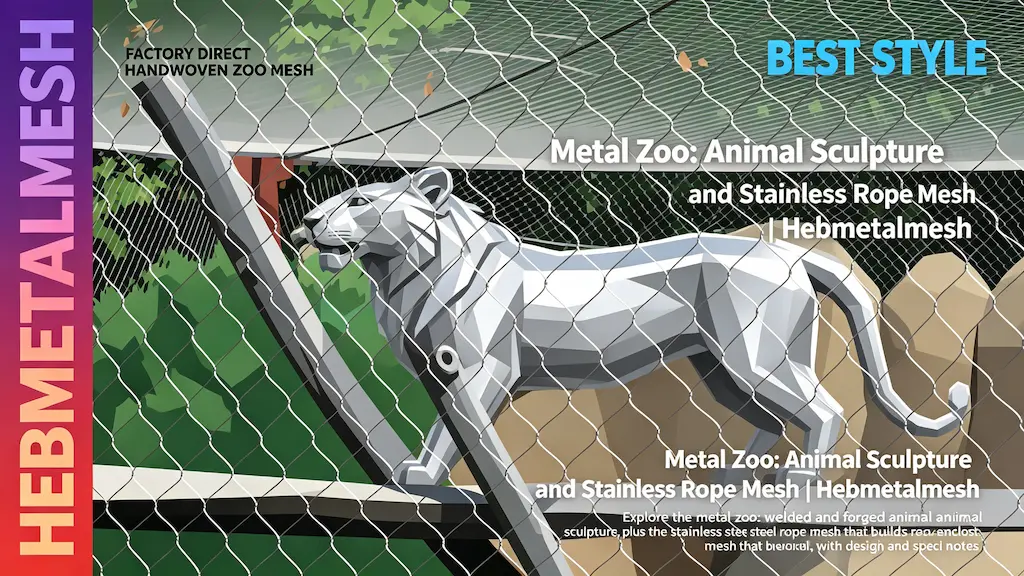
A metal zoo is two ideas sharing one word. In art it is a body of work: animal figures welded, forged and cast from steel, bronze and recycled metal, arranged in parks and galleries as public sculpture. In industry it is more literal — the stainless steel rope mesh that forms the walls of a working zoo enclosure, an animal fence that decides whether a lion, an eagle or a herd of deer stays safe. Both are metal zoos, and both are made by people who understand the same handful of things: how a metal behaves under load, how it ages in weather, and how a form in metal can carry a story about wildlife. This guide looks at the art, the craft behind it, and the point where a sculpture garden gives way to the engineered mesh of a real exhibit.
Executive Summary
The metal zoo began as an art tradition and matured into an engineering one. As sculpture it means animal figures built from steel plate, bronze and recovered scrap, joined by welding, forging, casting or brazing and finished with a deliberate patina. As structure it means the hand-woven stainless steel rope mesh — 1.2 mm to 3.2 mm rope, 20 mm to 102 mm aperture — that encloses animals in zoos, sanctuaries and wildlife parks today. The design logic is shared: an armature or frame carries the load, the metal skin defines the form, and the finish decides how the piece survives a decade of weather. The reference specification is the animal fence mesh product page.
Planning a sculpture feature or an animal enclosure in metal? Send your dimensions, species or sculpture scale and finish preference for a mesh specification and planning price.
Quick Answer:
Quick Answer: A metal zoo is the tradition of animal sculpture made from metal — steel, bronze and recycled metal shaped by welding, forging and casting — and, in the working-zoo sense, the stainless steel rope mesh that encloses real animals. The art form uses an armature and a maquette to plan a figure; the engineering form uses the same hand-woven rope mesh, at 3.2 mm rope and about 7 kN per strand, to build a fence no animal can defeat.
Key Takeaways
- A metal zoo in the artistic sense is animal sculpture: steel, bronze or recycled metal worked by welding, forging and casting, with a patina chosen for outdoor life.
- A metal zoo in the structural sense is stainless steel rope mesh — an animal fence of 1.2-3.2 mm rope and 20-102 mm aperture that encloses live animals.
- Both rely on a frame. Sculptors call it an armature; engineers call it a support structure. Remove it and neither holds its shape.
- The finish decides the lifespan: patina and bronze weather by design, while SS304 and SS316 rope mesh resist corrosion by alloy.
- A good metal zoo installation reads as one idea — the carved bronze animal and the woven steel fence should belong to the same visual language.
Public sculpture about wildlife usually carries a conservation message, and that message is best grounded in real figures. The International Union for Conservation of Nature maintains the Red List that most sculpture parks and zoo interpretation panels now reference, which is why a metal zoo often pairs an artwork with the conservation status of the species it depicts.
What a Metal Zoo Actually Is
The phrase has two lives, and confusing them leads to bad briefs. A metal zoo as an art collection is a set of animal figures, usually life-size or larger, displayed along a trail or inside a hall. A metal zoo as a built facility is a place where animals live, and the metal in it is a barrier, not a statement. Most public confusion comes from the overlap: a sculpture of a lion standing outside a lion enclosure is both, and the two objects answer completely different questions.
For an editorial or tourism audience the metal zoo is an exhibition — a world metal zoo of figures, a metal zoo gallery arranged through a park, a metal zoo collection of smaller works, or a single metal zoo statues commission anchoring a plaza. For a design or construction audience it is a specification: rope diameter, aperture, panel size and alloy. The interesting material is where the two meet, because the same workshop logic — measure twice, join cleanly, finish for the weather — governs a bronze antelope and a steel animal fence alike.
Craft Behind Animal Sculpture: Welding, Forging and the Armature
Every serious metal zoo figure starts small. The sculptor builds a maquette, a scaled model that fixes pose, proportion and mass before any full-size steel is cut. From the maquette comes the armature, the internal skeleton that carries the weight of the skin and keeps the animal’s posture true. Animal poses are asymmetrical by nature — a stalking cat carries its mass forward, a leaping deer throws it sideways — so the armature is doing real structural work, not just holding a shape.
Welding is the usual joining method for mild steel and stainless, with MIG for speed and TIG for clean, visible seams on stainless. Casting suits bronze, where a mould carries fine surface detail such as fur, feather or scale. Forging shapes hot metal under hammer, which gives limbs and antlers a drawn, organic taper that plate alone cannot produce, and brazing joins dissimilar metals at lower temperature where welding would distort thin sheet. Each process leaves its own signature, and a good metal zoo art piece is usually a deliberate mixture of them.
Materials, Finish and the Patina
Three material families dominate a metal zoo. Mild and stainless steel give strength and a modern, industrial read; stainless can be left bright or finished in a black oxide tone that cuts glare. Bronze gives warmth and fine detail, and it is the material most associated with a traditional metal wildlife sculpture. Recycled metal — plate, chain, sprockets, sheet offcuts — gives a found-object character and carries its own environmental narrative, which suits a sculpture about conservation.
Finish is where outdoor sculpture lives or dies. Bronze develops a patina as copper oxides form, turning first brown and then the green verdigris of copper carbonate; sculptors often accelerate this with applied chemicals so the colour is deliberate rather than accidental. Steel needs either a protective coating or a material that resists rust on its own. That is the first bridge to the engineering side of the metal zoo, because a fence faces exactly the same weather as a statue.
From Sculpture to Structure: Rope Mesh in a Working Zoo
Walk from the sculpture trail into the animal area and the metal changes job. Instead of holding a static figure, it now has to hold an animal that pushes, climbs and bites. The material that solved this well is hand-woven stainless steel rope mesh — the animal fence mesh core page carries the full aperture and alloy table — and its logic is close to a sculptor’s. Rope is drawn from 1.2 mm to 3.2 mm, woven at an aperture from 20 mm to 102 mm, and joined at the panel edge into a flexible field. There is no weld to crack, because the strands are interwoven rather than spot-joined, and the field flexes and returns instead of transferring every impact straight into the frame.
That behaviour is what lets a single material serve a finch flight, a deer paddock and a tiger perimeter. The table below compares the art object and the structural barrier, because they are often specified by the same person on the same project.
| Dimension | Metal zoo sculpture | Structural zoo mesh |
| Typical material | Steel, bronze, recycled metal | SS304 / SS316 rope |
| Joining method | Welding, brazing, casting | Hand-woven rope, swaged fittings |
| Governing load | Self-weight plus wind | Animal impact, about 7 kN per rope |
| Service life | Decades with patina care | 20 years plus, set by corrosion |
| Primary function | Public art and interpretation | Containment and public safety |
For a fuller picture of how the barrier side is used across species, see our notes on stainless steel rope mesh application, and for the material trade-off, the rope mesh vs plastic netting guide explains why flexible steel outlasts polymer in a wet, sunlit exhibit.
Design Notes for an Installation or Sculpture Garden
A metal zoo design that works on site starts with the visitor’s line of approach. Figures should be placed so that the silhouette reads against sky or planting rather than against a busy background, and the sequence should build — an entry figure, a mid-trail grouping, a payoff piece. A metal zoo sculpture garden usually mixes scales on purpose: one heroic piece at 1.5 to 2 times life size, surrounded by smaller metal zoo figures that invite close inspection of the welding and surface detail.
Fixings matter more than clients expect. A life-size animal in bronze can weigh several tonnes, so the base must be engineered, and the anchor points should be accessible for inspection and re-coating. Leave maintenance access around every piece, and choose a surface that can be re-treated without dismantling the sculpture. These are the same disciplines an engineer applies to an enclosure frame, which is why the two halves of the metal zoo world keep borrowing each other’s methods — the galvanised vs stainless cable mesh comparison is as relevant to a steel sculpture base as it is to a fence.
Commissioning, Fabrication and Cost
A metal zoo commission is a project, not a purchase. It usually runs through a maquette review, a structural check for the armature and base, fabrication in the workshop, surface finishing, and installation on site. The metal zoo artist and the fabricator are often different people, so the brief must fix the pose, the material, the finish and the fixing method before work starts. Where a figure will sit inside or beside an animal enclosure, the same project should also fix the mesh specification, so the artwork and the barrier are built to the same standard.
On cost, honest ranges are the only useful answer, because scale and material move the number more than anything else. As a planning guide, a small metal animal sculpture is a workshop piece; a life-size bronze or fabricated steel figure, with engineered base and installation, is a project-scale budget; and a full metal zoo installation of many figures plus landscape works is tendered per site. On the structural side, stainless rope mesh used as enclosure fencing carries a planning range of about $20-38 / m² depending on rope diameter and aperture, with the wider family of containment netting and fence mesh prices published separately.
Frequently Asked Questions
A metal zoo is either a collection of animal sculptures made from metal, or the stainless steel mesh structure that encloses animals in a real zoo. The art sense covers steel, bronze and recycled metal figures; the structural sense covers hand-woven rope mesh at 1.2-3.2 mm and 20-102 mm aperture. Both are built around a supporting frame.
Metal zoo sculptures are made by sculptors working with fabricators, often two separate roles. The sculptor makes the maquette and directs the form; the fabricator does the welding, casting, brazing and finishing. For a large public piece, an engineer also checks the armature and the base fixings.
The common materials are mild and stainless steel, bronze, aluminium and recycled metal. Steel gives strength and an industrial look, bronze gives warmth and fine detail, and recycled metal gives a found-object character with an environmental message. Stainless steel is favoured outdoors because it resists corrosion.
Cost scales with size and material more than with anything else. Small workshop figures sit in one bracket, life-size bronze or fabricated steel pieces with engineered bases in a higher one, and full multi-figure installations are tendered per site. Treat any figure you are given as a planning range, not a fixed price.
Yes, with the right material and finish. Bronze is designed to patina outdoors, developing a protective green verdigris, and stainless steel resists rust without coating. Mild steel needs a protective finish and periodic re-coating. Whatever the metal, plan maintenance access around the base from the start.
SS304, with 18% chromium and 8% nickel, suits inland exhibits with normal humidity. SS316 adds molybdenum for coastal sites, salt-spray zones and enclosures washed with chlorinated water. Both carry the same breaking load of about 7 kN at 3.2 mm rope; the difference is long-term corrosion resistance. Our zoo enclosure barrier notes cover how that choice plays out across exhibits.
Working on a sculpture feature or an animal enclosure? Send your scale, species and finish brief to our team for a factory-direct metal mesh quote.
Written by the Hebmetalmesh stainless steel mesh export team. Shijiazhuang Netting Trading Co., Ltd, No.386 Zhaiying Street, Shijiazhuang, Hebei, China. Contact: info@hebmetalmesh.com. Rope mesh is manufactured in 13 rope/aperture combinations from 1.2 mm / 20 mm to 3.2 mm / 102 mm, in SS304 and SS316, with a black oxide finish option for low-glare exhibit and sculpture settings.