
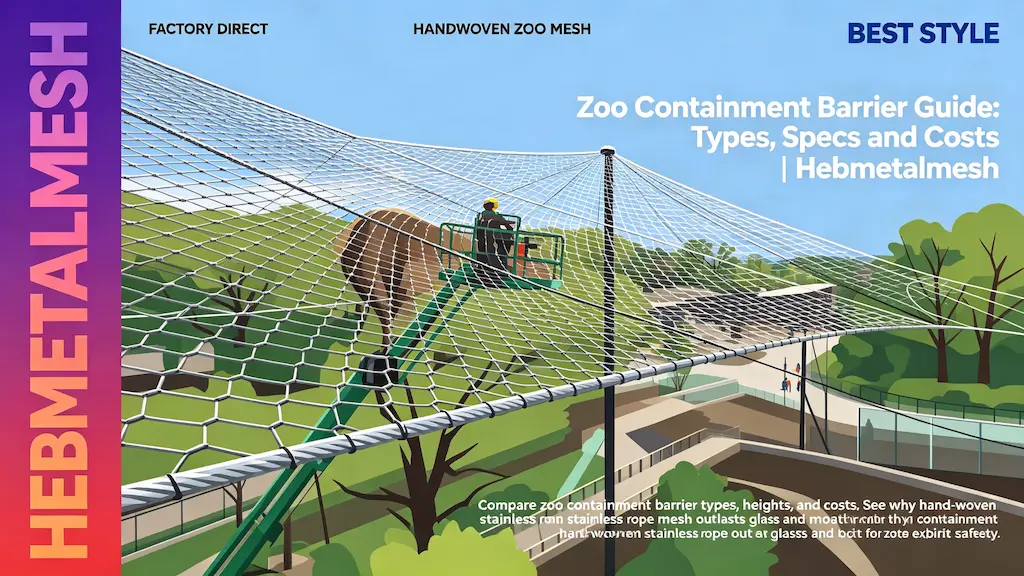
A zoo containment barrier has to do four jobs at once and cannot get any of them wrong: hold the animal in, hold the public out, disappear visually, and stay safe for the keeper who services it at six in the morning. Hand-woven stainless steel wire rope mesh is the only barrier material that does all four at commercial scale — it carries a documented barrier load rating, reads as open air from ten meters away, absorbs impact rather than resisting it, and lasts 20–30 years outdoors with nothing but washing and inspection. Welded mesh, laminated glass, acrylic, and dry moats each win on one axis and lose badly on the others.
Executive Summary
Most failed zoo barriers were not weak; they were mismatched. A panel strong enough for a tiger can still be wrong for a tiger if the aperture admits a paw or the frame deflects every time the cat leans in. Getting the specification right means four decisions in order: barrier type, mesh code matched to the species, height and anti-climb detail, and the stainless grade your climate demands. Skip the second or third and you rebuild inside five years. The reference specification is the animal fence mesh product page.
Quick Answer:
What is the best zoo containment barrier for most animal exhibits? Hand-woven stainless steel wire rope mesh — the only barrier type combining a verifiable load rating with near-invisibility, impact absorption, and a 20–30 year outdoor service life. Specify 3.2 mm rope at 51–76 mm for big cats, 3.2 mm at 38–51 mm for primates and bears, and 1.6–2.0 mm at 25–38 mm for aviaries. Choose SS316 for coastal or humid sites, SS304 inland, and buy panels woven to your exhibit’s exact dimensions.
Key Takeaways
- Barrier type follows the animal, not the budget. Species that climb, grip, or charge each eliminate different options.
- Aperture is a welfare decision, not a cost decision. The opening must deny a grip while staying small enough that no hand is trapped on the pull-back.
- Height is set by the best climber in the group, not the largest animal, and every reachable face needs an anti-climb overhang.
- Stainless grade is a site decision. The 10–15% premium for SS316 is the cheapest insurance in a coastal or tropical exhibit.
- Life-cycle cost beats purchase price. A barrier needing no coating renewal or panel replacement wins every twenty-year comparison.
Barrier standards are not optional paperwork. Accredited institutions work to published animal-care frameworks, and the Association of Zoos and Aquariums publishes the accreditation standards most North American exhibits are designed against.
Zoo Containment Barrier Design: The Four Jobs
Containment. The barrier must resist the animal’s characteristic attack: a cat swiping, a bear standing and pulling, a primate working one crossing for weeks.
Public separation. A primary barrier holds the animal; a standoff barrier — rail, hedge, or change of grade — holds the public back far enough that no visitor can reach through.
Secondary containment. When a keeper opens a shift door, the animal must still be held by something — a holding run, transfer corridor, or mesh-lined service yard is what makes daily husbandry possible without a dart gun.
Welfare. A barrier that reads as a wall changes how an animal uses its space. Flexible open mesh keeps sightlines and airflow intact, so it is the naturalistic-design default rather than an economy choice.
Types of Containment Barriers Compared
Types of containment barriers in use today fall into five families, each balancing containment, sightline, and maintenance differently.
| Barrier type | Containment | Sightline | Animal welfare | Maintenance | Service life | Relative cost |
| Hand-woven rope mesh | Excellent — documented load rating | Near-invisible beyond 10 m | Excellent — flexible | Inspection, washing | 20–30 yr | Medium |
| Welded wire mesh | Good; welds fail | Fair — visible grid | Fair — rigid, noisy | Weld repair, repainting | 8–15 yr | Low |
| Laminated glass / acrylic | Excellent | Unobstructed | Poor — no give, heats up | Daily cleaning | 10–20 yr | Very high |
| Dry moat / ha-ha | Excellent, non-climbers | Excellent | Excellent | Erosion, drainage | 15–25 yr | Medium-high |
| Chain link | Poor — grips, rust | Poor | Poor — noisy | Frequent repair | 5–10 yr | Lowest |
Woven rope mesh is a tensioned membrane: each crossing spreads a local load into its neighbors, so a hit that would crack a weld flexes a dozen crossings and springs back. That is why it dominates modern accredited exhibits.
Containment Barrier vs Glass: Where Each Wins
Containment barrier vs glass is the argument every design meeting eventually has. Glass wins on one axis only: clarity at close range, which is why it survives in underwater viewing, immersion tunnels, and contact zones where centimeters separate animal from visitor.
Outdoors it loses on nearly every other axis. Glass has no give, becomes a greenhouse wall in tropical heat, and takes permanent scratches. Worst of all, limited panel sizes turn a long boundary into a series of climbable frames.
The honest answer is hybrid: glass at the visitor viewing panel where faces come close, rope mesh wherever the barrier must span distance, absorb impact, or carry a roof.
How to Choose Zoo Containment Mesh
How to choose zoo containment mesh comes down to two numbers and one environmental question.
Rope diameter drives strength. The catalog runs 1.2 mm to 3.2 mm. A 3.2 mm rope carries roughly 7 kN of breaking load, 2.4 mm about 4.4 kN, lighter ropes less. Any species that throws its weight at a boundary or pries with hands belongs on 3.2 mm or 2.4 mm.
Aperture drives grip and entrapment safety. Openings run 20 mm to 102 mm. Too large and you hand the animal a grip; too small and you buy steel you do not need:
| Exhibit group | Recommended HM code | Rope Ø | Aperture | Reasoning |
| Big cats — lion, tiger, leopard | HM3250 / HM3276 | 3.2 mm | 51 / 76 mm | Resists charge and swipe; 51 mm with cubs |
| Bears | HM3250 | 3.2 mm | 51 mm | Standing pull and paw work need heaviest rope |
| Primates and apes | HM3238 / HM3250 | 3.2 mm | 38 / 51 mm | 38 mm denies a finger grip; 51 mm for large hands |
| Hoofstock — giraffe, deer, antelope | HM24102 / HM32102 | 2.4 / 3.2 mm | 102 mm | Visibility over grip; no gripping hands |
| Aviaries and free-flight | HM1625 / HM2038 | 1.6 / 2.0 mm | 25 / 38 mm | Small apertures protect beaks and heads |
| Small mammals, reptiles | HM1220 / HM1625 | 1.2 / 1.6 mm | 20 / 25 mm | Escape prevention at smallest scale |
Every code above comes in SS304 or SS316 with either the bright Nature finish or a black oxide finish that cuts glare and reads as shadow. Panels are woven to order up to 9 m × 18 m, so a boundary face arrives as a single sheet instead of a patchwork of climbable splices — a capability covered on the animal fence mesh product page. Species ranges are covered separately: tiger enclosure netting for big cats, primate netting for apes and monkeys, and aviary bird netting for free-flight work.
Zoo Containment Barrier Height and the Anti-Climb Detail
Zoo containment barrier height is set by the group’s best climber, not its heaviest animal. A mixed primate troop gets its boundary sized for the nimblest juvenile, because the silverback was never the escape risk.
Working heights:
- Big cats: 4–5 m, or 3 m plus a 60° inward anti climb overhang.
- Apes and monkeys: 5–6 m, overhang on every reachable face.
- Bears: 4–5 m with a smooth overhang; bears hook, so the transition detail matters more than height.
- Hoofstock: 2–2.5 m with no climbable structure nearby.
- Aviaries: full enclosure; height set by flight behavior.
The anti climb overhang is the most cost-effective detail in barrier design: 60° inward, 600–900 mm deep, it removes the top edge as a destination without adding steel to the whole face. Pair it with a two-meter clear climb zone — no trees, poles, or enrichment frames — and most climbing escapes vanish at the drawing stage. Containment barrier systems need a roof wherever the animal climbs or flies.
Zoo Containment Barrier Panels, Posts and Tensioning
Zoo containment barrier panels are only as good as the frame carrying them. Post spacing of 3–5 m on engineered footings holds barrier deflection small when a big cat leans in; wider spacing saves steel and costs you the visual line within a season.
The tensioning sequence matters more than most installers admit: lace the panel to a perimeter edge rope of 6–8 mm stainless cable, tie mesh to rope with hog rings on a fixed grid, then pull the rope to tension at each post. In that order an impact deforms the whole face and recovers. Clamp mesh direct to posts and load concentrates at the fixing — where the first failure appears.
Every perimeter door needs a double latch keeper door arrangement, latch recessed, and every gate a shift door so animals move between spaces without the barrier opening to the outside. All fixings belong outside the animal space.
Grade, Finish and the Corrosion Map
SS304 — 18% chromium, 8% nickel — is the right default for clean inland facilities. SS316 adds molybdenum, sharply raising resistance to chlorides in coastal air, tropical humidity, and the daily pressure-washing real exhibits get. The premium is 10–15% of material cost, and against a 25-year service life it is not a real decision: build a corrosion map — distance to coast, prevailing wind, rainfall, washdown frequency — and buy accordingly. Within a few kilometers of salt water, our 304 vs 316 mesh comparison walks the grade chemistry, and the galvanized versus stainless comparison covers why galvanized is a false economy near animals.
Finish is welfare plus presentation. Nature finish disappears against sky and foliage; black oxide reads as darker structure and cuts glare. Neither is a coating — both are surface conditions of the steel, so there is nothing to flake and nothing for a parrot to ingest.
Zoo Containment Barrier Cost
Zoo containment barrier cost is best read as cost per square meter, divided by years of service.
- Aviary-grade mesh (1.6–2.0 mm rope): $10–22 per m².
- Carnivore and primate-grade mesh (2.4–3.2 mm rope): $20–38 per m².
- SS316 adds 10–15% over SS304, either class.
Planning figures only, material ex-works. Framing, footings, and installation usually exceed the mesh line item, and freight is volatile because rope mesh ships by volume and panel nesting changes the container count.
The comparison glass cannot win: a stainless membrane lasting 25 years costs a fraction per year of a welded fence repaired twice and replaced once. Life cycle cost, not purchase price, makes a barrier sustainable.
Zoo Containment Barrier Maintenance and Standards
Zoo containment barrier maintenance is inspection, not repair, if the specification was right. A sensible inspection schedule runs twice yearly plus a walk after severe weather: check for distorted crossings, verify perimeter tensioning at the turnbuckles, confirm hog rings are seated.
Cleaning is plain water and a soft brush where algae gathers, with a mild stainless cleaner for heavier soiling. Never use carbon steel brushes or wire wool — embedded iron rusts even 316.
Zoo containment barrier standards vary by jurisdiction, but the requirement is consistent: a documented load rating, an inspection schedule, and a documented containment line. Containment integrity is a record you keep, not a claim you make at handover.
FAQ
Zoo containment barrier types are hand-woven rope mesh, welded wire mesh, laminated glass or acrylic, dry moats, and chain link. Woven rope mesh is the default for new exhibits because it alone combines a documented load rating, near-invisibility, and impact absorption.
A containment barrier for zoos is engineered against a defined animal load and a public-safety duty, with documented inspection and secondary containment. A farm fence discourages rather than guarantees.
Zoo habitat barrier design for apes and monkeys typically runs 5–6 m with a 60° inward overhang, because the boundary is sized for the group’s best climber. Height alone is never sufficient without the overhang.
Zoo visitor barrier height is typically 1.0–1.1 m for a standoff rail, set back far enough that no visitor can reach the primary barrier. Where one structure does both jobs, animal containment height governs.
Zoo containment barrier safety is verified at sign-off and re-verified on a fixed inspection schedule. Final tension, latch function, and overhang geometry should be documented at handover and re-checked twice yearly.
The Bottom Line on Exhibit Barriers
Every durable exhibit was specified the same way: a clear behavioral brief, an honest corrosion map, and a barrier chosen for decades rather than the opening season. Hand-woven stainless rope mesh keeps winning that comparison — 3.2 mm rope where animals are large, 38–51 mm apertures where hands are involved, SS316 in wet air, and panels woven full-height so the boundary has no seams to climb or joints to fail.
Ready to specify your barrier? Contact our enclosure team with your exhibit dimensions and species list.