
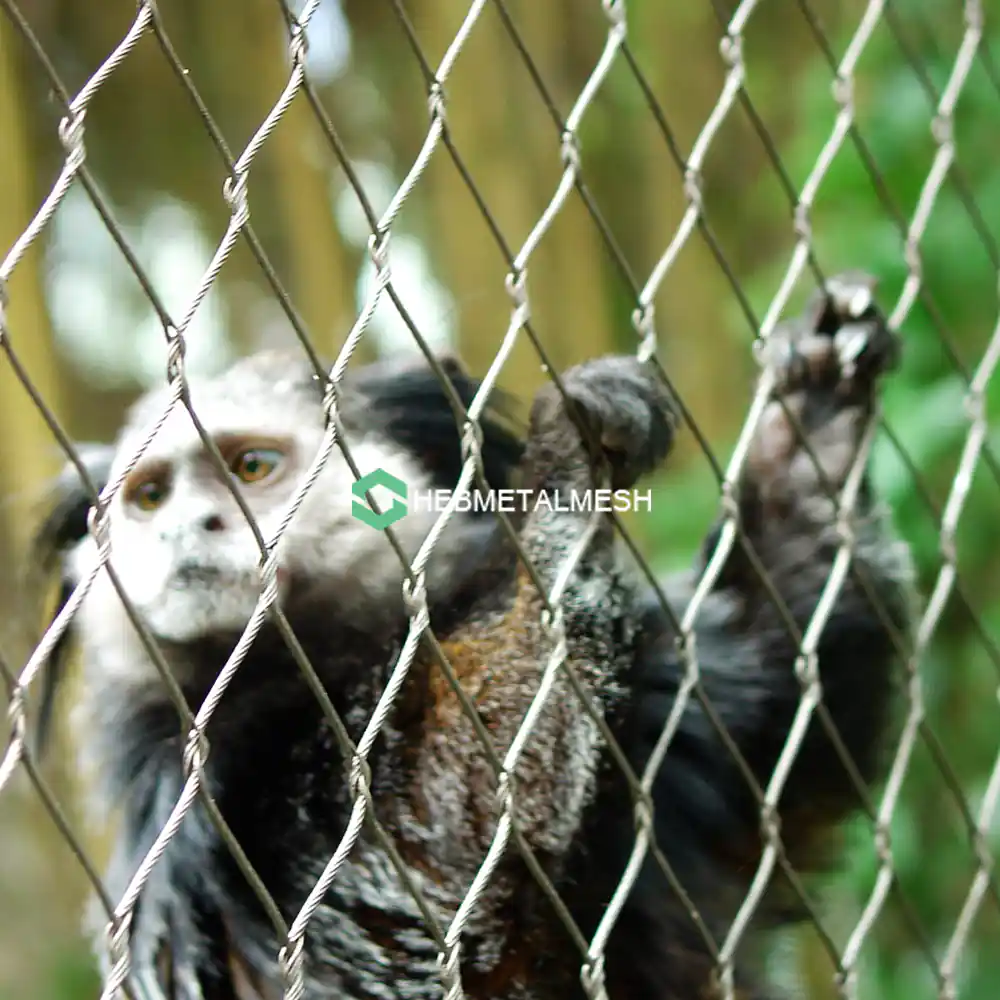
A wire monkey starts as a straight length of wire and ends as a recognisable animal; so does a monkey enclosure. Both begin with steel wire pulled to a controlled diameter, softened by annealing, then shaped by hand until the form holds on its own. One becomes a wire monkey mesh panel that keeps a living primate safe; the other stays on a shelf as wire monkey art. The craft underneath them is the same, and knowing where the two diverge is the quickest way to understand why a cheap mesh fails an exhibit that an engineered one survives by decades.
Executive Summary
Send the species, the exhibit height and photographs of the frame before you order. We weave to your panel sizes and supply finished pieces rather than a pile of offcuts, so a primate house arrives as a set of panels ready to tension. Contact Hebmetalmesh
Wire monkey mesh works when three decisions are right: the aperture suits the species, the rope diameter suits the span the panel must cover, and the panel is tensioned at its edges rather than stretched across the middle. Get those right and a stainless panel runs twenty-five to thirty years in a humid primate house. Get the aperture wrong and an infant macaque slips a shoulder through a gap meant for a larger animal; get the tensioning wrong and the mesh bellies, fatigues at the clamp and fails at the perimeter rather than in the field. Neither failure is a materials problem, and both are avoidable at the design stage. The reference specification is the monkey enclosure netting product page.
Quick Answer:
Wire monkey mesh is hand-woven stainless steel rope mesh built for primate enclosures. Size it to the animal: 25 mm aperture for small callitrichids and squirrel monkeys, 50 mm for capuchins, macaques and baboons, and 76 mm where a large climber needs an open, visually light panel. Rope runs 1.6 mm for fine mesh up to 3.2 mm for wide spans and heavy animals. Use SS304 in temperate inland climates and SS316 where humidity, salt or cleaning chemicals are constant. Tension on a stainless perimeter cable with a swaged fitting, and expect twenty-five to thirty years of service.
Key Takeaways
- Aperture is an animal-safety decision, not a cost decision. Match the gap to the smallest animal that will ever live there, offspring included.
- Rope diameter follows the span. A wide panel on fine rope sags and fatigues whatever the grade.
- Tension the perimeter, not the field. Almost every failed primate panel fails at a clamp.
- SS316 is the default for indoor primate houses, where humidity and cleaning chemicals sit on the wire far longer than they do outdoors.
- Custom panels cut site labour, not just waste — they arrive pre-sized and pre-fitted.
Design guidance from the World Association of Zoos and Aquariums treats the barrier as central to both animal welfare and visitor experience, which is why the mesh decision deserves engineering input rather than a quick quote comparison.
Why wire monkeys are still shaped by hand
The wire monkey sculpture survived cheap casting and 3D printing for one reason: wire has no thickness to hide behind. A wire monkey figurine built from a single continuous strand shows every decision the maker made — where the wrist turns, how the shoulder carries weight, whether the posture reads as an animal or as a diagram. The best pieces rely on nothing but tension and balance, the same principle that holds a woven panel taut in a primate house.
Making one is a discipline of reduction. The maker starts with a handmade wire monkey armature, adds limbs, then works backwards, removing mass until only the essential line is left. Two figures can use identical wire and look nothing alike: one is a wire monkey craft exercise; the other belongs with the wire monkey sculptures — the ones collectors treat as wire sculpture monkeys rather than wire figures, because the posture reads as a thinking animal. That is what wire monkey making is really about, and it is why collectors still pay for the hand-built version.
Metal wire only became an artistic medium at scale once industrial wire drawing made consistent diameters cheap. Before that, makers bent whatever they found; afterwards they could plan a decorative wire monkey mesh form around a known gauge. The same shift gave zoos a material they could specify and repeat — a drawn wire that behaves the same way in panel one and panel four hundred. What a sculpture cannot tell you is how that material behaves under load, and that is where the exhibit engineer’s interest begins.
Sizing wire monkey mesh: aperture and rope
The monkey mesh specification that matters most is the aperture — the clear distance between crossing wires. It is set by the smallest animal that will ever be inside, not by the current adult: a 12 kg capuchin needs a very different gap from the 400 g infant it will produce next season. Standard apertures, rope diameters and panel sizes are listed on our monkey enclosure netting page.
| Species group | Typical aperture | Rope diameter | Notes |
| Marmosets, tamarins, squirrel monkeys | 20–25 mm | 1.2–1.6 mm | Fine mesh; fingertips must not pass |
| Capuchins, macaques, colobus | 50 mm | 2.0–2.4 mm | The workhorse exhibit specification |
| Baboons, mandrills, large climbers | 50–76 mm | 2.4–3.2 mm | Higher load, wider spans |
| Walk-through primate houses | 50 mm | 2.0–3.2 mm | Sight lines drive the choice |
Rope diameter is not a free variable. The wider the panel span and the heavier the animal, the thicker the rope has to be, because the panel carries its own weight plus the animal’s dynamic load. A wide monkey run mesh span built on 1.6 mm rope sags within a season and fatigues at the fixings long before the wire itself corrodes. Where a large climber uses the mesh as a climbing frame rather than a barrier, treat every panel as a structural element.
Stainless grades for humid primate houses
Primate houses are among the most aggressive environments on a zoo site: humidity is held high for the animals’ comfort, cleaning chemicals are used daily, and the mesh is never dry for long.
SS304 (18% chromium, 8% nickel) is the right choice for temperate, inland, well-ventilated exhibits; it resists atmospheric corrosion indefinitely and costs less. SS316 adds molybdenum, which resists the chloride pitting that appears where cleaning agents, salt spray or coastal air sit on the wire. For an indoor primate house, SS316 is usually the safer default. The comparison is set out in our guide to 304 versus 316 stainless cable mesh, and the same logic applies when a project weighs galvanised against stainless mesh. Galvanised steel is a legitimate material for a garden or a temporary run; it is not a sensible lifetime choice for a primate barrier that will be cleaned every day for decades.
Tensioning panels and the load path
A woven panel is a flexible structure, and it only behaves like a barrier when its edges are restrained. The load path runs from the mesh, through the edge, into a perimeter load bearing cable, and from there into the frame. If that chain has a weak link, the panel fails there.
Three details decide the outcome. The perimeter cable must be stainless and sized for the span, because an undersized cable stretches and the mesh follows it. The mesh must be attached to that cable with the right swaged fitting at intervals close enough to stop it concertinaing between fixings. And the corners must carry tension round the perimeter instead of concentrating it at a single anchor.
On site, the practical rule is that the mesh should resist a firm push without deflecting more than a hand’s width. Anything looser invites climbing animals to work the wire against itself, which is how fatigue cracks start. Our overview of stainless steel rope mesh applications covers the same tensioning principles across other zoo building types.
What monkey mesh costs, and when custom pays
Monkey mesh cost is driven by four things: rope diameter, aperture, panel size and grade. Fine 1.2 mm mesh at 20 mm aperture uses far more wire per square metre than 3.2 mm mesh at 76 mm, so the finest mesh is not automatically the cheapest. As a planning range — not a quotation — primate-grade stainless rope mesh typically lands between $20 and $38 per square metre depending on rope diameter, aperture and total area.
Custom monkey mesh panels are usually worth the modest premium. A panel woven to the frame dimensions arrives ready to tension, removing cutting, dressing raw ends and re-clamping from the installation programme. On a multi-panel primate house, the saving in site labour and wasted offcuts frequently outweighs the unit-price difference. A supplier who weaves to your dimensions is also the right monkey mesh supplier to ask about panel tolerance, end finishing and the documentation that ships with the order.
Monkey mesh specification requests should always carry the certificate. Ask for the mill test report, and if the project specifies 316, verify the alloy on the report rather than the invoice — a 201-grade substitution is invisible on the wire itself and only shows up in the paperwork.
From a primate sculpture mesh panel to the real thing
A woven panel outlasts a welded one for the same reason a good wire monkey sculpture outlasts a cast one: continuous material distributes load in a way that joints cannot. In a woven panel every crossing is a load-sharing point, so a point load spreads across a wide area instead of concentrating at one weld.
That suits primates specifically. These are animals with formidable hands and a demonstrated capacity for problem solving — the field of primate cognition is built almost entirely on how they manipulate the physical world. A barrier with a smooth, continuous, hand-hostile surface is a very different proposition from welded rectangles with grip points at every corner.
Annealed wire behaves the same way in a panel as in a sculpture: softening the metal lets it take a shape and keep it without work-hardening to brittleness. In an enclosure, that flexibility lets the mesh absorb an impact and return to shape instead of cracking at the clamp. The sculptural form of a well-hung panel — even, tensioned, without slack corners — is not only an aesthetic judgement; it is the visible sign that the load path is working.
Where the mesh bounds a mixed exhibit, the same panel serves both barrier and display — an enclosure is one engineered object, not a fence with accessories. Our guide to better zoo enclosure barriers covers how barrier choice affects welfare and viewing, and the benefits of mesh enclosures makes the wider case for woven systems over solid walls.
Frequently asked questions
Wire monkey mesh is hand-woven stainless steel rope mesh used to enclose monkeys and other primates. It is a flexible woven panel — not a welded grid — tensioned on a perimeter cable and sized to the species.
Use 25 mm for small callitrichids and squirrel monkeys and 50 mm for capuchins, macaques and baboons; 76 mm suits large climbers on thicker rope. Always size to the smallest animal the enclosure will ever hold.
Yes, when the aperture is smaller than the animal can push a finger through. A woven panel presents a continuous surface with no weld spurs or sharp edges, which is why it is preferred over welded mesh for hands-on species.
As a planning range, primate-grade stainless rope mesh runs about $20 to $38 per square metre. Rope diameter, aperture, panel size and grade all move the figure, so ask for a quotation against your actual dimensions.
Twenty-five to thirty years with no maintenance beyond an occasional rinse. The limiting factors are grade selection and tensioning rather than the wire itself, so SS316 and a properly sized load bearing cable repay the small premium.
Yes, if the panel is designed as a structural element: increase the rope diameter, reduce the unsupported span, and treat the perimeter cable and fittings as load-bearing parts of the enclosure.
Ordering a wire monkey mesh enclosure
The shortest path from a design drawing to a finished primate house is to send the dimensions with the order. Species, exhibit height, frame photographs and the spans involved are enough for us to recommend an aperture, a rope diameter and a grade, and to weave the panels to fit.
Request a quotation from Hebmetalmesh and the panels arrive sized, documented and ready to tension.
Hebmetalmesh — Shijiazhuang Netting Trading Co., Ltd, No.386 Zhaiying Street, Shijiazhuang, Hebei, China. info@hebmetalmesh.com