
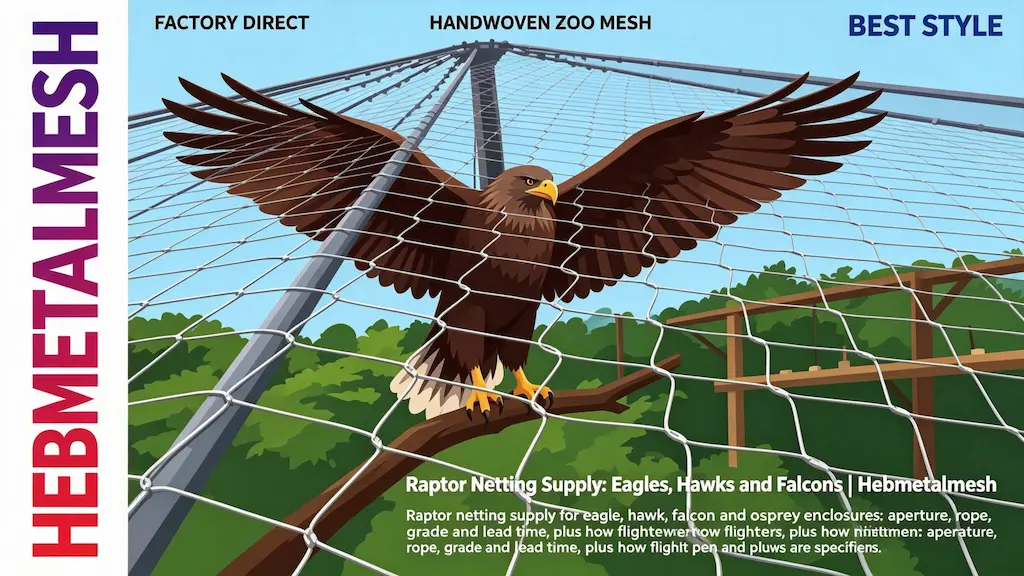
Buying netting for a bird of prey is not the same purchase as buying it for a mammal. A raptor lands on the mesh, closes its feet, and pulls. It leaves a perch at flight speed and arrives at the boundary hard. It drags its primary feathers against whatever surface it lives beside, every day, for years. Raptor netting supply is therefore a specification problem long before it is a price problem — and the aviaries that fail usually failed at the specification stage, not because the roll was cheap.
Executive Summary
Send the species list, the enclosure type and the panel spans before you ask for a price. A flight pen, a mews and a rehabilitation flight need three different specifications, and we weave to your panel sizes. Contact Hebmetalmesh
Three enclosure types account for almost every raptor order, and they are not interchangeable. A flight pen is a volume in which a bird exercises and must be tall enough to fly in. A mews is a small sheltered chamber where the netting is doing very little and ventilation matters more. A hospital flight sits between them, sized for a bird that is recovering, may not fly straight, and must not be able to injure itself against the boundary. Get the enclosure type right, size the aperture to the smallest foot in the house, and treat the perch layout as part of the specification rather than an afterthought. The reference specification is the eagle enclosure netting product page.
Quick Answer:
Raptor netting supply orders are sized by the foot and the flight volume, not by the bird’s weight. Use 38 mm aperture in 2.0 mm rope (HM2038) for a standard eagle aviary, 20–25 mm in 1.2–1.6 mm (HM1220/HM1625) where kestrels and small falcons share a house with larger birds, and 50 mm in 2.4–3.2 mm (HM3250) for a sea eagle, vulture or public-contact flight. Aperture should never exceed 50 mm on a raptor, because a hooked talon above that becomes a broken toe. Specify SS304 inland and SS316 within about 5 km of salt water, with stainless ferrules and the mill report. Flight enclosures need 6 m of height or more; a mews needs only the clearance to open the wings.
Key Takeaways
- Aperture is set by the foot, not the body. Above 50 mm a talon can hook the weave, and a hooked talon means an injury.
- Surface finish is a welfare line item. A smooth, weld-free weave is what prevents feather damage.
- The enclosure type decides the order. Flight pen, mews and hospital flight take different panels and different heights.
- Grade must be documented. Ask for the mill test report before the crate leaves, not after the ferrules discolour.
- Ferrules are part of the specification. An aluminium ferrule on stainless rope is a galvanic couple waiting to fail.
Where a species is being held under a managed programme, the IUCN Red List is the reference most zoos and rehabilitation centres work to, and it is a reminder that a raptor enclosure usually supports something larger than one bird.
What “raptor” covers, and why the species list decides the order
There is no single raptor aviary specification, because an osprey, a kestrel and a condor do not present the same problem to a net. The order starts with the species list.
| Species group | Aperture | Rope diameter | Enclosure note |
| Kestrels, merlins, small falcons | 20–25 mm | 1.2–1.6 mm | Fine weave; the smallest bird must not pass |
| Hawks, buzzards, most falcons | 38 mm | 2.0 mm | The general-purpose raptor specification |
| Golden and bald eagles | 38–50 mm | 2.0–2.4 mm | Flight volume matters more than raw strength |
| Sea eagles, vultures, condors | 50 mm | 2.4–3.2 mm | Widest spans, heaviest birds |
| Mixed bird-of-prey houses | 25 mm | 1.6 mm | Fine enough for the smallest foot in the building |
The same logic governs raptor mesh supply across the whole group: the aperture has to suit the smallest foot in the enclosure rather than the average one, and the panel has to suit the widest span. The full standard range sits on our eagle enclosure netting page.
Flight pens, mews and hospital flights
Three enclosure types account for almost every bird of prey netting supply order.
A flight pen is the volume a bird exercises in. Height is the governing dimension — 6 m or more for eagles — because a raptor needs a flight corridor long enough to build speed and a glide path it can actually use. Flight pen netting is specified for span and wind load rather than strength alone, and raptor flight pen netting panels are usually the largest single pieces in the order; on a small eagle flight pen netting supply job the binding constraint is more often the door detail and the roof span than the mesh itself. Where the flight is open to the sky, height also lets a bird use a thermal updraft, which is what makes a tall flight worth building.
A mews is the opposite: a small, sheltered chamber, often with a solid roof and only part of the face netted or barred. The netting is doing much less work here, so raptor mews netting is chosen for ventilation and light rather than for flight containment. Falconers who manage a bird on a creance line and fly it to the lure need a weathering area instead — a tethered outdoor space that is usually fully meshed for predator exclusion, and a routine falconry netting order.
A hospital or rehabilitation flight sits between the two. Raptor hospital netting and raptor rehabilitation netting are specified for a bird that is recovering, may not fly straight, and must not be allowed to injure itself against the boundary. That argues for a finer aperture, a softer surface and generous height. The whole point of a rehabilitation flight is a soft release: the bird is exercised back to fitness inside the enclosure and released when it can hunt, not when the wing merely looks healed.
Rope, grade and the checks that matter at order stage
Rope diameter follows the span and the bird’s dynamic load; the grade follows the climate. The material detail that catches people out is the fitting. A stainless rope closed with an aluminium ferrule creates a galvanic couple, and the joint corrodes long before the rope does — so specify stainless ferrules and swaged ends, and treat them as part of the mesh specification rather than a consumable.
For grade, the split is the one used across the range: SS304 for temperate inland sites, SS316 where salt, humidity or cleaning chemicals sit on the wire. The comparison is set out in our guide to 304 versus 316 stainless cable mesh, and the same reasoning applies when a project is weighing galvanised against stainless mesh.
What to ask for at order stage is short: the mill test report covering the grade and the rope construction. A 201-grade substitution is invisible on the wire itself, performs differently within a few years, and shows up only on paper — which is why the document is requested with the quotation rather than with the complaint.
Falconry and mixed-species orders
Falconry netting and falconry mesh orders are usually smaller and more specific than zoo work: a weathering area, a breeding chamber, a screen around a bird in training. They are also the orders most likely to need panel sizes that do not match a standard module, which is why they are worth sending to a raptor netting factory with the dimensions rather than adjusting a stock panel on site.
Where a collection runs several species at once — and a raptor netting supplier is very often asked to cover an entire bird-of-prey house in a single order — specify to the smallest foot and the widest span, and treat those as two separate decisions. Osprey netting, and netting for other fish-eating raptors, presents the same problem as a sea eagle: a large, powerful bird that lives close to water, where a stainless grade and a documented alloy matter more than in a dry inland aviary.
What raptor netting costs
Raptor netting price follows the same four variables as the rest of the range: rope diameter, aperture, panel size and grade. Fine 1.2 mm mesh at 20 mm aperture carries far more wire per square metre than 3.2 mm mesh at 50 mm, so the finest specification is rarely the cheapest. As a planning range — not a quotation — raptor-grade stainless rope mesh typically lands between $20 and $38 per square metre, and a flight pen with a large roof area sits at the upper end because of the span and rope diameter it needs.
Raptor netting installation is the other half of the cost. A tensioned panel needs a perimeter cable, fittings and a frame that can carry the load, and that work is the same whether the mesh arrived from a raptor netting manufacturer as a roll or as a finished panel. Panels woven to size usually win on a multi-enclosure project, because cutting, dressing ends and re-clamping on site cost more than the difference in unit price.
Installation notes that decide whether the mesh lasts
The load path runs from the mesh into a perimeter cable and from there into the frame, and that chain is where raptor panels fail if anything does. Mesh should resist a firm push without deflecting more than a hand’s width. Where keepers enter regularly, build an air lock rather than a single door, and keep perches far enough from the netted face that a landing bird does not arrive at the mesh at speed.
A flight enclosure also has to account for weather. Wind load on a large roof panel is the design case, and the panel most exposed to a bird strike from an incoming bird is the ceiling. A mesh that deflects in a gust and gives under an impact is doing its job; a rigid one transfers that energy into the frame and the bird, with no benefit to raptor welfare. Our overview of stainless steel rope mesh applications covers the same principles across other zoo building types, the benefits of mesh enclosures makes the wider case for woven systems, and our guide to better zoo enclosure barriers sets out how barrier choice affects both animal welfare and the visitor’s view.
Frequently asked questions
Raptor netting is hand-woven stainless steel rope mesh used to enclose eagles, hawks, falcons and other birds of prey. It is a flexible woven panel — not a welded grid — specified by aperture, rope diameter and grade.
Use 20–25 mm for kestrels and small falcons, 38 mm for hawks and most eagles, and 50 mm for sea eagles, vultures and condors. Never go above 50 mm on a raptor, because a talon can hook the weave.
Yes, when the aperture is small enough that a toe cannot lock into it and the surface is smooth. A woven panel has no welds or cut ends, which is what prevents feather damage and talon injury.
As a planning range, raptor-grade stainless rope mesh runs about $20 to $38 per square metre. Rope diameter, aperture, panel size and grade all move the figure, and a large flight pen sits at the upper end.
Woven panels are typically two to four weeks from order, plus two to six weeks transit for export. Custom panel sizes take the longer end of that range; standard rolls ship sooner.
Yes. Mews, weathering areas, hospital flights and full rehabilitation enclosures are all standard work, and we weave to your dimensions rather than working from a stock module.
Ordering raptor netting
Send the species, the enclosure type, the height and the panel dimensions. That is enough to recommend an aperture, a rope diameter and a grade, and to weave panels that arrive ready to tension with the mill documentation attached.
Request a raptor netting quotation from Hebmetalmesh and the panels ship sized and documented.
Hebmetalmesh — Shijiazhuang Netting Trading Co., Ltd, No.386 Zhaiying Street, Shijiazhuang, Hebei, China. info@hebmetalmesh.com