
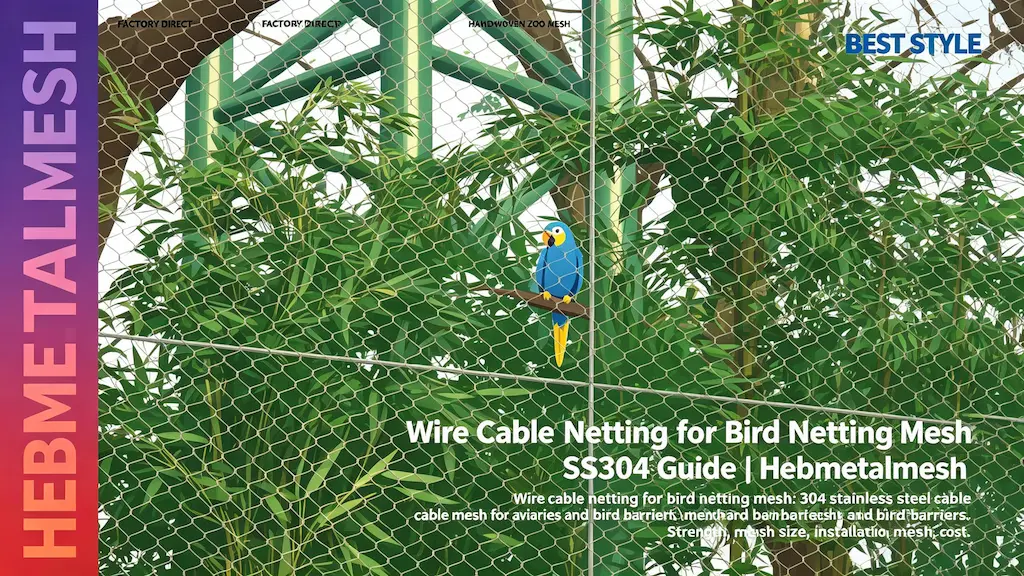
Bird proofing netting is a permanent answer to a problem most buildings solve badly. Nylon and polyethylene nets are cheap on the day they go up and expensive by year four: they stretch under snow, embrittle in ultraviolet light, and the whole roll is bought again. A stainless steel roll, fixed properly to a facade, is the same product built to still be doing its job when the building is repainted for the second time.
The rolls and their specification sit on the aviary netting product page, which is the reference for the range. This guide covers the part that decides whether the installation works: aperture for the species you actually have, the grade for your climate, and the fixing detail that keeps a net tight for decades.
Executive Summary
Send elevations and the species you are excluding before you order. We weave to your panel sizes and supply rolls for standard runs, so a facade arrives as a set of finished pieces rather than a pile of offcuts. Contact Hebmetalmesh
Bird proofing fails in two ways. The mesh is wrong for the species, so small birds pass through a pigeon-sized aperture, or the fixing is wrong, so the net bellies out of the frame within two seasons and a determined bird finds the gap. Neither is a materials problem. A stainless roll at the correct aperture, tensioned on a perimeter cable with proper edge tensioning, holds for twenty-five to thirty years with no maintenance beyond an occasional rinse.
Quick Answer:
Bird proofing netting should be sized to the species: 20 mm aperture for sparrows, finches and small migrants, 25 mm for starlings and swallows, and 50 mm for pigeons, gulls and cormorants. Use 1.2 to 1.6 mm rope on fine mesh and 2.0 to 3.2 mm on the larger apertures. Specify SS304 inland and SS316 within about 5 km of salt water. Fix it on a stainless perimeter cable with a netting eyelet roughly every 300 to 500 mm, and tension the edges rather than the field. Correctly installed, a stainless roll runs twenty-five to thirty years; a nylon net of the same size is replaced every three to five.
Key Takeaways
- Match aperture to the species, not to the building. 50 mm excludes pigeons and lets sparrows straight through.
- Fine mesh needs finer wire. 1.2 to 1.6 mm rope keeps 20 to 25 mm apertures supple and light.
- Tension the edges. A net that is tight only in the middle will belly and fail at the perimeter.
- Stainless costs more once and less over thirty years than nylon replaced five or six times.
- Coastal sites need SS316. Molybdenum is what stops chloride pitting at the coast.
Where exclusion has to be non-lethal and the building is on a migration route, design guidance from the Smithsonian National Zoo and its bird conservation work is a useful reminder that a well-built net simply moves birds on rather than harming them.
Why birds come back to the same building
Birds do not choose a ledge at random. They return to a roosting site that has already worked, and a structure offers exactly what a colony needs: shelter from wind, a wide view, warmth from the masonry, and a surface that never gets cleaned. Under those conditions flock pressure builds season on season, and guano accumulation follows at roughly 1 kg per pigeon per month.
That is why repellent products underperform. A bird spike covers a few centimetres of parapet and leaves the rest of the elevation open. An ultrasonic deterrent has no lasting effect on birds that have already committed to a site, and audible scarers are usually excluded from occupied buildings anyway. Droppings corrosion is the expensive part of the problem: the uric acid in guano attacks paint, galvanised steel, and even the lime in concrete, and roof gutters blocked with nesting material cause water damage long before the birds themselves are a nuisance. Only a physical exclusion layer covering the whole opening solves the problem permanently, which is what bird abatement netting and bird abatement mesh are for.
Choosing aperture for the species you have
Aperture is the single decision that determines whether the installation works. Work from the bird, not from the net.
| Target bird | Aperture | Rope Ø | Code |
| Sparrows, finches, small migrants | 20 mm | 1.2 mm | HM1220 |
| Starlings, swallows, budgerigar-size birds | 25 mm | 1.6 mm | HM1625 |
| Pigeons and larger perching birds | 50 mm | 2.0 mm | HM2050 |
| Gulls and cormorants on exposed elevations | 50 mm | 3.2 mm | HM3250 |
A pigeon netting specification drawn up around feral pigeons almost always lands on 50 mm, because a pigeon cannot pass a 50 mm opening and the wider mesh keeps the installation light and inexpensive. The same 50 mm mesh is a waste of money against sparrows, however, and this is the most common mistake in domestic work. A pigeon deterrent netting job on a town centre shopfront and a pigeon exclusion netting job on a listed facade need different fixings but the same aperture logic, and a gull netting screen on a coastal roof needs 3.2 mm rope to survive wind loading rather than 1.6 mm. Where birds simply must not land on a rail or a sign, a fine bird guard netting panel is cheaper than rebuilding the structure around a spike system.
Measure the void before you choose the mesh. A net has to close the whole opening, including the shadow under an overhang and the gap behind a downpipe, because birds find the one corner left open. Where a facade presents several openings, treat each as its own panel rather than stretching one net across unrelated planes. Where two species are present, pigeons on the parapet and sparrows in the gutter, size the installation for the smaller bird.
Stainless steel against nylon and galvanised wire
The material decides how often the job is redone, and that is the whole economic argument.
| Material | Service life | What ends it |
| Nylon or polyethylene | 3 to 5 years | UV embrittlement, sag, storm damage |
| Galvanised steel wire | 10 to 15 years | Coating consumed, rust staining, then breakage |
| Stainless steel rope mesh | 25 to 30 years | Nothing in normal service |
Nylon is the cheapest material on the day and the most expensive over a building’s life, because the access cost of replacing a net is usually larger than the net itself. Galvanised wire lasts longer but the coating is a consumable, and the rust that follows stains render, stone and cladding. The full comparison of the two steel options is in our galvanised versus stainless guide.
Stainless has no coating to consume. SS304, at roughly 18% chromium and 8% nickel, is the right grade inland and in most urban settings. SS316 carries 2 to 3% molybdenum and is the specification for coastal elevations, tropical humidity, and anywhere the mesh is exposed to chloride. A 7×7 rope, forty-nine wires, is what gives the panel its flexibility and its fatigue resistance, and it is the same construction used across our other stainless steel rope mesh applications. How the two grades behave over a full service life is set out in our 304 versus 316 comparison.
Exposure also argues for heavier rope. Wind load rises with the square of wind speed, and a net on the corner of a tall building takes the direct pressure on one face and the suction on the other, so 1.2 mm rope that is ideal across a sheltered courtyard is the wrong choice on a coastal tower. Step up to 2.0 mm, shorten the eyelet spacing, and split a very large elevation into two panels on an intermediate cable so that one failure does not release the whole field.
Fixing a roll or panel to a facade
Almost every failed net was fixed badly rather than made badly. The mesh is only half the installation; the frame does the rest.
- Run a perimeter cable. A stainless cable set into the structure at the corners carries the load. The net hangs from it, it does not carry itself.
- Fit a netting eyelet at 300 to 500 mm centres. Closer spacing on exposed elevations and corners, wider on sheltered runs.
- Tension the edge, not the field. Edge tensioning pulls the perimeter tight and lets the field hang naturally; tightening the middle of a panel only pulls the perimeter out of line.
- Fix to structure, not to cladding. Anchor bolts should land in structural steelwork or sound masonry. A cladding line that looks solid is often a 0.7 mm sheet over insulation.
- Keep the soffit line tight. The gap between the top of the net and the underside of the roof is where birds get in, and it is the detail most often left loose.
- Use a bugle head screw and a washer with any sheet fixing, so the load spreads instead of tearing through the sheet.
A bird proofing installation on a warehouse bay, a loading canopy or a balcony follows the same order every time: set the anchors, run and tension the perimeter cable, hang from the top down, then work the edges. Our wire fence roll guide covers the same sequence for large flat runs, where a stock roll is the practical format.
Rolls, custom panels, price and lead time
A standard roll suits a long straight run; anything with a corner, a pitched roof, or a chimney stack is better served by a woven panel. We supply both, and as a bird proofing manufacturer we weave panels up to about 9 m by 18 m in one piece, so a facade arrives as a set of finished pieces rather than a pile of offcuts. A bird proofing supplier who can only sell stock roll widths is, in effect, selling you the overlaps — and every overlap is a line where the net can sag and a bird can work its way in.
Bird proofing rolls in fine bird proofing mesh are the usual choice for straight runs, and the finer bird proofing wire used in a 20 mm panel is the same stainless rope, just drawn thinner. Choose a supplier who quotes the grade and the mill certificate with the price: a 201 stainless substitute carries less nickel and more manganese, looks identical on delivery, and starts to corrode in a coastal atmosphere within a few years. Ask for the EN 10204 3.1 report.
Bird proofing price tracks rope diameter and aperture rather than the size of the opening. A $10 to $22 per square metre planning range covers a fine bird-proofing panel at 1.2 to 1.6 mm; heavier 3.2 mm rope for gull and cormorant work lands toward the top of that band. Bird proofing cost also depends on access, since scaffolding or rope access is usually the largest single line on a high-level job, which is the strongest argument for specifying a material you will not have to go back to. The complete range, including the finer panels used for enclosures, is specified on the aviary netting product page. Lead time is two to four weeks for woven panels plus two to six weeks transit. Ask for the mill test certificate and a sample of the weave before the run starts, and confirm the tolerance on the finished panel size, so the pieces that arrive match the elevations you measured.
Frequently Asked Questions
50 mm aperture. A pigeon cannot pass a 50 mm opening, and the wider mesh keeps the panel light and the cost down.
No. Sparrows, finches and small migrants need 20 mm, and starlings and swallows 25 mm. Finer mesh needs finer rope, in the 1.2 to 1.6 mm range.
Twenty-five to thirty years in normal service, against three to five years for nylon and ten to fifteen for galvanised wire. There is no coating to renew.
A stainless perimeter cable anchored into the structure, with the net hung from it on eyelets at 300 to 500 mm centres, then tensioned at the edges.
Yes. Panels weave to about 9 m by 18 m in one piece, so warehouse openings, loading canopies and roof voids can be covered without field seams.
SS304 inland, SS316 on coastal or chlorinated sites. Ask for the mill certificate with the delivery.
Send your elevations and we will price the panels. Tell us the opening sizes, the species you are excluding, and how exposed the building is. We will return grades, panel sizes and a delivered price, with no obligation. Request a quote from Hebmetalmesh
Hebmetalmesh weaves hand-woven stainless steel rope mesh to order for buildings, aviaries, gardens and wildlife parks worldwide.