
Executive Summary
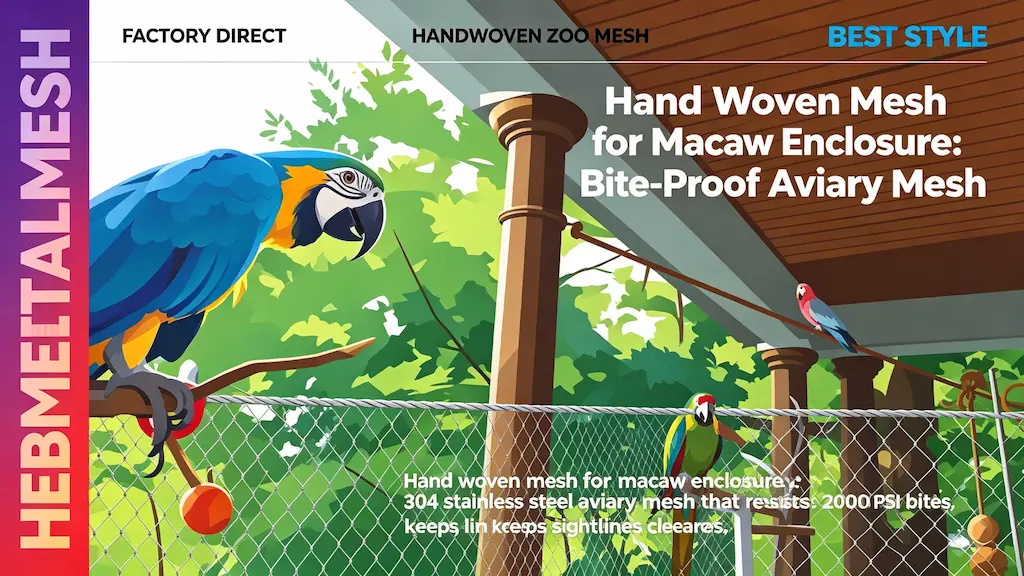
The best mesh for a macaw enclosure is hand-woven stainless steel rope mesh. A macaw’s beak delivers roughly 2000 PSI of bite force — enough to crack a Brazil nut — so any mesh that cannot survive that force is a short-term solution. Hand woven mesh for macaw enclosure builds solves the problem in one material: 304 stainless steel strands that resist biting, corrosion, and UV, woven into panels that stay transparent enough for a clear view and open enough for ventilation. This guide answers the practical questions in order: what material, what mesh size for macaw cage, how hand-woven panels behave under a macaw’s beak, how the mesh supports natural behaviors, how it is installed and maintained, and what it costs over the life of the exhibit. The answer for anyone specifying a build is the macaw proof fence product page.
Specifying Macaw Enclosure Mesh? Get a Free Quote
Send us your macaw species, enclosure dimensions, and climate. We return a mesh grade, aperture, and wire diameter recommendation within 24 hours.
Request My Free Quote →Quick Answer: What Mesh Do Macaws Need?
Macaws need a mesh with three properties in one panel: bite resistance, transparency, and longevity. Stainless steel rope mesh delivers all three because it is woven — not welded — from solid 304 stainless steel cable. Welded wire fails at the joints under repeated biting and weather cycling; a hand-woven panel has no welds to fail. Coated products lose their coating to a macaw’s beak within months. The practical specification is a bite proof macaw mesh in 304 stainless steel, with an aperture that fits the bird’s head size and a wire diameter matched to the species. For the full product range, the macaw enclosure netting page is the reference.
Key Takeaways
- Macaws generate roughly 2000 PSI of bite force; the mesh must be structurally unchewable.
- Hand-woven stainless steel mesh has no welds, so it has no weld-joint failure mode.
- Aperture is set by the bird’s head: tight enough to prevent escapes, open enough for clear views.
- Transparency and ventilation are welfare features — macaws need light, airflow, and sightlines.
- The mesh doubles as climbing structure, supporting natural behaviors like gripping and perching.
- Installation and tensioning determine field performance more than panel price.
- 304 stainless steel handles most sites; 316 is specified near salt water or heavy spray.
Why Macaws Destroy Ordinary Fencing
The first design fact is the beak. Macaws are large parrots with bite forces reported in the range of 2000 PSI, adapted for cracking the hardest nuts in their native rainforest. That force is applied to the enclosure barrier daily, deliberately, and in the same spot until something gives. Ordinary fencing was never engineered for this. Polymer mesh is cut or shredded. Welded wire mesh fails at its joints, where the weld bead creates a weak point and a gripping edge. Galvanized or coated products lose their protective layer, then corrode from the bite site outward.
The behavior matters as much as the force. A macaw that finds a weak point will work it — a beak that can crack a nut will crack a weld. This is why macaw exhibit mesh, macaw cage mesh, and macaw enclosure fencing mesh are specified as structural barriers, not as fencing. The material must survive both the attack and the environment, and it must do so for decades without maintenance drama.
Hand-Woven vs Welded vs Coated: The Material Comparison
The comparison that matters for a macaw enclosure is not “mesh or no mesh”; it is which mesh construction survives the bird.
| Property | Hand-woven stainless steel mesh | Welded wire mesh | Coated / polymer mesh |
| Bite resistance | High — solid strands, no welds | Low — weld joints fail | Low — coating is removed, then cut |
| Joint failure mode | None (no welds) | Weld fatigue and corrosion | Coating peel, then strand damage |
| Corrosion | 304/316 stainless, no coating to lose | Galvanizing wears at bite sites | Coating damage exposes core |
| Transparency | High at viewing distance | Moderate | Moderate |
| Service life | Decades | Years | Years |
| Climbing support | Excellent — smooth round strands | Poor — sharp edges | Poor — coatings mark easily |
Stainless steel macaw mesh, hand woven macaw mesh, and hand woven stainless steel aviary mesh occupy the same technical family: solid stainless cable woven into panels. The weave gives the panel flexibility to absorb impact without permanent deformation, and the round strand surface gives a macaw’s beak nothing to grip — a genuinely bite-proof mesh rather than a coating that wears off. For a broader look at how aviary mesh material choice plays out, see how to choose aviary mesh material.
Mesh Size for Macaw Cage: Aperture and Wire Diameter
Two numbers define the spec: aperture and wire diameter. The mesh size for macaw cage starts with the bird’s head. Aperture must be small enough that the head cannot pass — an adult macaw’s head sets the upper limit, and if juveniles are present, their smaller heads set the limit instead. Common macaw enclosures use apertures in the 1 x 1 inch to 2 x 2 inch range depending on species, and the choice is verified against the actual residents, not a catalog photo.
Wire diameter follows species size and activity. Smaller macaws are served by lighter cable; large macaws and high-activity groups need heavier cable. Macaw cage mesh wire diameter is specified together with aperture because the same bird sets both — a 2 x 2 inch aperture in a light cable may be fine for a small conure-scale bird but under-specified for a large macaw that swings its full weight onto the panel. Macaw aviary mesh panels are also sized for the panel layout, so the spec sheet should list panel dimensions, aperture, and wire diameter together.
How Hand-Woven Mesh Supports Natural Behaviors
A macaw enclosure is not a storage room; it is a habitat. The mesh is part of that habitat. Macaws climb with beak and feet, and a properly tensioned mesh panel gives them a natural grip surface. The same stainless steel netting used on the perimeter can be tensioned internally as hammocks, angled climbing panels, and visual partitions that let birds move between zones without crossing open ground.
This is where natural behaviors — climbing, swinging, foraging, and social movement — are supported by design rather than left to chance. Mesh also provides ventilation and light: the open weave lets air move through the enclosure, which matters for a species native to humid forests, and it lets sunlight reach the interior without the shadowed cage feeling of solid panels. Ventilation and transparency are bird welfare features as much as they are keeper conveniences. For a full build guide, the ultimate macaw aviary guide walks through the design from foundation to roof.
Macaw Exhibit Mesh in Practice
The same mesh serves three different settings, and the priorities shift slightly in each.
In a zoo macaw exhibit, macaw exhibit mesh carries an additional job: the exhibit must read as an open jungle space for the public. The transparency of hand-woven panels keeps sightlines clear, and the mesh is often doubled or paired with an offset barrier for animal-to-public protection. Macaw exhibit safety mesh is specified with the same rigor as the containment, because the visitor side of the barrier is part of the safety system. For guidance on building these larger structures, see how to build a macaw exhibit.
In an outdoor aviary, macaw aviary mesh for outdoor enclosures must survive weather as much as beaks. Rain, UV, and temperature swings are constant; 304 stainless steel handles all three without painting or chemical treatment. The outdoor build adds wind-load and tensioning concerns that indoor cages never face, which is why the outdoor macaw aviary guide is a separate resource.
In a macaw cage — including flight cages and breeding cages — macaw cage mesh is often the entire structure. Hand-woven panels form walls and roof, with the same aperture logic applied at smaller scale. Hand woven mesh macaw exhibit panels are also used to create flight tunnels between indoor holding and outdoor flight, giving the birds choice of space.
Installation and Tensioning
Macaw enclosure mesh installation determines whether the spec performs. The two classic field failures are sagging panels and loose edges. Sag appears when panels are not pre-stretched and tensioned to spec; loose edges appear when border cables are undersized or clamps are skipped. Both turn a tensioned barrier into a slack climbing net, and a slack net invites chewing at the edges.
Installation is a professional job. Tensioning stainless steel rope mesh requires jacks, torque specifications, and experience reading a panel under load. Over-tension stresses the frame; under-tension creates slack. The installer should work from the same spec sheet that selected the mesh, verifying aperture and tension on site. Our macaw enclosure mesh installation guide covers the step-by-step procedure, and the safety standards reference lists the checks that apply to macaw enclosures specifically.
Maintenance and Longevity
A hand-woven stainless steel enclosure is a low-maintenance system, and low maintenance means inspection, not neglect. The open weave drains and dries quickly, which limits fungal and bacterial buildup, and the panels clean with water and standard sanitizers. The material needs no painting and no chemical treatment, which removes the largest recurring upkeep costs of coated alternatives.
The maintenance discipline is a scheduled perimeter check: tension, seams, clamps, and the ground line. A loose clamp or a stretched border cable is an early warning that costs nothing to fix and a great deal to ignore. Inspection frequency follows site conditions — monthly is a reasonable baseline, with an immediate check after storms or any reported escape attempt. For the long-term cost picture, including how cable diameter and grade move the budget, see what drives zoo enclosure fencing cost.
Sourcing and Value
Hand woven mesh for macaw enclosure is a specification purchase: the value is in the weave quality, the tolerance, and the border cable work. A reliable supplier asks about the species before quoting, confirms the aperture against the residents, and provides a tensioning spec rather than just selling panels. For guidance on what separates a dependable source from a margin-driven one, read where to find quality zoo mesh.
The cost comparison that matters is cost per year of safe service. A stainless hand-woven panel that lasts decades without replacement, repainting, or repeated repair is routinely cheaper over the exhibit’s life than a coated product replaced every few years — even at a higher initial price. This is the same value logic that applies across the aviary, which is why this hand-woven netting in stainless steel is the default for serious macaw facilities rather than a premium option.
FAQ
Hand-woven stainless steel rope mesh in 304 grade. It resists the macaw’s bite, has no welds to fail, stays transparent, and lasts decades without coating or painting.
Set the aperture by the smallest head that must stay inside — adults set the upper limit, juveniles set the lower. Common macaw enclosures use apertures from 1 x 1 inch to 2 x 2 inches depending on species. Wire diameter follows adult size and activity level.
No. Stainless steel rope mesh is structurally unchewable — 304 stainless strands exceed what a macaw’s beak can damage, and the round surface gives the beak nothing to grip. Welded or coated products are the ones macaws destroy.
More upfront, but it lasts decades and needs no coating, repainting, or weld repair. Over the life of the enclosure it is usually the cheapest option per year of safe service.
Monthly as a baseline — tension, seams, clamps, and ground line — with an immediate check after storms or escape attempts. Daily visual checks of gates and locks are standard keeper practice.
Conclusion
Hand woven mesh for macaw enclosure is the answer because it matches the animal: a 2000 PSI beak meets a material it cannot damage, an active climber meets a surface it can grip, and a public-facing exhibit meets a barrier it can see through. Specify 304 stainless steel, set the aperture from the bird’s head, verify wire diameter against the species, install to tension, and inspect on schedule — that sequence produces a macaw enclosure that is safe, visible, and durable for decades. For the wider picture of how the mesh performs against traditional cage construction, our comparison of mesh enclosures vs traditional cages is a useful next read.
If you are ready to spec your build, send us your species and dimensions. We will confirm the macaw aviary mesh specification that fits your birds, your climate, and your budget.
Ready to Spec Your Macaw Enclosure?
Tell us the macaw species, enclosure footprint, and site climate. We reply with a mesh grade, aperture, and wire diameter recommendation within 24 hours.
Talk to a Mesh Specialist →